

From a New York Times Magazine article:
 It was all horribly familiar — a rerun of an episode 15 months earlier, when she was with her family in River Vale, N.J. Back then, the burning pressure sent her to the emergency department, and she was told the same thing: She was having a heart attack. Immediately the cardiologist looked for blockages in the coronary arteries, which feed blood and oxygen to the hardworking muscles of her heart. That was the cause of most heart attacks. But they found no blockage.
Since childhood, she had frequent terrible canker sores that lasted for weeks. Sometimes it was hard to eat or even talk. Her mother, a nurse, told her everybody got them and thought she was being dramatic when she complained. So she had never brought them up with her doctors. Now the woman saw that her answer somehow made sense to the rheumatologist.
 Indeed, that was the clue that led the rheumatologist to a likely diagnosis: Behcet’s disease. It’s an unusual inflammatory disorder characterized by joint pains, muscle pains and recurrent ulcers in mucus membranes throughout the body. Almost any part of the body can be involved — the eyes, the nose and lungs, the brain, the blood vessels, even the heart. Behcet’s was named after a Turkish dermatologist who in 1937 described a triad of clinical findings including canker sores (medically known as aphthous ulcers), genital ulcers and an inflammatory condition of the eye.




 A third of the nurses who took the survey are baby boomers and 20% of survey takers said they planned to retire in the next five years. More than a quarter, 27%, said they were unlikely to be working at their current job in a year.



 The idea for this ADU was conceived in the wake of the 2018 Woolsey Fire, as a way to help families reinhabit their properties while rebuilding their primary residence. All “BUD” designs provide beautiful living spaces that can be delivered quickly and enjoyed for generations as a valuable addition to almost any property.

 One of the most impressive aspects of the book is the wealth of contextual material, which never feels digressional but illuminatingly sets the scene for Hilliard’s remarkable life and achievement. His early life in Exeter; the family networks of goldsmiths in Devon and London; the political, religious and cultural worlds he would have encountered in London, Geneva, Paris and also – usually overlooked – in Wesel and Frankfurt; all make for compelling reading. This book is not just the definitive biography of Hilliard but essential reading for anyone interested in late 16th- and early 17th-century England.





 You may have seen the aftermath of a landslide, driving along a twisty mountain road—a scattering of rocks and scree impinging on the pavement. And up until now, that’s pretty much how scientists have tracked landslides—roadside observations and spotty satellite images. Now, researchers are hoping to track landslides systematically by instrumenting an entire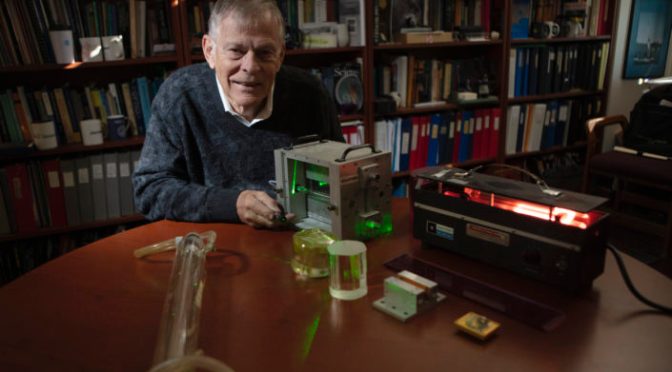
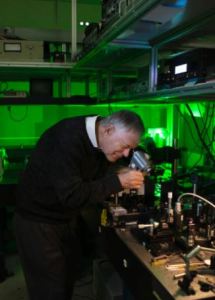 Byer also helped develop the quietest, most stable laser in the world, called the diode-pumped YAG laser. YAG lasers are today found in everything from communications satellites to green handheld laser pointers, which Byer co-developed with two of his graduate students and cites as one of his favorite inventions (he had joined Stanford in 1969). YAG lasers also form the main beams of the gravitational wave-detecting instrument, LIGO, which in 2015 achieved the most precise measurement ever made by humans when its antenna detected the tenuous spacetime fluctuations generated by two colliding black holes 1.3 billion light-years away.
 One summer morning in 1964, Byer drove the hour from Berkeley down to Mountain View for a job interview at a California company called Spectra Physics. He walked in to find an empty lobby but could hear clapping and cheering in the back of the building. After politely waiting for several minutes, he followed the commotion to a darkened room filled with men whose jubilant faces were illuminated by a rod of red-orange light that seemed to float above an instrument-strewn table
 Boomers Daily