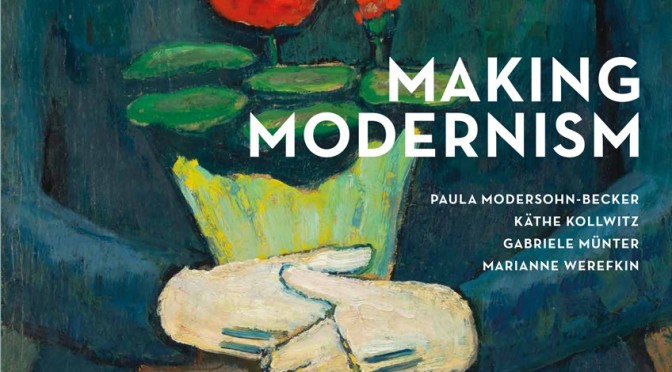
Royal Academy of Art (December 14, 2022) – What would Modernism look like if you saw it through the eyes of women artists? How would it change your perception? What other stories might you find?
Watch Royal Academy curators Sarah Lea and Professor Dorothy Price discuss the pioneering work of four women making art on their own terms: Paula Modersohn-Becker, Kӓthe Kollwitz, Gabriele Münter and Marianne Werefkin.
Christopher Putvinski (December 14, 2022) – Snowfall in Old Québec at around 5 a.m. during the Christmas season. I had included this footage in an edit on Christmas in Québec, but felt it was so nice that it deserved its own edit as well. Song is Provence by GÅEL.
Visit to Quebec City in December to capture the Christmas season.
Monocle Films (December 14, 2022) – The world is urbanising fast. But how do you accommodate people in cities in a way that offers dignity, affordability and a sense of community? Vienna may have a solution. Explore the enduring legacy of the city’s ‘Gemeindebau’ apartment blocks in the latest episode of our Design Tours series.
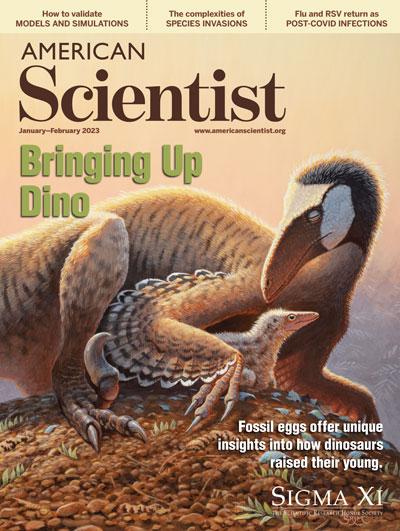
In “A New Picture of Dinosaur Nesting Ecology” (Perspective), paleontologist Daniel T. Ksepka offers an overview of these sweeping advances in his field, showcasing the spectrum of reproductive traits among the dinosaurs, often with surprising mixes of reptilian and avian traits.
Financial Times (December 14, 2022) – Dire warnings about the banana’s impending extinction have been circulating for some time, but despite that, as the FT’s Clive Cookson explains, global production has expanded in recent years. That growth, however, is at risk from an outbreak of Panama disease, which has spread to at least 22 countries.
We discuss the state of global unity on the war in Ukraine with Aliona Hlivco and Michael Binyon. Plus: Jair Bolsonaro’s supporters clash with police in Brasília as Lula unveils his new cabinet and a round-up of fashion news.
Millions face the freezing Ukrainian winter without power following waves of Russian strikes on energy infrastructure. Dozens of countries have pledged €1bn in aid.
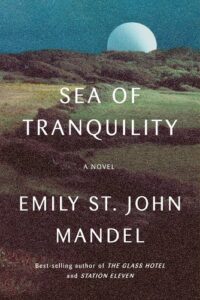
“In Sea of Tranquility, Mandel offers one of her finest novels and one of her most satisfying forays into the arena of speculative fiction yet, but it is her ability to convincingly inhabit the ordinary, and her ability to project a sustaining acknowledgment of beauty, that sets the novel apart. As in Ishiguro, this is not born of some cheap, made-for-television, faux-emotional gimmick or mechanism, but of empathy and hard-won understanding, beautifully built into language … It is that aspect of Sea of Tranquility, Mandel’s finely rendered, characteristically understated descriptions of the old-growth forests her characters walk through, the domed moon colonies some of them call home, the robot-tended fields they gaze over or the whooshing airship liftoff sound they hear even in their dreams, that will, for this reader at least, linger longest.”
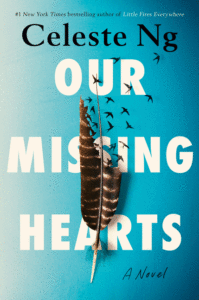
“Stunning … One of Ng’s most poignant tricks in this novel is to bury its central tragedy…in the middle of the action. This raises the narrative from the specific story of a confused boy and his defeated father to a reflection on the universal bond between parents and children … Our Missing Hearts will land differently for individual readers. One element we shouldn’t miss is Ng’s bold reversal of the biblical story of the Tower of Babel. It is the drive for conformity, the suppression of our glorious cacophony, that will doom us. And it is the expression of individual souls that will save us.”
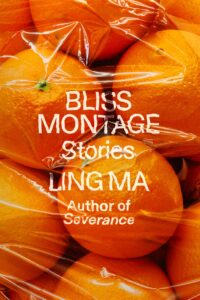
“The strangeness of living in a body is exposed, the absurdity of carrying race and gender on one’s face, all against the backdrop of an America in ruin … Ma’s meticulously-crafted mood and characterization … Ma’s gift for endings is evident … Ma masterfully captures her characters’ double consciousness, always seeing themselves through the white gaze, in stunning and bold new ways … Even the weaker stories in the book…are redeemed by Ma’s restrained prose style, dry humor, and clever gut-punch endings. But all this technical prowess doesn’t mean the collection lacks a heart. First- and second-generation Americans who might have been invisible for most of their lives are seen and held lovingly in Ma’s fiction.”
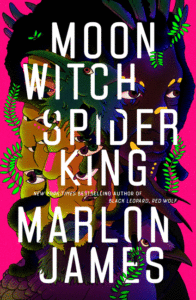
“Marlon James’s Moon Witch, Spider King, the second book in his Dark Star trilogy, is both a continuation of the narrative that began with Black Leopard, Red Wolf in 2019 and an outstanding retelling of that story that expands on what the first book started. While shifting points of view, James…enriches the existing story, and the result is a book that simultaneously celebrates African mythology while creating its own … an impressive amalgamation of folklore, magic, and mythology that weaves together several narratives, but the element that makes it memorable is James’s prose. As lush as the forests he describes, the prose in this novel is simple, rhythmic, and strangely elegant. This is writing with a kind of cadence that turns every line into a poem, every story a tale told around a fire, every event an occurrence deserving of attention … Retelling the same story from a different perspective is not a gimmick here; it is a successful literary device that leads to a gripping narrative … This is a novel about the power of grief where anger is a driving force, and in that, despite all its fantastical elements, it is a deeply human story.”
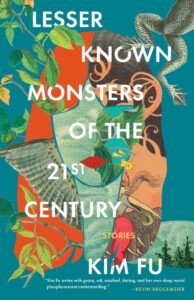
Read a story from Lesser Known Monsters of the 21st Centuryhere
“..the horrors are more intimate, smaller, and less global in scale. This is not a collection filled with fantastic beasts, although a sea monster does make an appearance, but instead illuminates the monstrous nature of humanity … Technology, rather than magic, catalyzes these changes. That is not to say there are not some traces of unexplained fantasy, such as a girl who sprouts wings from her ankles, but mostly, Fu’s monsters manifest from modernity … The success of Kim Fu’s stories is the element of the unexpected. There are surprises lurking in these narratives, whether it is a quick final plot twist or unexpected peculiarity …
Although Fu seems more concerned with alienation stemming from individual relationships, there is criticism of conventional consumer capitalism … The characters in Fu’s collection are eccentric and unexpected in their choices, and many of their stories feature unforeseen endings that strike the right tone for the dark era we live in … Fu opens a window looking onto the sad possibilities of our own failures.”
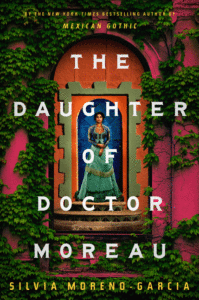
“The imagination of Silvia Moreno-Garcia is a thing of wonder, restless and romantic, fearless in the face of genre, embracing the polarities of storytelling—the sleek and the bizarre, wild passions and deep hatreds—with cool equanimity … the novel immerses readers in the rich world of 19th-century Mexico, exploring colonialism and resistance in a compulsively readable story of a woman’s coming-of-age … The visceral horror of what Carlota has endured, combined with Moreno-Garcia’s pacing and drama, makes for a mesmerizing horror novel.”














 Boomers Daily