Cover Preview: Nature Magazine – June 16, 2022

Volume 606 Issue 7914

Living the high life

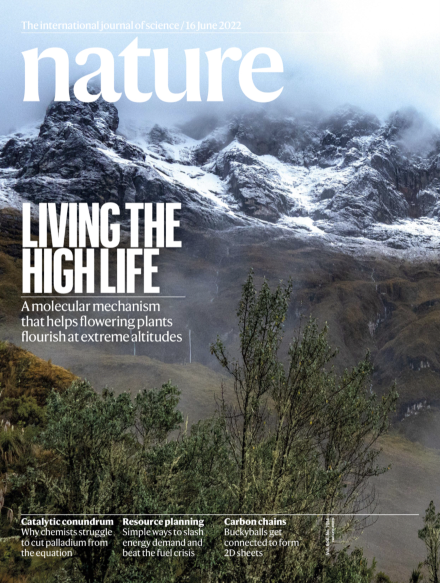
The cover image shows plants growing at altitude on Altar Volcano in Chimborazo, Ecuador. Extreme altitudes pose challenges for most forms of life, and flowering plants are no exception. But flowering plants have been found growing as high as 6,400 metres above sea level. In this week’s issue, Michael Holdsworth and his colleagues reveal a molecular mechanism that helps plants to adapt to the extremes of altitude. The researchers studied a range of plants, representing four diverse clades of flowering plants — thale cress (Arabidopsis thaliana), tomato, poppy and the grass 

Brachypodium distachyon. They found that plants use genetic adaptations to adjust their sensitivity to atmospheric oxygen, whose partial pressure decreases with altitude. By decoding the ambient oxygen level, the plants are able to sense the altitude at which they grow and optimize internal biochemical processes.

Cover image: Cristian Miño, Ecuador.

Views: Ancient Food In Merzouga, Morocco

Ancient food in the Merzouga Region of Morocco. Merzouga is a small Moroccan town in the Sahara Desert, near the Algerian border. It’s known as a gateway to Erg Chebbi, a huge expanse of sand dunes north of town. West of Merzouga, Dayet Srji is a seasonal salt lake that’s often dry in summer. When full, it attracts a wide range of migratory and desert birds, including desert warblers, Egyptian nightjars and, occasionally, flamingos.

Restaurants: Dar Aytma Restaurant and Dar Gnaoua Bambara.

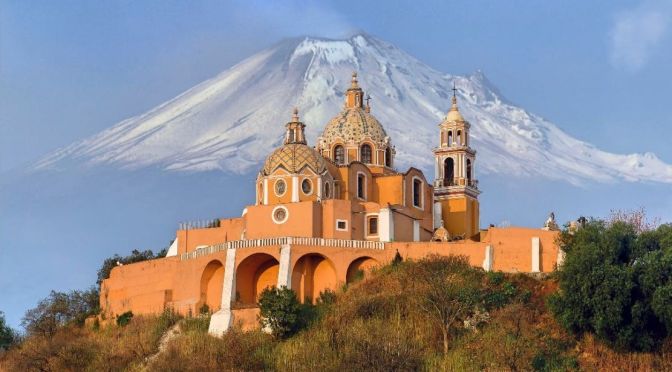
Magical Towns: Cholula & Puebla, Southern Mexico

@Eva zu Beck takes you on a journey to Cholula and Puebla, two cities in central Mexico designated as Pueblos Mágicos, or Magical Towns. These are places that offer visitors a very special experience, owing to their typical historic character and in some cases, colonial-era architecture. As well as a spectacular pyramid and a miniature volcano, the towns are a great place to experience the Danza de los Voladores, or Dance of the Flyers.

Preview: Times Literary Supplement – June 17, 2022

This week’s Times Literary Supplement @TheTLS, featuring @muldoonpoetry on Ulysses at 100; John Fuller on Auden; @MatthewReiszTHE on science reporting; @MalikShushma on elite women in Rome; @majorjonnyd on Yorkshire – and more.

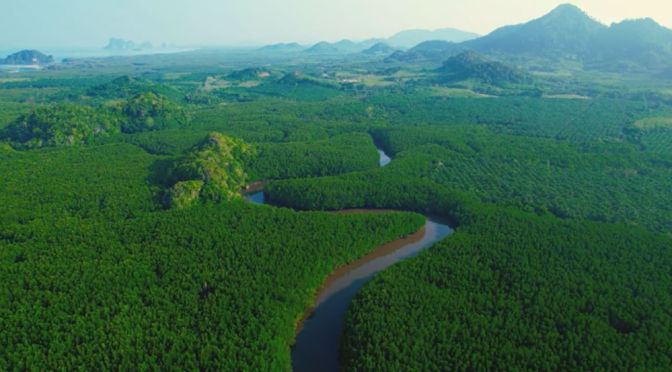
Forest Views: Khao Jom Pa Mangroves, Thailand (4K)

Trang, also called Mueang Thap Thiang, is one of the southern provinces (changwat) of Thailand, on the west side of the Malay Peninsula facing the Strait of Malacca. Neighboring provinces are (from north clockwise) Krabi, Nakhon Si Thammarat, Phatthalung, and Satun.

Trang was formerly a port involved in foreign trade. It was the first place where rubber was planted in Thailand. Phraya Ratsadanupradit Mahison Phakdi brought rubber saplings from Malaya and planted them here in 1899, and rubber is now an important export of the country. The Trang River flows through the province from its origin in the Khao Luang mountain range, and the Palian River flows from the Banthat mountains. The province of Trang has an area of approximately 5,000 square km and 199 km of Strait of Malacca shoreline.

Morning News: Britain’s Foiled Asylum Policy, Taliban Tax Collectors

The European Court of Human rights foiled Britain’s plans to send asylum-seekers to Rwanda yesterday by holding that British courts must first find the policy legal. The Taliban have proven surprisingly adept tax collectors, though they will spend much of the funds on defence rather than improving the lives of struggling Afghans. And the world is buying too few electric vehicles to meaningfully reduce carbon emissions.

Covers: Architectural Review – June 2022

xindex-magazines-1492-1000x666.jpg

AR June 2022: France

Amelia Tavella Architectes | Kristell Filotico | Atelier Roberta | Patrick Bouchain | Iwona Buczkowska | Barrault Pressacco | NP2F | OFFICE Kersten Geers David …

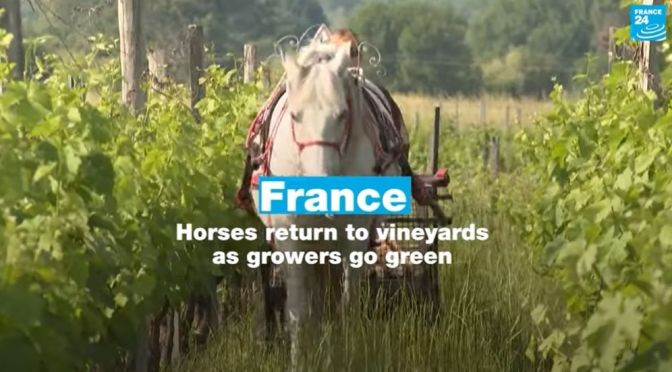
Views: Horses Return To Vineyards In France

Horsepower is making a comeback in vineyards across France as wine growers look for more ecological ways to operate. Not only does using horses instead of tractors help reduce CO2 emissions, the animals are also more precise and better for the soil, say converts.