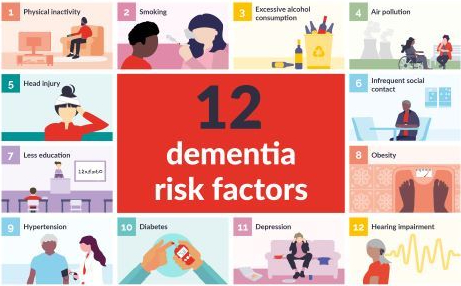
Infographic: ’12 Dementia Risk Factors’ (The Lancet)

Executive summary

The number of older people, including those living with dementia, is rising, as younger age mortality declines. However, the age-specific incidence of dementia has fallen in many countries, probably because of improvements in education, nutrition, health care, and lifestyle changes.
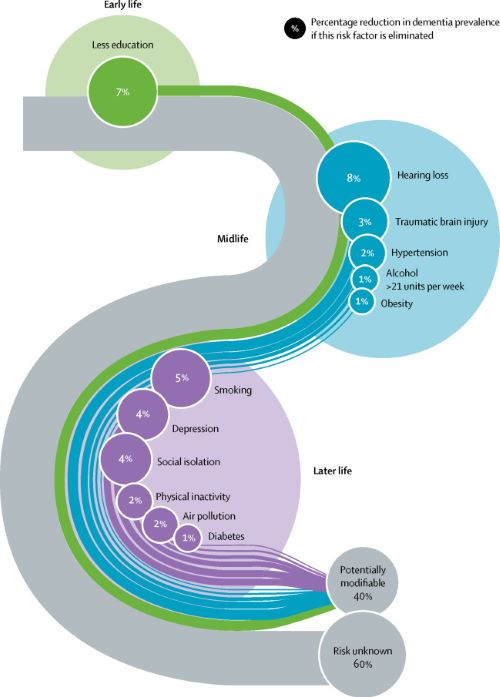
Overall, a growing body of evidence supports the nine potentially modifiable risk factors for dementia modelled by the 2017 Lancet Commission on dementia prevention, intervention, and care: less education, hypertension, hearing impairment, smoking, obesity, depression, physical inactivity, diabetes, and low social contact.

We now add three more risk factors for dementia with newer, convincing evidence. These factors are excessive alcohol consumption, traumatic brain injury, and air pollution. We have completed new reviews and meta-analyses and incorporated these into an updated 12 risk factor life-course model of dementia prevention. Together the 12 modifiable risk factors account for around 40% of worldwide dementias, which consequently could theoretically be prevented or delayed.

The potential for prevention is high and might be higher in low-income and middle-income countries (LMIC) where more dementias occur. Our new life-course model and evidence synthesis has paramount worldwide policy implications. It is never too early and never too late in the life course for dementia prevention. Early-life (younger than 45 years) risks, such as less education, affect cognitive reserve; midlife (45–65 years), and later-life (older than 65 years) risk factors influence reserve and triggering of neuropathological developments.

Culture, poverty, and inequality are key drivers of the need for change. Individuals who are most deprived need these changes the most and will derive the highest benefit.

Read full Dementia Study and Report

Top New CGI Videos: ‘Lost Places’ By Fabian Aerts

Produced and Directed by: Fabian Aerts

Lost Places is a little series i worked on the last couple of weeks. The initial idea was to challenge myself in the creation of full CG environments. I wanted to create large scale scenes and elaborated landscapes. But next to that, the mysterious beauty of abandoned places always fascinated me. I’m addicted to travel but unfortunately the current pandemic and the lock down forced us to stay safe at home for long months so i guess it was for me the only way to explore some far away lands and imaginary countries. Alan Watts wise words resonated and helped me put all this research together and make sense of it. 

New Walking Tour Videos: London, Mayfair (2020)

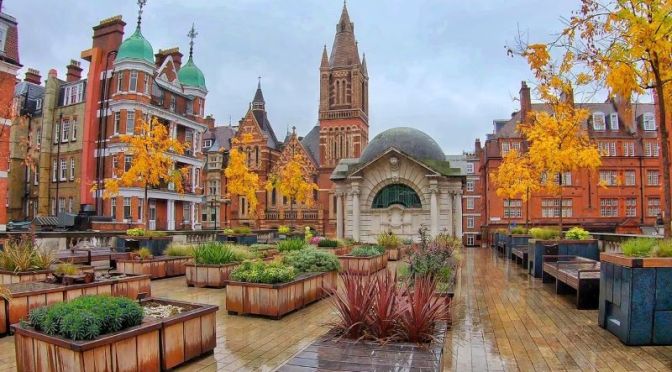
Today we will walk through Mayfair, London in the rain. From Oxford Street to Berkeley Square, we will discover some beautiful parks and Mount Street where there are many historical buildings with luxury stores. Enjoy the view of London and the sound of autumn rain.

ROUTE MAP : https://goo.gl/maps/9kBNAGQwtJa2nmY4A00:00 Oxford Street 00:26 Balderton Street 02:51 Brown Hart Gardens 05:12 Duke Street 07:47 Grosvenor Square 10:21 South Audley Street 12:52 Mount Street 16:42 Carlos Place 20:27 Mount Street Gardens 23:51 South Audley Street 26:05 South Street 28:40 Farm Street 30:33 Hill Street 31:11 Berkeley Square

SIGHTS TIME STAMPS: (Please see the pinned comment for the associated times below) ● Selfridge Department ● The Beaumont Hotel (right) ● Brown Hart Gardens ● Ukrainian Church ● Marriott Hotel Grosvenor Square (right) ● Grosvenor Square ● Roosevelt Statue ● Meditation 1554, 2019 by Seo Young-Deok ● 34 Mayfair Restaurant ● Richoux Restaurant ● James Purdey & Sons Gun Shop ● Crouching Figure No. 4 ● The Connaught Hotel ● Mount Street Gardens ● Catholic Church of the Immaculate Conception ● Drinking Fountain by Ernest George, Grade II ● Mayfair Library ● Thomas Goode Chinaware Shop ● Blue Plaque: J. Arthur Rank, 1888-1972 Industrialist and Film Producer worked here ● Blue Plaque: Lord Ashfield,1874-1948, First Chairman of London Transport lived here ● The Punchbowl Restaurant ● Catholic Church of the Immaculate Conception ● Coach & Horses Pub ● Berkeley Square

Sunday Podcast: News From Zurich, London & Bangkok (Monocle)

Monocle’s editor in chief Tyler Brûle and panelists cover the weekend’s biggest news. Plus a word from our editor Andrew Tuck in London and our Bangkok correspondent, and we check in with what’s making the headlines in Israel’s ‘Haaretz’ newspaper.

The Impressionists: ‘A Dazzling Still Life From Van Gogh’s Final Days’

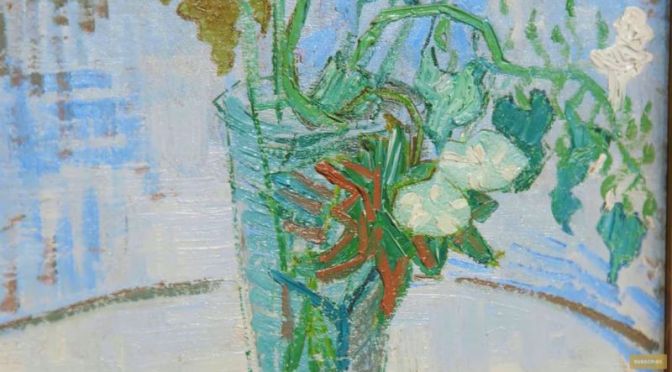
“’Auvers is very beautiful, really profoundly beautiful” wrote Vincent van Gogh to his brother Theo, and his stay there in the final days of his life proved to be enormously productive. In his seventy days in Auvers, van Gogh would paint seventy or so canvases, including the masterwork Fleurs dans un verre. Intricately rendered, this vibrant canvas represents one of the few still life paintings executed during this period and will be a highlight of Sotheby’s Impressionist and Modern Art Evening Sale in New York.

Learn More: https://www.sothebys.com/en/buy/aucti…

Timelapse Travel Video: ‘Forest Light – The Black Forest, Bavaria, Germany’

Filmed and Directed by: Matthias Haller

Forest Light – a timelapse journey, one year through the Black Forest. Wide landscapes, refreshing waterfalls and magical forest light. Last year I was able to spend many hours in the Black Forest to capture the most beautiful moods of the four seasons. Around 80,000 individual pictures were taken during this time.

The Black Forest is a mountainous region in southwest Germany, bordering France. Known for its dense, evergreen forests and picturesque villages, it is often associated with the Brothers Grimm fairy tales. It’s renowned for its spas and the cuckoo clocks produced in the region since the 1700s. The region’s largest town, Freiburg, is filled with Gothic buildings and surrounded by vineyards.

Covid-19 Infographic: ‘Exercise Is Medicine’ (BMJ)

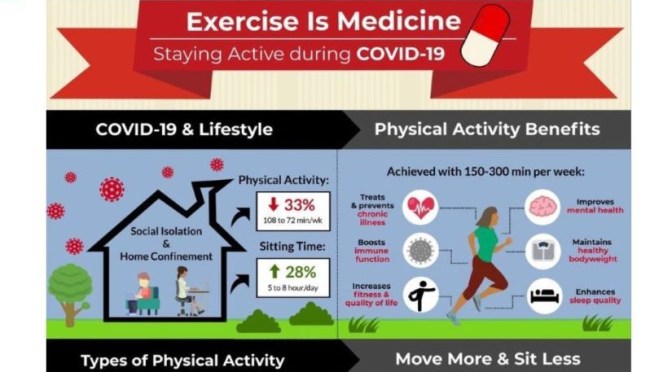
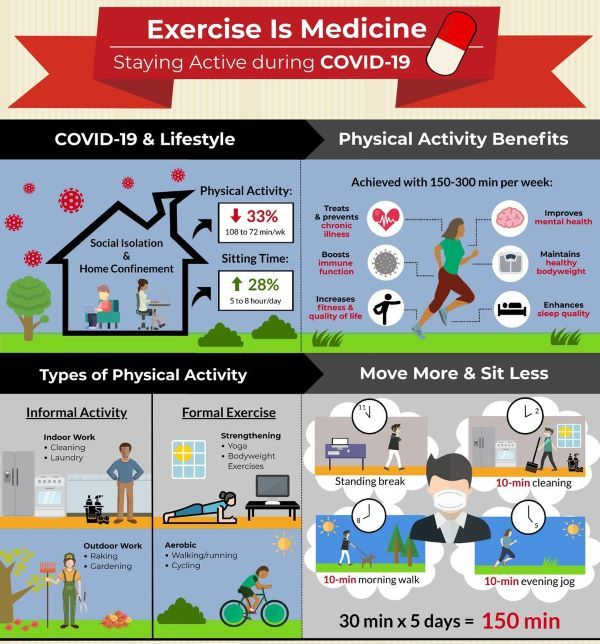
There are over 35,000,000 reported cases of COVID-19 disease and 1 000 000 deaths across more than 200 countries worldwide.1 With cases continuing to rise and a robust vaccine not yet available for safe and widespread delivery, lifestyle adaptations will be needed for the foreseeable future. As we try to contain the spread of the virus, adults are spending more time at home. Recent evidence2 suggests that physical activity levels have decreased by ~30% and sitting time has increased by ~30%. This is a major concern as physical inactivity and sedentary behaviour are risk factors3 for cardiovascular disease, obesity, cancer, diabetes, hypertension, bone and joint disease, depression and premature death.

To date, more than 130 authors from across the world have provided COVID-19-related commentary on these concerns. Many experts4 have emphasised the importance of increasing healthy living behaviours and others5 have indicated that we are now simultaneously fighting not one but two pandemics (ie, COVID-19, physical inactivity). Physical inactivity alone results in over 3 million deaths per year5 and a global burden of US$50 billion.6 Immediate action is required to facilitate physical activity during the COVID-19 pandemic because it is an effective form of medicine3 to promote good health, prevent disease and bolster immune function. Accordingly, widespread messaging to keep adults physically active is of paramount importance.

Several organisations including the WHO, American Heart Association and American College of Sports Medicine have offered initial suggestions and resources for engaging in physical activity during the COVID-19 pandemic. Expanding on these resources, our infographic aims to present a comprehensive illustration for promoting daily physical activity to the lay audience during the COVID-19 pandemic (figure 1). As illustrated, adults are spending more time at home, moving less and sitting more. Physical activity provides numerous health benefits, some of which may even help directly combat the effects of COVID-19. For substantial health benefits, adults should engage in 150–300 min of moderate-to-vigorous intensity physical activity each week and limit the time spent sitting. The recommended levels of physical activity are safely attainable even at home. Using a combination of both formal and informal activities, 150 min can be reached during the week with frequent sessions of physical activity spread throughout the day. Sedentary behaviour can be further reduced by breaking up prolonged sitting with short active breaks. In summary, this infographic offers as an evidence-based tool for public health officials, clinicians, educators and policymakers to communicate the importance of engaging in physical activity during the COVID-19 pandemic.

Read more