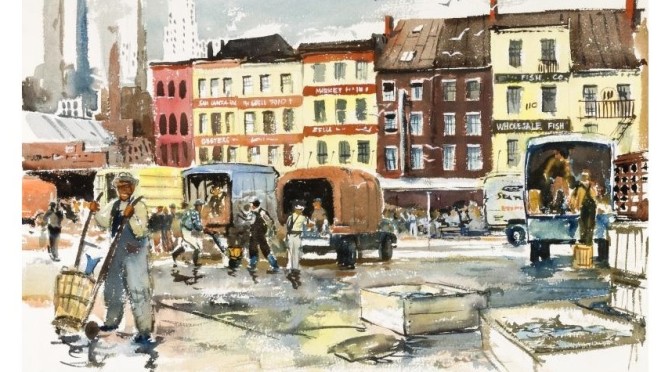
The Fulton Fish Market in New York is celebrating its 200th anniversary this year. Jeff Glor goes inside and takes a look at the market’s history.
Opened in 1822, New York City’s Fulton Fish Market is one of the oldest fish markets in the United States. Well before the Brooklyn Bridge was even built, the market at South Street Seaport thrived with fishing boats and fishmongers bartering and bantering over stalls heaving with fresh fish. Each night the colorful market would come to life with its cast of characters, eager chefs and curious tourists, all mingling over bushels of oysters, crates of lobsters and a kaleidoscope of sea creatures from near and far. Perhaps more than any other institution, the Fulton Fish Market captured the spirit and tradition of old New York.
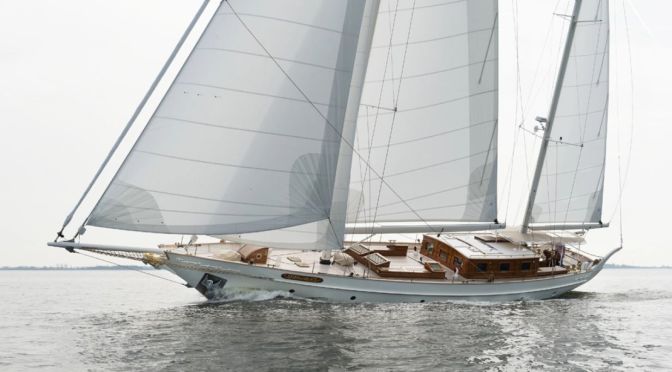
Launched in 2018 at VMG Shipyard, the 89’ (27.32m) SPIRIT OF VENICE is a classic masterpiece and is the perfect example of close collaboration between owner and designer. She boasts a rich Dutch pedigree with an aluminum hull built by Dijkstra Metaalbewerking, a superstructure built by VMG and designs by Olivier van Meer.
The yacht was built with all the features to be sailed single-handedly around the world with the utmost comfort and updated technology. Her 2018 build has combined modern elements with an authentic, classic style. SPIRIT OF VENICE can enter small harbors and shallow sailing areas, and her stern platform allows the owner to easily maneuverer the tender into the water.
SPIRIT OF VENICE welcomes up to six guests in the comfort of three well-appointed cabins. The master cabin features a double bed, stylish sofa, plenty of storage space and a clever book corner. The adjoining bathroom is traditional, with a classic bathtub and gold hardware. The two additional cabins also offer storage and a spacious bathroom.
Most cars now have touch screens in the middle of the dashboard. Some tech heavy cars – such as those by companies like Tesla and Rivian – rely nearly entirely on them. They’re also cheaper to make and maintain. But some people hate them. They say they are less safe, confusing, unnecessary, and take longer than a simple button or switch.
But touch screens in cars aren’t going away. Some innovations, such as those by suppliers such as Harman and Continental, may blend some of the best of the old with entirely new possibilities, while managing risks.
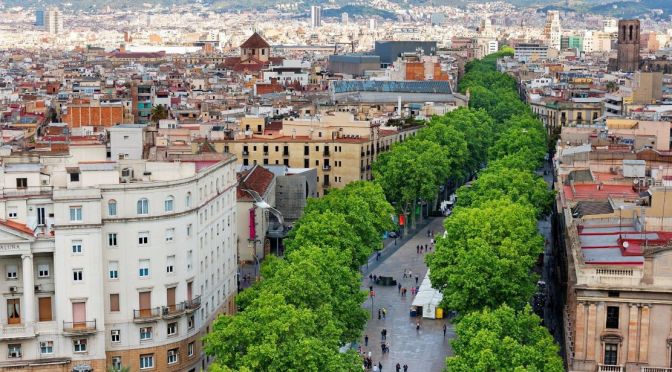
Every visitor to Barcelona will sometime take a stroll along La Rambla. The Catalan capital’s leafy boulevard is simply the place to be – but what makes this street world-famous, and what secrets does it hold? Fermin Villar, president of the Friends of La Rambla, clues us in.
La Rambla is a street in central Barcelona. A tree-lined pedestrian street, it stretches for 1.2 km connecting the Plaça de Catalunya in its center with the Christopher Columbus Monument at Port Vell. La Rambla forms the boundary between the neighbourhoods of the Barri Gòtic to the east and the El Raval to the west.
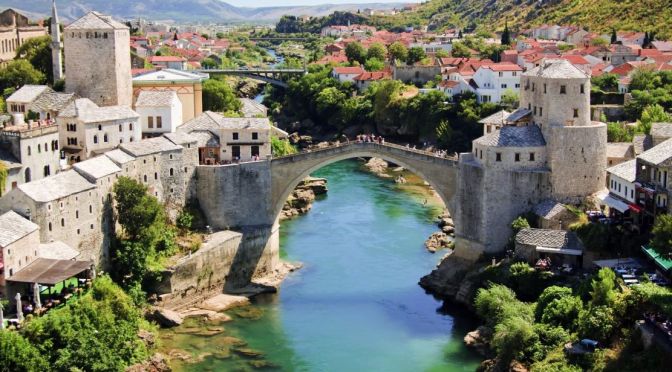
Mostar is a city in southern Bosnia and Herzegovina, straddling the Neretva River. It’s known for the iconic Stari Most (Old Bridge), a reconstructed medieval arched bridge. The nearby alleys are full of shops and market stalls, and the Old Bridge Museum explores the bridge’s long history. A narrow staircase leads up to the Koski Mehmed-Pasha Mosque’s minaret for panoramic city views.
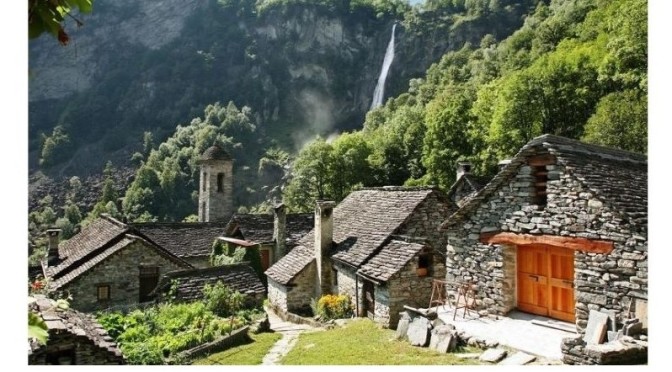
The town of Sonlerto lies in Bavona Valley (Val Bavona), arguably the wildest one among the valleys of Ticino. This spectacular side valley is part of the Maggia Valley. The whole region is part of the Lepontine Alps – a mountain range that covers various parts of Switzerland (Valais, Ticino, Uri, Graubünden) and Italy (Piedmont and Lombardy).
The Bavona Valley has seen massive rocks fall from mountains time and time again. Sometimes the stones are as big as houses. Locals then build new houses next to the stones after they fall. Locals refer to it as Splui. As such, it is no surprise that the houses in this area are built from stone.
Curieuse Island is a small granitic island 1.13 sq mi in the Seychelles close to the north coast of the island of Praslin. Curieuse is notable for its bare red earth intermingled with the unique coco de mer palms, one of the cultural icons of the Seychelles, only growing on the two neighboring islands.
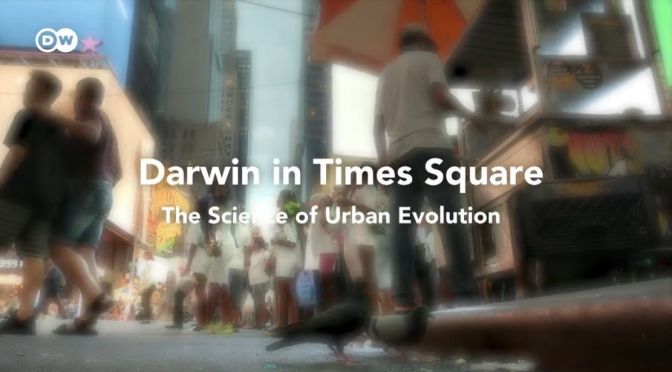
It’s a new and surprising chapter in the theory of evolution. According to recent studies, it’s in our cities, of all places, that animals and plants adapt particularly quickly to changing living conditions.
Nature’s response to the spread of cities is astonishing: Why do catfish in the river of a French city systematically prey on urban pigeons on the banks? Why do female birds on a university campus in California suddenly change their mating behavior? How do mice in New York’s Central Park cope with an altered diet of human food waste? How have killifish in the Atlantic built up resistance to deadly chemical waste?
And, is it possible for moths to adapt to nighttime light pollution? New research provides surprising new insights into Darwin’s theory of evolution. Nowhere else do animals and plants adapt so quickly to new living conditions as in cities. Biologists have long known that animals and plants occupy new habitats in the vicinity of humans.
But now, new genetic analyses show that these adaptations are accompanied by significant changes in DNA. Even more surprising: these evolutionary changes have not occurred over periods of millennia, but within just a few decades. The process has amazed scientists, who watch as nature transforms even our most hostile man-made interventions — pollution, light pollution, noise, garbage and dense development — into creative energy for new adaptations. Some researchers believe that our cities may soon develop their own, brand-new life forms. What are the implications of these developments for the balance between humans and nature on our planet?
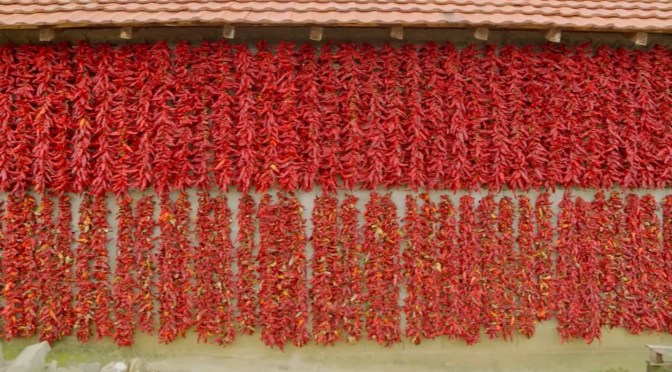
Donja Lokosnica is an unassuming agricultural village in Serbia. That is until it’s time for the annual pepper harvest, where around 250 out of 280 households in the village engage in growing the crimson crop. The sweet peppers are the lifeblood of the small village that produces 60,000 tons of peppers a year.
To learn more about how the Serbian farmers turn the quaint village a rich red, tune in brand new episodes of Europe From Above. Thursdays at 8pm, on National Geographic UK
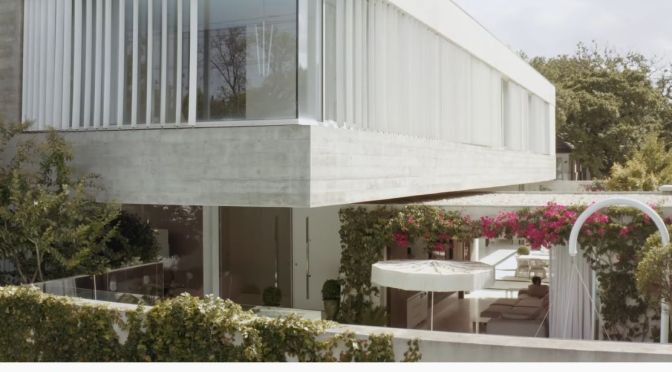
Approached with experience and discernment, Toorak Residence is an architectural dwelling with a considered interiority. Designed by Architecton, the luxury home embraces its context, enabling seamless transitions between indoor and outdoor space.
Video Timeline: 00:00 – The Local Project Print Publication 00:15 – Introduction to Architectural Toorak Residence 01:02 – The Levels and Layers of the Home 01:46 – Blurring the Lines Between Living and Landscape 02:30 – The Material Palette of the Architectural Home 03:15 – A Sculptural Champagne Cork 03:28 – Lighting Considerations 04:08 – A Range of Versatile Living Areas 04:44 – Ageing Like a Fine Champagne 05:13 – Subscribe to The Local Project Print Publication
Located in the affluent suburb of Toorak in close proximity to the Melbourne CBD, Toorak Residence is strong element in the impressive architectural environment. Marked externally by a bold sculpture, the home sits at over 1000 square metres and features three spacious levels. Arriving at Toorak Residence, the process of entry is elongated by carefully layered experiential details. Beyond the front gate lies an informal garden space – a tactile composition of pleasant greenery – which effortlessly navigates residents towards the main entrance. Stepping inside the architectural home, the material palette is intentionally restrained. Architecton champions concrete, natural stone, timber and glass as the ideal canvases for light and bases for architectural detail. Flowing out towards the landscape whilst internally welcoming sunlight, Toorak Residence does justice to the rigour of Artchitecton. A house tour reveals the architectural residence to be a peaceful dwelling, encouraging intuitive patterns of movement for superior living.
News, Views and Reviews For The Intellectually Curious



 Boomers Daily