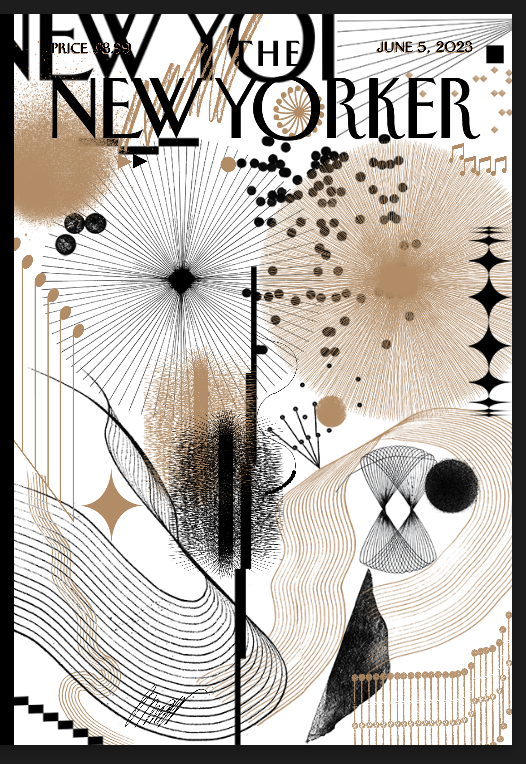
The New Yorker – June 5, 2023 issue: Masha Titova’s “The Music of Art”. The magazine publishes its first synesthetic, collaborative, and interactive cover. By Françoise Mouly.
The pop singer’s trial for copyright infringement of Marvin Gaye and Ed Townsend’s “Let’s Get It On” highlights how hard it is to draw the property lines of pop.
When the critic Joanna Biggs was thirty-two, her mother, still in her fifties, was diagnosed with Alzheimer’s. “Everything wobbled,” she recalls. Biggs was married but not sure she wanted to be, suddenly distrustful of the neat, conventional course—marriage, kids, burbs—plotted out since she met her husband, at nineteen. It was as though the disease’s rending of a maternal bond had severed her contract with the prescribed feminine itinerary. Soon enough, she and her husband were seeing other people; then he moved out, and she began making pilgrimages to visit Mary Wollstonecraft’s grave.
DW Documentary (May 25, 2023) – Amidst the traffic chaos of Sri Lanka: the popular auto-rickshaws, or tuk-tuks. They’re traditionally driven by men. But increasingly, you’ll see a woman at the wheel – and this film is about three of them: Anulawathi, Thushari and Jega. Anulawathi, Thushari and Jega all do the same job: they’re auto rickshaw drivers in Sri Lanka, three women in a sector traditionally dominated by men.
Besides being a popular mode of transport, the three-wheeled tuk-tuk also provides these three women with a reliable source of income. All three were left by their husbands and had to find a way to feed themselves and their children. They were forced to challenge societal norms. After all, in Sri Lanka, men are traditioanally seen as the providers. Male tuk-tuk drivers view their female colleagues as rivals. But unsurprisingly, female customers love them. Thushari lives in the capital Colombo. She is a longtime parent and works to support herself and her two daughters.
Anuwalathi works in Kandy. She lived abroad for a few years and saved up enough money to buy her own tuk-tuk. Jega is also a single parent. She lives with her son and niece in the tourist resort of Hikkaduwa. All three women earn a steady income from the tuk-tuk business, which brings them closer to their eventual goal – independence and freedom.
World Economic Forum (March 25, 2023) – This week’s top stories of the week include:
0:15 NASA launches space based pollution monitor – It’s called TEMPO, which stands for Tropospheric Emissions: Monitoring of Pollution. Built by Ball Aerospace, TEMPO will measure levels of major air pollutants every hour from a geostationary orbit 22,000 miles above the equator. It will monitor a huge region of North America from Canada’s oil sands in northern Alberta to below Mexico City at a resolution of up to 4 square miles. Air pollution poses a major threat to human and planetary health as 99% of the global population breathes air that exceeds WHO health guidelines. Air pollution carries a total economic cost of more than $8 trillion. Therefore, monitoring it is critical to understanding its impacts. Though TEMPO is due to launch in April 2023, watch to learn more about how it will monitor air pollution from space.
1:58 8 best countries for working women – The Economist ranked 29 OECD nations according to the role and influence of women in the workplace. Iceland scores well on numerous factors. From low childcare costs to education attainment for women to female representation at senior levels. At the current rate, it will take 132 years to close the global gender gap How does your country support women at work?
3:23 What is the polycrisis? – Today we are once again beset by seemingly unconnected crises. Such as the war in Ukraine, the climate crisis and the aftermath of COVID-19. “So economics, politics, geopolitics and then the natural environment blowing back at us – and those 4 things, they don’t reduce to a single common denominator. They don’t reduce to a single factor. And that’s why I think the polycrisis term has a real utility descriptively as much as anything else, because it’s kind of hand-waving, of course, it’s kind of arm waving. It’s going, look, there’s a lot of stuff happening here all at once. And that precisely is what we’re trying to wrap our minds around.”
6:54 Are Chatbots going to take our jobs? – “I get this question asked 10 times a week, which is that, look, is conversational AI going to take away jobs? And my consistent answer is no. And the best analogy I will give to you is banks and ATMs. So prior to the technology of ATMs, the most common reason why people would walk into a bank would be to take out money. So imagine there’s no ATMs and 90% of the reason why somebody goes inside the bank is to say, I need to take out some cash, I need to take out some money. As a result, you know, you and I don’t even remember these days, but banks used to be crowded. There used to be long lines and so on. Here comes the ATM, which automates really what should be a very simple task.”
_____________________________________________
The World Economic Forum is the International Organization for Public-Private Cooperation. The Forum engages the foremost political, business, cultural and other leaders of society to shape global, regional and industry agendas. We believe that progress happens by bringing together people from all walks of life who have the drive and the influence to make positive change.
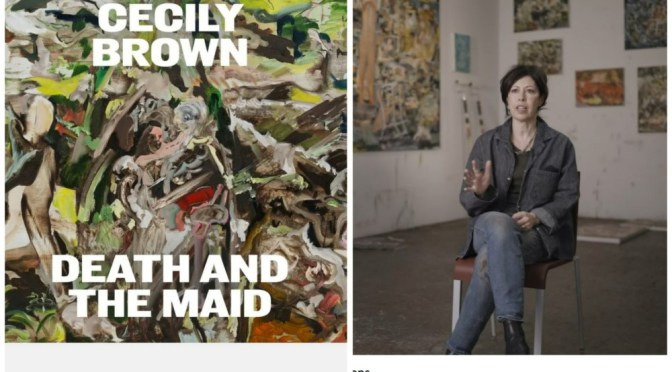
The Metropolitan Museum of Art (March 19, 2023) – Go behind the scenes with artist Cecily Brown, who discusses the inspiration and making of Cecily Brown: Death and the Maid, the first full-fledged museum survey of Brown’s work in New York since she made the city her home.
Cecily Brown: Death and the Maid assembles a select group of some fifty paintings, drawings, sketchbooks, and monotypes from across her career to explore the intertwined themes of still life, memento mori, mirroring, and vanitas—symbolic depictions of human vanity or life’s brevity—that have propelled her dynamic and impactful practice for decades. On view April 4th, 2023 through December 3rd, 2023.
FRANCE 24 (March 17, 2023) – Morocco is often hailed for its stability, its position as a regional leader in women’s rights and for having a rich cultural history. But it’s still a largely male-dominated society. So what does that mean for women in the arts?
Eve Jackson meets three female creatives in and around Morocco’s frenetic commercial hub Casablanca, who are making space for themselves in their craft by using their art to protect and celebrate their heritage, while at the same time creating constructive conversations about subjects sometimes considered sensitive in the kingdom.
Brazilian democracy is young, hard-won and under threat. As the country goes to the polls, its history reminds us that the right to vote is not a given.
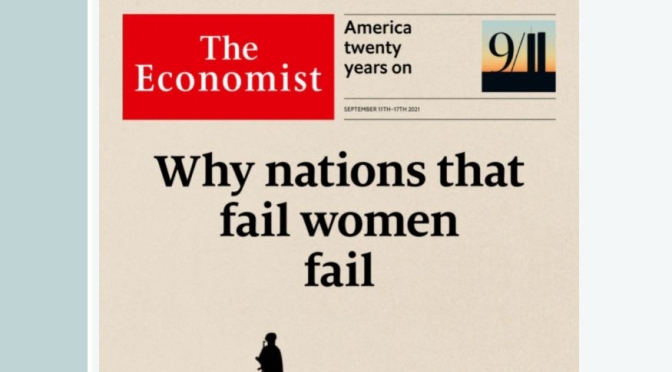
A selection of three essential articles read aloud from the latest issue of The Economist. This week, America then and now: the bitter legacy of 9/11. Why nations that fail women fail, (9:42) and a forgotten revolution in pottery (17:58)
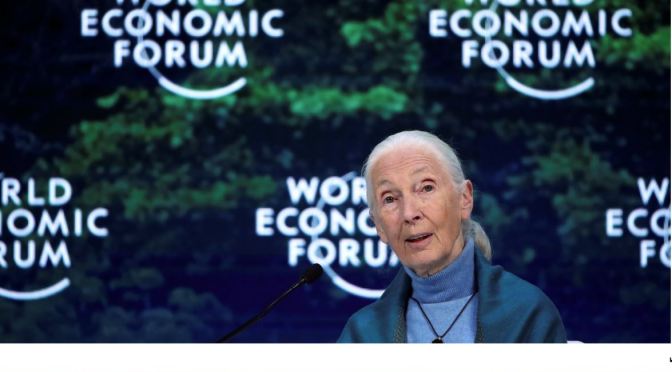
"I read Peter Singer’s book back in the 1970s. I didn’t know about factory farms. I was shocked. The next time I saw a piece of meat on my plate, I thought, Goodness, this symbolizes fear, pain, death. Who wants to eat fear, pain and death?" https://t.co/BVRZPxNzcP















 Boomers Daily