

The shipping industry plays a critical role in the global economy, carrying approximately 90% of the total tonnage of world’s traded goods. Shipping propulsion has changed radically since the mid-19th century, from the renewable energy of sail power, to the coal power of steamships, to the predominance of heavy fuel oil and marine diesel oil. But renewable energy technologies could transform the global shipping fleet again, at all levels and scales.
Tag Archives: Technology

Media: ‘The Law At The Center Of The Big Tech Debate In Congress’ (WSJ)
Leaders in government and tech want to rewrite a law that governs the internet. WSJ explains Section 230, how it shaped the modern internet, and what lawmakers and tech executives want to change.
Photo illustration: Carlos Waters/WSJ

Technology Podcast: Concerns Over Facial Recognition Technology

Scientists have grave concerns over ethical and societal impacts of facial-recognition technology. In this surveillance special, we dig into the details.
In this episode:
03:24 Standing up against ‘smart cities’
Cities across the globe are installing thousands of surveillance cameras equipped with facial recognition technology. Although marketed as a way to reduce crime, researchers worry that these systems are ripe for exploitation and are calling for strict regulations on their deployment.
Feature: Resisting the rise of facial recognition
17:44 The ethics of researching facial recognition technology
Despite concerns surrounding consent and use, researchers are still working on facial recognition technology. Can this sort of work be justified? We hear some of the debates going on in academia about this field of research.
Feature: The ethical questions that haunt facial-recognition research
25:02 What do researchers actually think?
Nature surveyed 480 researchers who have published papers on facial recognition, AI and computer science. The results revealed that many researchers think there’s a problem.

Air Travel: ‘Flight Of The New Concordes – A New Supersonic Era’ (Video)
The Concorde took its last flight in 2003, making commercial supersonic travel a thing of the past. In recent years, however, a number of companies have been laying the groundwork for a new supersonic era.

The Future Of Driving: Designing ‘The Apple Car’
Every time Californian tech giant Apple puts out a new product, it makes headlines around the world. That was true of its early home computers – the first to use a recognizably modern user interface – and it was even more true of the iPod, which singlehandedly revolutionized the music industry. Not to mention the very smartphone you’re probably watching this video on.
But the world’s biggest and best-loved technology company isn’t done yet. For several years, now Apple engineers have secretly been eyeing up transportation as the next industry ripe for their unique brand of scorched-earth disruption. So today we’re asking the question – when will we see the Apple Car?

Boating Tech: Inside Tesla’s Self-Charging Model Y Yacht (Video)
Tesla is fast becoming one of the leading automakers due to its innovation of electric cars. Elon Musk is known as a ruthless entrepreneur and a serial risk-taker, well, it seems that reputation is not going anywhere anytime soon. His company is up for another technological marvel- the Tesla Model Y Yacht. Hey, before we get into the video, be sure to enter our brand new giveaway, we’ll be giving away any of these items. To enter the giveaway, comment the secret keyword in the video, subscribe and turn on post notifications….Ooh and most importantly watch the whole video. It’s that simple!

Health: ‘Risks & Benefits Of AI Revolution In Medicine’

It has taken time — some say far too long — but medicine stands on the brink of an AI revolution. In a recent article in the New England Journal of Medicine, Isaac Kohane, head of Harvard Medical School’s Department of Biomedical Informatics, and his co-authors say that AI will indeed make it possible to bring all medical knowledge to bear in service of any case.
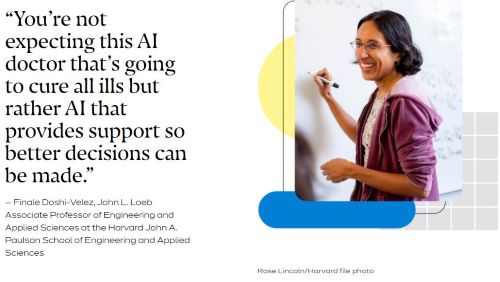
Properly designed AI also has the potential to make our health care system more efficient and less expensive, ease the paperwork burden that has more and more doctors considering new careers, fill the gaping holes in access to quality care in the world’s poorest places, and, among many other things, serve as an unblinking watchdog on the lookout for the medical errors that kill an estimated 200,000 people and cost $1.9 billion annually.
“I’m convinced that the implementation of AI in medicine will be one of the things that change the way care is delivered going forward,” said David Bates, chief of internal medicine at Harvard-affiliated Brigham and Women’s Hospital, professor of medicine at Harvard Medical School and of health policy and management at the Harvard T.H. Chan School of Public Health. “It’s clear that clinicians don’t make as good decisions as they could. If they had support to make better decisions, they could do a better job.”

Health & Technology: New MIT AI Model Detects Asymptomatic Covid-19
A team of MIT researchers have developed an AI model that can distinguish asymptomatic people with Covid-19 from healthy individuals without the disease through forced-cough recordings. (Learn more: http://news.mit.edu/2020/covid-19-cou…

Future Of Hospitals: ‘The New Pavilion At Penn Medicine – 2021’ (Video)
The new Pavilion at Penn Medicine will be one of the most state-of-the-art patient care facilities in the world when it opens in 2021.

Smart Technology: ‘The Internet Of Bodies’ (IoB)
Internet-connected “smart” devices are increasingly available in the marketplace, promising consumers and businesses improved convenience and efficiency. Within this broader Internet of Things (IoT) lies a growing industry of devices that monitor the human body and transmit the data collected via the internet.
This development, which some have called the Internet of Bodies (IoB), includes an expanding array of devices that combine software, hardware, and communication capabilities to track personal health data, provide vital medical treatment, or enhance bodily comfort, function, health, or well-being. However, these devices also complicate a field already fraught with legal, regulatory, and ethical risks. In this video,
RAND mathematician Mary Lee examines this emerging collection of human body–centric and internet-connected technologies; explores their benefits, security and privacy risks, and ethical implications; surveys the nascent regulatory landscape for these devices and the data they collect; and makes recommendations to balance IoB risks and rewards.
Read more about the Internet of Bodies here: https://www.rand.org/pubs/research_re…
 Boomers Daily