
Tag Archives: Reviews

Preview: The New Yorker Magazine – October 7, 2024

A portrait of Kamala Harris in profile against a blue background.

The New Yorker (September 30, 2024): The latest issue features Malika Favre’s “The Candidate” – Onward and upward with the nation.

Kamala Harris for President

The Vice-President has displayed the basic values and political skills that would enable her to help end, once and for all, a poisonous era defined by Donald Trump. By The Editors

Has Social Media Fuelled a Teen-Suicide Crisis?

Mental-health struggles have risen sharply among young Americans, and parents and lawmakers alike are scrutinizing life online for answers. By Andrew Solomon

Is a Chat with a Bot a Conversation?

An artificial voice has long been a dream of tinkerers and technologists. Now that A.I. can talk, though, we may forget who we’re talking to.

By Jill Lepore

Finance Preview: Barron’s Magazine – Sept. 30, 2024

Magazine - Latest Issue - Barron's

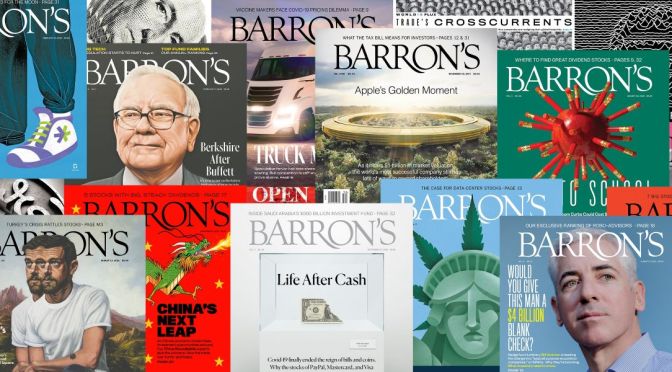
BARRON’S MAGAZINE (September 21, 2024): The latest issue features ‘Healthcare’s Magical Moment’ – The sector is bouncing back. Our roundtable pros talk cutting-edge science and alluring pharma and biotech stocks…

21 Stocks to Play a ‘Magical Moment’ in Healthcare

21 Stocks to Play a ‘Magical Moment’ in Healthcare

Barron’s 2024 Healthcare Roundtable panelists make the case for 21 healthcare companies of all stripes, including Humana, Novo Nordisk, BioLife Solutions, and more.

Seniors Shouldn’t Worry About a Few Extra Pounds. ‘Too Skinny Is Not a Good Thing’

Seniors Shouldn't Worry About a Few Extra Pounds. ‘Too Skinny Is Not a Good Thing’

Numerous studies show that seniors who lose weight have higher mortality rates.

China’s Stock Market Gets Another Lift. Can Beijing Follow Through?

China’s problems run deep, but policymakers are changing their tone. Experts are taking note but are still wary as previous moves haven’t worked.4 min read

Caterpillar Stock Is Digging Out of the Mining Malaise. Why It’s Time to Buy.

The construction business is strong. The real growth for the company will come from a rebound in the mining sector, fueled by demand from China and elsewhere.Long read

Shareholders Say Companies Are Using New Tactics to Muzzle Them

Shareholders say companies are increasingly limiting what they can say at annual meetings. How virtual meetings are making it worse.

Sugar High: How a Glucose Monitor Told Me Startling Things About My Diet

Sugar High: How a Glucose Monitor Told Me Startling Things About My Diet

Little did I realize a few grapes could send my blood sugar soaring until I tried the first glucose monitor without a prescription. I managed to lose seven pounds.

Politics: The Guardian Weekly-September 27, 2024

Image

The Guardian Weekly (September 12, 2024) – The new issue features ‘The Long Shadow’ – Are Israel and Hezbollah headed for all-out war?…

In the space of a few days, the focus of Israeli military operations appears to have shifted decisively from Gaza in the south to Lebanon in the north.

A dizzying escalation between Israel and Hezbollah began last week with exploding pagers and walkie-talkies and culminated in a ferocious Israeli bombardment of alleged Hezbollah military targets, killing hundreds of people.

With Iran’s support, the Lebanon-based Shia militia has conducted a background conflict with Israel since the 1980s. Is this the intensification that finally signals all-out war?

Five essential reads in this week’s edition

1

Spotlight | The brutal truth behind Italy’s migrant reduction
A Guardian investigation reveals EU money goes to forces involved in abuse, leaving people to die in the desert and colluding with smugglers

2

Technology | Why aren’t humanoids in our homes yet?
The development of robots is dogged by technical and safety challenges. But the dream of a multipurpose domestic droid lives on, writes Victoria Turk

3

Feature | An Israeli and a Palestinian discuss 7 October, Gaza – and the future
Could Couples Therapy’s Orna Guralnik and former participant Christine try to understand one another without the conversation breaking down?

4

Opinion | Zelenskyy needs Biden to back his plan to win peace
In besieged Kharkiv, Timothy Garton Ash saw how Ukraine is approaching a perilous moment. To turn the tide, it needs to decisively knock back Russia

5

Culture | Chappell Roan on sexuality, superstardom and the joy of drag
She’s gone from obscurity to the A-list, but not without struggle. Kate Solomon talks to the singer about teenage angst and her queer inspirations

Research Preview: Science Magazine – Sept. 27, 2024

Current Issue Cover

Science Magazine – September 19, 2024: The new issue features ‘Worth The Effort’ – Removing derelict fishing gear reduces monk seal entanglement rates…

Doomsday delayed at vulnerable Antarctic glacier

Thwaites collaboration finds glacier has stabilized somewhat—in the short term

Rare photos reveal North Korea’s nuclear program

Nation appears to have upgraded its bombmaking capacity, experts say

When the Mediterranean dried to a salty crust, life was devastated

Tens of thousands of fossils detail the sea’s dramatic loss and eventual rebound

The New York Review Of Books – October 17, 2024

The New York Review of Books (September 26, 2024)The latest issue features:

‘The Death of Some Ideal’

The Irish novelist Anne Enright writes with great prowess and wit about women who make a virtue of getting on with things.

The Wren, the Wren by Anne Enright

The Fact Man

At the heart of Daniel Defoe’s fictional world is a feeling for change, of the mutability and shiftiness of modern life and the people who thrive in it.

The Oxford Handbook of Daniel Defoe edited by Nicholas Seager and J.A. Downie

The Problems with Polls

Political polling’s greatest achievement is its complete co-opting of our understanding of public opinion, which we can no longer imagine without it.

Strength in Numbers: How Polls Work and Why We Need Them by G. Elliott Morris

The Economist Magazine – September 28, 2024 Preview

Crunch time for Ukraine

The Economist Magazine (September 19, 2024): The latest issue features Crunch time for Ukraine

The war is going badly. Ukraine and its allies must change course

Time for credible war aims—and NATO membership

An Israel-Hizbullah war would be a disaster for both

Both must find a way to step back

War fever in Lebanon

Hizbullah seems to have miscalculated in its fight with Israel

What Donald Trump taught J.D. Vance

The vice-presidential candidate is devising his own tactics for bending the truth

Is the big state failing its citizens?

Why voters across the rich world are miserable

Youtube v Hollywood

Legions of self-taught film-makers are coming for the television industry 

Reports: Tufts Health & Nutrition – October 2024

Tufts Health & Nutrition Letter (September 25, 2024): The new issue features

Healthy Meals with “Nothing” in the House

Stress and Your Health 

The Facts About Sugar Substitutes

Mushroom Mania

Myth of the Month: 
Canola oil is bad for you and should be avoided

Plant Power!

Current Affairs: Prospect Magazine – November 2024

Prospect Magazine - Britain's leading monthly current affairs magazine

Prospect Magazine (September 25, 2024) – The latest issue features ‘A Year Of Darkness’ – Horror and trauma in the Middle East…

The humiliation of trying to survive

Looking back at 7th October and the start of the Gaza war, a Palestinian writer reflects on a year of horror and trauma

Gender and race won’t hold Kamala Harris back

Fragments: when reality falls apart

Arts/Books: Times Literary Supplement – Sept. 27, 2024

Times Literary Supplement (September 25, 2024): The latest issue features ‘Body and Soul’ – Noel Malcolm on Diamaid MacCulloch’s history of sex and Christianity; Jean Genet’s lost drama; Becoming Lucy Sante; Poor little kids and How the compass got its points…

Book Reviews: Best Of International Fiction

Foreign Policy (September 20, 2024): The Mediterranean was the backdrop for much of FP’s summer reading. For the first installment of our new column about international fiction, we travel to two very different settings along this vast sea: Muammar al-Qaddafi’s Libya and modern Sicily. Plus, we highlight the buzziest releases in international fiction this month.


My Friends: A Novel

Hisham Matar (Random House, 416 pp., $28.99, January 2024)

Hisham Matar’s latest novel, recently longlisted for the 2024 Booker Prize, is about friendship and exile. Matar, a Libyan American writer based in London, was raised in a family of anti-Qaddafi dissidents and has made the tyrant’s maniacal rule the subject of most of his work.

In My Friends, Matar follows protagonist and narrator Khaled from his school days in Benghazi to the period following Qaddafi’s overthrow in 2011. After attending a 1984 anti-Qaddafi demonstration in London and landing on the dictator’s hit list, Khaled is forced to upend his quiet life as a university student in Edinburgh and start over in the British capital. (The real-life protest, where officials at the Libyan Embassy shot several protesters and killed a police officer, led Libya and Britain to sever ties.)

Khaled develops strong friendships with two fellow Libyans in London, Hosam and Mustafa. Unlike Khaled, both are unwavering in their political convictions. Although Khaled is opposed to Qaddafi’s regime, he is also aware of the costs—and futility—of speaking out. That Khaled’s criticism of Qaddafi’s Libya never leaves the private, rhetorical sphere is a point of contention between him and his friends. Ultimately, Hosam and Mustafa return to Libya in 2011 to join the militias fighting Qaddafi; Khaled remains in Britain, deeply insecure about his inaction.

Khaled’s decision to attend the 1984 protest was one he made hesitantly, so it is all the more shocking that his first brush with activism fundamentally altered the course of his life. Khaled’s father, an academic who resigned himself to a mid-level career under Qaddafi to avoid repression, had taught his son that it is “almost always best to leave things be.”

At its core, My Friends is a debate over whether, in the face of repression, such silence is a form of self-preservation or cowardice. This tension exists between the book’s main characters—the friends—as well as within Khaled’s own head. While Khaled’s exile led him to make great friends, his time in London is equally a painful experience of solitude. With Libyan phone lines tapped and mail pilfered by the regime, he has had to uphold a decades-long lie to his family about why he can no longer return home—all because he attended a single protest.

An author with an agenda might have sought to portray Hosam and Mustafa as valiant fighters whose sacrifices are rewarded, opposite Khaled, who prefers comfort to confrontation. But Libyan history does not follow a morally righteous narrative arc. At the end of the book, Libya becomes enveloped in a new crisis, and each friend seeks to find his place within it.—Allison Meakem


The Hypocrite: A Novel

Jo Hamya (Pantheon, 240 pp., $26, August 2024)

The Mediterranean is a time-honored stage for the psychosocial dramas of the elite. From British novelist John Fowles’s 1965 masterpiece, The Magus, to the entire Mamma Mia! franchise, fictional foreigners have long flocked to Greek and Italian isles to escape from—and, more often, confront—their heartbreaks and pathologies and familial squabbles. Often left out of these tales are the locals.

The Hypocrite by British author Jo Hamya at first seems like more of the same. It takes place over the course of one staging of a play about a summer that Sophia, the young playwright, once spent in Sicily’s Aeolian Islands with her father, a famous novelist whose work has aged poorly. It’s a smooth and often witty portrait of the upper-middle-class London art scene, written in the streamlined Rachel Cusk-esque register that defines much contemporary literary fiction.

Yet The Hypocrite also attempts to do something more. Although Sophia’s family dramas make up the bulk of the narrative, Hamya eventually shifts her focus to the family’s housekeeper in Sicily. She recalls that Sophia “was demanding in the worst way an English tourist could be.” Sophia didn’t try to learn even a little Italian. She and her father, the housekeeper thinks, were “lazy, messy people” who never bothered “to make her job easier with the simplest of acts.”

Hamya’s novel is part of the recent trend of examining who, historically, has been omitted in traditional narratives, especially ones set in locales that are under-resourced, exoticized, and deeply reliant on tourism. (Sicilians are European, yes, but they also live in one of Italy’s poorest regions.) In this regard, the novel is closer in spirit to HBO’s The White Lotus, the much-lauded send-up of the rich at a luxury resort chain (first in Hawaii, then in Sicily, and soon in Thailand), than many of its other predecessors.

Hamya does not dwell, however, on this upstairs-downstairs dynamic. Rather than skewering the careless interlopers, she aims for a bit more nuance, attending—if only fleetingly—to both the narrower interests of her protagonists and the invisible hands that helped set the stage for them that summer.—Chloe Hadavas