

The Almeda fire left a path of destruction as it tore through the Rogue Valley in southern Oregon. About 24 hours after it started, an estimated 2,350 homes had been left in ashes. We used satellite images, videos and social media posts to track what happened.
Tag Archives: NYT

New Travel Books: “New York Times Explorer – 100 Trips Around The World”
 NYT Explorer. 100 Trips Around the World takes travel beyond the obvious with adventures in exotic places and new perspectives in familiar ones, all based on the distinguished travel journalism of The New York Times. Each journey features a first-person narrative and postcard-perfect photography, capturing the unique personality of the destination—as well as practical information to help get you on your way.
Whether it’s a culinary adventure in vibrant Mexico City, an historic and meditative train ride through Siberia, or a solo trip to Paris, get your bucket lists ready and share in the discoveries of Explorer a collection of 100 dream destinations—four volumes’ worth of adventures in one—from the Travel pages of The New York Times.
The Times writers offer guidance, from the personal to the practical, along with a wealth of color photographs that capture the catch-your-breath awe of each destination. Motor past pink sands and bougainvillea in Bermuda with Andrew McCarthy, follow Virginia Woolf’s footsteps through the English countryside with Francine Prose, or dare to pilot a boat through the Venice lagoon with Tony Perrottet.
The editor
Barbara Ireland edits the 36 Hours, Explorer, and forthcoming Cultured Traveler series of travel books in collaboration with The New York Times and TASCHEN. A writer and editor based in upstate New York, she is a former deputy Travel editor and deputy Op-Ed page editor at The New York Times. She is a graduate of Cornell University and was a John S. Knight journalism fellow at Stanford University.
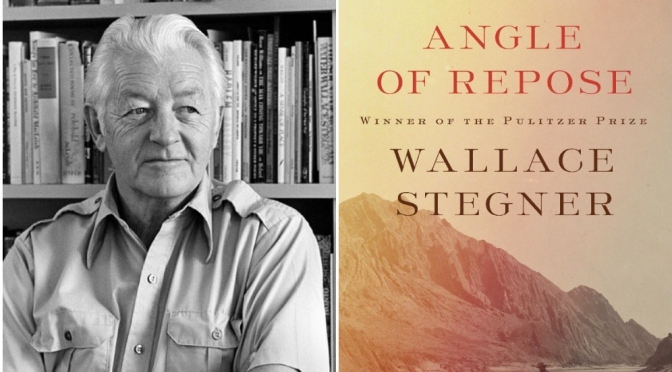
Podcast Essays: American Western Writer Wallace Stegner (1909-1993) By NY Times Critic A.O. Scott
Scott discusses his first in a series of essays about American writers, Wallace Stegner, and David Kamp talks about “Sunny Days: The Children’s Television Revolution That Changed America.”
Wallace Earle Stegner (February 18, 1909 – April 13, 1993) was an American novelist, short story writer, environmentalist, and historian, often called “The Dean of Western Writers”. He won the Pulitzer Prize in 1972 and the U.S. National Book Award in 1977.

Food & Travel: “Bangkok’s Fresh Food Markets” (NYT)
From the New York Times (June 1, 2020):
 The aromas here are rich and pungent — smoked, cured, dried and fresh seafood, along with many forms of meat, both raw and cooked. The awnings over the stalls create a shadowy atmosphere that’s punctuated by thin streaks of dancing light.

Early this year, in search of inspiration beyond the food scene in New York (and not yet locked down by the spread of Covid-19), I spent two weeks visiting and documenting life among the fresh markets and street vendors in and around Bangkok.
It made for an unlikely itinerary since tourists in Thailand often spend only a day or two in the capital before heading south toward the country’s many islands.

Interviews: Travel Guru “Rick Steves” (NYT Podcast)
 Rick Steves is a travel evangelist, always in motion, traversing faraway places and inspiring others to do the same. So when the world shuts down, and Rick Steves can no longer travel, then who is Rick Steves?
Sam Anderson, a writer for The Times Magazine, profiled the travel guru last year. Today, Sam asks Rick how he’s been expanding his horizons from home. Dreaming of travel, we learn, is nearly as sweet as the real thing.


Travel & Quarantines: Author Frances Mayes Writes Of Poet John Keats In Naples, Italy In 1820 (NYT)
From the New York Times (March 26, 2020):
I have seen Naples from his vantage of a ship anchored offshore — one of the most sublime locations in the world, that sweep of coast stacked with apricot, carmine, azure and rose villas; the blue, blue U of the harbor; the emphatic Vesuvius anchoring the view.

In October of 1820, typhus raged in Naples. With his artist friend, Joseph Severn, the British poet John Keats rocked in the city’s harbor for 10 days, not nearly the quaranta giorni — 40 days — that give us our word quarantine.
Before this journey, Keats always felt intense melancholy. In “On Seeing the Elgin Marbles for the First Time,” he wrote “… mortality / Weighs heavily on me like unwilling sleep.” (And in the smooth pentameter of “Ode to a Nightingale”: “I have been half in love with easeful death.”) Not a holiday, this voyage out of England was a desperate trip to the sunny climate of Italy. His cough had grown steadily worse. Since the morning he’d seen a splotch of blood on his pillow, he knew he had little chance of surviving the consumption that had invaded his lungs. His last-ditch: Go to Rome. Meanwhile, exile at sea.

How China And South Korea Are Containing “Coronavirus / Covid-19”
Global health officials have praised China and South Korea for the success of their efforts to contain the coronavirus. What are those countries getting right — and what can everyone else learn from them?
Guest: Donald G. McNeil Jr., a science and health reporter for The New York Times. For more information on today’s episode, visit nytimes.com/thedaily.
Background reading:
- While world leaders are finally speaking out about the gravity of the pandemic, their response lacks unity with the United States absent from its traditional conductor role in managing global crises.
- Stocks tanked again as the outbreak was officially declared a pandemic and policies to address its impact proved lacking or ineffective.
- All flights to the U.S. have been suspended from Europe. Many schools announced they would close indefinitely, some nursing homes banned visitors, and workplaces across the country have urged their employees to work from home. Here are the latest updates.

Inteviews: 67-Year Old British Author Hilary Mantel – “Extraordinarily Probable Fiction” (NYT)
Excerpts from a New York Times interview (Feb 24, 2020):

“Hilary has reset the historical patterns through the way in which she’s reimagined the man,” said Diarmaid MacCulloch, an Oxford theology professor who published a new Cromwell biography in 2018. “It’s fiction which is extraordinarily probable, and it’s remarkably like the Cromwell I’d been excavating myself.”
Hilary Mantel has a recurring anxiety dream that takes place in a library. She finds a book with some scrap of historical information she’s been seeking, but when she tries to read it, the words disintegrate before her eyes.
“And then when you wake up,” she said, “you’ve got the rhythm of a sentence in your head, but you don’t know what the sentence was.”
To an unusual degree for a novelist, Mantel feels bound by facts. That approach has made her latest project — a nearly 1,800-page trilogy about the 16th-century lawyer and fixer Thomas Cromwell — more complicated than anything she’s undertaken in her four decades of writing.

Video Profiles: “Remote, Subarctic Backdrops” Of Nova Scotia Architect Omar Gandhi (NY Times)

Though Gandhi’s projects are dramatically different in form, such consideration of their remote, subarctic backdrop connects them to one another — they “look like they could only be in Nova Scotia,” he says.
EVERY FEW DAYS, the Canadian architect Omar Gandhi migrates between Toronto, his hometown, and Halifax, the capital of Nova Scotia, where he opened his eponymous firm in 2010. A year and a half ago, Gandhi added New Haven to his weekly peregrinations — he was teaching a seminar at the Yale School of Architecture called Where the Wild Things Are, after Maurice Sendak’s 1963 children’s book.

 For the final project of the semester, the professor took his class to the wind-swept island of Cape Breton (a glove-shaped appendage separated from Nova Scotia’s main peninsula by the narrow Strait of Canso) to visit Rabbit Snare Gorge — his 2013 project with the New York-based architecture firm Design Base 8 — a slender cabin that stretches 43 feet tall, like a 16th-century Mannerist portrait. Touring the surrounding plot, a 47-acre wooded slope bisected by the creek that gives the house its name, Gandhi, 40, asked his students to conceive a “campus of creatures” — a set of structures that, as he described it when we met at his Halifax studio last summer, “have an attitude and respond and look like they move.”
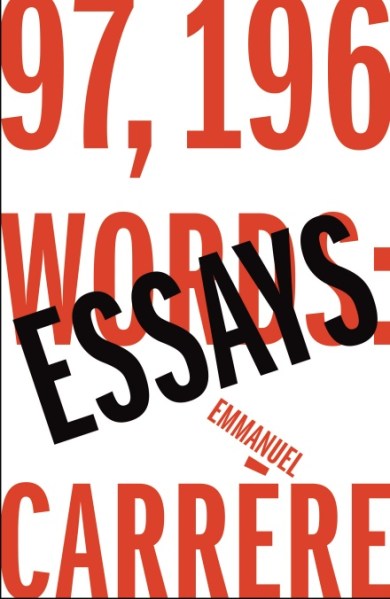
Top Nonfiction Books: “97,196 Words: Essays” By Emmanuel Carrère (NYT)
From a New York Times online review:
 At the trial, experts analyzed and propounded, and he himself spoke lucidly and in apparent control. Yet Carrère, on hand to cover the proceedings for Le Nouvel Observateur, remarks that those in the courtroom “have had ample time to wonder, from the height of our clinical ignorance and flying in the face of four psychiatric experts, if he really belonged in a criminal court, and if what you felt on your nape wasn’t the cold wind of psychosis.” He ends his two-part article this way: “Behind his glass enclosure, Romand listens expressionless. No one knows what he’s thinking, not even him.”
“At dawn on Monday, Jan. 11, 1993, the fire brigade came to put out a fire in a house in Prévessin-Moëns, a small village in France’s Ain department, near the Swiss border. They found the partially charred bodies of a woman and two children, and a badly burned man, who was taken to the hospital in a critical state.”
So begins the first account by Emmanuel Carrère (now reprinted in “97,196 Words,” his new collection of essays) of the horrifying case of Dr. Jean-Claude Romand that galvanized France: No one had heard of anything like it; no one could understand it. Yet the facts were incontestable, the verdict and sentence assured: guilty, and life imprisonment, the death penalty being a thing of the past in France. (In fact, he was released from prison just this past spring, after serving 26 years.)
 Boomers Daily