Our annual ranking of the country’s Top 1,200 Financial Advisors finds a broader embrace of digital tools among advisors and clients alike. The result: more flexibility, potentially lower fees, and greater access to specialists.
Our annual ranking, now in its 16th year, finds an industry that has changed with the times. Here’s what investors need to know about the selection process.
THE NEW YORK TIMES BOOK REVIEW (March ,8 2024): The latest issue featuresRenaissance scholar Ramie Targoff’s new book, “Shakespeare’s Sisters,” which sets out to show modern readers that the Elizabethan era did indeed produce its share of great women writers, and she details four of them across a range of disciplines.
In “Shakespeare’s Sisters,” the Renaissance scholar Ramie Targoff presents an astounding group of Elizabethan women of letters.
By Tina Brown
SHAKESPEARE’S SISTERS: How Women Wrote the Renaissance, by Ramie Targoff
Judith Shakespeare, Virginia Woolf’s imaginary sister of the Bard, was for years the accepted portrait of the nonexistent writer of Renaissance England. In “A Room of One’s Own,” her seminal feminist essay, Woolf concluded that any glimmer of female creativity in Shakespeare’s time would have been expunged by a pinched life as a breeding machine of children who so often died, disallowed opinions of her own. Had any woman survived these conditions, wrote Woolf, “whatever she had written would have been twisted and deformed, issued from a strained and morbid imagination.”
Using clever camera methods, a new photo book illuminates how honeybees see plants and flowers.
By William Atkins
In WHAT THE BEES SEE: The Honeybee and Its Importance to You and Me, Craig P. Burrows’s ultraviolet-lit photographs mimic the fluorescence his botanical subjects emit when exposed to sunlight, revealing colors and textures usually obscured by the dazzle of visible light. Because bees see in the ultraviolet spectrum, Burrows’s method can afford us a glimpse of the world as they perceive it: His portraits of plants are, in part, prompts for interspecies empathy at a time when bees are under attack on multiple fronts, from air pollution to pesticides.
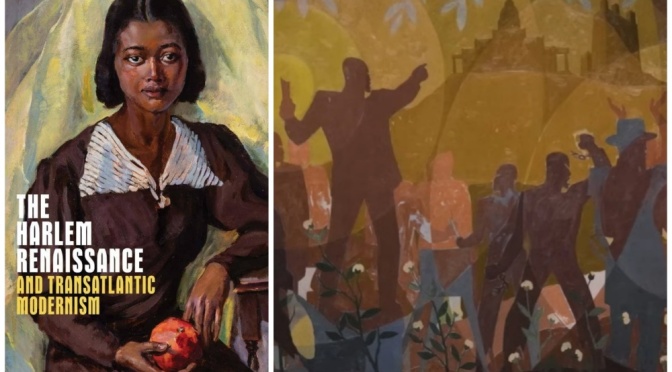
Through some 160 works of painting, sculpture, photography, film, and ephemera, it will explore the comprehensive and far-reaching ways in which Black artists portrayed everyday modern life in the new Black cities that took shape in the 1920s–40s in New York City’s Harlem and nationwide in the early decades of the Great Migration when millions of African Americans began to move away from the segregated rural South.
The first art museum survey of the subject in New York City since 1987, the exhibition will establish the Harlem Renaissance and its radically new development of the modern Black subject as central to the development of international modern art.
The Globalist (March 8, 2024): We review Joe Biden’s final State of the Union address before the US presidential election in November.
Plus: Latvia becomes the first EU country to ban agricultural products from Russia and Belarus, the latest on the ongoing Israel-Hamas ceasefire talks and David Cameron’s trip to Berlin.
The Economist Magazine (March 7, 2024): The latest issue features Three big risks that might tip America’s presidential election – Third parties, the Trump trials and the candidates’ age introduce a high degree of uncertainty; Xi Jinping’s hunger for power is hurting China’s economy; How to fix the Ivy League – Its supremacy is being undermined by bad leadership…
Expedia (March 7, 2024): What is Canadian food? Episode 1 of Where To goes beyond the search results to pull up a chair and find out.
From the Bay of Fundy in the east to the rugged Pacific coastline of Vancouver Island in the west, Canada provides glorious outdoor sights. Tour the nation’s impressive scenery, sophisticated cities and peaceful countryside for a vacation you will remember forever.
In the east, the fictional home of Anne of Green Gables on Prince Edward Island will make the beloved young adult series come alive. In nearby Nova Scotia and New Brunswick, see the unusual tides of the Bay of Fundy that rise and fall up to 50 feet (16 meters) each day.
On the western coast, British Columbia has lovely harbors in Vancouver and Victoria, with whale watching, sunbathing and shoreline walks. These and other Canadian cities have eclectic neighborhoods with concentrations of artists and ethnic centers, including interesting Chinatowns.
Spread across the center of the country, Montreal, Ottawa, Toronto, Calgary and Edmonton are among the nation’s largest metropolitan areas. All have modern city centers with wonderful restaurants, shopping, museums and galleries. In addition, each has its unique personality, from old French customs to major league baseball to cowboy rodeos.
Canada’s mountainous regions offer superb opportunities for summer hiking and sightseeing and winter skiing. Visit Revelstoke and Whistler in British Columbia and Banff and Lake Louise in Alberta for some of the best Rocky Mountain slopes and views. In the east, Mont-Tremblant in Québec has excellent skiing in the Laurentian Mountains.
Head to the lakes regions in Manitoba and Saskatchewan for fishing and hunting. Travel north to Nunavut, the Northwest Territories and the Yukon to camp under the northern lights. Canada’s national and provincial parks cater to Canadian and international visitors with scenic trails and adventurous activities.
In Canada try panning for gold, taste maple syrup fresh from production or even go on a polar bear safari. Across the nation you’re likely to be greeted with a friendly welcome. Arrive anywhere and keep exploring the beautiful lands and waters of this great nation.
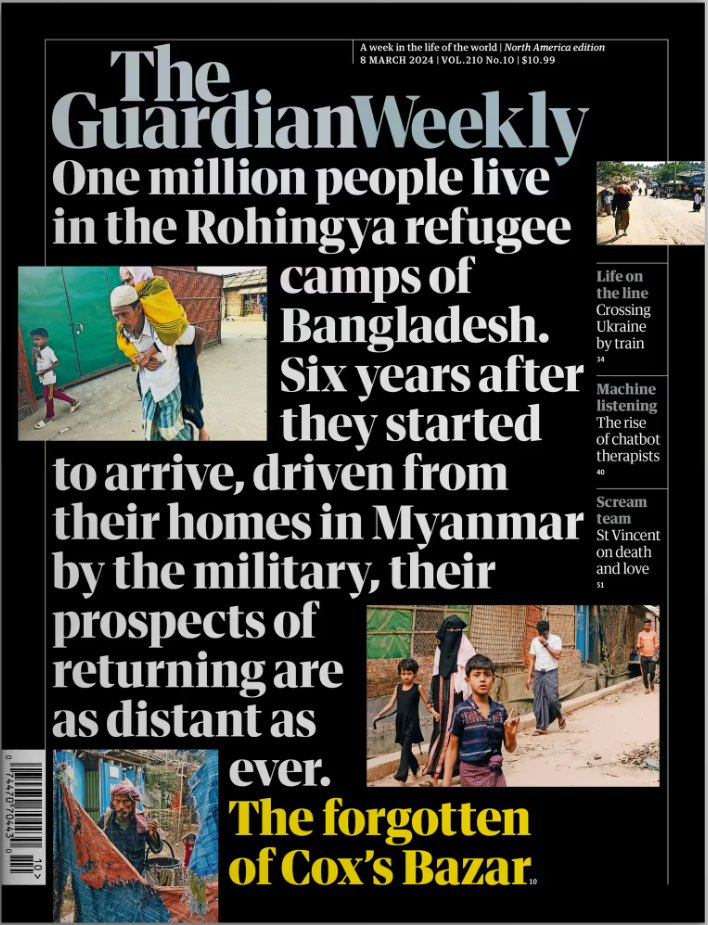
It was August 2017 when the world really started to take note of Myanmar’s Rohingya people. Descendants of Arab Muslims who speak a different language to most other people in Myanmar, the Rohingya had up to that point lived mainly in the northern Rakhine state, coexisting uneasily alongside the majority Buddhist population.
But the Rohingya were reviled by many as illegal immigrants and treated by the then government as stateless people. In 2017, when violence broke out in the north of the state, security forces supported by Buddhist militia launched a “clearance operation”that forced more than 1 million Rohingya people to flee their homes and the country, actions that many onlookers saw as ethnic cleansing. Most Rohingya were driven into vast refugee camps in the Cox’s Bazar region of Bangladesh, where they have remained ever since.
The Guardian global development reporter Kaamil Ahmed has been covering the Rohingya crisis for almost a decade, making multiple trips to the region. For this week’s Big Story, Kaamil returned to Cox’s Bazar where, in two moving reports, he details how disease and illness are widespread in the ramshackle camps, and how the desperation to escape has resulted in rich business for people traffickers.
And, with Myanmar now controlled by a military junta and introducing a deeply unpopular conscription drive (as Rebecca Ratcliffe and Aung Naing Soe report), the prospect of any Rohingya people being able to return home to Rakhine state remains as distant as it did in 2017.
The Globalist (March ,7 2024): The latest developments from the European People’s Party Congress in Bucharest with Nina dos Santos.
Plus: can Venezuela’s opposition navigate the presidential election’s tight deadlines? Adam Hancock reports from Kuala Lumpur ahead of the 10-year anniversary of the disappearance of Malaysia Airlines Flight 370.
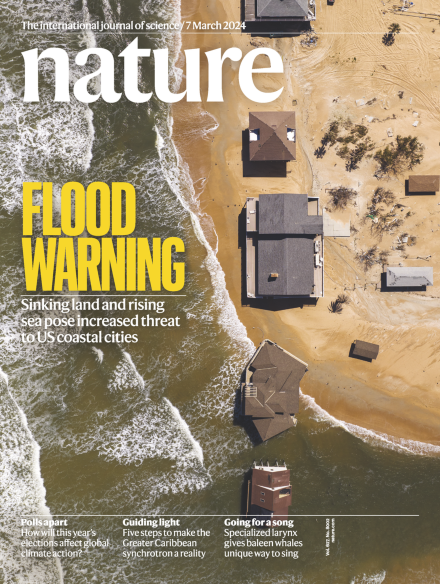
Nature Magazine – March 6, 2024: The latest issue cover features ‘Flood Warning’ – Sinking land and rising sea pose increased threat to US coastal cities.…
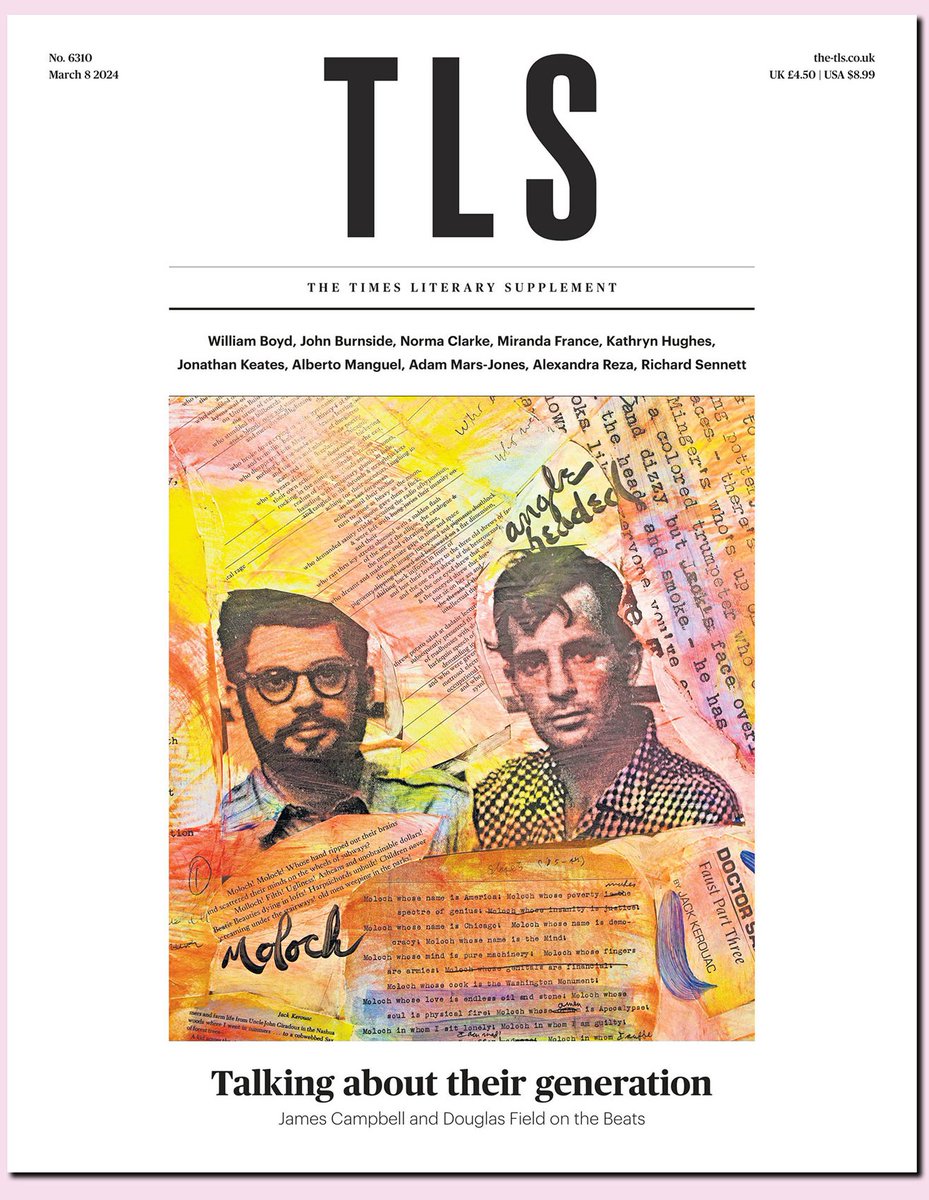
Times Literary Supplement (March 6, 2024): The latest issue features‘Talking about their generation’ – James Campbell and Douglas Field on the Beats including Jack Kerouac and Allen Ginsberg; Alexandra Reza on Frantz Fanon; Miranda France on Montserrat Roig….























 Boomers Daily