
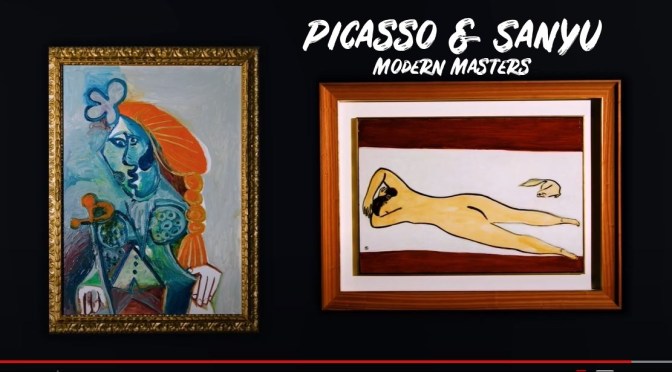
Pablo Picasso is perhaps the Modern master most admired by Asian artists. His commitment to breaking with tradition resonated deeply with Chinese modernist pioneer Sanyu. In this episode of Expert Voices, our Head of Modern Art in Asia, Felix Kwok, introduces masterworks by both artists, which will headline our upcoming Beyond Legends: Modern Art Evening Sale (18 April | Hong Kong). ‘Nu Avec un Pékinois’ is a masterpiece from Sanyu’s post-war period that reflects themes of love and perseverance and ‘Buste de Matador’ from the 1970s is the first painting in Picasso’s final Matador and reflects an urgency in the face of mortality.
Tag Archives: Arts

Art Exhibitions: ‘Anselm Kiefer – Field Of The Cloth Of Gold’ (Gagosian NYC)
For the fifth episode of Gagosian Premieres, we celebrate “Anselm Kiefer: Field of the Cloth of Gold”—a new exhibition at Gagosian, Le Bourget—with a conversation between the artist and art historian James Cuno and a debut ballet performance by Hugo Marchand and Hannah O’Neill, choreographed by Florent Melac and set to music composed by Steve Reich. The episode airs on March 23 at 2pm EDT. In this episode of Gagosian Premieres, James Cuno, president and CEO of the J. Paul Getty Trust, speaks to the artist in an exclusive interview about the inextricable relationship between history and place that animates the works on view. Hugo Marchand and Hannah O’Neill—principal dancer and first soloist, respectively, at the Ballet de l’Opéra national de Paris—perform original choreography by Florent Melac in the gallery. Set to Steve Reich’s “Duet,” a contemplative composition scored for two solo violins and a string ensemble, the dance was created in direct response to Kiefer’s exhibition of monumental paintings in the vast Jean Nouvel–designed former airplane hangar.
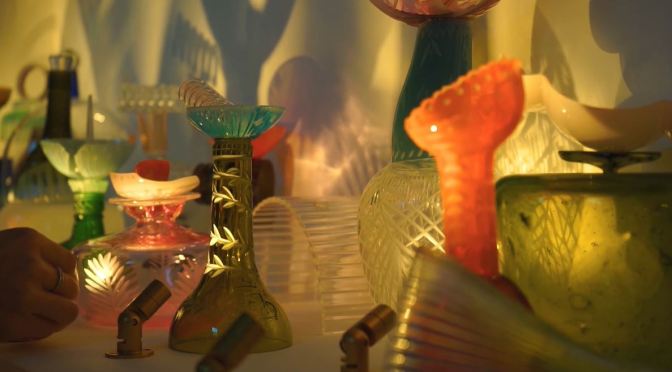
Art & Nostalgia: ‘Glass, Meet the Future’ (Video)
This film was commissioned by North Lands Creative, as part of the UK in Japan 2019-20 bilateral campaign, a partnership between British Council Scotland and Creative Scotland. Supported by project partners Toyama Institute of Glass Art, Toyama Glass Art Museum and Museum of Arts and Design, New York.
The Premiere is part of the “Glass, Meet the Future” Film Festival 2021”
In Collaboration with Rusty Coin Production and Daniel Del Risco Animation.
Project Developed in part OUR COMMON HUMANITY
Commission for the Royal Edinburgh Hospital —
by Edinburgh Lothian Foundation
Large Scale Installation in Partnership with GRAS Architects ( project lead — Jan Hajek )
Edinburgh, Scotland
2016-2021
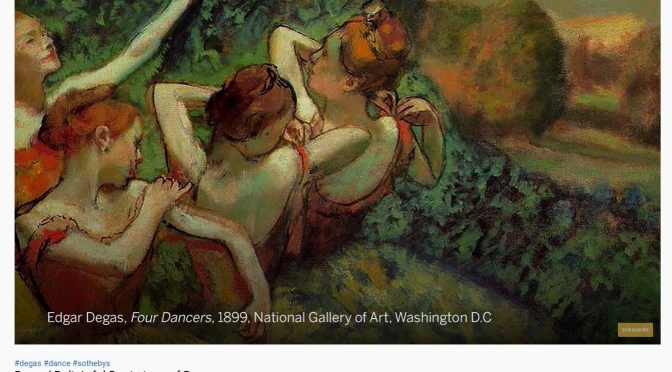
Art Insider: ‘Delightful Dance’ Of Degas (Video)
Edgar Degas was a prolific artist of dance. In this latest episode of Expert Voices, Sotheby’s specialist Brooke Lampley takes us through his fascination with dance, exploring how he perfectly captured every movement both on and off-stage. Ahead of Sotheby’s upcoming Art Impressionniste et Moderne Evening Sale (25 March 2021 | Paris) discover how his painting ‘Danseuse au Tutu Vert’ beautifully illustrates a dancer’s private moment backstage. Find out about the artist’s intense use of colour and how his chosen medium of pastel has truly stood the test of time.
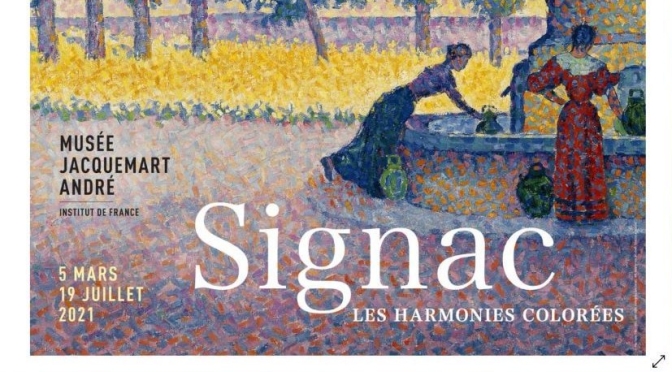
Paris Exhibitions: ‘Signac – The Colored Harmonies’ Musée Jacquemart-André
Signac, Colored Harmonies – From March 26 to July 19, 2021
In 2021, discover the work of Paul Signac (1863 – 1935), master of landscape and main theorist of neo-impressionism, through nearly 70 works from the finest collection of neo-impressionist works in private hands. Alongside 25 of his paintings such as Avant du Tub (1888), Saint-Briac. Les Balises (1890), Saint-Tropez. After the storm (1895), Avignon. Matin (1909) or Juan-les-Pins, Soir (1914) and around twenty watercolors, the exhibition will present more than twenty works by Georges Seurat, Camille Pissarro, Maximilen Luce, Théo Van Rysselberghe, Henri-Edmond Cross , Louis Hayet, Achille Laugé, Georges Lacombe and Georges Lemmen.
The entire exhibition will follow a chronological route, from the first impressionist paintings painted by Signac under the influence of Claude Monet to the brightly colored works produced by the artist in the 20th century, including his meeting with Georges Seurat in 1884. The exhibition, which will retrace the life of Signac and his work to liberate color, will also evoke the history of neo-impressionism.
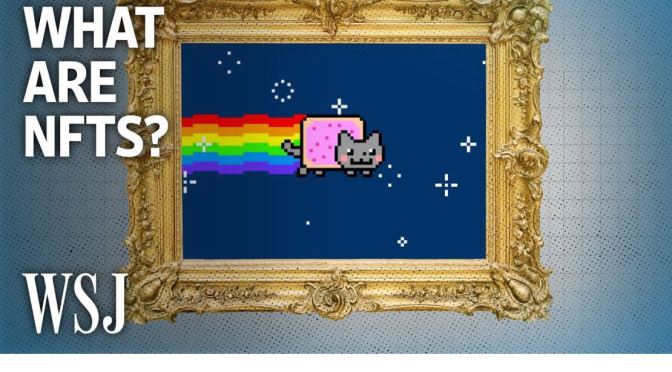
Analysis: ‘NFT’s And The Digital Art Boom’ (Video)
Non-fungible tokens, or NFTs, have exploded onto the digital art scene this past year. Proponents say they are a way to make digital assets scarce, and therefore more valuable. WSJ explains how they work, and why skeptics question whether they’re built to last. Photo Illustration: Jacob Reynolds/WSJ
A non-fungible token is a special type of cryptographic token which represents something unique. NFTs are called non-fungible because they are not mutually interchangeable, since they contain unique information, although it is possible to mint any number of NFTs representing the same object.

The Arts: ‘The Underwater Museum Of Cannes’ (Video)
Six large sculptures of fractured human faces form the underwater museum that British sculptor Jason deCaires Taylor has created off the coast of Cannes, France. The Underwater Museum of Cannes is a permanent installation beside the island of Sainte-Marguerite that is intended to “draw more people underwater” to engage with marine life. It is designed by deCaires Taylor to be highly accessible by either snorkelling or diving, positioned two and three metres below sea level. The goal is that visitors will “foster a sense of care” for marine life and better appreciate its value, while oceans environments are continually threatened by human activity.
Read more on Dezeen: https://www.dezeen.com/?p=1619810
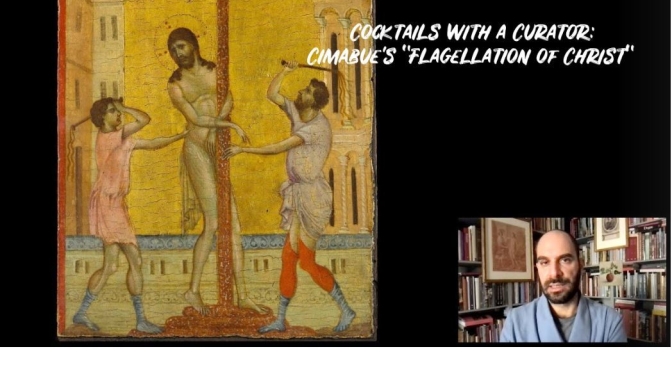
Cocktails With A Curator: Cimabue’s “Flagellation of Christ” (Frick Video)
In this week’s episode of “Cocktails with a Curator,” Deputy Director and Peter Jay Sharp Chief Curator Xavier F. Salomon examines the only work by Cimabue in a public collection in the United States, a small panel depicting “The Flagellation of Christ.” Acquired by the Frick in 1950, the attribution of this work was a topic of debate until a sister panel was discovered in 2000, establishing that they once belonged to a larger ensemble by the 13th-century Florentine. (In 2019, a third fragment was discovered.) As a nod to the gold background, this week’s complementary cocktail is the Gold Rush, a drink invented in New York in the 1920s.
Cimabue, also known as Cenni di Pepo or Cenni di Pepi, was an Italian painter and designer of mosaics from Florence. Although heavily influenced by Byzantine models, Cimabue is generally regarded as one of the first great Italian painters to break from the Italo-Byzantine style.
To view this painting in detail, please visit our website: https://www.frick.org/cimabuechrist

The Arts: ‘Technology & The Future of Theatre’
Art and technology are often seen as distinct disciplines. But combining them results in magic. Sarah Ellis, the Director of Digital Development at the Royal Shakespeare Company, teaches us how technology is reimagining the experience of theatre, taking it beyond the stage and into our living rooms. As an award-winning producer, Sarah Ellis currently works as Director of Digital Development for the Royal Shakespeare Company to explore new artistic initiatives and partnerships.
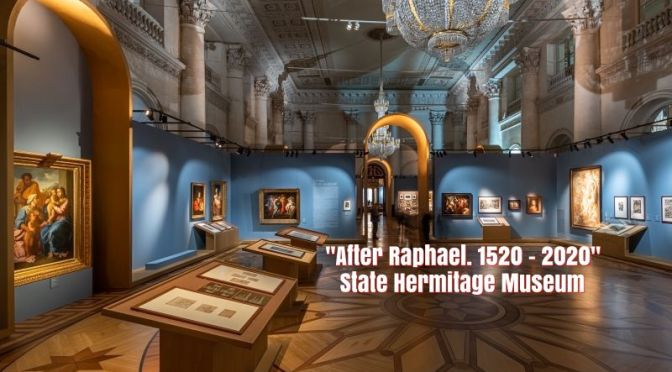
Art: ‘After Raphael. 1520 -2020’ – State Hermitage Museum, Russia (Video)
A film about the Exhibition “After Raphael. 1520 – 2020” at the State Hermitage Museum. Director of the film – Manas Sirakanyan. The film was made with the support of the U.S. Ambassadors Fund for Cultural Preservation, U.S. Embassy Moscow and the Hermitage Museum Foundation (USA)
Raphael is the most influential artist of the Modern Era. Over the course of five centuries, exponents of Mannerism and Academicism, Caravaggisti and masters of the Baroque, Romantics and Modernists have invariably compared their own work with Raphael’s legacy. What is the cause of such fame? What did his name represent in this or that historical period, and what does it represent today? What connects the artist’s followers in different centuries? The exhibition in the Hermitage is an attempt to answer those questions and to look at the art of the past 500 years through the lens of Raphael’s influence.
The large-scale display includes more than 300 exhibits – paintings, graphic art, sculpture and applied art from the Hermitage’s own stocks and twelve other collections in Russia and Western Europe. They include both famous masterpieces and previously unknown works. Dozens of paintings and pieces of graphic art are leaving the museum’s storerooms and being presented to the public for the first time, while a whole number of the exhibits are going on show after painstaking restoration in the Hermitage’s workshops.
The display opens with works by the master himself: a painting and drawings from European collections. Without claiming to be a full representation of the artist’s oeuvre, they serve to set the tone, as it were, and after viewers have “tuned themselves in” it will be easier for them to identify echoes of Raphaelesque harmony in the works from later centuries. The choice of graphic art for this purpose reveals another dimension to the main metaphor: it is specifically the beauty of the clear, precise line, so evident in the drawings made by the master’s own hand, that lies at the foundation of the aesthetics of Raphael himself and many of his followers.
 Boomers Daily