MIT Technology Review – September/October 2023: ‘The Ethics issue’ features Experimental Drugs – Who should get them?; Eric Schmidt on transforming science; When AI goes to war, and more…
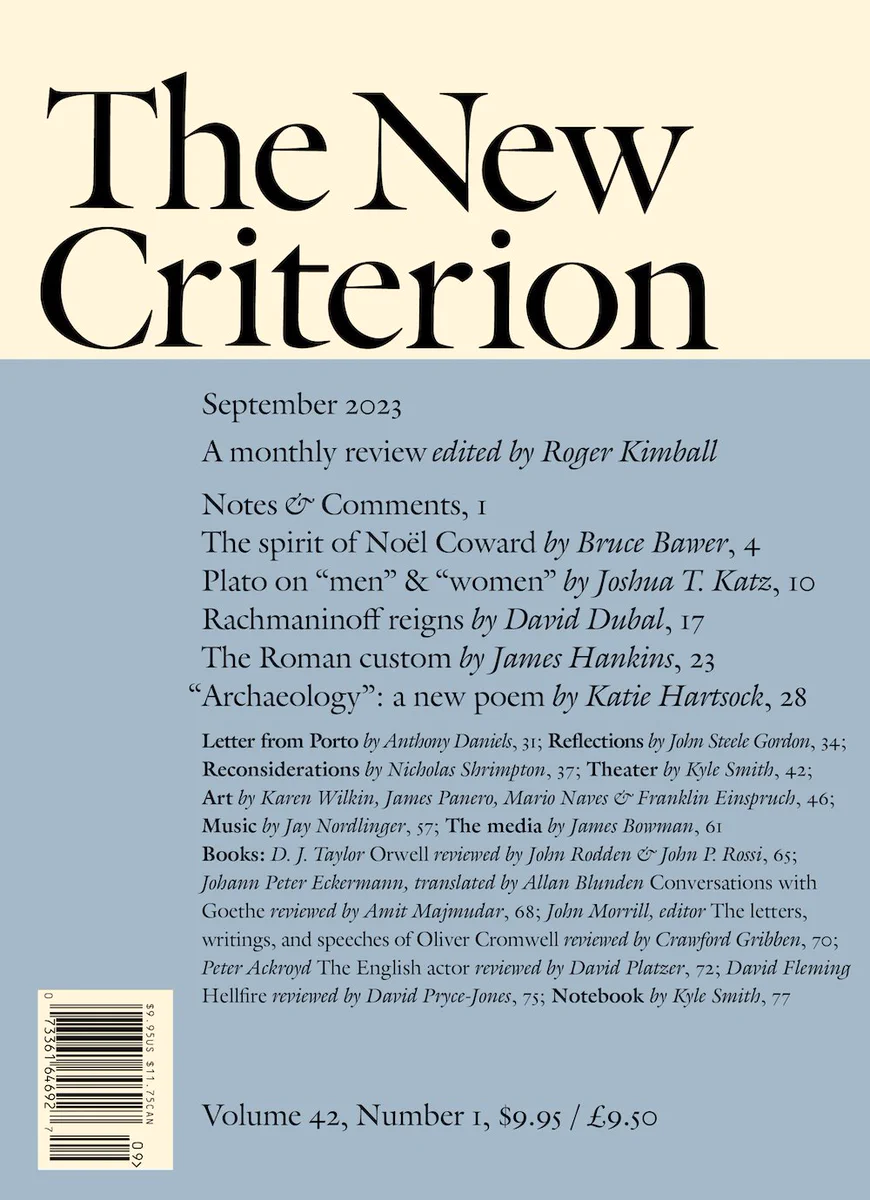
The spirit of Noël Coward by Bruce Bawer Plato on “men” & “women” by Joshua T. Katz Rachmaninoff reigns by David Dubal The Roman custom by James Hankins
THE NEW YORK TIMES BOOK REVIEW – August 20, 2023: The issue features “never before told” narrative histories including a tale of the female botanists who surveyed the Grand Canyon in 1938, a recent biography of the 19th-century “abortionist of Fifth Avenue” and the book on this week’s cover: Prudence Peiffer’s “The Slip,” which brings into focus a thriving artistic community that existed at the southernmost tip of Manhattan in the 1950s and ’60s.
In Melissa Sevigny’s “Brave the Wild River,” we meet the two scientists who explored unknown terrain — and broke barriers.
BRAVE THE WILD RIVER: The Untold Story of Two Women Who Mapped the Botany of the Grand Canyon, by Melissa L. Sevigny
Let’s start this story on a sun-blistered evening in August 1938. A small band of adventurers had just concluded a 43-day journey from Utah to Nevada — although perhaps “journey” is too tame a description for a trip that had required weeks of small wooden boats tumbling down more than 600 miles of rock-strewn rivers. The goal was twofold. First, to simply survive. And then, to chart the plants building homes along the serrated walls of the Grand Canyon.
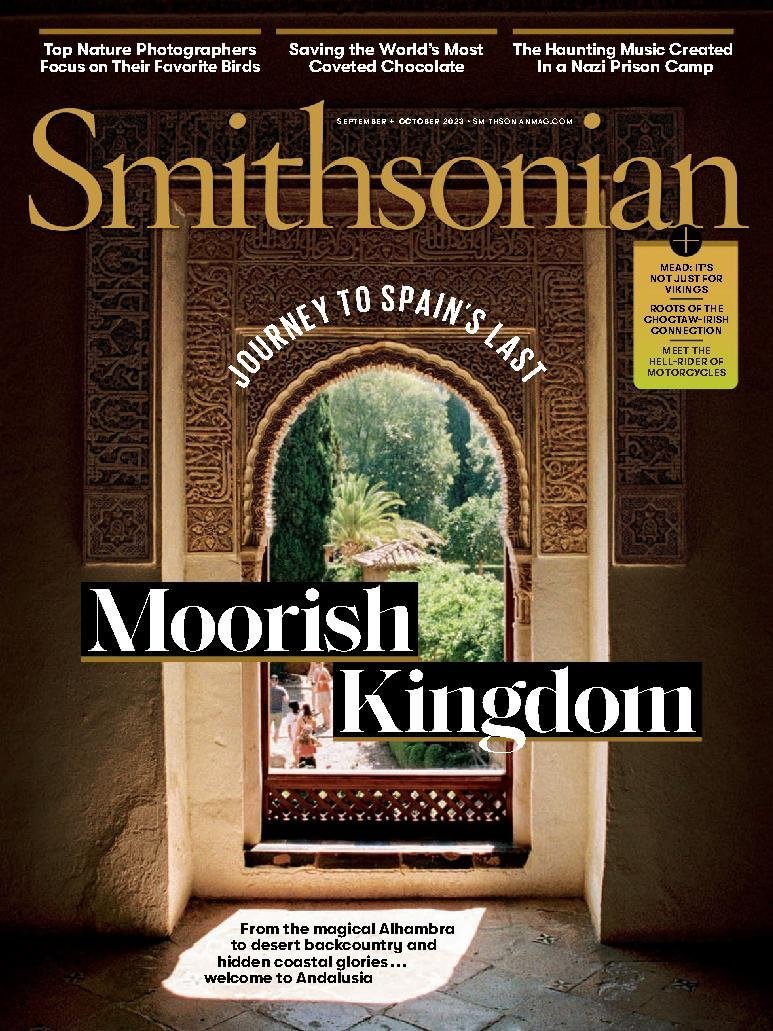
Smithsonian Magazine (September/October Issue) – Journey to Spain’s last Moorish Kingdom – From the magical Alhambra to desert backcountry and hidden coastal glories…welcome to Andalusia; Saving the world’s most coveted Chocolate; Mead – it’s not just for Vikings, and more…
Ötzi, the 5,300-year-old mummy found murdered high in the Alps with an arrow in his back, is a prehistoric celebrity who attracts 300,000 visitors a year to his custom cooling chamber in the South Tyrol Museum of Archaeology in Bolzano, Italy. Years of studies have revealed much about the Iceman, from his last meal—dried ibex and deer meat with einkorn wheat—to the distant Tuscan origins of his copper ax. But while the wizened mummy is extraordinarily well preserved for its age, it gives little impression of how Ötzi would have appeared in life. Now, a detailed genetic study has revealed much more about what the Iceman looked like—and traces the Copper Age corpse’s ancestral lineage back to Anatolia, an area that is now the Asian portion of Turkey.
Scientists have newly sequenced Ötzi’s genome a decade after an earlier effort, using modern techniques and comparative data to produce a much higher-quality result than ever before. The study published Wednesday in Cell Genomics reveals that Ötzi had dark eyes and skin pigmentation darker than that commonly seen among modern inhabitants of Greece or Sicily, though he’s previously been depicted with lighter skin more akin to that of Europeans living in the Alps today. And contrary to most artists’ interpretations, it also appears that he suffered from an age-old affliction still troublesome today—he was going bald.
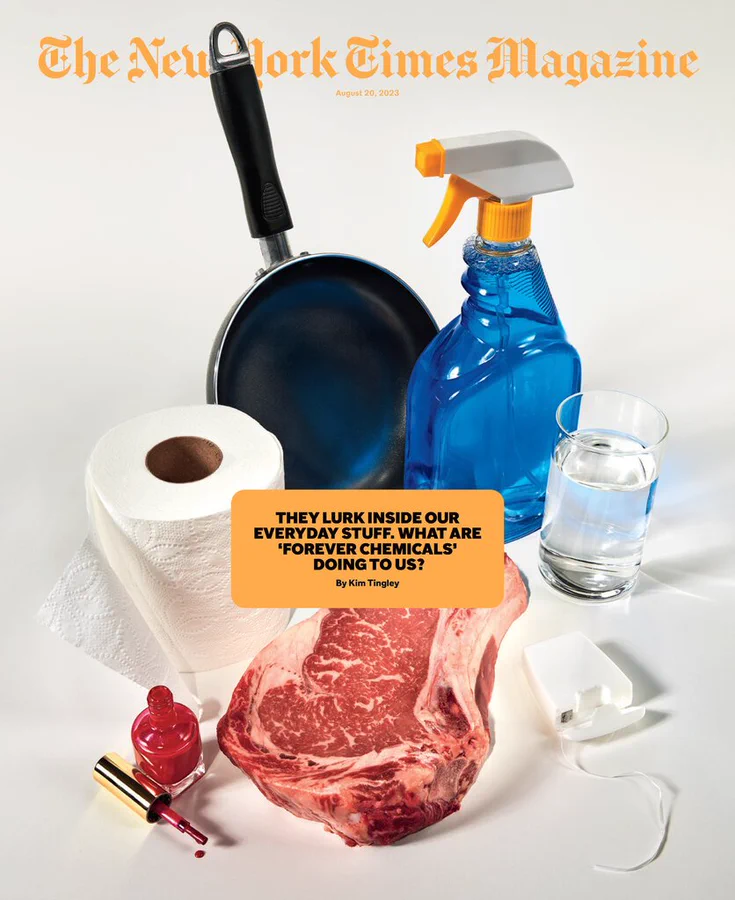
THE NEW YORK TIMES MAGAZINE (August 20, 2023) – In this week’s cover story, what are “forever chemicals” and what are they doing to us? Plus, inside the racism scandal that rocked an affluent town’s high school and checking in with the dancehall star Sean Paul.
PFAS lurk in so much of what we eat, drink and use. Scientists are only beginning to understand how they’re impacting our health — and what to do about them.
By Kim Tingley
The Faroe Islands, an incongruous speckling of green in the North Atlantic, are about as far away as you can hope to get on Earth from a toxic-waste dump, time zones distant from the nearest population centers (Norway to the east, Iceland to the west). Pál Weihe was born in the Faroes and has lived there for most of his life. He is a public-health authority for the nation, population around 53,000; chairman of the Faroese Medical Association and chief physician of the Department of Occupational Medicine and Public Health in the Faroese hospital system. He is also vice chairman of the Faroe Islands Art Society; a widower; a grandfather. A crumpled funeral program and half-empty juice boxes share space in the back seat of his Land Cruiser.
Matthieu Ricard is an ordained Buddhist monk and an internationally best-selling author of books about altruism, animal rights, happiness and wisdom. His humanitarian efforts led to his homeland’s awarding him the French National Order of Merit. (Ricard’s primary residence is a Nepalese monastery.) He was the Dalai Lama’s French interpreter and holds a Ph.D in cellular genetics. In the early 2000s, researchers at the University of Wisconsin found that Ricard’s brain produced gamma waves — which have been linked to learning, attention and memory — at such pronounced levels that the media named him “the world’s happiest man.”
Blazes and high winds blew projects apart and left a tight-knit research community shaken. What will it take to prevent future island fires?
In the wake of a series of powerful wildfires that ripped through Maui’s dry forests and the historic city of Lahaina this week killing more than 50 people, researchers on the island remain concerned about the personal fallout for fellow scientists and their families. Some are reeling from disruption to their projects: Studies of whales may be disrupted, for example, and a rare plant facility sustained damage. “We’re still wrapping our heads around what this really means, because right now, most of us are still in shock,” says marine mammal ecologist Marc Lammers. “And, of course, we’re thinking about our colleagues.”
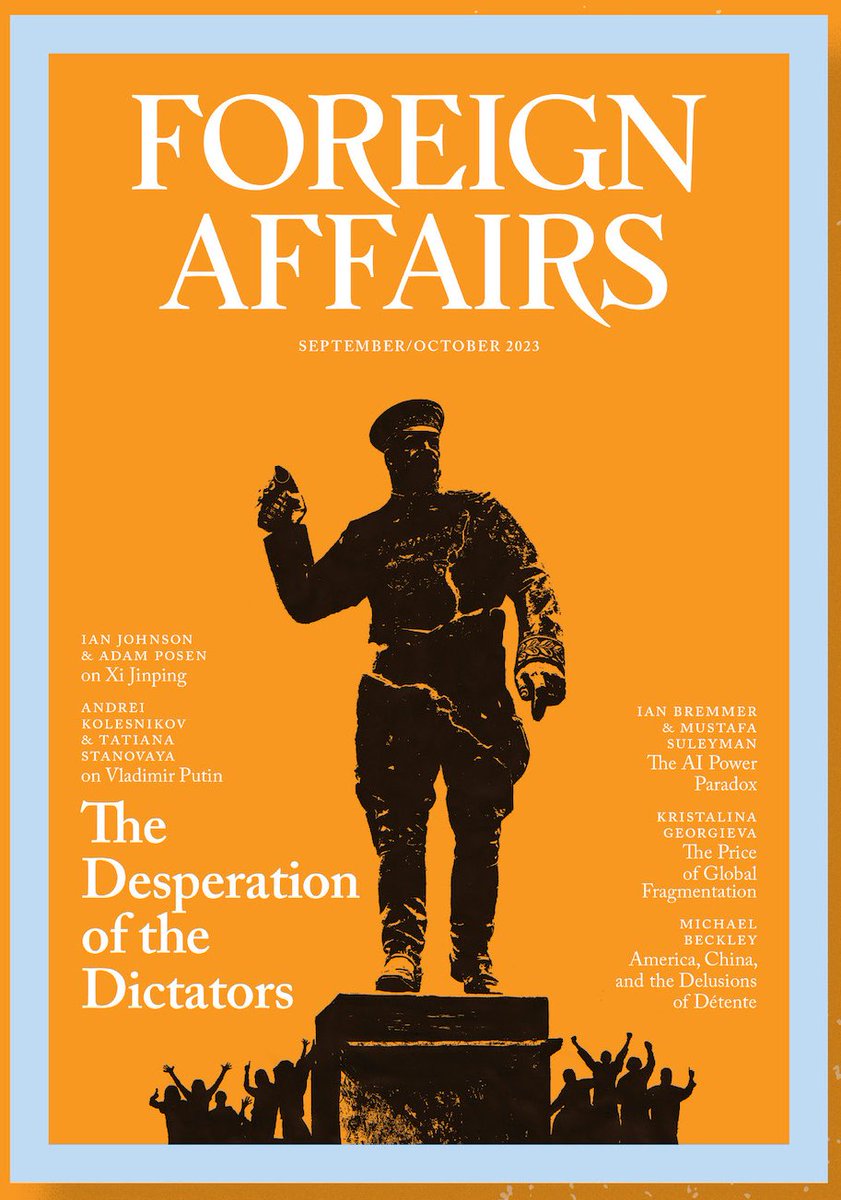
Xi Jinping wants them to focus on the party’s goals. Many cannot see why they should
The crowd did not seem excited to see George Michael and Andrew Ridgeley. When Wham! became the first Western pop group to perform in Communist China, the audience was instructed to stay in their seats. It was 1985 and, despite appearances, the young people in attendance were in fact joyous. The country around them was by no means free, but it was starting to reform and open up. Over the next three decades the economy would grow at a rapid pace, producing new opportunities.
Young Chinese have little hope for the future. Xi Jinping wants them to toughen up
In the southern city of Huizhou an electronics factory is hiring. The monthly salary on offer is between 4,500 and 6,000 yuan (or $620 and $830), enough to pay for food and essentials, but not much else. The advertisement says new employees are expected to “work hard and endure hardship”. The message might have resonated with Chinese of an older generation, many of whom worked long hours in poor conditions to give their children a brighter future. But many of those children now face similar drudgery—and are unwilling to endure it. “I can’t sit on an assembly line,” says Zhang, a 20-something barista with dyed-red hair at a local tea shop. He scoffs at the idea of making such sacrifices for so little gain. The job at the tea shop pays just 4,000 yuan a month, but he enjoys chatting up customers.
nature Magazine – August 17, 2023 issue: The cover shows an artist’s impression of Venetoraptor gassenae, a species of ancient reptile that lived some 230 million years ago. Dinosaurs and pterosaurs dominated land and air, respectively, around 70 million to 200 million years ago, but their evolutionary precursors are not that well known.
The Guardian Weekly (August 18, 2023) – This issue features ‘Back to the office: Is the work from home revolution over?’; Bangladesh’s ‘lost children’; AI does architecture; Pathfinders – In Ukraine minefields and more…
With even the big internet firms warning staff they need to show up more often, is working from home over? Or have the attitudes and expectations of employees changed for ever?
For years, Bibi Hasenaar felt rejected because she was adopted aged four. Then she saw a photo that described her as missing – and began to uncover an astonishing dark history
News, Views and Reviews For The Intellectually Curious