
Paris Review Spring 2024 — The new issue features interviews with Jhumpa Lahiri and Alice Notley, prose by Joy Williams and Eliot Weinberger, poetry by Mary Ruefle and Jessica Laser, art by Chris Oh and Farah Al Qasimi, two covers by Nicolas Party, and more…
Jhumpa Lahiri on the Art of Fiction: “My question is, What makes a language yours, or mine?”
Alice Notley on the Art of Poetry: “Writing is not therapy. That’s the last thing it is. I still have my grief.”
Prose by Elijah Bailey, Julien Columeau, Joanna Kavenna, Samanta Schweblin, Eliot Weinberger, and Joy Williams.
Poetry by Gbenga Adesina, Elisa Gabbert, Jessica Laser, Maureen N. McLane, Mary Ruefle, Julian Talamantez Brolaski, and Matthew Zapruder.
The New Yorker (March 18, 2024): The new issue‘s cover features Klaas Verplancke’s “On the Grid” – The artist blends the preferred pastimes and stylish attire of New York’s commuters. By Françoise Mouly with Art by Klaas Verplancke.
As the art market cools, Julien’s Auctions earns millions selling celebrity ephemera—and used its connections to help Kim Kardashian borrow Marilyn Monroe’s J.F.K.-birthday dress.
The sidewalks of Lower Broadway in downtown Nashville are filled with people moving among neon-lit venues owned by celebrity musicians: Kid Rock’s Big Ass Honky Tonk & Rock ‘n’ Roll Steakhouse, Jason Aldean’s Kitchen & Rooftop Bar, Miranda Lambert’s Casa Rosa. The Hard Rock Café, which opened in 1994, when the neighborhood could still reasonably be called eclectic, sits at the far edge of the strip, overlooking the Cumberland River. One evening last November, Julien’s Auctions took over a private room at the restaurant for a three-day sale in honor of the company’s twentieth anniversary. There was a spotlighted stage full of objects that musicians had worn or touched or played: a scratched amber ring that Janis Joplin wore onstage at the Monterey Pop Festival, in 1967; Prince’s gold snakeskin-print suit, small enough to fit on an adolescent-size mannequin; ripped jeans that had belonged to Kurt Cobain.
The Capitol Hill Club, in a white brick town house a few blocks from the House of Representatives, is a social institution exclusively for Republicans. One evening in October, Representative Mike Garcia was eating there alone when Representative Mike Johnson stopped to chat. Garcia is a first-generation immigrant and a retired Navy pilot from a Democratic-leaning district in Southern California. His predecessor, a Democrat, resigned after a scandal four years ago, and Garcia highlighted disagreements with his party to win reëlection in 2022. He was also a loyalist to former House Speaker Kevin McCarthy, a fellow-Californian who had just been ousted by a small band of hard-line conservative rebels annoyed at his willingness to compromise on budget disputes. Garcia had formally nominated McCarthy as Speaker at the beginning of 2023, and his removal deprived Garcia of a patron.
Poetry a special section Black poetry by William Logan Shakespeare’s words by Amit Majmudar Bachmann: the unspeakable spoken by Peter Filkins The new & the old by Katie Hartsock The answer to Lord Chandos by Pascal Quignard
New translations by Ryan Choi, Frederick Amrine, Patrick Whalen & Beverley Bie Brahic
When it comes to fiction, humor is serious business. If tragedy appeals to the emotions, wit appeals to the mind. “You have to know where the funny is,” the writer Sheila Heti says, “and if you know where the funny is, you know everything.” Humor is a bulwark against complacency and conformity, mediocrity and predictability.
With all this in mind, we’ve put together a list of 22 of the funniest novels written in English since Joseph Heller’s “Catch-22” (1961). That book presented a voice that was fresh, liberated, angry and also funny — about something American novels hadn’t been funny about before: war. Set during World War II and featuring Capt. John Yossarian, a B-25 bombardier, the novel presaged, in its black humor, its outraged intelligence, its blend of tragedy and farce, and its awareness of the corrupt values that got us into Vietnam, not just Bob Dylan but the counterculture writ large.
These are things gaslighters say, writes Kate Abramson.
As she explains in “On Gaslighting,” the term originated in the 1944 film “Gaslight,” and after entering the therapeutic lexicon of the 1980s, steadily made its way into colloquial usage.
As a society we have become adept at classifying actions within interpersonal relationships using therapy-speak. From “attachment style” to “trauma-bonding,” personal judgments have become diagnoses — without the assistance of a licensed professional: Anyone with a social media account or a jokey T-shirt can get in on the action. (In 2021, the flippant phrase “gaslight, gatekeep, girlboss” became a popular, snide social-media shorthand for a certain kind of capitalist feminism.)
The New Yorker (March 11, 2024): The new issue‘s cover features Peter de Sève’s “Downhill” – The artist depicts carving up the slopes, straight into spring.
Katja Grace’s apartment, in West Berkeley, is in an old machinist’s factory, with pitched roofs and windows at odd angles. It has terra-cotta floors and no central heating, which can create the impression that you’ve stepped out of the California sunshine and into a duskier place, somewhere long ago or far away. Yet there are also some quietly futuristic touches. High-capacity air purifiers thrumming in the corners. Nonperishables stacked in the pantry. A sleek white machine that does lab-quality RNA tests. The sorts of objects that could portend a future of tech-enabled ease, or one of constant vigilance.
The classical-education movement seeks to fundamentally reorient schooling in America. Its emphasis on morality and civics has also primed it for partisan takeover.
THE NEW YORK TIMES BOOK REVIEW (March ,8 2024): The latest issue featuresRenaissance scholar Ramie Targoff’s new book, “Shakespeare’s Sisters,” which sets out to show modern readers that the Elizabethan era did indeed produce its share of great women writers, and she details four of them across a range of disciplines.
In “Shakespeare’s Sisters,” the Renaissance scholar Ramie Targoff presents an astounding group of Elizabethan women of letters.
By Tina Brown
SHAKESPEARE’S SISTERS: How Women Wrote the Renaissance, by Ramie Targoff
Judith Shakespeare, Virginia Woolf’s imaginary sister of the Bard, was for years the accepted portrait of the nonexistent writer of Renaissance England. In “A Room of One’s Own,” her seminal feminist essay, Woolf concluded that any glimmer of female creativity in Shakespeare’s time would have been expunged by a pinched life as a breeding machine of children who so often died, disallowed opinions of her own. Had any woman survived these conditions, wrote Woolf, “whatever she had written would have been twisted and deformed, issued from a strained and morbid imagination.”
Using clever camera methods, a new photo book illuminates how honeybees see plants and flowers.
By William Atkins
In WHAT THE BEES SEE: The Honeybee and Its Importance to You and Me, Craig P. Burrows’s ultraviolet-lit photographs mimic the fluorescence his botanical subjects emit when exposed to sunlight, revealing colors and textures usually obscured by the dazzle of visible light. Because bees see in the ultraviolet spectrum, Burrows’s method can afford us a glimpse of the world as they perceive it: His portraits of plants are, in part, prompts for interspecies empathy at a time when bees are under attack on multiple fronts, from air pollution to pesticides.
The Week In Art Podcast (March 8, 2024): To coincide with International Women’s Day on 8 March, the South London Gallery is opening the exhibition Acts of Resistance: Photography, Feminisms and the Art of Protest.
Activism and photography have long gone hand in hand but this collaborative exhibition, organised with the Victoria and Albert Museum (V&A), attempts to capture a new chapter in this distinguished history, with a particular focus on feminism across the world. We talk to Sarah Allen, the head of programme at the South London Gallery, and Fiona Rogers, the V&A’s Parasol Foundation curator of women in photography, about the show. The financier, philanthropist, collector and leader of cultural organisations Jacob Rothschild died last week at the age of 87.
We talk to Anna Somers Cocks, the founder of The Art Newspaper, who interviewed Lord Rothschild on numerous occasions, about his impact on the visual arts and heritage. And this episode’s Work of the Week is Adelphi, made in 1967 by Robert Ryman. It is one of around 50 pieces by Ryman in the exhibition The Act of Looking, which opened this week at the Musée de l’Orangerie in Paris. Guillaume Fabius, the co-curator of the show, joins us to discuss the painting.
Acts of Resistance: Photography, Feminisms and the Art of Protest, South London Gallery, London, 8 March-9 June.
Robert Ryman: The Act of Looking, Musée de l’Orangerie, Paris, until 1 July.
Through some 160 works of painting, sculpture, photography, film, and ephemera, it will explore the comprehensive and far-reaching ways in which Black artists portrayed everyday modern life in the new Black cities that took shape in the 1920s–40s in New York City’s Harlem and nationwide in the early decades of the Great Migration when millions of African Americans began to move away from the segregated rural South.
The first art museum survey of the subject in New York City since 1987, the exhibition will establish the Harlem Renaissance and its radically new development of the modern Black subject as central to the development of international modern art.
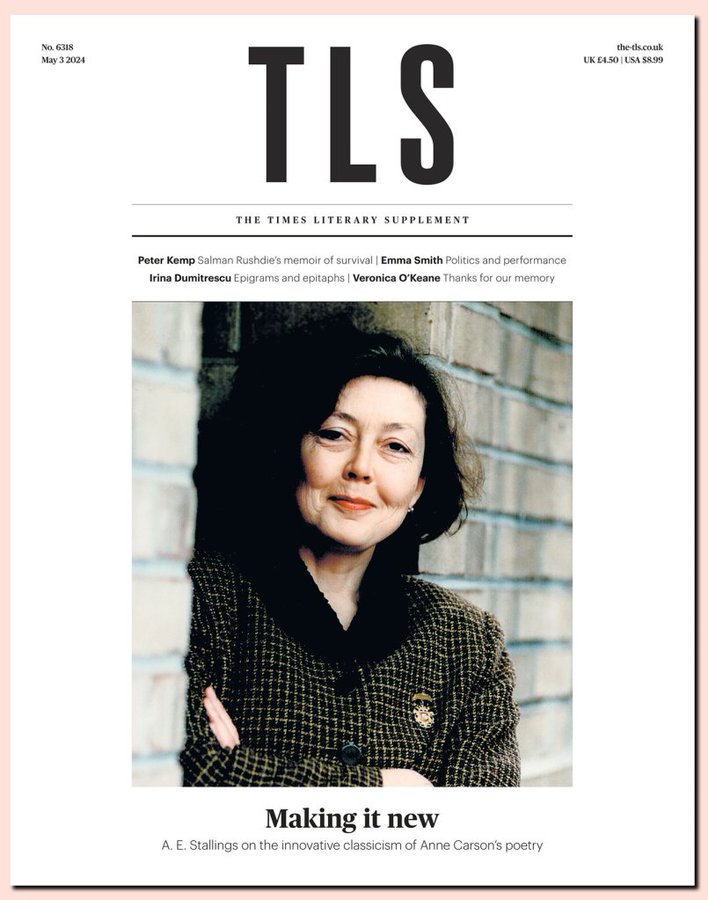
Times Literary Supplement (March 6, 2024): The latest issue features‘Talking about their generation’ – James Campbell and Douglas Field on the Beats including Jack Kerouac and Allen Ginsberg; Alexandra Reza on Frantz Fanon; Miranda France on Montserrat Roig….
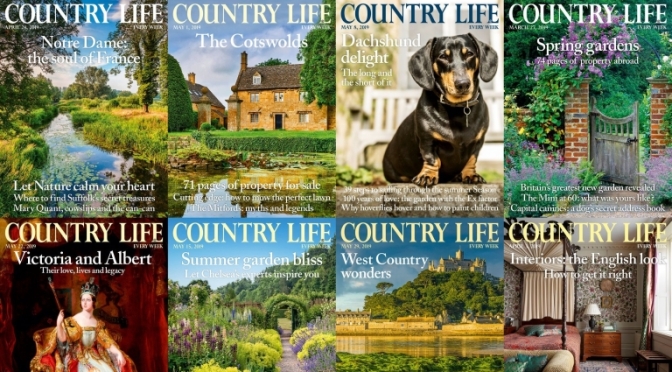
Country Life Magazine – March 5, 2024: The latest issue features The Country Life Top 100 – Britain’s leading exponents of country-house architecture, interior design, gardens and specialist services…
Welcome to the eighth edition of our guide to Britain’s leading exponents of country-house architecture, interior design, gardens and specialist services
New series: The legacy
In the first of this new series, Kate Green celebrates Dame Miriam Rothschild’s remarkable contribution to the nation as a pioneer of wildflower gardening
Reach for the Skye
Following in the slipstream of swimming cattle, Joe Gibbs enjoys safe passage to the Isle of Skye courtesy of the world’s last manual turntable ferry
Hail the conquering heroes
Jack Watkins is in the saddle for a canter through 100 years of the Cheltenham National Hunt Festival’s Blue Riband event, the Gold Cup
Arts & antiques
Works by a whole host of great artists are more accessible than you might imagine. Carla Passino talks to leading art dealers about the Old Masters you could collect
Sir Alistair Spalding’s favourite painting
The artistic director admires a religious fresco that encourages contemplation and reflection
Out of Africa
Carla Carlisle reflects on the life of Karen Blixen after visiting the author’s former home in Kenya
Renewal and recovery
The restoration of Boston Manor House in Greater London offers a fascinating insight into changing tastes, reveals Charles O’Brien
The Devil wears parsley
March can be the month of all weathers, warns Lia Leendertz
The masked singer
Jack Watkins goes in search of the elusive, enchanting woodlark
London Life
Cashing in with Russell Higham
Celebrating Claridge’s
Revisiting James Burton’s beat with Carla Passino
Jack Watkins finds change in the air at the Natural History Museum
Stancombe revisited
Marion Mako visits Stancombe Park, Gloucestershire — Waugh’s garden inspiration for Brideshead
Kitchen garden cook
Melanie Johnson harnesses the subtle depth of flavour of leeks
And so to sleep…
Hemlock is a pretty addition to riverbanks, but its charm ends there, says Deborah Nicholls-Lee
The claws are out
Simon Lester shares the thrill of an encounter with the secretive native white-clawed crayfish
The good stuff
Patterned or pastel? Hetty Lintell showcases the finest waistcoats
News, Views and Reviews For The Intellectually Curious