

The science required for a helicopter to achieve flight is a lot more complicated than it might seem.
All posts by She Seeks Serene

Covid-19 Podcast: New Studies On Transmission

In this audio interview conducted on November 25, 2020, the editors look at new studies of disease transmission in closed environments and provide updates on convalescent plasma and hydroxychloroquine.
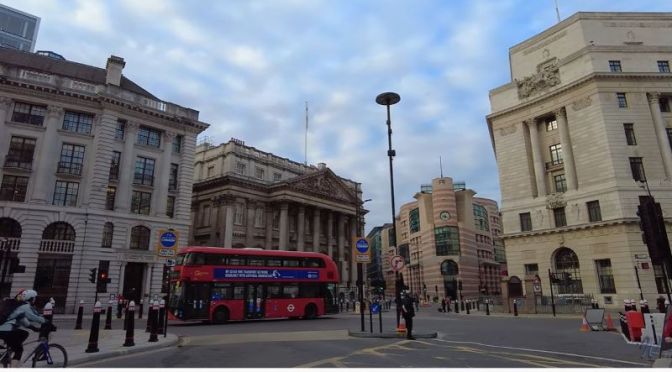
Travel: A Thanksgiving Walk Through The Old ‘City Of London’ (Video)
Date filmed: Thursday – November 26, 2020
The City of London is a city, ceremonial county and local government district that contains the historic centre and the primary central business district (CBD) of London. It constituted most of London from its settlement by the Romans in the 1st century AD to the Middle Ages, but the modern city named London has since grown far beyond the formal City of London borders.[4][5] The City is now only a tiny part of the metropolis of London, though it remains a notable part of central London. Administratively, it forms one of the 33 local authority districts of London; however, the City of London is not a London borough, a status reserved for the other 32 districts (including London’s only other city, the City of Westminster). It is also a separate ceremonial county, being an enclave surrounded by Greater London, and is the smallest county in the United Kingdom.
The City of London is widely referred to simply as the City (differentiated from the phrase “the city of London” by capitalising City) and is also colloquially known as the Square Mile, as it is 1.12 sq mi (716.80 acres; 2.90 km2)[6] in area. Both of these terms are also often used as metonyms for the United Kingdom’s trading and financial services industries, which continue a notable history of being largely based in the City.[7] The name London is now ordinarily used for a far wider area than just the City. London most often denotes the sprawling London metropolis, or the 32 London boroughs, in addition to the City of London itself. This wider usage of London is documented as far back as 1888, when the County of London was created.[5]

Morning News Podcast: Biden Transition, Black Friday Shopping Changes

Biden is expected to announce more members of his cabinet. His administration will place a focus on civil rights. And, stores are changing things up to keep shoppers safe on Black Friday.
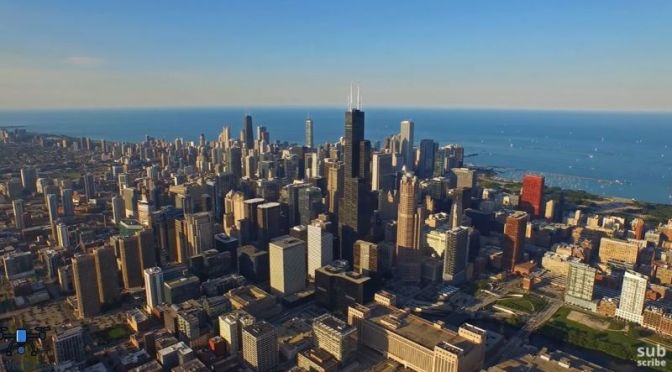
Aerial Travel Video: ‘Chicago – Illinois’
Chicago, on Lake Michigan in Illinois, is among the largest cities in the U.S. Famed for its bold architecture, it has a skyline punctuated by skyscrapers such as the iconic John Hancock Center, 1,451-ft. Willis Tower (formerly the Sears Tower) and the neo-Gothic Tribune Tower. The city is also renowned for its museums, including the Art Institute of Chicago with its noted Impressionist and Post-Impressionist works.

TOP JOURNALS: RESEARCH HIGHLIGHTS FROM SCIENCE MAGAZINE (NOV 27, 2020)



Science Podcast: Covid-19 In Schools, Why Leaves Die And Fall From Trees

Many schools closed in the spring, during the first wave of the coronavirus pandemic. Many opened in the fall. Staff Writer Jennifer Couzin-Frankel joins host Sarah Crespi to talk about what was learned in spring about how coronavirus spreads in schools that might help keep children safe as cases surge once again.
Also this week: What makes leaves fall off deciduous trees when they do—is it the short, cold nights? Or is the timing of so-called “leaf senescence” linked to when spring happens? Sarah talked to Constantin Zohner, a lead scientist at the Institute of Integrative Biology at ETH Zurich, about his tree leaf timing study. Sarah also spoke with commentary author Christy Rollinson, a forest ecologist at the Morton Arboretum, about how important these trees and the timing of their leaf drop is for climate change. In the books segment, host Kiki Sanford talks with Ruth DeFries about her book, What Would Nature Do? A Guide for Our Uncertain Times.

Profile: German Painter & Engraver Albrecht Dürer
‘Saint Eustace’ by Albrecht Dürer depicts the popular medieval legend of a Roman General becoming a saint. In this episode of Anatomy of an Artwork, discover how Dürer captured the intricate detail of the story through the arduous medium of engraving.
Albrecht Dürer (1471 -1528), sometimes spelt in English as Durer or Duerer, was a German painter, printmaker, and theorist of the German Renaissance. Born in Nuremberg, Dürer established his reputation and influence across Europe when he was in his twenties due to his high-quality woodcut prints.

Travel: Can Airlines Recover In 2021? (Video)
After losses of €100 billion in 2020, will next year see air travel take off again? We speak to Alexandre de Juniac, the head of industry body IATA.
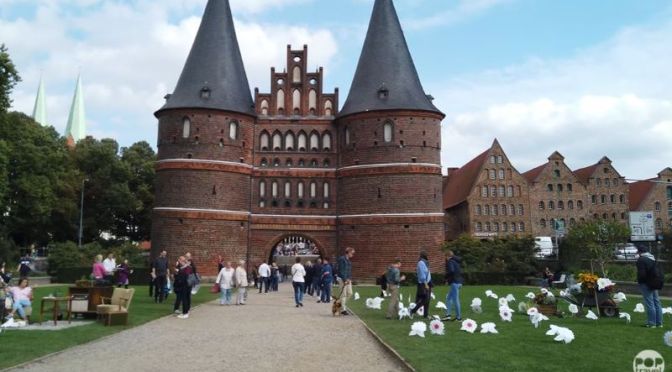
New Walking Tour Video: ‘Lübeck – Germany’ (2020)
Lübeck is a northern German city distinguished by Brick Gothic architecture, which dates to its time as the medieval capital of the Hanseatic League, a powerful trading confederation. Its symbol is the Holstentor, a red-brick city gate that defended the river-bounded Altstadt (old town). Rebuilt following WW II, the Marienkirche is a 13th–14th-century landmark that widely influenced Northern European church design.
Timeline: 0:00 Lübeck Hauptbahnhof 1:00 Bus station (ZOB) 3:00 Hansestraße / Lindenplatz 5:15 Puppenbrücke 8:00 Holstentor 12:00 Western City Center 16:00 Breite Straße 17:00 Markt 19:00 Breite Straße / Marienkirche 21:15 Fischstraße / Breite Straße 27:00 Beckergrube 33:00 Along the Trave River 40:00 Back to the City Center 43:00 St. Jakobi Kirche 45:00 Towards the Northern Old Town 48:00 Burgtor
Filmed in September 2020
 Boomers Daily