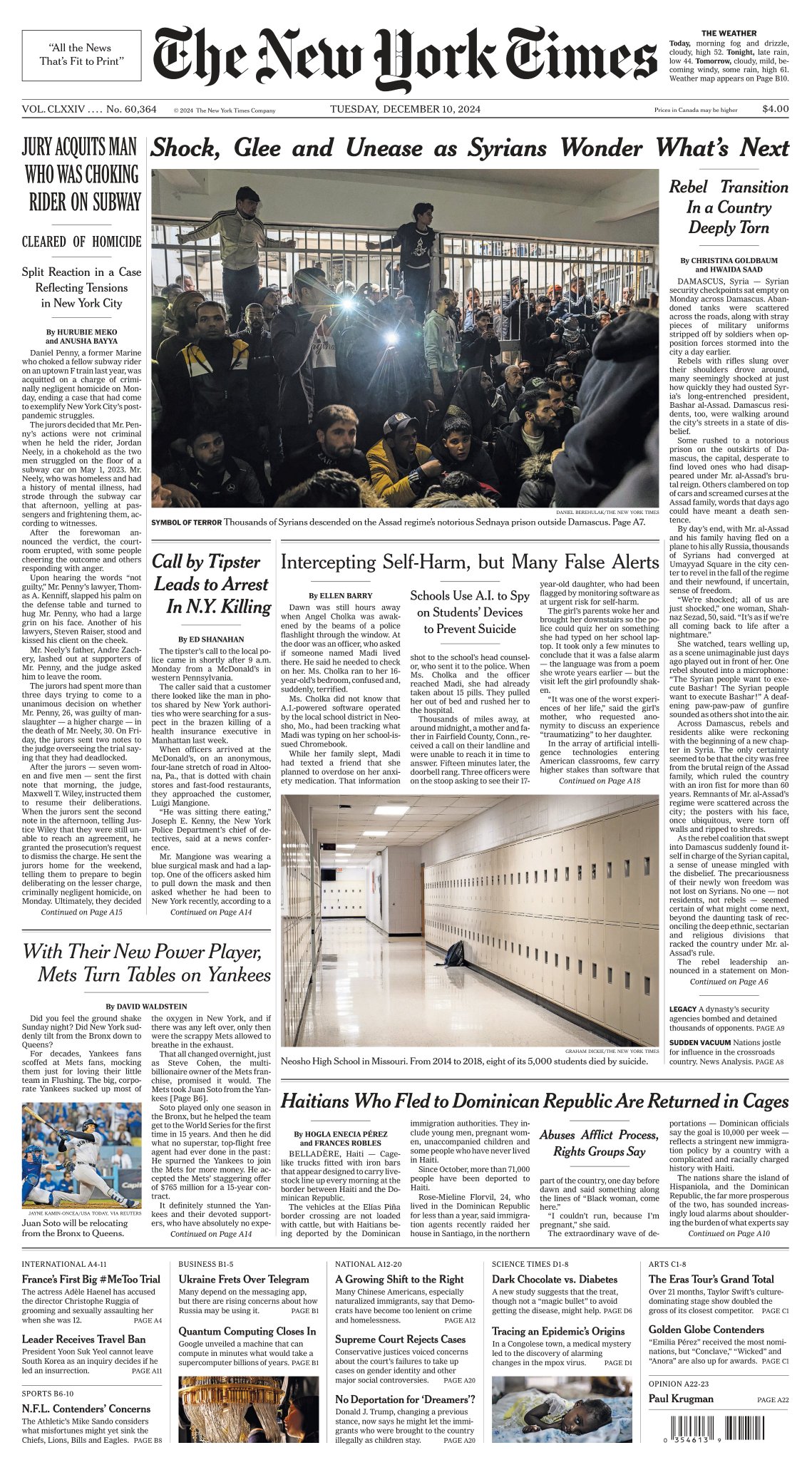
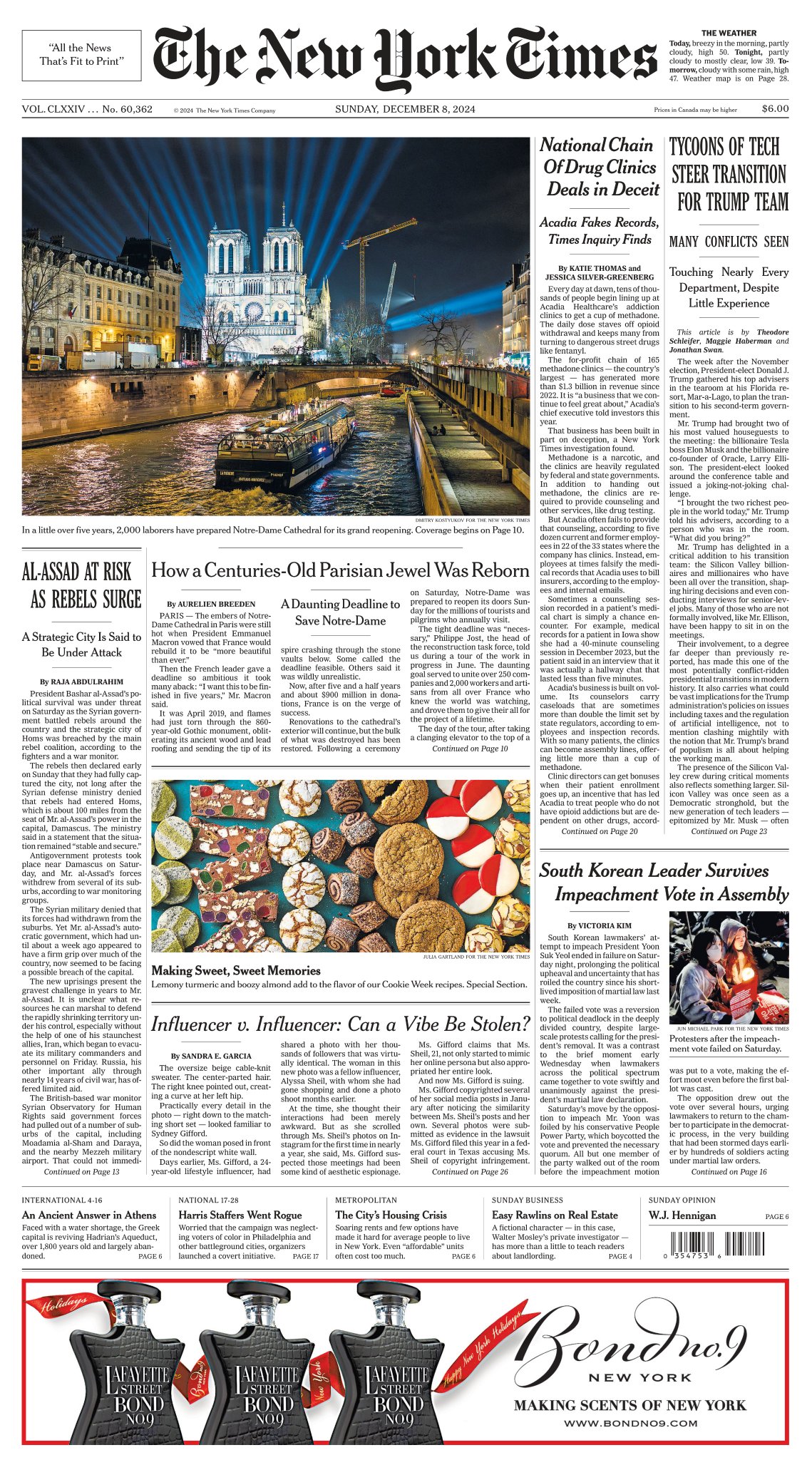
A day after the regime of President Bashar al-Assad fell, civilians poured into the streets of Damascus, weeping in disbelief. Many sought word of relatives held in a notorious prison on the outskirts of the city.
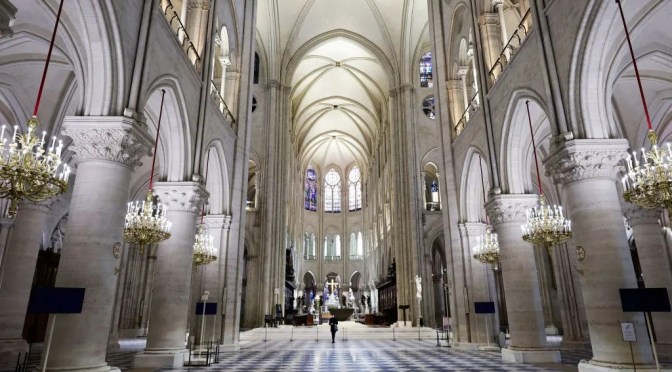
CBS Mornings (December 9, 2024): Saturday was a special day in Paris as Notre Dame Cathedral held its first mass in more than five years after a fire in April 2019 destroyed much of the cathedral’s roof. Senior foreign correspondent Seth Doane has been following the renovation over the years.
Monocle Radio Podcast (December 9, 2024): The latest on Syria as Bashar al-Assad flees to Moscow and rebels claim Damascus. Plus, the future of Yoon Suk Yeol, Romania’s cancelled election and Saudi Arabia’s new date-based soft drink.
President Bashar al-Assad had kept opposition forces at bay for a decade with help from Russia and Iran. But rebels struck at a moment of weakness for those countries.
With the fall of President Bashar al-Assad of Syria, Vladimir V. Putin has suffered one of the biggest geopolitical setbacks of his quarter-century in power.
Want a Job in the Trump Administration? Be Prepared for the Loyalty Test.
Applicants for government posts, including inside the Pentagon and the intelligence agencies, say they have been asked about their thoughts on Jan. 6 and who they believe won the 2020 election.
Foreign Policy Magazine(December 8, 2023): The Best of Books 2024 on international politics, economics, and history that were featured in the magazine this year, selected by Foreign Affairs’ editors and book reviewers.
In a revelatory book, Farrell and Newman describe how the United States has turned its control over information networks into a hidden tool of economic domination—and warn of the risks of Washington’s weaponization of data power for ordinary people, as well as for the global financial system.read the review
In a major reconsideration of Cold War history, Radchenko examines the Soviet Union’s competing ambitions for revolution, security, and legitimacy—and how Soviet leadership, blinded by its own hubris and aggression, set the stage for the downfall of the USSR. read the review
Kahan argues that what unifies liberals across the centuries, including those involved in building and defending liberal democracy today, are their efforts to build societies free from the fear of arbitrary power. He sculpts a masterful and beautifully written history of liberalism’s long intellectual journey. read the review
In this sobering study, Levitsky and Ziblatt demonstrate how the United States’ enduring constitutional order—one forged in a pre-democratic age—increasingly thwarts the will of an expanding multicultural majority in favor of a shrinking rural white minority.read the review
Focused on the sophisticated and networked world of autocracy, dictatorship, and tyranny, Applebaum argues that what separates hardcore autocratic states, such as China and Russia, from softer illiberal and authoritarian regimes, such as those in Hungary, India, and Turkey, is the ruthlessness and reach of their dictatorial power and their deep hostility to the Western-led democratic world.read the review
Monocle on Sunday (December 8, 2024): Juliet Linley and Myriam Zumbühl join Monocle’s editorial director, Tyler Brûlé, to discuss the week’s key topics in a festive programme during Monocle’s Christmas market in Zürich. Plus: an update from Naomi Xu Elegant in Singapore.
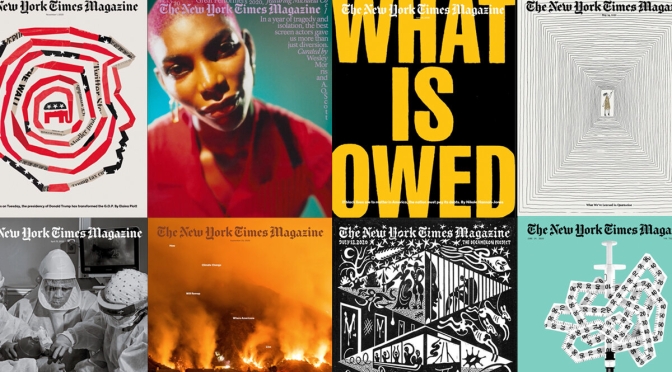
THE NEW YORK TIMES MAGAZINE (December 7 2024): The 12.8.24 Issue features William Langewiesche on the secret Pentagon war game how nuclear escalation spirals out of control; Daniel Bergner on a mysterious gap in psychosis rates; Alexis Okeowo on an endless war in Ethiopia; and more.
Black Americans experience schizophrenia and related disorders at twice the rate of white Americans. It’s a disparity that has parallels in other cultures. By Daniel Bergner















 Boomers Daily