Tag Archives: Culture

Travel: The Scottish Village Of Gurro In Italy

Great Big Story (February 29, 2024); The Italian Alps, home to countless quintessential Italian villages…and one not-so traditional. Welcome to Gurro, the Scottish village in Italy.

Video timeline: 00:00 Intro 00:51 Meet Rosa Patritti 01:09 Folklore 01:54 Traditional Dress 02:18 Language 03:01 Music 04:00 Food

So what actually makes this village Scottish? Legend has it that the population descended from Scottish soldiers, who stumbled across the area whilst fleeing a battle 500 years ago.

But it’s not just their supposed ancestors flying the Scottish flag – the inhabitants today wear traditional tartan, grab drinks in their local Scottish bar and they even mix Scottish into their language…Ay, can you believe it! These are the Italian locals keeping this delightfully unexpected Scottish tradition alive.

#Scotland #Italy #Travel

Previews: The New Yorker Magazine – March 4, 2024

A group of small children hold hands and cross a street in Manhattan.

The New Yorker (February 26, 2024): The new issue‘s cover features ‘Victoria Tentler-Krylov’s “All Clear” ‘ – The artist captures New York’s smallest pedestrians as they make their way through the big city.

INSIDE NORTH KOREA’S FORCED-LABOR PROGRAM

Workers sent from the country to Chinese factories describe enduring beatings and sexual abuse, having their wages taken by the state, and being told that if they try to escape they will be “killed without a trace.”

What a Major Solar Storm Could Do to Our Planet

Electricity shooting from the sun to the earth.

Disturbances on the sun may have the potential to devastate our power grid and communication systems. When the next big storm arrives, will we be prepared for it?

By Kathryn Schulz

Politics: The Guardian Weekly – February 23, 2024

Image

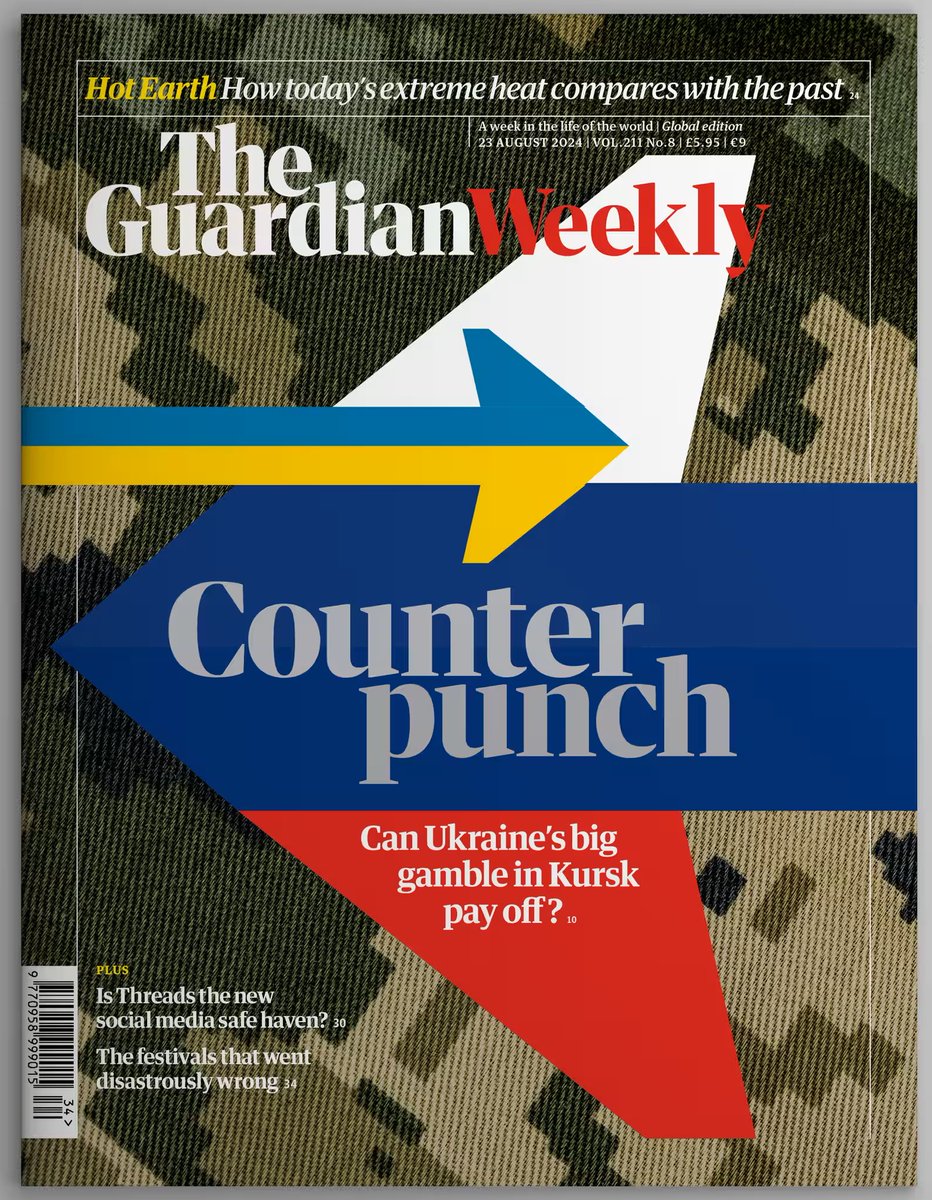
The Guardian Weekly (February 22, 2024) – The new issue features ‘Ukraine’s Lonely Road’ – After two years, is there a way out of Putin’s war?…

Shaun Walker reports on this week’s big story, the fall of the strategic town of Avdiivka to Russian troops has come at a grim time for Ukraine’s president, Volodymyr Zelenskiy. While the army is struggling to hold ground, war fatigue is setting in among parts of the population and disagreements among the leadership have been spilling into the open.

At the same time, the death of the jailed Russian critic Alexei Navalny last week – widely seen as another political assassination – appears to emphasise the strengthening hand of Vladimir Putin, who is expected to secure another six-year term as Russia’s president in tightly controlled elections next month. Amid a familiar wave of international outrage, our Russia affairs reporter Pjotr Sauer asks what Putin might do next.

Coupled with the possibility of a Donald Trump victory in the US elections later this year, it all makes for a deeply worrying outlook for Ukraine, reflected in the Kyiv-based illustrator Sergiy Maidukov’s haunting cover artwork for the magazine this week.

“This war is the hardest test of my life, similar to an endless ultramarathon,” writes Sergiy. “It is good to try to not think about the finish when running long distance. This is important knowledge to endure.”

Previews: The New Yorker Magazine – Feb 26, 2024

People enjoy a variety of winter activities like skating sledding and skiing.

The New Yorker (February 19, 2024): The new issue‘s cover features Marcellus Hall’s “Winter Wonders” – The artist depicts an array of invigorating, comforting, and delightful cold-weather activities.

Legal Weed in New York Was Going to Be a Revolution. What Happened?

A cannabis leaf growing roots into buildings and piles of paper.

Lawsuits. Unlicensed dispensaries. Corporations pushing to get in. The messy rollout of a law that has tried to deliver social justice with marijuana.

Matt Gaetz’s Chaos Agenda

Matt Gaetz photographed by Mark Peterson  Redux for The New Yorker.

The Florida Republican is among the most brazen and controversial figures in Donald Trump’s G.O.P. He’s also among the most influential.

By Dexter Filkins

Representative Matt Gaetz arrived at the White House in the last days of 2020, amid a gathering national crisis. President Donald Trump had lost his bid for reëlection the previous month, and his allies were exploring strategies to keep him in office. Though only thirty-eight years old, Gaetz, the scion of a political family in Florida’s Panhandle, had become one of the Republican Party’s most prominent and divisive figures. His dark hair styled in a kind of bouffant, his lips often curled in a wry smile, Gaetz bore a resemblance to Elvis Presley, or, in the description of a Florida friend, “either Beavis or Butt-head.” He was quick-witted and sometimes very funny, and he loved to taunt his enemies, who were numerous, especially in his own party. “He’s the most unpopular member of Congress, with the possible exception of Marjorie Taylor Greene, and he doesn’t care,” a fellow-congressman told me. 

Previews: New Humanist Magazine – Spring 2024

Image

NEW HUMANIST MAGAZINE – SPRING 2024 ISSUE: The new issue features Emma Park on how the culture wars are damaging the sciences, theoretical physicist Tasneem Zehra Husain on why the imagination is key to decoding the universe, and Alom Shaha on what can be gained by thinking like a scientist

Beyond the two cultures

Amid a polarised debate, science and art seem further apart than ever. Emma Park, editor of The Freethinker, explores what humanism has to teach us about the apparent conflict between these ways of thinking and how to bridge the divide.

“While humanities scholars are often (not without justification) accused of being Luddites, those on the science and technology side could also benefit from the knowledge that the humanities have accumulated over the centuries … [And] no intellectual activity worth the name can flourish in a politically repressive environment: freedom of expression and enquiry should be an issue to unite artists, scholars and scientists.”

The poetry of science

Metaphors are key to unlocking the secrets of the universe – scientists should do more to harness their power, writes acclaimed physicist Tasneem Zehra Husain.

“Metaphors aren’t only a means of description, they can also lead to revelations. Centuries ago, Newton was able to calculate the gravitational attraction between two objects … [but] would ‘feign no hypothesis’ as to why it was so. He had the equation, but he did not understand gravitation … With Einstein, we finally have a metaphor. When we picture space-time as a dynamic ‘fabric’ … we begin to understand what gravity means.”

Arts/Politics: The Atlantic Magazine – March 2024

Image

The Atlantic Magazine – February 13, 2024: The latest issue features ‘To stop a school shooter’ – the case of the contested Basquiats; uncancel Woodrow Wilson; and start-up cities. Plus Michael R. Jackson, the despots of Silicon Valley, Raina Telgemeier, the James Bond trap, “Africa & Byzantium,” Marilynne Robinson, and more.

TO STOP A SHOOTER

photo of building with "Marjory Stoneman Douglas High School" on it, behind trees against cloudy gray sky

Why would an armed officer stand by as a school shooting unfolds? By Jamie Thompson

It was the early afternoon of Valentine’s Day 2018, and the campus of Marjory Stoneman Douglas High School was full of kids exchanging stuffed animals and heart-shaped chocolates. Scot Peterson, a Broward County sheriff’s deputy, was in his office at the school, waiting to talk with a parent about a student’s fake ID. At 2:21 p.m., a report came over the school radio about a strange sound—firecrackers, possibly—coming from Building 12. Peterson stepped outside, moving briskly, talking into the radio on his shoulder. Then the fire alarm rang. Peterson, wearing a sheriff’s uniform with a Glock on his belt, started running.

A Trove of ‘Lost Basquiats’ Led to a Splashy Exhibition. Then the FBI Showed Up.

A man looking at a large portrait of Basquiat in museum gallery with two paintings hanging in the background.

Why is it so hard to root out fakes and forgeries?

By Bianca Bosker

Culture And Traditions: The Porters Of Slovakia

DW Documentary (February 13, 2024) – Delivery service in the world’s smallest high mountain range is still done the traditional way. In the Alps and other European mountains, porters have long been replaced by helicopters and cable cars.

But not in the High Tatras of Slovakia. When loaded, the wooden carrying frames used by the so-called ‘Tatra Sherpas’ weigh up to 100 kilos or more. The porters climb up to 2,000 meters with their loads, supplying essentials to remote mountain huts in the Slovakian national park. Števo Bačkor is one of around 60 porters in the region today. Two to three times a week, the 47-year-old loads his self-built frame with firewood or food.

With the goods stacked on his back, he climbs up the mountains to deliver them, come snow, ice, heat, rain or storm. The mountain huts of the High Tatras depend on the porters’ deliveries, as there are hardly any roads or cable cars. The high mountain region in the Carpathians is a strictly protected nature reserve and, together with the Polish national park, a UNESCO biosphere reserve. This film accompanies Števo Bačkor on his dizzying ascents. He falls into a meditative stride to cope with the exertion.

Strength and courage are not enough – passion is also a requirement for the tough job. It takes him just under three hours to climb 1,000 meters, ultimately reaching the Zbojnícka hut at an elevation of almost 2,000 meters. ‘Reaching the top is always a special moment. You may be exhausted, but you feel complete.’ Some of the ‘Tatra Sherpas’ have already lost their lives on delivery missions through the high mountains. In memory of colleagues who have died, the ‘Sherpa Rally’ takes place as a memorial run every year.

#documentary #dwdocumentary

Politics: The Guardian Weekly – February 9, 2024

Image

The Guardian Weekly (February 8, 2024) – The new issue features ‘Final Straw’ – What’s eating Europe’s Farmers?; Joe Biden’s Middle East masterplan; Can anything stop the AI deepfakes? and The Pet Shop Boys are back in town…

If you live in France, Germany, Belgium, the Netherlands, Poland or Greece, you may well have already run into one of the numerous roadblocks or protests formed in recent weeks by furious farmers. If you’re in Spain and Italy, take cover – because they are coming to you soon, if not already.

In this week’s cover story, we explore what has proved to be the final straw for Europe’s farmers. A combination of rising costs, environmental rules and grievances over EU policies, coupled with more localised complaints, seem to be the factors driving the convoys of tractors. But far-right and anti-establishment parties, who could make major gains in forthcoming European parliament elections, have also picked up on the protests as part of their agenda against EU influence.

Paris correspondent Angelique Chrisafis and Europe correspondent Jon Henley delve into the protests (if not the piles of steaming dung being dumped on the continent’s roads, as illustrated wonderfully by Neil Jamieson on this week’s cover), and ask what can be done to placate them.

Previews: The New Yorker Magazine – Feb 12 & 19, 2024

Pixelated Eustace Tilley magazine cover that appears and disappears.

The New Yorker (February 5, 2024): The new issue‘s cover features Nicholas Konrad’s “Online Profile” – The magazine celebrates its ninety-ninth anniversary..

How Nikola Jokić Became the World’s Best Basketball Player

Nikola Jokić holding a basketball during a game.

He doesn’t run very fast or jump very high, and seems to prefer the company of horses. But he has mastered the game’s new geometry like nobody else.

By Louisa Thomas

The Art World Before and After Thelma Golden

Thelma Golden photographed by Lyle Ashton Harris.

When Golden was a young curator in the nineties, her shows, centering Black artists, were unprecedented. Today, those artists are the stars of the art market.

By Calvin Tomkins

Baruch Spinoza and the Art of Thinking in Dangerous Times

A portrait of Baruch Spinoza by Franz Wulfhagen, 1664.

The philosopher was a champion of political and intellectual freedom, but he had no interest in being a martyr. Instead, he shows us how prudence and boldness can go hand in hand.

By Adam Kirsch