
Category Archives: Technology

To Improve Healthcare: A New, Unbiased “Health Information Agency” Would Transform System

From a HealthAffairs.org online article:

Health Information AgencyThis proposed agency could work like a seal of approval, like the Energy Star program run by the Environmental Protection Agency, for new software, apps, and vendors that will be handling sensitive health information. Just like dishwashers evaluated by Consumer Reports, apps that handle personal health information should have a similar unbiased review process.   

The US health care system is finally at a tipping point of much needed and overdue modernization. While it promises a brave new world of streamlined and improved health care, we are facing nothing short of a revolutionary transformation that is based on a tsunami of readily accessible health information and digital tools.

Currently, there is no federal agency, public-private collaboration, or private industry mechanism that is prepared to handle the ensuing activity in its entirety. We need to get a handle on how best to protect our private health care data while also making sure that information is allowed to flow as freely as necessary to improve our delivery system and population’s health. We need a dedicated team of experts who speak the language of both information technology and public policy. We need a new federal agency that has jurisdiction and dedicated staff to oversee health information and the technology that will simplify and operationalize the information.


To read more: https://www.healthaffairs.org/do/10.1377/hblog20191108.972878/full/?utm_campaign=HASU&utm_medium=email&utm_content=Association+Health+Plans%3B+HIV+Preventive+Recommendations%3B+Improper+Medicaid+Enrollment+Following+Expansion%3B+Health+Reform+On+The+Campaign+Trail%3B+Frequent+Emergency+Department+Users&utm_source=Newsletter

Technology Innovations: “WI-CHARGE” Charges Smart Devices Wirelessly With Infrared Light

From an Interesting Engineering online review:

Wi-Charge TechnologyWi-Charge says it has a solution to the problem. Its technology allows users to power small devices, such as smartphones, smart fire alarms, and smart locks, from several feet away without any wires.

The technology works by sending out a thin beam of infrared light. A receiver on the enabled device then converts the beam into electricity.

Electronic waste is expected to exceed 50 million tonnes by 2020. That number simply isn’t sustainable.

One company is aiming to get rid of one of the main culprits in e-waste: the electronic cable. Wi-Charge has created a method for powering devices wirelessly using safe and efficient infrared technology.

Aside from having the potential to end a great deal of waste, the company is also aiming to meet a growing demand for power that will only increase with the advent of 5G.

WiCharge_Charging_-infographic_wide_v2

To read more: https://interestingengineering.com/is-wireless-power-the-future-for-charging-smart-home-devices?_source=newsletter&_campaign=YqN5dY3r3bJLA&_uid=46dBBxnxd7&_h=0c209d493fa27bb2c39469a873cbbd733289c833&utm_source=newsletter&utm_medium=mailing&utm_campaign=Newsletter-15-11-2019


Medical Podcasts: New Stanford Hospital Uses Technology To Stay “Future-Proofed”

From a Stanford Medicine online article:

Stanford Medicine“A simple example would be copper and fiber wires. When you’re putting wires in a new facility, it’s easier to put in many more than you need that moment because putting them in 5 years from now or 10 years from now is quite hard. Something like 85 percent of our copper wires and fiber optic cables are dark right now because we know we’re going to need them in the future.”

When you consider the fast pace of technological advances today, you wonder how do you go about building a new hospital and keep the technology relevant for 10, 20 or even 50 years?  I put that question to Stanford Health Care’s technology wiz Gary Fritz. He told me:

“We try to do something we call future-proof the hospital. We tried to make design decisions and technology decisions that allow us to move to the current or the next generation technology as easily as possible.”


Automotive Nostalgia: 1940s British Van “Morris Commercial” Relaunches With All-Electric Model

From a AutoCar online article:

Morris Commercial Electric VanThe van is new from the ground up, sitting on a new modular platform and featuring a 60kWh lithium ion powertrain said to endow it with a “power-to-weight efficiency that fully maximises the range of the vehicle”. It can fast charge to 80% in 30 minutes. 

Morris Commercial ranks it alongside the Mini, Morris Minor and Land Rover Defender as a “truly iconic post-war British automotive design”.

Revived thanks to unnamed UK and European financial backing, Morris Commercial’s first production model since the 1960s has a 200-mile range, a 1000kg payload and a 2.5-tonne gross weight.

Company website: https://www.morris-commercial.com/

It’ll be priced from £60,000 and set to be built in the UK at an undisclosed location, with the design an engineering taking place in a facility in Worcestershire.

Morris Commercial Electric Van

To read more: https://www.autocar.co.uk/car-news/new-cars/morris-commercial-revived-1940s-style-electric-van?utm_medium=EMAIL&utm_campaign=&utm_content=ACAR%20ENews%20Bulletin%20-%20SUBS%20AD%20V5%20(14.11.2019)::article2_readmore&utm_source=20191114


Top New Science Podcasts: 3D Printer Advances, Gut Microbes Linked To Liver Disease (Nature Magazine)

Nature PodcastHear this week’s science news, with Nick Howe and Shamini Bundell. This week, a new 3D printer allows quick shifting between many materials, and understanding the link between gut microbes and liver disease.


In this episode:

00:46 A new dimension for 3D printers

A new nozzle lets a 3D printer switch between materials at a rapid rate, opening the door to a range of applications. Research Article: Skylar-Scott et al.News and Views: How to print multi-material devices in one go

08:07 Research Highlights

The slippery secrets of ice, and cells wrapping up their nuclei. Research Highlight: Viscous water holds the secret to an ice skater’s smooth glideResearch Highlight: Super-thin layer of ‘bubble wrap’ cushions a cell’s nucleus

10:17 Linking bacteria to liver disease

Researchers have isolated a bacterial strain that appears to play an important role in alcoholic liver disease. Research paper: Duan et al.News and Views: Microbial clues to a liver disease

17:10 News Chat

‘Megaconstellations’ of satellites concern astronomers, and a report on the gender gap in chemistry. News: SpaceX launch highlights threat to astronomy from ‘megaconstellations’News: Huge study documents gender gap in chemistry publishing

Consumer Surveys: Only 30% Of Baby Boomers Use Online Grocery Services

From a Chain Store Age online release:

Chain Store Age CoverAccording to a recent survey of 1,000 U.S. consumers from advertising platform Criteo, 48% of millennial and Gen Z respondents use online grocery delivery services, compared to 37% of Gen X respondents and only 30% of baby boomer respondents. 

Baby boomers are much less likely than younger consumers to participate in a particular omnichannel grocery activity.

Results for browsing multiple sites to read product reviews are essentially the same across generations. But Gen X consumers are much more likely to browse multiple sites if a product they want is unavailable (37%) than Gen Z/millennial (28%) or baby boomer/silent generation consumers (22%). And more than half (51%) of baby boomer/silent generation consumers will browse multiple sites for none of these reasons, compared to 27% of Gen X and 15% of Gen Z/millennial consumers.

To read more: https://chainstoreage.com/survey-boomers-dont-say-ok-grocery-service

Trends In Transportation: The BST-Hypertek Electric, Carbon Fiber Motorcycle Is “The New Standard”

From a New Atlas online review:

BST-Hypertek Electric MotorcycleWell, with this extraordinary electric bike, I think I finally understand what Terblanche has been trying to get at all these years, and I absolutely love it. Designed and built in partnership with South African carbon wheel specialists BST, meet the all-electric Hypertek.

There could be no better name for this thing and its unabashed, triumphant futuristicism. Every component and detail seems stripped back, technical, modular, functional. It’s like a Confederate jumped in a teleportation machine without realizing there was already a Dyson vacuum in there.

The Hypertek is built around the reasonably unglamorous DHX Hawk water-cooled PMS electric motor, presumably chosen for its compact size and high torque output of 120 Nm (88.5 lb-ft). BST claims a peak power of 80 kW (107 hp), but we can’t find any motor on the DHX website capable of such peaks – the company’s largest advertised Hawk motor makes 120 Nm but peaks at 55.3 kW (74 hp) and offers a continuous power of 34.5 kW (46.3 hp). So perhaps it’s a custom build.

To read more: https://newatlas.com/motorcycles/bst-hypertek-crazy-electric-motorcycle/

Innovations In Cocktails: “Barsys Coaster” Weighs Ingredients, Guides Mixing With AI Smart App

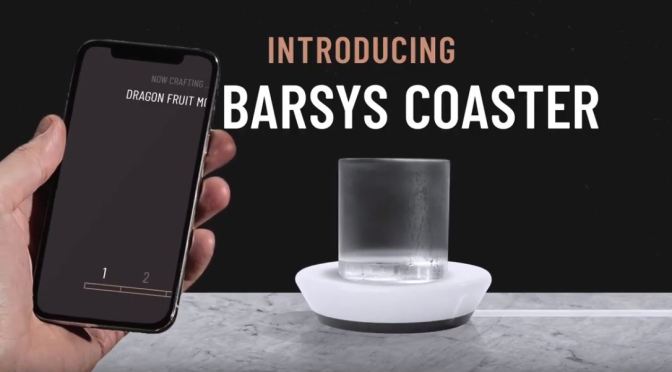
The Barsys CoasterThe Barsys CoasterThe Barsys CoasterFrom a Yanko Design online review:

This is the Barsys Coaster, a smart coaster with a mini weighing-machine and an AI inside it that coaches you through the fine cocktail-mixing process. The coaster works with the Barsys app, which lets you select a recipe, while the coaster itself sits on a table with an empty glass above it. The app tells you how to build your cocktail, by telling you what to pour into your glass, while the coaster and its weight-sensor lets you know when to stop pouring. 

The incredibly precise weight-sensor within the coaster can know exactly when you’ve poured the right amount of gin, or vodka, or orange juice, while the app itself then tells you to stop pouring and proceed to the next step. The result? Precisely crafted cocktails courtesy an AI bartender and your passion for drinking fine cocktails from the comfort of your own house as Netflix cues the next episode of whatever it is you’re watching!

To read more: https://www.yankodesign.com/2019/11/08/this-coaster-has-an-ai-bartender-that-guides-you-through-the-cocktail-making-process/

Online Ads Explained: How Google Operates Its Advertising Machine (Wall Street Journal)

From a Wall Street Journal online article:

In interviews, dozens of publishing and advertising executives said Google is doing just that with an array of interwoven products. Google operates the leading selling and buying tools, and the biggest marketplace where online ad deals happen.

OG-DK310_201911_E_20191106192428

Overall, Google made $116 billion in advertising revenue last year, a 22% rise from the previous year and 85% of the company’s total revenue. Most of that ad revenue came from Google’s own properties, but the company’s vast role in brokering online ad sales off its own platforms gives it an added level of dominance.

Alphabet Inc. ’s Google is under fire for its dominance in digital advertising, in part because of issues like this. The U.S. Justice Department and state attorneys general are investigating whether Google is abusing its power, including as the dominant broker of digital ad sales across the web. Most of the nearly 130 questions the states asked in a September subpoena were about the inner workings of Google’s ad products and how they interact.

To read more: https://www.wsj.com/articles/how-google-edged-out-rivals-and-built-the-worlds-dominant-ad-machine-a-visual-guide-11573142071?mod=hp_lead_pos8