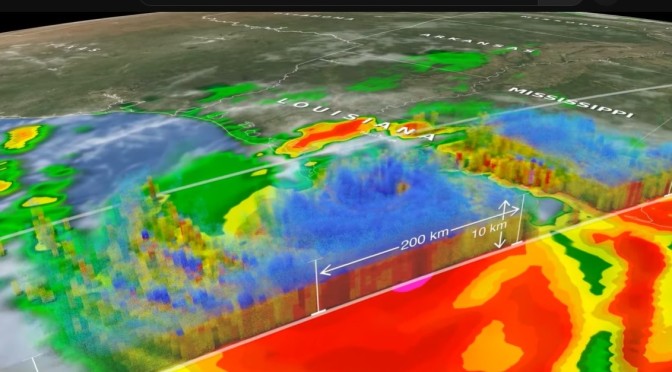
NASA Goddard (December 2022) – NASA is developing the Earth System Observatory, the core of which is five satellite missions providing critical data on climate change, severe weather and other natural hazards, wildfires, and global food production.
These observations will address the most pressing questions about our changing planet. Taken together as a single Observatory, NASA will have a holistic, 3D view of Earth to better understand how our planet’s complex systems work together and improve our capability to predict how our climate may change.
NASA’s Open Source Science strategy is the key to bringing the data from these missions together into a single observatory to help understand the earth as a system and accelerate our ability to use this understanding. These observations will better inform decision-makers on how our planet is changing, with greater precision on previously unimaginable scales – from entire continents down to individual trees, from atmosphere to bedrock.
World Economic Forum (December 9, 2022) – This week’s top stories of the week include:
0:15The world’s most expensive cities – This list of the most expensive cities is based Worldwide Cost of Living 2022 report that compares 200 products and services in more than 170 cities. Prices in big cities have risen by an average of 8.1% in the past year. Their fastest rise for 20 years. Driven by the knock-on effects of the pandemic and Russia’s invasion of Ukraine, some of these most expensive cities have high wages and taxes, while another has an average rent of about 92% of the median worker’s pre-tax salary. Watch to know which cities are the most expensive to live in.
1:36The era of the megalopolis has begun – Today 60% of people live in urban areas, and by 2100 it’s forecast to be 85%. We are entering the era of the megalopolis. Cities around the world are merging as they grow and spread, forming supercities connected by urban sprawl. The largest megalopolis is in China – it’s known as the Greater Bay Area. But what are megapolis?
2:53Scientists develop a universal flu vaccine – Scientists have developed a universal flu vaccine. It’s effective against all 20 known strains of flu and could help us fight off dangerous new strains before they develop into a pandemic. The new vaccine could be in use within 2 years.
3:53This device will heat our homes sustainably – Heat pumps run on electricity rather than fossil fuels and are 3 times more efficient than gas boilers. They capture thermal energy from the air outside and use that energy to warm your home.
Two million year-old DNA found in frozen soil has been sequenced, revealing a surprising picture of an ancient landscape. Extinct creatures including, unexpectedly, elephant-like mastadons turn out to be among the beasts roaming Greenland. Researcher Eske Willerslev explains how DNA found in the environment can be used to reconstruct the past as so-called ‘eDNA’ becomes a vital tool for palaeontologists.
CNET (December 4, 2022) – Archer Aviation introduced its first production model eVTOL that’s called Midnight, an electric air taxi designed for high-demand urban flights. United Airlines has put down a deposit for 100 Midnights to begin passenger service in 2025.
Video timeline: 0:00 Intro 0:55 Midnight eVTOL 1:54 Maker Prototype Test Flight 2:29 Archer x United 3:26 Conclusion
The cost of health care is unaffordable for many in the developing world. But while universal health care may sound like an impossible dream, it’s more achievable than you might think.
Video timeline: 00:00 – The argument for universal health coverage is clear 00:57 – Thailand’s path to universal health coverage 03:31 – Universal health care around the world 04:48 – How to finance universal health coverage? 05:30 – Rwanda: from genocide to public health exemplar 07:19 – What is a pooling finance system? 08:01 – Which services make the cut? 11:17 – The economic benefits of UHC 12:23 – Could covid-19 be a catalyst for reform?
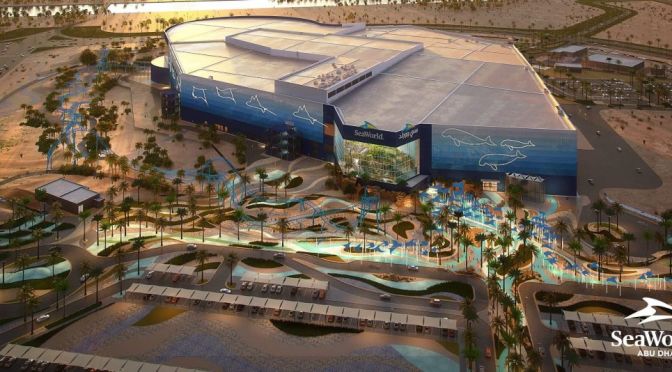
The B1M – ABU DHABI has built some of the world’s most striking construction projects. And it’s not done yet. Work is underway to build a record-breaking aquarium, one that will blow all the others out of the water.
The Shedd Aquarium in Chicago holds about 19M litres of water. Chimelong Ocean Kingdom in China holds 49M, and is currently the world’s largest – but when Sea World Abu Dhabi completes, it’ll likely contain a whopping 58M litres of water. That’s the same as 23.2 Olympic pools.
Designing and building a tank this big poses an extreme engineering challenge. It has to withstand immense water pressure, let in the right amount of light for tens of thousands of species to survive and immerse millions of visitors in an underwater world.
Greg Corrado – Ph.D., Head of Health AI, November 28, 2022:
Alongside licensing our AI technology, iCAD will also use Google Cloud’s secure, scalable infrastructure, giving them the ability to rapidly expand cloud-hosted solutions into new regions. By doing so, iCAD can scale access to AI-based tools in underserved regions where infrastructure challenges may constrain their ability to offer breast cancer screenings.
Breast cancer is one of the world’s most common cancers; thankfully, early detection can help save lives and improve outcomes among many who develop the disease. At Google Health we’re developing AI to improve the accuracy and expand the availability of breast cancer screenings. Over time, better screenings will improve health outcomes and reduce disparities for people around the world.
Today, we’re announcing a partnership with iCAD, a leader in medical technology and cancer detection, marking the first time we are licensing our mammography AI research model. iCAD will work toward validating and incorporating our mammography AI technology with its products for use in clinical practices with the goal of improving breast cancer detection and assessment of short-term personal cancer risk for the more than two million people globally diagnosed with breast cancer every year.
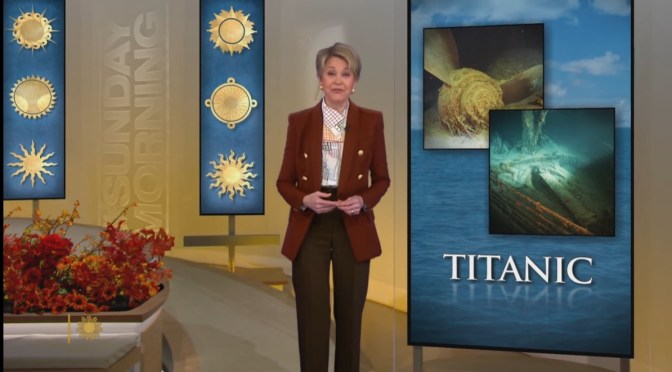
CBS Sunday Morning – Correspondent David Pogue joins Titanic enthusiasts (nicknamed “Titaniacs”) who will happily pay a small fortune to ride in OceanGate’s specially-designed submersible vehicle, equipped with 4K video cameras, to visit the remains of the luxury liner 13,000 feet beneath the North Atlantic (weather conditions permitting).
RMS Titanic was a British passenger liner, operated by the White Star Line, which sank in the North Atlantic Ocean on 15 April 1912 after striking an iceberg during her maiden voyage from Southampton, England, to New York City, United States.
0:15 This island nation has moved to the metaverse – Rising seas are due to swamp Tuvalu by the end of the century. So the Pacific archipelago of 12,000 people has taken a remarkable step, declaring itself the world’s ‘first digital nation’.
1:39 Crosswords battle memory loss – Researchers studied 107 elderly people with mild cognitive impairment. 4 times a week, they spent half an hour either doing a crossword or completing tasks on a popular brain-training computer platform. Then they were reassessed after 12 and 66 weeks. Crossword players scored better on cognitive decline and daily functioning tests.
2:50 UK is rolling out ‘buzz’ stops for bees – The UK is planting bee-friendly native flowers on the roofs of roadside bus shelters, creating a parallel transport network for bugs. Management company Clear Channel aims to convert 1,000 shelters overall with native plants such as pansies and thyme.
4:05 Entrepreneur running 200 marathons for water – Guli is an Australian entrepreneur and environmental activist. She plans to complete Run Blue in time for the UN Conference on Water in March 2023 and to inspire as many people as possible along the way. Guli’s mission has taken her to the front lines of the global water crisis.
_____________________________________________
The World Economic Forum is the International Organization for Public-Private Cooperation. The Forum engages the foremost political, business, cultural and other leaders of society to shape global, regional and industry agendas. We believe that progress happens by bringing together people from all walks of life who have the drive and the influence to make positive change.
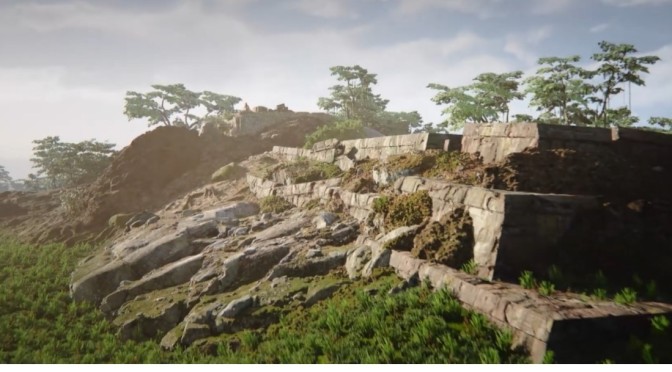
National Geographic UK – Modern technology has enabled archaeologists to virtually peel back a forest to discover the lost Maya city, an ancient civilisation that existed for up to 3,000 years and stretched from the pacific coast to the gulf coast of Mexico.
The technology, known as LIDAR, shot lasers from a plane through the tree canopy which bounced off of the ground to create an image of the earth below. The images were then used to map and uncover the hidden historical structures that make up the ancient Maya city.
According to a report in The New York Times, a fortified Maya settlement thought to be the capital of the Sak Tz’i’ dynasty is being investigated on private land in southern Mexico by a team of researchers including Charles Golden of Brandeis University. The site is thought to have been occupied as early as 750 B.C. until the end of the Classic period, around A.D. 900.
Golden said that the ruins cover about 100 acres and include an acropolis dominated by a 45-foot-tall pyramid, temples, plazas, reception halls, a palace, ceremonial centers, and a ball court measuring about 350 feet long by 16 feet wide. Inscriptions from other sites had linked the kingdom of Sak Tz’i’ to the Maya cities of Piedras Negras, Bonampak, Palenque, Tonina, and Yaxchilan.
News, Views and Reviews For The Intellectually Curious













 Boomers Daily