

Category Archives: News

Top New Science Podcasts: Latest Trends In Research, Carnivorous Plant Traps
 We start our first episode of the new year looking at future trends in policy and research with host Joel Goldberg and several Science News writers. Jeffrey Mervis discusses upcoming policy changes, Kelly Servick gives a rundown of areas to watch in the life sciences, and Ann Gibbons talks about potential advances in ancient proteins and DNA.
In research news, host Meagan Cantwell talks with Beatriz Pinto-Goncalves, a postdoctoral researcher at the John Innes Centre, about carnivorous plant traps. Through understanding the mechanisms that create these traps, Pinto-Goncalves and colleagues elucidate what this could mean for how they emerged in the evolutionary history of plants.

Studies: New Protein Therapy Improves Cardiac Function, Scar Formation After Heart Attack
From a New Atlas online article (Jan 1, 2020):
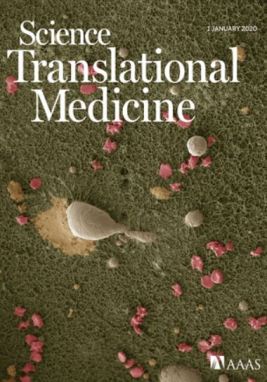 “This is an entirely new approach with no current treatments able to change scar in this way,” says Associate Professor James Chong who led the research. “By improving cardiac function and scar formation following heart attack, treatment with rhPDGF-AB led to an overall increase in survival rate in our study.”
The research centers on a protein therapy called recombinant human platelet-derived growth factor-AB (rhPDGF-AB), which had previously been shown to improve heart function in mice that had suffered a heart attack. In a new study aimed at bringing the treatment closer to human trials, a team set out to discover if it produced similar results in large animals, namely pigs.
The researchers from the Westmead Institute for Medical Research (WIMR) and the University of Sydney found that when pigs that had suffered a heart attack received an infusion of rhPDGF, it did indeed prompt the formation of new blood vessels in the heart and led to a reduction of potentially fatal heart arrhythmia.

Top Science Podcasts: Soles And Calluses, Far Side Of The Moon & Nobel Prize Winner Q&A (Nature)
 The podcast team share some of their highlights from the past 12 months: A sole sensation, The make up of the far side of the Moon, Growth Mindset, ‘Manferences’ and Q&A with Nobel Prize winner John Goodenough.
In this episode:
00:33 A sole sensation
A study of people who do and don’t wear shoes looks into whether calluses make feet less sensitive. Nature Podcast: 26 June 2019; Research article: Holowka et al.; News and Views: Your sensitive sole
08:56 The make up of the far side of the Moon
Initial observations from the first lander to touch down on the far side of the Moon. Nature Podcast: 15 May 2019; Research article: Li et al.
15:43 Growth Mindset
How a one hour course could improve academic achievement. Nature Podcast: 07 August 2019; Research article: Yeager et al.
27:44 ‘Manferences’
Nature investigates the prevalence of conferences where most of the speakers are male. Nature Podcast: 11 September 2019; News Feature: How to banish manels and manferences from scientific meetings
34:02 Q&A with Nobel Prize winner John Goodenough
We talk to John Goodenough, who was jointly awarded the 2019 Nobel Prize in Chemistry for his role in the development of the lithium-ion battery. Podcast Extra: 09 October 2019

Medical Technology: New Artificial Intelligence (AI) Model Predicts Breast Cancer More Accurately
A new Artificial Intelligence (AI) model predicts breast cancer in mammograms more accurately than radiologists, reducing false positives and false negatives, reports a large international study from Google, Northwestern Medicine and two screening centers in the United Kingdom (U.K.).

Heart Studies: Alcohol Abstinence For Atrial Fibrillation Reduces Arrhythmia (NEJM)
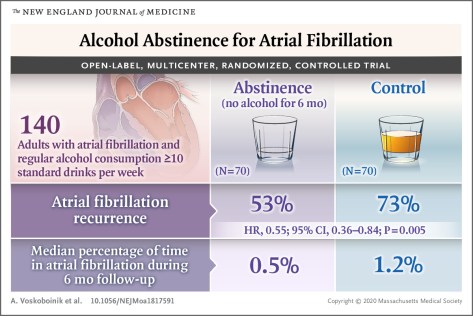
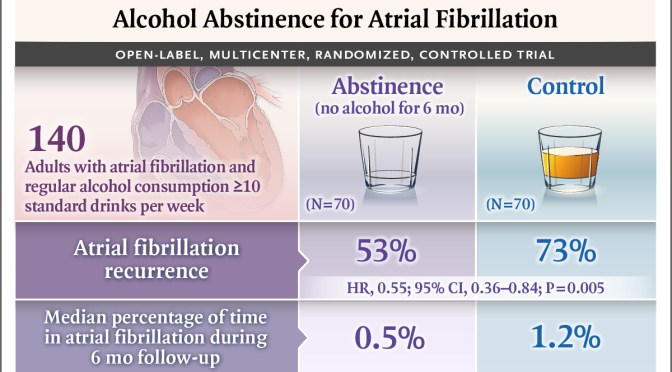
Abstinence from alcohol reduced arrhythmia recurrences in regular drinkers with atrial fibrillation.

January 2, 2020 Atrial fibrillation is the most common sustained arrhythmia,1 and alcohol is consumed by a majority of U.S. adults.2 The current study showed that among regular drinkers, a substantial reduction in alcohol consumption by patients with symptomatic atrial fibrillation was associated with a reduction in recurrence of atrial fibrillation and a reduced proportion of time spent in atrial fibrillation. Earlier meta-analyses showed that alcohol was associated with a dose-related increased risk of incident atrial fibrillation, with increased risk observed even among drinkers who consumed as few as 7 drinks per week.8 Current trends show a rise in alcohol consumption among adults older than 60 years of age,2coupled with greater prevalence of atrial fibrillation in this age group. The present study, with participants having an average intake of approximately 17 drinks per week at baseline, suggests that consumption at these levels may contribute to atrial fibrillation.

Profiles: 79-Year Old NBA Commissioner David Stern Has Died (1942-2020)
From an NBA.com online release:
“It was David Stern being a marketing genius who turned the league around. That’s why our brand is so strong,” said (Magic) Johnson, who announced he was retiring because of HIV in 1991 but returned the following year at the All-Star Game with Stern’s backing.
“It was David Stern who took this league worldwide.”
NEW YORK — David Stern, the basketball-loving lawyer who took the NBA around the world during 30 years as its longest-serving commissioner and oversaw its growth into a global powerhouse, died Wednesday. He was 77.
Stern suffered a brain hemorrhage on Dec. 12 and underwent emergency surgery. The league said he died with his wife, Dianne, and their family at his bedside.
Stern had been involved with the NBA for nearly two decades before he became its fourth commissioner on Feb. 1, 1984. By the time he left his position in 2014 — he wouldn’t say or let league staffers say “retire,” because he never stopped working — a league that fought for a foothold before him had grown to a more than $5 billion a year
industry and made NBA basketball perhaps the world’s most popular sport after soccer.
New Years Resolutions: “Stop Making Excuses Not To Exercise!!” (NY Times)
From a New York Times online article:
 At the moment, about two-thirds of Americans do not meet the standard exercise guidelines of about 30 minutes a day of moderate exercise, such as walking.
These findings might suggest that, if we adjusted our schedules and turned off the TV, phone or computer, most of us would have plenty of time to work out.
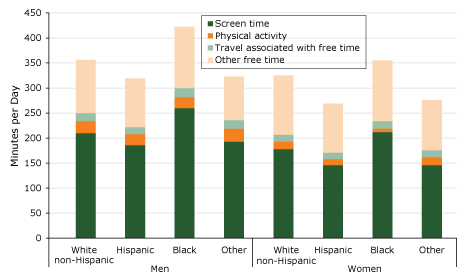
Almost all of the respondents — whatever their income, age, gender or ethnicity — reported about five hours a day of leisure time. Men tended to have more free time than women, older people more than the young, and African-American women the least of all. But no group reported less than about four and a half hours a day of free time.

Economics: A Review Of The U.S. Economy Over The Decade Of The 2010’s (PBS)
As the year comes to a close, we look back at the past decade in the American economy — the first without a recession since record-keeping began in the 1950s. While unemployment remains at a historic low, wage growth has been sluggish, and inequality continues to divide the country. David Wessel of the Brookings Institution and The Washington Post’s Catherine Rampell join Jeffrey Brown.

News: Susan Page And Domenico Montaro On “Politics Monday” (PBS)
USA Today’s Susan Page and Domenico Montanaro of NPR join Lisa Desjardins to discuss the latest political news, including the outlook for 2020 Democrats not making it to the debate stage, campaign dynamics in Iowa and New Hampshire, how senators running for president will handle a potential impeachment trial, House Speaker Nancy Pelosi’s impeachment strategy and the year in review.
 Boomers Daily