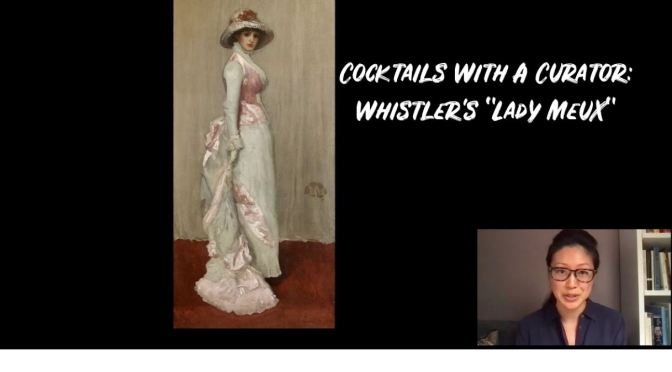
In this week’s episode of “Cocktails with a Curator,” Curator Aimee Ng explores the turbulent life of the woman portrayed in James McNeill Whistler’s serene “Harmony in Pink and Gray: Portrait of Lady Meux,” currently on view on the fourth floor of Frick Madison. A former bartender and actress, Lady Meux was shunned by London polite society even after she married Sir Henry Bruce Meux, heir to a huge brewery fortune. This week’s complementary cocktail is a refreshing Mummy, a nod to her extensive collection of some 1,800 Egyptian and Assyrian objects, including an infamous mummy of Nesmin.
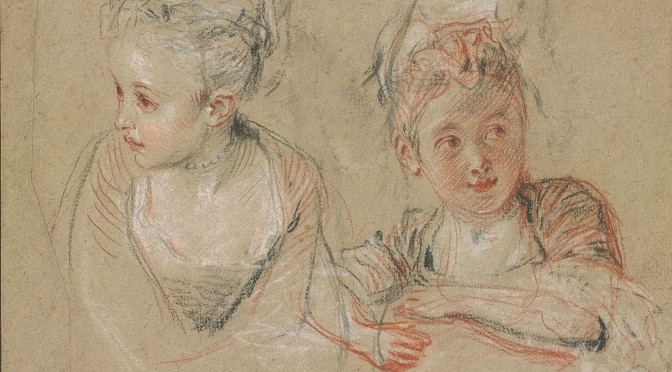
Director Colin B. Bailey takes a close look at three drawings by Jean-Antoine Watteau (1684–1721), considered some of the finest drawings in the Morgan’s collection: Seated Young Woman (ca. 1716), Young Woman Wearing a Chemise (ca. 1718), and Two Studies of the Head and Shoulders of a Little Girl.
British Airways i360 is a 162 m observation tower on the seafront of Brighton, East Sussex, England at the landward end of the remains of the West Pier. The tower opened on 4 August 2016. From the fully enclosed viewing pod, visitors experience 360-degree views across Brighton, the South Downs and the English Channel.
In this week’s episode of “Cocktails with a Curator,” Deputy Director and Peter Jay Sharp Chief Curator Xavier F. Salomon focuses on Francesco da Sangallo’s “St. John Baptizing,” which can be found at the very center of the third floor of Frick Madison. Commissioned in the 16th century for a church in the Tuscan town of Prato, the bronze statuette has been installed atop a facsimile of the marble holy water font on which it was originally displayed, allowing visitors to see it as it was meant to be viewed. This week’s complementary cocktail is the White Negroni, a modern twist on a classic Florentine cocktail.
In this week’s episode of “Cocktails with a Curator,” join Deputy Director and Peter Jay Sharp Chief Curator Xavier F. Salomon as he delves into the mystery of three rare Saint-Porchaire objects currently on view in a room featuring enamels and clocks on the third floor of Frick Madison. Much remains unknown about 16th-century Saint-Porchaire ware—exquisite pieces inlaid with colored clay and embellished with three-dimensional reliefs—but an ongoing Frick research project recently identified an exciting potential link between the great French ceramicist Bernard Palissy and a lizard on one of the ewers at the Frick. This week’s complementary cocktail is a classic French American drink, the Boulevardier.
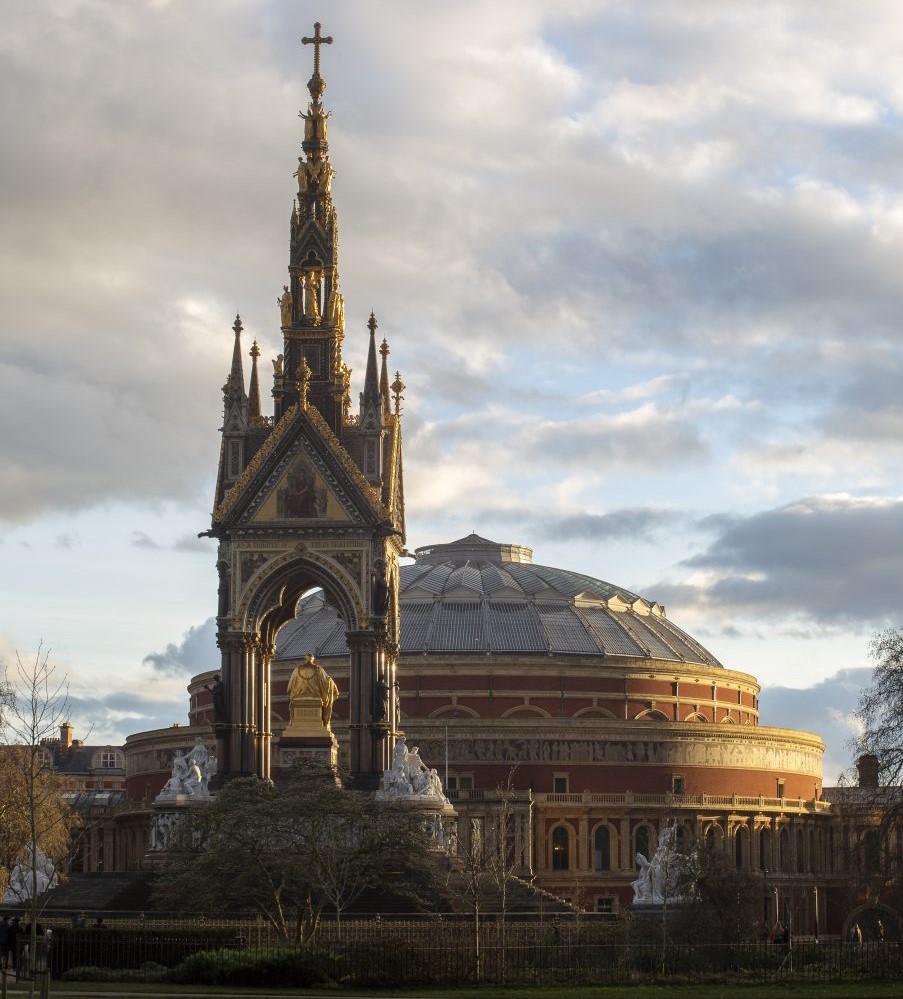
Over the 150 years that have passed since this opening, the Royal Albert Hall has established itself as one of the most important public venues in Britain, instantly recognisable as a backdrop to everything from the BBC Proms to comedy shows and from sporting events to theatre.
As described by Marcus Binney (COUNTRY LIFE, March 25, 1971) and The Survey of London, vol 38 (1975), the future Royal Albert Hall was one product of this initiative. The idea of building a music hall on the estate was first proposed in 1853, but, two years later, Prince Albert suggested something more ambitious: a music hall within an enclosing quadrangle of shops and flats inspired by the Palais Royale. He also directed that his exiled compatriot, Gottfried Semper, the architect of the Dresden opera house, design it.
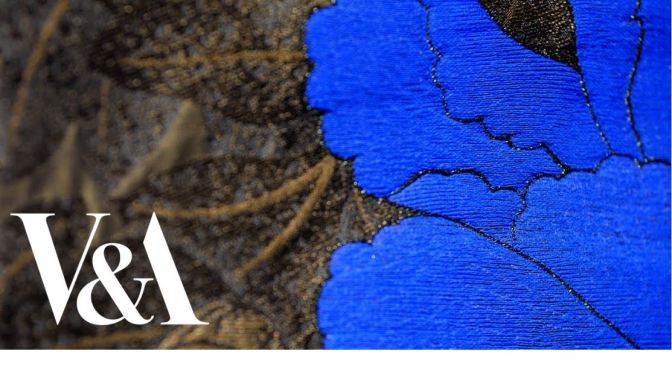
Nishijin-ori textiles are known for their exquisite detail, and have been made in the Nishijin area of Kyoto, Japan for over 1,200 years. Follow the intricate process involved in creating obi (the sash worn with traditional Japanese clothing), using a specialised technique called hikikaku – weaving with precious metallic thread. From the making of the thread itself, to the weaving on the loom, watch as three obis are made – one from 100-year-old silver foil, one from mother of pearl, and one from the semi-precious stone, lapis lazuli.
Processes: Silver foil obi: 1:26 Mother of pearl obi: 4:17 Lapis lazuli obi: 6:35
Originating in Heian-kyōto over 1200 years ago, Nishijin weaving is known for its highly-decorative and finely-woven designs, created through the use of tedious and specialised production processes. It is well-regarded for the high quality and craftsmanship of the resulting fabrics, commonly used for high-quality obi and kimono.
To outsiders, Turkmenistan is one of the world’s least known countries. For the first time in ten years, a film crew has been free to visit spectacular excavation sites and follow international researchers into areas that have long been off-limits. Once considered the poorest part of the Soviet Union, oil and natural gas have brought new wealth to Turkmenistan today.
A little known fact in the West is that 4,000 years ago, the country was home to one of the ancient world’s centers of power. Although it flourished around the same time as the advanced civilizations of Mesopotamia and Egypt, the Margiana empire was later largely forgotten. But recently, archaeologists have discovered palace buildings and magnificent burial treasures at the site of the capital, Gonur Depe, in the Karakum Desert. Incredible aerial photography shows the dimensions of the lost metropolis. An international team of researchers also unearthed monumental fortifications in neighboring Ulug Depe.
The ruined cities of Merv and Kunya-Urgench have been declared UNESCO World Heritage Sites. Suddenly, historians and the media are paying much more attention to Central Asia. Why has Turkmenistan seen powerful empires rise and fall since the Bronze Age? DNA analysis shows a highly mobile population, whose contacts reached as far as India, the Urals and the Mediterranean Sea. The Silk Road between China and Europe was the world’s most important trade route for thousands of years, lending Turkmenistan great historical significance. Since the fall of the Soviet Union, the country has been slowly opening up to international researchers, and its astounding cultural heritage is coming to light.
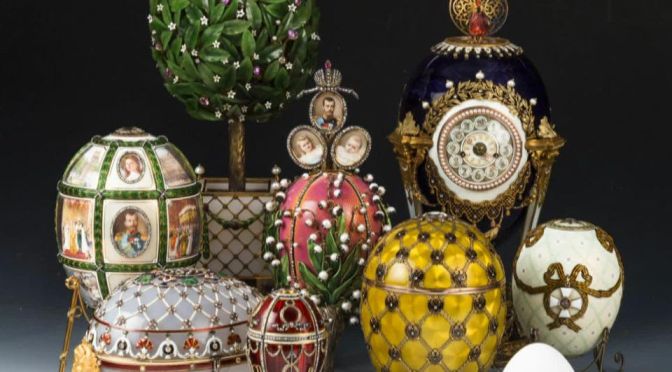
In the era of the Russian tsars, Peter Carl Fabergé’s jewel-studded objets d’art were a royal riff on a much humbler Easter tradition of ordinary folk giving each other colored hens’ eggs. Correspondent Elizabeth Palmer reports on the lore of Fabergé eggs, from opulent originals to sparkling counterfeits.
The celebrated series of 50 Imperial Easter eggs was created for the Russian Imperial family from 1885 to 1916 when the company was run by Peter Carl Fabergé. These creations are inextricably linked to the glory and tragic fate of the last Romanov family. They were the ultimate achievement of the renowned Russian jewellery house and must also be considered the last great commissions of objets d’art . Ten eggs were produced from 1885 to 1893, during the reign of Emperor Alexander III; 40 more were created during the rule of his dutiful son, Nicholas II, two each year, one for his mother, the dowager, the second for his wife.
This week we’re up on the hill of Montmartre, as we put the focus on a little-known, yet defining chapter of French history: the Paris Commune. Walking around the picturesque area today, there’s little trace of the chaotic and deadly scenes that played out here just 150 years ago: a brutal civil war that came hot on the heels of a deadly Prussian siege. We look back at the Paris Commune and explore its legacy today. We also hear from historian Ludivine Bantigny.
The Paris Commune was a revolutionary socialist government that controlled Paris from 18 March to 28 May 1871. During the events of the Franco-Prussian War, Paris had been defended by the National Guard, where working class radicalism grew among soldiers.
News, Views and Reviews For The Intellectually Curious








 Boomers Daily