

Responsive Elegance: How AI Is Rewriting the Code of Luxury Fashion
From Prada’s neural silhouettes to Hermès’ algorithmic resistance, a new aesthetic regime emerges—where beauty is no longer just crafted, but computed.
By Michael Cummins, Editor, August 18, 2025

The atelier no longer glows with candlelight, nor hums with the quiet labor of hand-stitching—it pulses with data. Fashion, once the domain of intuition, ritual, and artisanal mastery, is being reshaped by artificial intelligence. Algorithms now whisper what beauty should look like, trained not on muses but on millions of images, trends, and cultural signals. The designer’s sketchbook has become a neural network; the runway, a reflection of predictive modeling—beauty, now rendered in code.
This transformation is not speculative—it’s unfolding in real time. Prada has explored AI tools to remix archival silhouettes with contemporary streetwear aesthetics. Burberry uses machine learning to forecast regional preferences and tailor collections to cultural nuance. LVMH, the world’s largest luxury conglomerate, has declared AI a strategic infrastructure, integrating it across its seventy-five maisons to optimize supply chains, personalize client experiences, and assist in creative ideation. Meanwhile, Hermès resists the wave, preserving opacity, restraint, and human discretion.
At the heart of this shift are two interlocking innovations: generative design, where AI produces visual forms based on input parameters, and predictive styling, which anticipates consumer desires through data. Together, they mark a new aesthetic regime—responsive elegance—where beauty is calibrated to cultural mood and optimized for relevance.
But what is lost in this optimization? Can algorithmic chic retain the aura of the original? Does prediction flatten surprise?
Generative Design & Predictive Styling: Fashion’s New Operating System
Generative design and predictive styling are not mere tools—they are provocations. They challenge the very foundations of fashion’s creative process, shifting the locus of authorship from the human hand to the algorithmic eye.
Generative design uses neural networks and evolutionary algorithms to produce visual outputs based on input parameters. In fashion, this means feeding the machine with data: historical collections, regional aesthetics, streetwear archives, and abstract mood descriptors. The algorithm then generates design options that reflect emergent patterns and cultural resonance.
Prada, known for its intellectual rigor, has experimented with such approaches. Analysts at Business of Fashion note that AI-driven archival remixing allows Prada to analyze past collections and filter them through contemporary preference data, producing silhouettes that feel both nostalgic and hyper-contemporary. A 1990s-inspired line recently drew on East Asian streetwear influences, creating garments that seemed to arrive from both memory and futurity at once.
Predictive styling, meanwhile, anticipates consumer desires by analyzing social media sentiment, purchasing behavior, influencer trends, and regional aesthetics. Burberry employs such tools to refine color palettes and silhouettes by geography: muted earth tones for Scandinavian markets, tailored minimalism for East Asian consumers. As Burberry’s Chief Digital Officer Rachel Waller told Vogue Business, “AI lets us listen to what customers are already telling us in ways no survey could capture.”
A McKinsey & Company 2024 report concluded:
“Generative AI is not just automation—it’s augmentation. It gives creatives the tools to experiment faster, freeing them to focus on what only humans can do.”
Yet this feedback loop—designing for what is already emerging—raises philosophical questions. Does prediction flatten originality? If fashion becomes a mirror of desire, does it lose its capacity to provoke?
Walter Benjamin, in The Work of Art in the Age of Mechanical Reproduction (1936), warned that mechanical replication erodes the ‘aura’—the singular presence of an artwork in time and space. In AI fashion, the aura is not lost—it is simulated, curated, and reassembled from data. The designer becomes less an originator than a selector of algorithmic possibility.
Still, there is poetry in this logic. Responsive elegance reflects the zeitgeist, translating cultural mood into material form. It is a mirror of collective desire, shaped by both human intuition and machine cognition. The challenge is to ensure that this beauty remains not only relevant—but resonant.
LVMH vs. Hermès: Two Philosophies of Luxury in the Algorithmic Age
The tension between responsive elegance and timeless restraint is embodied in the divergent strategies of LVMH and Hermès—two titans of luxury, each offering a distinct vision of beauty in the age of AI.
LVMH has embraced artificial intelligence as strategic infrastructure. In 2023, it announced a deep partnership with Google Cloud, creating a sophisticated platform that integrates AI across its seventy-five maisons. Louis Vuitton uses generative design to remix archival motifs with trend data. Sephora curates personalized product bundles through machine learning. Dom Pérignon experiments with immersive digital storytelling and packaging design based on cultural sentiment.
Franck Le Moal, LVMH’s Chief Information Officer, describes the conglomerate’s approach as “weaving together data and AI that connects the digital and store experiences, all while being seamless and invisible.” The goal is not automation for its own sake, but augmentation of the luxury experience—empowering client advisors, deepening emotional resonance, and enhancing agility.
As Forbes observed in 2024:
“LVMH sees the AI challenge for luxury not as a technological one, but as a human one. The brands prosper on authenticity and person-to-person connection. Irresponsible use of GenAI can threaten that.”
Hermès, by contrast, resists the algorithmic tide. Its brand strategy is built on restraint, consistency, and long-term value. Hermès avoids e-commerce for many products, limits advertising, and maintains a deliberately opaque supply chain. While it uses AI for logistics and internal operations, it does not foreground AI in client experiences. Its mystique depends on human discretion, not algorithmic prediction.
As Chaotropy’s Luxury Analysis 2025 put it:
“Hermès is not only immune to the coming tsunami of technological innovation—it may benefit from it. In an era of automation, scarcity and craftsmanship become more desirable.”
These two models reflect deeper aesthetic divides. LVMH offers responsive elegance—beauty that adapts to us. Hermès offers elusive beauty—beauty that asks us to adapt to it. One is immersive, scalable, and optimized; the other opaque, ritualistic, and human-centered.
When Machines Dream in Silk: Speculative Futures of AI Luxury
If today’s AI fashion is co-authored, tomorrow’s may be autonomous. As generative design and predictive styling evolve, we inch closer to a future where products are not just assisted by AI—but entirely designed by it.
Louis Vuitton’s “Sentiment Handbag” scrapes global sentiment to reflect the emotional climate of the world. Iridescent textures for optimism, protective silhouettes for anxiety. Fashion becomes emotional cartography.
Sephora’s “AI Skin Atlas” tailors skincare to micro-geographies and genetic lineages. Packaging, scent, and texture resonate with local rituals and biological needs.
Dom Pérignon’s “Algorithmic Vintage” blends champagne based on predictive modeling of soil, weather, and taste profiles. Terroir meets tensor flow.
TAG Heuer’s Smart-AI Timepiece adapts its face to your stress levels and calendar. A watch that doesn’t just tell time—it tells mood.
Bulgari’s AR-enhanced jewelry refracts algorithmic lightplay through centuries of tradition. Heritage collapses into spectacle.
These speculative products reflect a future where responsive elegance becomes autonomous elegance. Designers may become philosopher-curators—stewards of sensibility, shaping not just what the machine sees, but what it dares to feel.
Yet ethical concerns loom. A 2025 study by Amity University warned:
“AI-generated aesthetics challenge traditional modes of design expression and raise unresolved questions about authorship, originality, and cultural integrity.”
To address these risks, the proposed F.A.S.H.I.O.N. AI Ethics Framework suggests principles like Fair Credit, Authentic Context, and Human-Centric Design. These frameworks aim to preserve dignity in design, ensuring that beauty remains not just a product of data, but a reflection of cultural care.
The Algorithm in the Boutique: Two Journeys, Two Futures
In 2030, a woman enters the Louis Vuitton flagship on the Champs-Élysées. The store AI recognizes her walk, gestures, and biometric stress markers. Her past purchases, Instagram aesthetic, and travel itineraries have been quietly parsed. She’s shown a handbag designed for her demographic cluster—and a speculative “future bag” generated from global sentiment. Augmented reality mirrors shift its hue based on fashion chatter.
Across town, a man steps into Hermès on Rue du Faubourg Saint-Honoré. No AI overlay. No predictive styling. He waits while a human advisor retrieves three options from the back room. Scarcity is preserved. Opacity enforced. Beauty demands patience, loyalty, and reverence.
Responsive elegance personalizes. Timeless restraint universalizes. One anticipates. The other withholds.
Ethical Horizons: Data, Desire, and Dignity
As AI saturates luxury, the ethical stakes grow sharper:
Privacy or Surveillance? Luxury thrives on intimacy, but when biometric and behavioral data feed design, where is the line between service and intrusion? A handbag tailored to your mood may delight—but what if that mood was inferred from stress markers you didn’t consent to share?
Cultural Reverence or Algorithmic Appropriation? Algorithms trained on global aesthetics may inadvertently exploit indigenous or marginalized designs without context or consent. This risk echoes past critiques of fast fashion—but now at algorithmic speed, and with the veneer of personalization.
Crafted Scarcity or Generative Excess? Hermès’ commitment to craft-based scarcity stands in contrast to AI’s generative abundance. What happens to luxury when it becomes infinitely reproducible? Does the aura of exclusivity dissolve when beauty is just another output stream?
Philosopher Byung-Chul Han, in The Transparency Society (2012), warns:
“When everything is transparent, nothing is erotic.”
Han’s critique of transparency culture reminds us that the erotic—the mysterious, the withheld—is eroded by algorithmic exposure. In luxury, opacity is not inefficiency—it is seduction. The challenge for fashion is to preserve mystery in an age that demands metrics.
Fashion’s New Frontier
Fashion has always been a mirror of its time. In the age of artificial intelligence, that mirror becomes a sensor—reading cultural mood, forecasting desire, and generating beauty optimized for relevance. Generative design and predictive styling are not just innovations; they are provocations. They reconfigure creativity, decentralize authorship, and introduce a new aesthetic logic.
Yet as fashion becomes increasingly responsive, it risks losing its capacity for rupture—for the unexpected, the irrational, the sublime. When beauty is calibrated to what is already emerging, it may cease to surprise. The algorithm designs for resonance, not resistance. It reflects desire, but does it provoke it?
The contrast between LVMH and Hermès reveals two futures. One immersive, scalable, and optimized; the other opaque, ritualistic, and elusive. These are not just business strategies—they are aesthetic philosophies. They ask us to choose between relevance and reverence, between immediacy and depth.
As AI evolves, fashion must ask deeper questions. Can responsive elegance coexist with emotional gravity? Can algorithmic chic retain the aura of the original? Will future designers be curators of machine imagination—or custodians of human mystery?
Perhaps the most urgent question is not what AI can do, but what it should be allowed to shape. Should it design garments that reflect our moods, or challenge them? Should it optimize beauty for engagement, or preserve it as a site of contemplation? In a world increasingly governed by prediction, the most radical gesture may be to remain unpredictable.
The future of fashion may lie in hybrid forms—where machine cognition enhances human intuition, and where data-driven relevance coexists with poetic restraint. Designers may become philosophers of form, guiding algorithms not toward efficiency, but toward meaning.
In this new frontier, fashion is no longer just what we wear. It is how we think, how we feel, how we respond to a world in flux. And in that response—whether crafted by hand or generated by code—beauty must remain not only timely, but timeless. Not only visible, but visceral. Not only predicted, but profoundly imagined.
THIS ESSAY WAS WRITTEN AND EDITED UTILIZING AI






 Alexander Vreeland, grandson of fashion journalist Diana Vreeland, tells us about his new book, ‘Bon Mots: Words of Wisdom from the Empress of Fashion’.
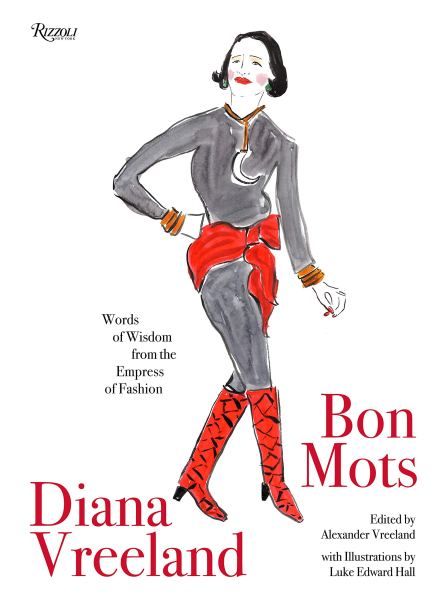 Diana Vreeland’s insightful edicts and evocative aphorisms remain her strongest legacy. She looked at life as a romantic and lived through dreams and imagination. Showing leadership, vision, and timeless wit, this book celebrates her visionary words that not only transformed the world of fashion, but also gave us sage advice to live by.
 Boomers Daily