From an Architectural Digest online article (March 14, 2020):
“Tangier is the crossroads of so many civilizations,” says AD100 talent Frank de Biasi of the evocative Moroccan port city that he and his partner, the multifaceted designer Gene Meyer, have made their home. “There’s a central energy here,” he explains, “where the Atlantic meets the Mediterranean, where Europe meets Africa. It’s a psychic point like no other place.”
Many of the traditional houses here, however, have a claustrophobic lack of light, so when the couple found a ruinous place on a little open square, with exposures on three sides, they knew they could make it their own. Their renovation ultimately took four years as they rebuilt paper-thin walls, replaced a life-threateningly vertiginous staircase with one inspired by the Old Fort Bay clubhouse in the Bahamas, and installed a light-well based on one de Biasi had seen in India and such mod cons as under-floor heating.
In 1928 Maruni Wood Industry was born out of a fascination with the masterful carpentry in ancient shrines. Today its furniture is found in the Californian headquarters of Apple as well as airport lounges, galleries and restaurants around the world. We meet the company’s president to talk about the challenges of managing a family-run business.
Pioneering the industrial application of craft skills following establishment of the company in 1928
.
From building structures such as Buddhist temples and Shinto shrines through to private dwellings and the tools that we use in our everyday lives, Japan is a nation that has for many centuries cultivated traditions based on wood that occupy an important position in our daily lives. Takeo Yamanaka, the founder of Maruni Wood Industry, spent his childhood at Miyajima in Hiroshima Prefecture, a place that has a rich heritage of traditional crafts based on the use of wood.
…a team of designers recently looked at the now-ruined castles of Middle Ages Europe, lifting the fortifications up from their dilapidated states and digitally reimagining the structures as they were in their heyday.
Seven European castles were virtually rebuilt, restoring them from their keeps to their baileys. Architects pored over old paintings, blueprints, and other research documents that describe the strongholds, then offered their opinions to the NeoMam Studios design team, which digitally revived the structures from the ground up.
From a Gentleman’s Journal article (March 26, 2020):
Studio 54. You had to be there. And even if you were, you’d scarcely believe it. Studio 54! The club that changed nightlife forever, where the crowds were so big they had to call in the fire brigade, where the brightest stars of the 1970s — Michael Jackson, Mick Jagger, Debbie Harry, Grace Jones and Andy Warhol, to name a handful …
Schrager and Rubell achieved an all-American comeback. The duo stormed back into Nightworld with Palladium, another runaway hit of a club, and Morgans, their first hotel. “It took off like a bat out of hell,” Schrager says. (One of his favorite memories of opening day is Andy Warhol with his nose pushed up against the window, waiting anxiously for the door to open.)
Morgans, and then the Royalton, followed by the Paramount, were the boutique hotels that invented the boutique hotel — a design and business paradigm that has thousands of imitators today.
Ian Schrager (born July 19, 1946) is an American entrepreneur, hotelier and real estate developer, often associated with co-creating the “boutique hotel” category of accommodation. Originally, he gained fame as co-owner and co-founder of Studio 54.
100 years ago the brothers Adolf (“Adi”) and Rudolf Dassler made their first pair of sports shoes. Hundreds of groundbreaking designs, epic moments, and star-studded collabs later, this book presents the first visual review of the adidas shoe through more than 350 models including never-before-seen prototypes and one-of-a-kind originals.
To further develop and tailor his products to athletes’ specific needs, Dassler asked them to return their worn footwear when no longer needed, with all the shoes eventually ending up in his attic (to this day, many athletes return their shoes to adidas, often as a thank you after winning a title or breaking a world record). This collection now makes up the “adidas archive”, one of the largest, if not the largest archive of any sports goods manufacturer in the world—which photographers Christian Habermeier and Sebastian Jäger have been visually documenting in extreme detail for years.
Shot using the highest reproduction techniques, these images reveal the fine details as much as the stains, the tears, the repair tape, the grass smudges, the faded autographs. It’s all here, unmanipulated and captured in extremely high resolution—and with it comes to light the personal stories of each individual wearer. We encounter the shoes worn by West Germany’s football team during its “miraculous” 1954 World Cup win and those worn by Kathrine Switzer when she ran the Boston Marathon in 1967, before women were officially allowed to compete; custom models for stars from Madonna to Lionel Messi; collabs with the likes of Kanye West, Pharrell Williams, Raf Simons, Stella McCartney, Parley for the Oceans or Yohji Yamamoto; as well as the brand’s trailblazing techniques and materials, like its pioneering use of plastic waste that is intercepted from beaches and coastal communities.
Accompanied by a foreword by designer Jacques Chassaing and expert texts, each picture tells us the why and the how, but also conveys the driving force behind adidas. What we discover goes beyond mere design; in the end, these are just shoes, worn out by their users who have loved them—but they are also first-hand witnesses of our sports, design, and culture history, from the beginnings of the Dassler brothers and the founding of adidas until today.
Concept and photography by
Christian Habermeierhas been working as a photographer and designer since 1989. He taught communication design and has taught photography and digital illustration from 2000 to 2006. His own projects span from Cuba, Kenya, Nepal, India, Switzerland, to Hong Kong. In 2000 he founded studio waldeck photographers and was able to realize his long cherished vision of a CO2-neutral studio in 2013.
Sebastian Jägerstudied design at the Georg-Simon-Ohm University of Applied Sciences in Nuremberg, focusing on moving images and photography, where he met former lecturer Christian Habermeier in 2005. Their joint company studio waldeck photographers serves customers from industry and the cultural sector. Since 2011, they have been creating a visual record of the holdings of the historical adidas archive.
In a leafy Boston suburb, a place to park cars and repair vintage scooters grows into a bucolic sanctuary.
.
To call architect Colin Flavin’s three-story steel-frame structure with mahogany slat screens a “garage” would be misleading. While there’s room for parking and a Vespa workshop behind the double-wide red door on the ground floor, the spaces above feel and function more like a country retreat. “The clients wanted something innovative to complement their traditional Dutch Colonial,” says Flavin, principal of Flavin Architects.
From Daikanyama Tsutaya Books in Tokyo to Kosmos Buchsalon in Zurich, Do You Read Me? travels the globe to discover these gems and some of the people behind them, who turn an ordinary trip to the bookstore into an extraordinary experience.
Bookstores are more than just places that sell books. They are focal points of communities, a warm welcome to a city, a place for first-time visitors and longtime residents alike to gather in a shared love of the written word. They are places where time moves a little slower, where customers can get lost in the pages of a book, or enjoy readings, concerts, and events that bring together like-minded individuals with a thirst for knowledge.
Each bookstore is as unique as the diverse customers who frequent them. There are the secret ones tucked away with stacks reaching floor to ceiling; there are minimalist concept stores; there are dazzling book temples. There are ones in apartments, on boats, and in Gothic cathedrals.
Travel writer Marianne Julia Strauss has scoured the globe for the past decade in search of the top bookstores. In Do You Read Me? she has collected a selection of the ones you need to include in your next itinerary.
Underappreciated in her lifetime, the career of late Irish architect and designer Eileen Gray is the subject of a timely new exhibition at The Bard Graduate Center Gallery in New York. Jennifer Goff, curator of the Eileen Gray collection at the National Museum of Ireland, tells us more.
Eileen Gray (born Kathleen Eileen Moray Smith; 9 August 1878 – 31 October 1976) was an Irish architect and furniture designer and a pioneer of the Modern Movement in architecture. Over her career, she was associated with many notable European artists of her era, including Kathleen Scott, Adrienne Gorska, Le Corbusier, and Jean Badovici, with whom she was romantically involved. Her most famous work is the house known as E-1027 in Roquebrune-Cap-Martin, France.
From 1922/1923 to 1926 Gray created an informal architectural apprenticeship for herself as she never received any formal training as an architect. She studied theoretical and technical books, took drafting lessons, and arranged to have Adrienne Gorska take her along to building sites. She also traveled with Badovici to study key buildings and learned by reworking architectural designs.
In 1926, she started work on a new holiday home near Monaco to share with Badovici. Because a foreigner in France couldn’t wholly own property, Gray bought the land and put it in Badovici’s name, making him her client on paper. Construction of the house took three years and Gray remained on site while Badovici visited occasionally.
Renewed interest in Gray’s work began in 1967 when historian Joseph Rykwert published an essay about her in the Italian design magazine Domus. After the publishing of the article many “students began to ring at her door” as eager to learn from the now famous designer.
At a Paris auction of 1972, Yves Saint Laurent bought ‘Le Destin’ and revived interest in Gray’s career.
The first retrospective exhibition of her work, titled ‘Eileen Gray: Pioneer of Design’, was held in London in 1972. A Dublin exhibition followed the next year. At the Dublin exhibit, the 95 year old Gray was given an honorary fellowship by the Royal Institute of the Architects of Ireland.
In 1973 Gray signed a contract to reproduce the Bibendum chair and many of her pieces for the first time. They remain in production.
Eileen Gray died on Halloween 1976. She is buried in the Père Lachaise cemetery in Paris, but because her family omitted to pay the licence fee her grave is not identifiable.
The Architizer A+Awards represent 2019’s best architecture and products, celebrated by a diverse group of influencers within and outside the architectural community. Entries are judged by more than 400 luminaries from fields as diverse as fashion, publishing, product design, real-estate development, and technology, and voted on by the public, culminating in a collection of the world’s finest buildings.
Each year, winners are honored in this fully illustrated compendium, and on Architizer.com, the largest online architecture community on the planet. Featuring select A+Award winners, this is the definitive guide to the year’s best buildings and spaces.
Architizer is the leading online resource for architecture. Through its vast building database, daily content, ‘Source’ marketplace, and A+Awards, it is revolutionizing the way architects connect with building-product manufacturers and the world beyond.
“After 96 years on this earth, Yona has moved up to build a Spatial City and install some Space Chains in the sky. The Fonds de Dotation Denise and Yona Friedman, which he founded last year, will continue his work.”
From an Instagram post (02/21/20)
Yona Friedman (5 June 1923 – 21 February 2020) was a Hungarian-born French architect, urban planner and designer. He was influential in the late 1950s and early 1960s, best known for his theory of mobile architecture.
In 1958, Yona Friedman published his first manifesto : “Mobile architecture”. It described a new kind of mobility not of the buildings, but for the inhabitants, who are given a new freedom.
Mobile architecture is the “dwelling decided on by the occupant” by way of “infrastructures that are neither determined nor determining”. Mobile architecture embodies an architecture available for a “mobile society”. To deal with it, the classical architect invented “the Average Man”. The projects of architects in the 1950s were undertaken, according to Friedman, to meet the needs of this make-believe entity, and not as an attempt to meet the needs of the actual members of this mobile society.
The teaching of architecture was largely responsible for the “classical” architect’s under-estimation of the role of the user. Furthermore, this teaching did not embrace any real theory of architecture. Friedman proposed then teaching manuals for the fundamentals of architecture for the general public.
The spatial city, which is a materialization of this theory, makes it possible for everyone to develop his or her own hypothesis. This is why, in the mobile city, buildings should :
touch the ground over a minimum area
be capable of being dismantled and moved
and be alterable as required by the individual occupant.
The Spatial City is the most significant application of “mobile architecture”. It is raised up on piles which contains inhabited volumes, fitted inside some of the “voids”, alternating with other unused volumes, making it look aesthetically pleasant. The basis of its design is that of trihedral elements which operate as “neighbourhoods” where dwellings are distributed without a price.
This structure introduces a kind of merger between countryside and city (compare to Paolo Soleri’s Arcology concept) and may span:
certain unavailable sites,
areas where building is not possible or permitted (expanses of water, marshland),
areas that have already been built upon (an existing city),
above farmland.
This spanning technique which includes container structures ushers in a new development in town-planning. Raised plans increase the original area of the city becoming three-dimensional. The tiering of the spatial city on several independent levels, one on top of the other, determines “spatial town-planning” both from the functional and from the aesthetic viewpoint. The lower level may be earmarked for public life and for premises designed for community services as well as pedestrian areas. The piles contain the vertical means of transport (lifts, staircases). The superposition of levels should make it possible to build a whole industrial city, or a residential or commercial city, on the same site. In this way, the Spatial City forms what Yona Friedman would call an “artificial topography”. This grid suspended in space outlines a new cartography of the terrain with the help of a continuous and indeterminate homogeneous network with a major positive outcome: this modular grid would authorize the limitless growth of the city.
The spaces in this grid are rectangular and habitable modular “voids”, with an average area of 25–35 square meters. Conversely, the form of the volumes included within the grid depends solely on the occupant, and their configuration set with a “Flatwriter” in the grid is completely free. Only one half of the spatial city would be occupied. The “fillings” which correspond to the dwellings only actually take up 50% of the three-dimensional lattice, permitting the light to spread freely in the spatial city. This introduction of elements on a three-dimensional grid with several levels on piles permits a changeable occupancy of the space by means of the convertibility of the forms and their adaptation to multiple uses.
In Yona Friedman’s own words “The city, as a mechanism, is thus nothing other than a labyrinth : a configuration of points of departure, and terminal points, separated by obstacles”.


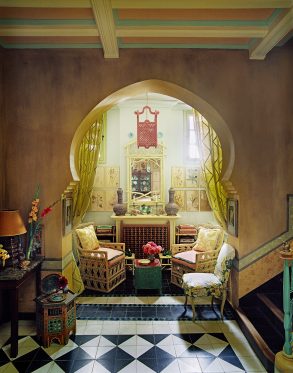 “Tangier is the crossroads of so many civilizations,” says AD100 talent Frank de Biasi of the evocative Moroccan port city that he and his partner, the multifaceted designer Gene Meyer, have made their home. “There’s a central energy here,” he explains, “where the Atlantic meets the Mediterranean, where Europe meets Africa. It’s a psychic point like no other place.”
 In 1928 Maruni Wood Industry was born out of a fascination with the masterful carpentry in ancient shrines. Today its furniture is found in the Californian headquarters of Apple as well as airport lounges, galleries and restaurants around the world. We meet the company’s president to talk about the challenges of managing a family-run business.



 Studio 54. You had to be there. And even if you were, you’d scarcely believe it. Studio 54! The club that changed nightlife forever, where the crowds were so big they had to call in the fire brigade, where the brightest stars of the 1970s — Michael Jackson, Mick Jagger, Debbie Harry, Grace Jones and Andy Warhol, to name a handful …

 thank you after winning a title or breaking a world record). This collection now makes up the “adidas archive”, one of the largest, if not the largest archive of any sports goods manufacturer in the world—which photographers Christian Habermeier and Sebastian Jäger have been visually documenting in extreme detail for years.


 In a leafy Boston suburb, a place to park cars and repair vintage scooters grows into a bucolic sanctuary.
 From Daikanyama Tsutaya Books in Tokyo to Kosmos Buchsalon in Zurich, Do You Read Me? travels the globe to discover these gems and some of the people behind them, who turn an ordinary trip to the bookstore into an extraordinary experience.
 Underappreciated in her lifetime, the career of late Irish architect and designer Eileen Gray is the subject of a timely new exhibition at The Bard Graduate Center Gallery in New York. Jennifer Goff, curator of the Eileen Gray collection at the National Museum of Ireland, tells us more.

 The Architizer A+Awards represent 2019’s best architecture and products, celebrated by a diverse group of influencers within and outside the architectural community. Entries are judged by more than 400 luminaries from fields as diverse as fashion, publishing, product design, real-estate development, and technology, and voted on by the public, culminating in a collection of the world’s finest buildings.


 Boomers Daily