
A selection of three essential articles read aloud from the latest issue of The Economist. This week, why the Democrats need to wake up and stop pandering to their extremes, Europe’s winter of discontent (9:50), and why bottling white wine in clear glass is an error (18:09).
Category Archives: Analysis
Opinion: Britain’s Perilous State, The Tik Tok Threat, Trumpism’s New DC Army
A selection of three essential articles read aloud from the latest issue of The Economist. This week, why Britain is in a dangerous state, why the world’s most exciting app is also its most mistrusted (10:49), and Trumpism’s new Washington army (18:38).
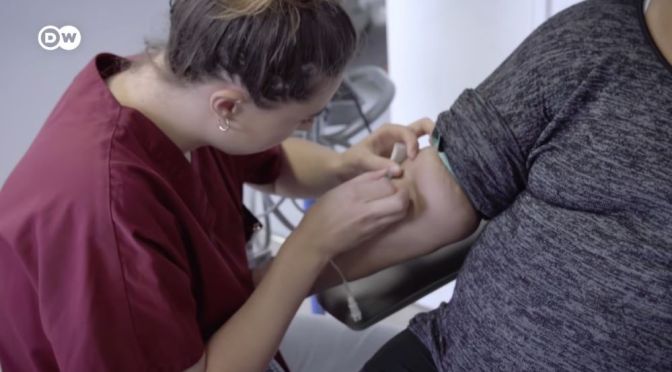
Insights: The Lucrative Business Of Diabetes (2022)
In our modern consumer society, Type 2 diabetes has become a widespread disease. Companies are developing drugs that are increasingly expensive, but not necessarily more effective. Health authorities are powerless. Diabetes is spreading rapidly, all over the world. The disease destroys lives and puts a strain on public budgets.
The UN is calling on governments to take action. Diabetes is proof that modern societies are incapable of adequately treating chronic disease. It affects around 430 million people worldwide, with two main metabolic disorders falling under the name diabetes. Type 1 is an autoimmune disease that must be treated with lifelong doses of insulin, while type 2 can develop when a person’s diet is too high in fat and sugar and they do not engage in enough physical activity.
With turnover of $46 billion, diabetes is a massive and extremely lucrative market. Constantly promised miracle cures have not led to satisfactory treatment, with patients either taking too many drugs or no longer being able to afford them. It’s a desperate situation, and the only ones benefiting seem to be pharmaceutical companies. A medical focus on blood glucose levels has led to an overreliance on medication, sometimes without due concern for dangerous side effects.
Patients become trapped in a cycle of treatment, which in many cases still does not halt the disease’s progression. This can lead to amputations, blindness and heart attacks. And yet there are alternatives that could flatten the curve of the type 2 diabetes epidemic, while reducing health care spending. Improved diet can be a preventative measure, and a strict adherence to diet can also bring about remission in the case of Type 2 diabetes.
But these solutions require effort, as well as a complete rethinking of chronic disease management. Filmed on three continents, this documentary features industry whistleblowers, patients, researchers and medical professionals. It also confronts pharmaceutical companies about their responsibility for the situation.

Museum Insider: ‘Caligula’ Marble Bust’s True Colors
Archaeologists Vinzenz and Ulrike Koch Brinkmann have spent the last 40 years dedicated to the study of polychromy—or “many colors” in Greek—in ancient sculpture. Once a fringe area of study, their research combats the misconception of white purity in ancient Greece and Rome. They reflect on the marble bust of Caligula and how the reconstruction of its former color can help us better understand history.
Explore more perspectives on Caligula: https://www.metmuseum.org/perspective…
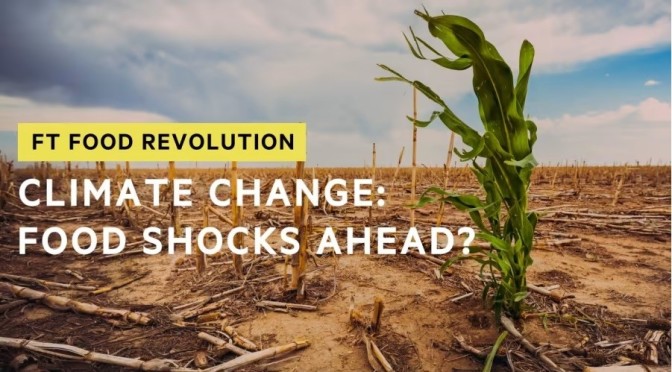
Climate Change: A World Of Future Food Shocks?
Recent crises such as the pandemic and Russia’s invasion of Ukraine have thrown the vulnerability of supply chains, and with them, food supplies, into sharp focus. But as the FT’s Camilla Hodgson reports, a landmark UN report says climate-related shocks such as extreme weather events will become more common and severe and could further upend food supply chains. But what can we do about it?
Opinions: Globalization Remade, Latin America Mired, Battle Tank Fix
A selection of three essential articles read aloud from the latest issue of The Economist. This week, the remaking of globalisation, Latin America’s vicious circle (9:55), and does the tank have a future? (17:55).
Opinions: New Frontier For AI, British Stagnation, Story Scene Imagination
A selection of three essential articles read aloud from the latest issue of The Economist. This week, why foundation models are artificial intelligence’s new frontier, the stagnation nation: a chronic British disease (10:30), and why visiting the scenes of stories is an act of imagination (18:20).
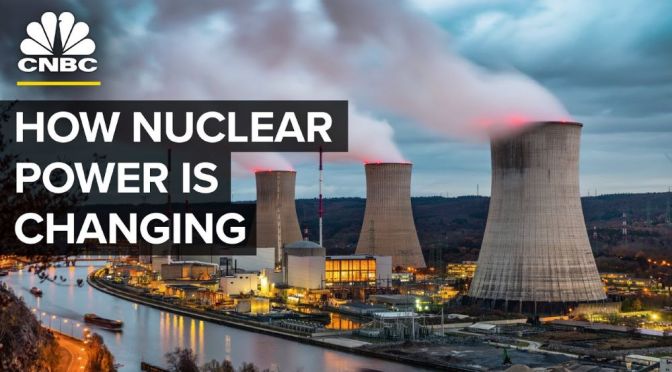
Analysis: How Nuclear Power Is Changing (CNBC)
For some, nuclear power may conjure images of mushroom clouds or bring back memories of disturbing nuclear disasters like Chernobyle and Fukushima. But despite public fear around nuclear power, the technology has proved to be an emission-free, reliable way to produce large amounts of electricity on a small footprint.
As a result, sentiments about the technology are beginning to change. Both the U.S. government and private companies including X Energy, NuScale and, Bill Gates-backed, TerraPower are pouring money into developing, what they say will be smaller, safer nuclear reactors. CNBC visited Idaho National Laboratory to see the Marvel microreactor firsthand and learn what such developments could mean for the future of nuclear power.
After humankind discovered nuclear fission, the first applied use was the atomic bomb. The study of fission for electricity production came later. In December 1953, President Dwight D. Eisenhower gave his fateful Atoms for Peace speech, an impassioned plea to reconstitute the power of the atomic bombs dropped in World War II for a more noble cause.
“Against the dark background of the atomic bomb, the United States does not wish merely to present strength, but also the desire and the hope for peace,” Eisenhower told the United Nations. Almost 70 years later, the tension between those end uses still underlies the space today. From the 1950s through the 1970s, the United States dramatically increased its nuclear energy generation.
But the Three Mile Island accident in 1979 and Chornobyl meltdown in 1986 changed the landscape, spurring fear that nuclear energy could not be controlled safely. Since the 1980s, nuclear energy capacity and generation in the U.S. has largely stayed flat. Today, the country’s fleet of nuclear power reactors produces only 19% of the country’s electricity, according to the government’s Energy Information Administration.
In more recent times, the Fukushima Daiichi accident in Japan in 2011 — and earlier this year the capture of nuclear power plants in Ukraine by invading Russian forces — have added to public concerns. But despite its fraught origin story and the psychological effect of high-profile accidents, nuclear energy is getting a second look. That’s largely because nuclear energy is clean energy, releasing no greenhouse gasses.
Meanwhile, the world is seeing more of the effects of climate change, including rising global temperatures, increased pollution, wildfires, and more intense and deadly storms. “We need to change course — now — and end our senseless and suicidal war against nature,” Antonio Guterres, the secretary-general of the United Nations, said in Stockholm on Thursday. “There is one thing that threatens all our progress. The climate crisis. Unless we act now, we will not have a livable planet,” Guterres said. “Scientists recently reported that there is a 50-50 chance that we could temporarily breach the Paris Agreement limit of 1.5 degrees Celsius in the next five years.”
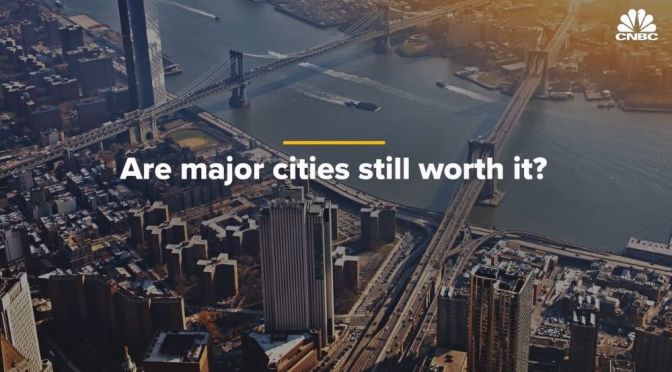
Urban Living: Are U.S. Big Cities Still Worth It?
A cost-of-living crisis is unfolding in U.S. major cities. Inflation data shows that costs for items such as rent and groceries are increasing quickly across the Sun Belt and coastal superstar cities. Now years removed from the darkest days of the pandemic, people are asking: Is a return to the city worth it?
Metropolitan regions have sprawled in recent years, raising budget concerns and quality-of-life issues for the people who remain downtown. Meanwhile the absence of commuters is slowing the recovery in leisure and hospitality. Many renters believe that a cost-of-living crisis is brewing in America’s major cities.
New York City is showing up as a hotspot of rent inflation. The average rent for 1-bedroom apartments in Manhattan rose to $3,995 a month in May 2022 — a 41% increase from one year ago, according to Zumper. Sudden, double-digit rent spikes are hitting other hubs, including Chicago, Los Angeles, and Austin, Texas. Zumper data shows that growth is particularly strong in Sun Belt cities such as Miami, where rents have risen to $2,700 a month in May 2022, a 64% increase from a year prior. During the pandemic, workers left the largest U.S. cities.
Two years in, renters have returned but many commuters haven’t as companies negotiate the particulars of a return to the office. Public officials are concerned about lagging transit ridership in cities such as New York. Ed Glaeser, an economist at Harvard University, says cities are becoming more important — not less — in the age of remote work. “When you Zoom to work, you miss the opportunity to watch the people who are older, to watch what they’ve done and to learn from them,” he told CNBC in an interview.
But for renters, a return to increasingly expensive cities might seem like a raw deal, especially if they can do their jobs from home. Researchers say remote work limits firms’ ability to train new workers. Data produced by Microsoft’s workforce suggests that it is more difficult to share in-depth information remotely, which can produce silos within companies’ rank and file.
“A lot of these tech companies, they’re saying you can work remotely,” said Andra Ghent, a professor of finance at the University of Utah. “But, you know, in many cases, they’re also saying, like, we’re not going to pay you quite the same amount.” Many renters believe that a cost-of-living crisis is brewing in America’s major cities. New York City is showing up as a hotspot of rent inflation. The average rent for 1-bedroom apartments in Manhattan rose to $3,995 a month in May 2022 — a 41% increase from one year ago, according to Zumper.
Sudden, double-digit rent spikes are hitting other hubs, including Chicago, Los Angeles, and Austin, Texas. Zumper data shows that growth is particularly strong in Sun Belt cities such as Miami, where rents have risen to $2,700 a month in May 2022, a 64% increase from a year prior. During the pandemic, workers left the largest U.S. cities. Two years in, renters have returned but many commuters haven’t as companies negotiate the particulars of a return to the office.
Public officials are concerned about lagging transit ridership in cities such as New York. Ed Glaeser, an economist at Harvard University, says cities are becoming more important — not less — in the age of remote work. “When you Zoom to work, you miss the opportunity to watch the people who are older, to watch what they’ve done and to learn from them,” he told CNBC in an interview. But for renters, a return to increasingly expensive cities might seem like a raw deal, especially if they can do their jobs from home.
Researchers say remote work limits firms’ ability to train new workers. Data produced by Microsoft’s workforce suggests that it is more difficult to share in-depth information remotely, which can produce silos within companies’ rank and file. “A lot of these tech companies, they’re saying you can work remotely,” said Andra Ghent, a professor of finance at the University of Utah. “But, you know, in many cases, they’re also saying, like, we’re not going to pay you quite the same amount.”
Opinion: India’s Economy, Workplace Surveillance, Infant Genome Screening
A selection of three essential articles read aloud from the latest issue of The Economist. This week, the forces that stand to transform India’s economy over the next decade (11:06), how surveilling workers could enhance productivity (21:07), and full-genome screening for newborn babies is now on the cards.
 Boomers Daily