Elizabeth, famously reticent during her decades in the public eye, was a source of fascination for many. These books offer a deeper understanding of her life, family and world.
Kingfishers or Alcedinidae are a family of small to medium-sized, brightly colored birds in the order Coraciiformes. They have a cosmopolitan distribution, with most species found in the tropical regions of Africa, Asia, and Oceania but also can be seen in Europe.
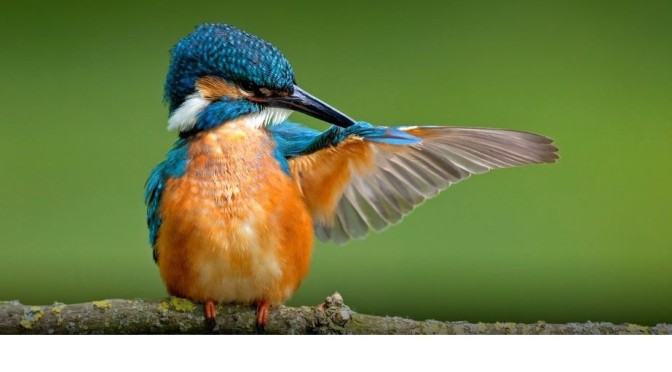
Kingfishers are known for their stocky body, long, thick bill and striking colors and markings. Many kingfishers are decked out in feathers of bright blue, green, turquoise, red, or gold. Some have splotches, dashes, stripes, or speckles. The dagger-shaped bill often seems too long or too big for the rest of the bird, but it is well designed for capturing food. Most kingfishers have short legs and strong feet, since they spend most of their time perched on a stalk, twig, or branch while keeping an eye out for a meal. Even though they are chunky birds, kingfishers are fast flyers. Some, like pied kingfishers, can even flap their wings fast enough to hover over water.
Kingfishers like to keep clean and bathe by diving into water and then perching in the sun to dry and preen their feathers. Some use their wings to scrub and scratch the top of their head. They also keep that impressive bill clean by scraping it against a branch until they are satisfied that the bill is in good condition.
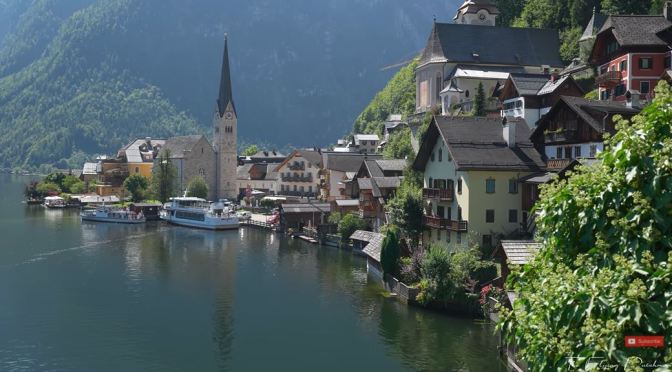
Hallstatt is a village on Lake Hallstatt’s western shore in Austria’s mountainous Salzkammergut region. Its 16th-century Alpine houses and alleyways are home to cafes and shops. A funicular railway connects to Salzwelten, an ancient salt mine with a subterranean salt lake, and to Skywalk Hallstatt viewing platform. A trail leads to the Echern Valley glacier garden with glacial potholes and Waldbachstrub Waterfall.
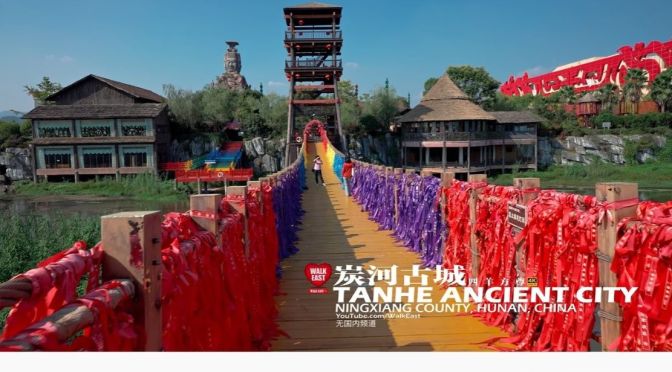
Tanhe Ancient City, based on the Tanheli Site, is China’s first park themed on the Zhou Dynasty (c.11th century-256 BC).
The Zhou Dynasty was the source and heyday of the Chinese civilization, and it created a splendid culture. Ningxiang where the Tanhe Ancient City is located is known as the “Hometown of Bronze wares in South China.” It has been the source of a number of important bronze wares, including the Four-ram Zun Vessel, a vessel of the late Shang Dynasty (c. 16th-11th century BC), and the Bronze Ding with human-mask design. It is also the center of ritual and music culture in China.
The cultural genes of the Zhou Dynasty have been passed down from generation to generation, and are influential to this day. The scenic area of the Tanhe Ancient City has simple and solemn palaces and temples as well as noisy and bustling old streets. Chime bells, poems, and rituals here make the life of three thousand years ago come back again, and the civilization from a distant age seems to reappear.
Like a medieval duel, but on the water: Contestants use lances to try to knock each other out of their boats. Since 1666, water-jousting events have been held yearly in the port city of Sète, southern France.
After a two-year break on account of the coronavirus pandemic, the traditional fisherman’s jousting event has returned. It’s considered the most important event of its kind – the the sport’s world championships. Each year, thousands of spectators and fans flock to the city to take part in the spectacle. The competition rules haven’t changed since 1666!
Though mourning and grief were visible in Britain’s capital on Friday, some young Britons were more muted in their reaction to an institution that many called increasingly irrelevant.
News, Views and Reviews For The Intellectually Curious









 Boomers Daily