
From a Wall Street Journal online article:
The rapid aging of the population, together with high rates of obesity and diabetes in all ages, are pushing both the rate and number of deaths from heart failure higher, the study said. Most deaths from heart failure occur in older Americans, but they are rising in adults under 65, too, the study showed.
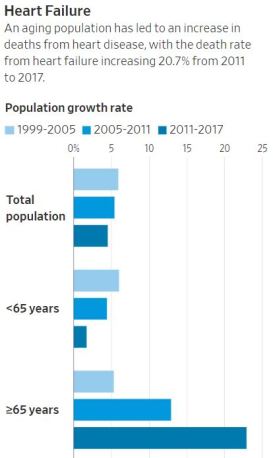 The findings help explain why a decadeslong decline in the death rate from cardiovascular disease has slowed substantially since 2011 and started rising in middle-aged people, helping drive down U.S. life expectancy.
Deaths from heart failure, one of the nation’s biggest killers, are surging as the population ages and the health of younger generations worsens.
The death rate from the chronic, debilitating condition rose 20.7% between 2011 and 2017 and is likely to keep climbing sharply, according to a study published Wednesday in the journal JAMA Cardiology.
To read more: https://www.wsj.com/articles/heart-failure-deaths-rise-contributing-to-worsening-life-expectancy-11572411901

 We headed west and hugged the shallow shoreline, casting at shadows of fish as the sun mixed with clouds making it more difficult to sight fish. We curled around a point of land I instantly recognized as Cambridge Beaches, where I stayed with my parents on my first visit to the island and where my sister celebrated her honeymoon.
 Mr. Chambers, a 48-year-old physical therapist in Jersey City, N.J., modified his sleep, diet and exercise routines. Eighteen months later, his performance on a battery of cognitive tests improved, particularly in areas like processing speed and executive function, such as decision-making and planning.
 In 2015, the Laser Interferometer Gravitational Wave Observatory (LIGO) facilities in the US directly detected ripples in space-time known as gravitational waves. These waves were produced by the final spiral of two oribiting black holes that smashed into each other, sending ripples across the universe.
 The ability to cover this distance is aided by Helia’s chassis and body panels made from carbon fibre, which grant it a kerb weight of 550 kilograms.
 The plot line of The Farewell is familiar to me. Like Billi’s Nai Nai, my aunt was diagnosed with metatastic lung cancer. Nobody in the family told her – nor did the doctors when she later underwent surgery to remove a tumour. The last time I saw her was in north-eastern China a few years ago. Her once-plump figure had shrunk to a wiry frame. She was in her early 70s, in good spirits, but a far cry from the feisty matriarch who used to dominate conversations.
 Boomers Daily