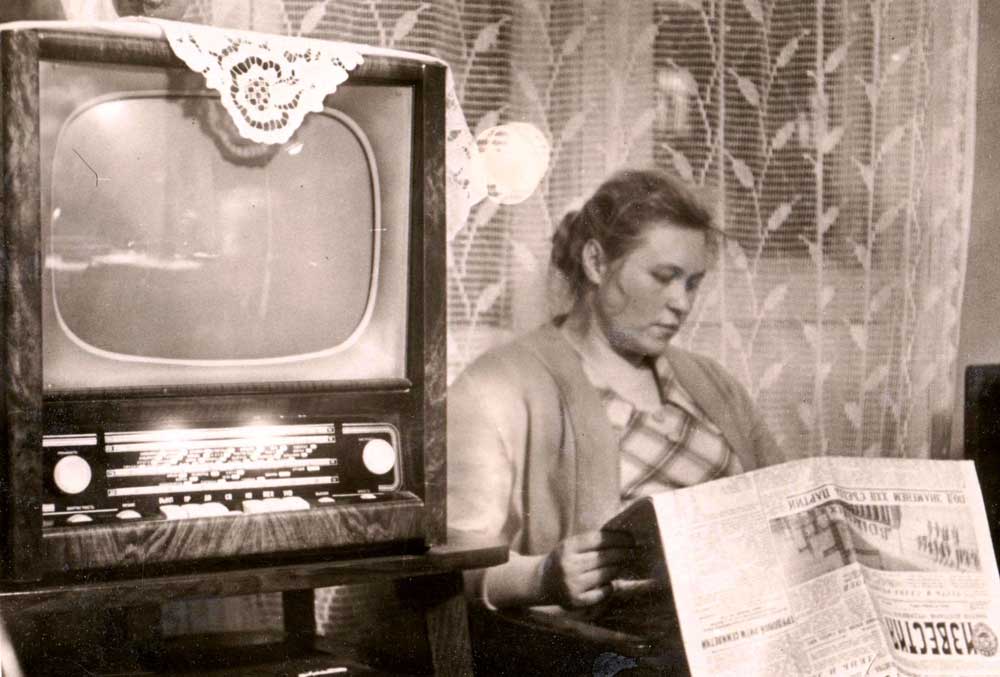
‘The ‘Belarus-5’ in an ordinary Soviet house,’ photographed in the 1960s.
Americanised globalisation and the new world of Russian business in the 1990s.
In the 1990s, a version of the satirical puppet show Spitting Image arrived on Russian television. A Muscovite once told the story of his father, who took great care to record every episode on VHS.
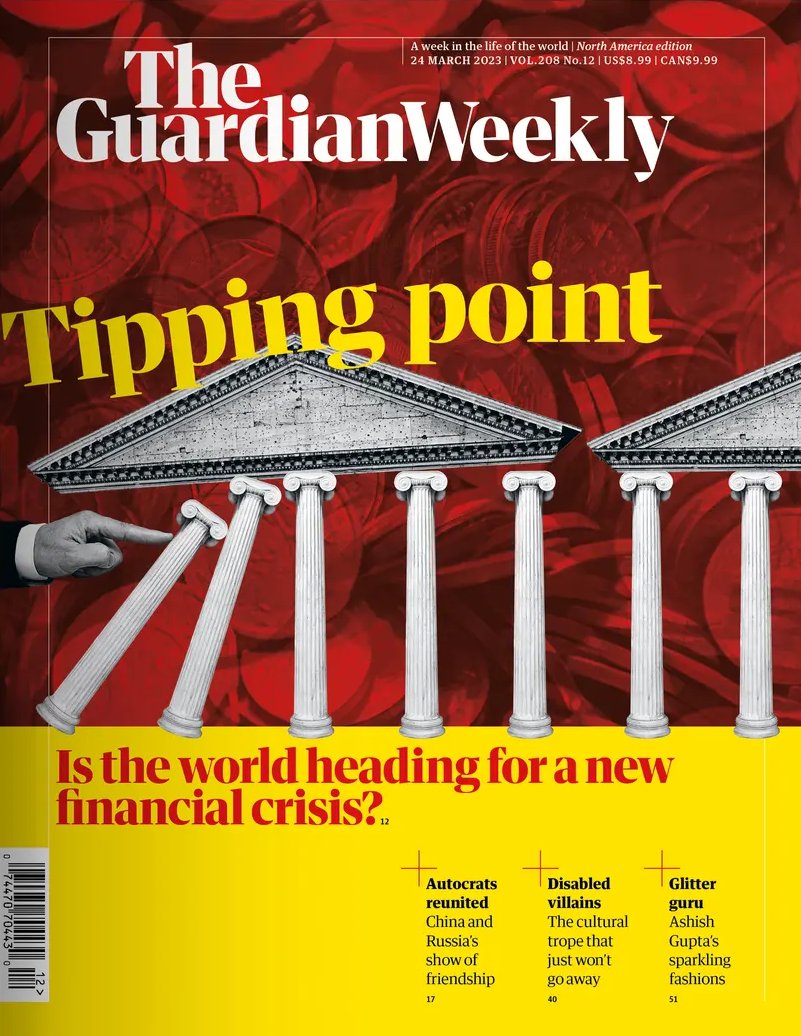
The Guardian Weekly (March 24, 2023)– You’d be forgiven for having allowed the collapse of the tech industry lender Silicon Valley Bank, earlier this month, to pass you by. Even the news that SVB’s UK operation had been salvaged in a deal brokered by the British government might not have registered too much. But the rescue this week of Switzerland’s second-largest lender Credit Suisse had a more ominous feel to it, a sense of fiscal dominoes cascading slowly into one another.
For our big story this week, Anna Isaac and Kalyeena Makortoff report on a week that brought back anxious memories of the 2008 financial crash, while economics editor Larry Elliott argues that only the era of ultra-low interest rates that followed the previous crash has prevented a further correction happening sooner.
Chinese president Xi Jinping’s visit to Russia this week had the feel of a pivotal momentfor global diplomacy. Russian affairs reporter Pjotr Sauer and senior China correspondent Amy Hawkins look at what the strengthening of the Sino-Russian alliance signifies for Moscow, Beijing and the rest of the world.
This week also saw the 20th anniversary of the US invasion of Iraq. Diplomatic editor Patrick Wintour reflects on a botched intervention that still haunts global politics to this day, while on the Opinion pages Randeep Ramesh argues that the US foreign policy debacle still serves to underline what he describes as “the capricious and self-centred nature of American global power”.
“This is going to change the world as we know it.”
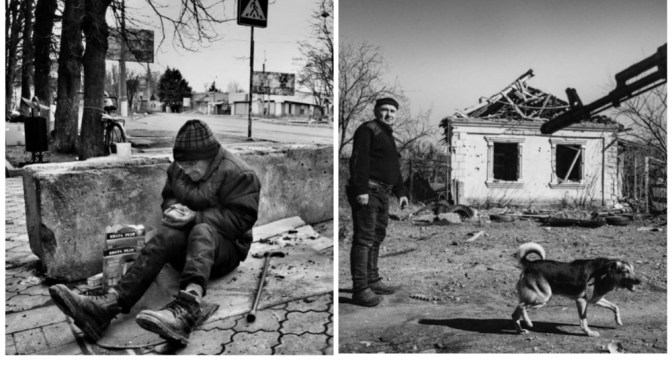
“The pictures are a documentation of the brutality within the conflict itself. It’s about civilians and civilian casualties because they are the ones hit the hardest. “
“The Russians are terrorizing the civilian population. They are hitting civilian infrastructure, may it be water, electricity, or heating. That brutality is extremely important to show. For me, it is about getting as close to these people as possible.”
Grarup is convinced that the ongoing war in Ukraine will mark the beginning of a new area that will isolate Russia from the Western World for generations to come: “I have been covering wars and conflicts for the last 35 years – just about every conflict you can imagine. In many ways, the brutality of the genocide in Rwanda in 1994 is second to none. But the war in Ukraine comes really, really close. It’s basically a country which is desiring democracy and freedom and independence – and because of that, its people are killed.”
Grarups also reflects upon his feelings covering the war, such as his general discomfort with silence as “you can be sure that something is about to happen.” On the other hand, he sees the necessity to document the war for future generations and the possible prosecution of war crimes. “What I like about black-and-white photography is its timelessness. We think in our part of the world that the world has changed, developed, and moved far away from what we have seen historically.
But the fact is: It hasn’t. It’s still the same atrocities. It’s still the same victims.” Jan Grarup was born in Denmark in 1968 and is today regarded as one of the leading and most experienced war photographers globally. Already in 1991, the year of his graduation, he won the prestigious Danish Press Photographer of the Year Award, a prize he would receive on several further occasions. In 1993, he moved to Berlin for a year, working as a freelance photographer for Danish newspapers and magazines. Afterwards, Grarup covered many wars and conflicts worldwide, including the Gulf War, the Rwandan genocide, the siege of Sarajevo and the Palestinian uprising against Israel in 2000.
His coverage of the conflict between Palestine and Israel led to two series: The Boys of Ramallah, which earned him the Pictures of the Year International World Understanding Award in 2002, followed by The Boys from Hebron. His book, Shadowland (2006), presents his work during the 12 years he spent in Kashmir, Sierra Leone, Chechnya, Rwanda, Kosovo, Slovakia, Ramallah, Hebron, Iraq, Iran, and Darfur. In the words of Foto8’s review, it is “intensely personal, deeply felt, and immaculately composed.”
His second book, Darfur: A Silent Genocide, was published in 2009. In 2017 he released the prizewinning bestseller And Then There Was Silence. He is currently working on a follow-up called While We Bleed with Danish author Adam Holm about the war in Ukraine. Jan Grarup has won numerous prizes for his dedicated work, for example eight World Press Awards, the Pictures of the Year International World Understanding Award, the UNICEF Children Photo of the Year Award, Visa d’Or, Leica Oskar Barnack Award, to mention a few of the more prestigious ones. Jan Grarup was interviewed by Marc-Christoph Wagner in Copenhagen, Denmark.
The interview took place at the Danish War Museum in March 2023 on the occasion of Grarup’s exhibition One Year With War. Camera: Jakob Solbakken Edited by: Helle Pagter Produced by: Marc-Christoph Wagner
March 14, 2023: Following the collapse of Silicon Valley Bank and Signature Bank, is Joe Biden facing a crisis of confidence in US financial institutions?
Plus: political turbulence in Moldova, Nicaragua’s decision to suspend relations with the Vatican and a special interview with Estonia’s former president Toomas Hendrik Ilves.
March 2023: The Seeker is my new drone 2023 reel. This short film is a kind of aerial footage reel that showcase the variety of different videos that I shot during the past several years.
Divided into two categories “nature and city” this 2-and-a-half-minute reel reveals just a glimpse of the diversity of some of my drone footage. Shot primarily in European locations this reel featured countries such as Russia, Spain, Portugal, Iceland, Italy, Norway, UAE and others.
February 24, 2023: We mark one year since the invasion of Ukraine with Kateryna Yushchenko, the country’s former First Lady. Plus: Nigeria heads to the polls, the day’s newspapers and the latest business news.
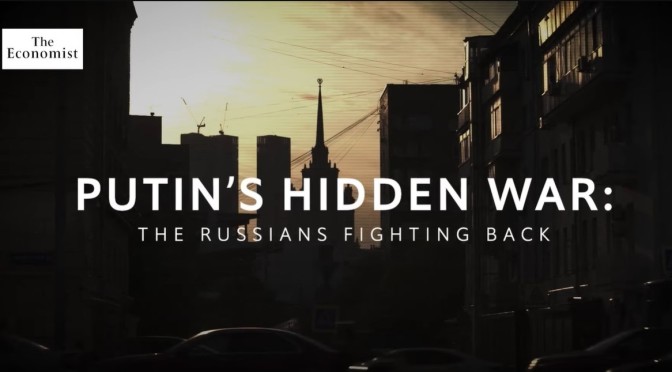
The Economist (February 23, 2023): The invasion of Ukraine left Russians with a stark choice: carry on as normal or make a stand against the war. But speaking out in Russia carries huge risks. How is the opposition managing to resist the regime – and at what personal cost?
Video timeline:00:00 – One year on 01:37 – The first wave of protests 05:43 – Crackdown on dissent 10:04 – Individual acts of rebellion 13:51 – Partial mobilisation 16:20 – Russia’s mass exodus 23:06 – The future of Russian rebellion
February 22, 2023: We report on the international reaction to Vladimir Putin’s state of the nation speech, and why South Africa hosts maritime exercises involving Russia.










 Boomers Daily