The president-elect became convinced that letting Pete Hegseth fail would set off a feeding frenzy among senators. What followed was a MAGA swarm that helped salvage his bid, at least for now.
Not even the most optimistic of rebels could have predicted the rapid collapse, last weekend, of the Assad dynasty that ruled Syria with an iron fist for more than 50 years. Yet while there was relief and joy both inside Syria and among the nation’s vast displaced diaspora, it was also accompanied by apprehension over what might come next.
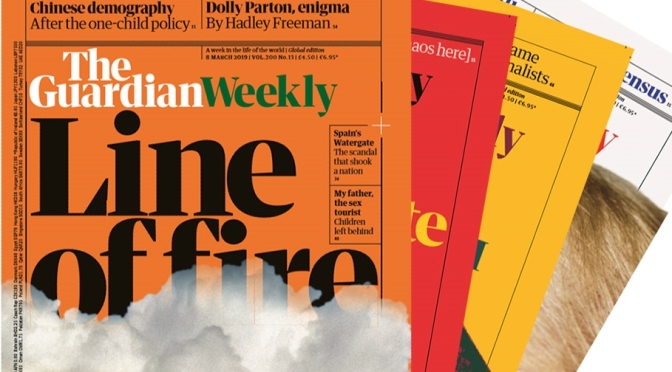
1
Spotlight | Russia and Ukraine wait warily for Trump transition The idea of the US president-election as a saviour for Ukraine, as unlikely as it may seem, holds an appeal for an exhausted nation without a clear path to victory. Shaun Walker and Pjotr Sauer report
2
Environment | The jailed anti-whaler defiant in face of extradition threat Capt Paul Watson talks to Daniel Boffey about his arrest on behalf of the Japanese government, his ‘interesting’ Greenland prison, and separation from his children
3
Feature | The growing threat of firearms that can be made at home One far-right cell wanted to use 3D-printed guns to cause ‘maximum confusion and fear’ on the streets of Finland. Could the police intercept them in time? By Samira Shackle
4
Opinion | Farage is lying in wait. Britain can’t afford for Starmer to fail It is not enough for the Labour leader’s ‘milestones’ to be achieved. Voters must feel the improvement in their daily lives, says Guardian columnist Jonathan Freedland
5
Culture | The best books of 2024 From a radical retelling of Huckleberry Finn to Al Pacino’s autobiography, our critics round up their favourite reads of the year
“When you invent the ship, you must also invent the shipwreck; when you invent the plane, you must also invent the plane crash; and when you invent electricity, you invent electrocution… Every technology carries its own negativity, which is invented at the same time as technical progress.” –Paul Virilio
“The human spirit must prevail over technology.” –Albert Einstein
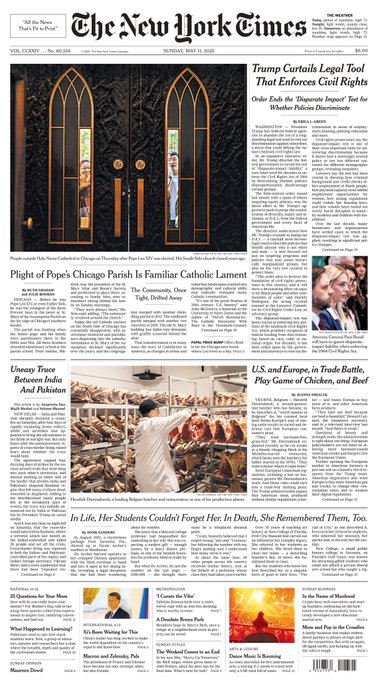
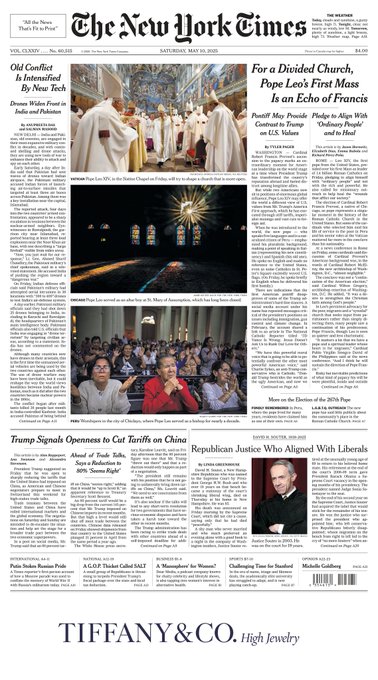
The suspect, Luigi Mangione, was an Ivy League tech graduate from a prominent Maryland family who in recent months had suffered physical and psychological pain.
The National Association of Realtors has created a nonprofit that gives more heavily to one side of the political aisle and to groups that have little to do with real estate and housing.
Amnesty International described it as a “human slaughterhouse,” where, other rights groups say, tens of thousands of people were detained, tortured and killed during the 13-year civil war.
Rage Grows Over a Spate of Brutal Murders of Women in Kenya
Almost 100 women have been killed in the span of three months, the police say. Rights groups want President William Ruto to declare femicide a national crisis.
A day after the regime of President Bashar al-Assad fell, civilians poured into the streets of Damascus, weeping in disbelief. Many sought word of relatives held in a notorious prison on the outskirts of the city.
President Bashar al-Assad had kept opposition forces at bay for a decade with help from Russia and Iran. But rebels struck at a moment of weakness for those countries.
With the fall of President Bashar al-Assad of Syria, Vladimir V. Putin has suffered one of the biggest geopolitical setbacks of his quarter-century in power.
Want a Job in the Trump Administration? Be Prepared for the Loyalty Test.
Applicants for government posts, including inside the Pentagon and the intelligence agencies, say they have been asked about their thoughts on Jan. 6 and who they believe won the 2020 election.
Foreign Policy Magazine(December 8, 2023): The Best of Books 2024 on international politics, economics, and history that were featured in the magazine this year, selected by Foreign Affairs’ editors and book reviewers.
In a revelatory book, Farrell and Newman describe how the United States has turned its control over information networks into a hidden tool of economic domination—and warn of the risks of Washington’s weaponization of data power for ordinary people, as well as for the global financial system.read the review
In a major reconsideration of Cold War history, Radchenko examines the Soviet Union’s competing ambitions for revolution, security, and legitimacy—and how Soviet leadership, blinded by its own hubris and aggression, set the stage for the downfall of the USSR. read the review
Kahan argues that what unifies liberals across the centuries, including those involved in building and defending liberal democracy today, are their efforts to build societies free from the fear of arbitrary power. He sculpts a masterful and beautifully written history of liberalism’s long intellectual journey. read the review
In this sobering study, Levitsky and Ziblatt demonstrate how the United States’ enduring constitutional order—one forged in a pre-democratic age—increasingly thwarts the will of an expanding multicultural majority in favor of a shrinking rural white minority.read the review
Focused on the sophisticated and networked world of autocracy, dictatorship, and tyranny, Applebaum argues that what separates hardcore autocratic states, such as China and Russia, from softer illiberal and authoritarian regimes, such as those in Hungary, India, and Turkey, is the ruthlessness and reach of their dictatorial power and their deep hostility to the Western-led democratic world.read the review
News, Views and Reviews For The Intellectually Curious