Tag Archives: History

Getty Art + Ideas Podcast: “Imagining The Afterlife”

“The underworld, the afterlife, is fairly dank, dark, shadowy; quite frankly, it’s a bit boring. Somewhat like waiting at a bus depot.”

Homer’s Odyssey depicts an afterlife that is relatively dull, with heroic actions and glory reserved for the living. Nonetheless, people in Southern Italy in the fourth century BCE were captivated by the underworld and decorated large funerary vases with scenes of the afterlife—the domain of Hades and Persephone, where sinners like Sisyphus are tortured for eternity and heroes like Herakles and Orpheus performed daring feats.

Little is known about precisely how these vases were used and seen in death rituals. A new book by Getty Publications, Underworld: Imagining the Afterlife in Ancient South Italian Vase Painting, brings together 40 such vases and explores new research on them.

In this episode, Getty Museum curator of antiquities David Saunders discusses these enormous and often elaborate vases, explaining the myths they depict and what is known about the ways in which they were used. Saunders is editor of Underworld.

For images, transcripts, and more, visit https://blogs.getty.edu/iris/podcast-imagining-the-afterlife-through-ancient-vases/ or http://www.getty.edu/podcasts

To buy the book Underworld: Imagining the Afterlife in Ancient South Italian Vase Painting, visit https://shop.getty.edu/products/underworld-imagining-the-afterlife-in-ancient-south-italian-vase-painting-978-1606067345

To learn more about the exhibition, visit 

Online Exhibitions: ‘Made In Chicago Museum’ (2022)

This short film by Martin Mulcahy was created for the launch of the 2022-23 exhibition of the Made In Chicago Museum, currently running at Klairmont Kollections, 3117 N. Knox Ave., Chicago, IL.

The film, the museum exhibit, and the corresponding online museum, highlight the many “everyday objects” manufactured by Chicago companies between 1900-1970, bringing to life the stories behind them and the legacy of items we might otherwise view as obsolete (or at best, “vintage”).

The Made In Chicago Museum was founded and curated by Andrew Clayman, and design elements of the exhibit, including this short film, are the work of Chicago designer and filmmaker Martin Mulcahy. For more, visit https://www.madeinchicagomuseum.com/

Art Exhibits: ‘The Red Studio’ By Henri Matisse

Henri Matisse’s landmark painting “The Red Studio” documented the artworks displayed in his workspace just outside Paris as it existed in 1911. For the first time since then, almost all the individual pieces depicted in his painting have been reunited for an installation at New York’s Museum of Modern Art. Correspondent Rita Braver reports.

Preview: The American Scholar – Summer 2022

Summer 2022

COVER STORY

Ulysses at 100

by Our Editors

Is there a novel more revered—and more famously unread—than James Joyce’s Ulysses? Despite its complexities, this love letter to Dublin, published a century ago, is a very readable chronicle of everyday life and everyday struggles. It’s a book about marriage, sex, religion, food, art, loneliness, companionship, and so much else. It’s a book, that is, about life. We hope that the following essays will send you on a quest to discover, or rediscover, this most staggering of epics.

A Remembrance of  Places Both Empty and Full

The divine, stark photographs of Robert Adams

by Megan Craig 

FICTION

How to Solve the Mystery of the Slope and the Line

by Cassandra Garbus 

Profiles: British Sculptor Henry Moore (1898-1986)

Henry Moore achieved international fame as a sculptor, despite once being denounced for promoting ‘the cult of ugliness’. And he also remained a most unassuming man, finds Laura Gascoigne, as two new exhibitions of his work prepare to welcome visitors.

Sculptors are very rarely household names, but no one who lived through the 1960s could be unfamiliar with the name of Henry Moore. At the height of his international success, Moore’s monumental public sculptures in prominent locations — from the 12ft-high Knife Edge Two Piece (1962–65) outside London’s Houses of Parliament to the 26ft-long Reclining Figure (1963–64) outside the Lincoln Centre in New York, US — became such a feature of the urban landscape that they appeared in cartoons in the popular press. For a Modernist abstract sculptor, that was fame.

In the 1950s, Moore added a new subject to his signature themes of the mother and child and the reclining figure. As a young man, his first sight of Stonehenge by moonlight, in 1921, had left an indelible impression; 30 years later, he began a series of large bronze totemic forms recalling prehistoric monoliths.

Henry Moore with three of his Upright Motives c.1955.Photo: Barry Warner

Read more

Ceramics: Ancient Athens Red-Figure Vase Painting

In this five-minute animated video, journey back to the 6th-century BCE workshop of the Athenian master Andokides and witness an ancient artist’s moment of creative ingenuity. For generations Athenian vase painters had employed black-figure technique, in which the figure is painted in a mixture of clay and water called slip and details are incised with a sharp tool.

At some point—we don’t know precisely when or why—a vase painter had the idea to reverse the scheme, leaving the figures the color of the clay and painting details with a brush. We now call this red-figure technique. Learn how ancient vase painters created vases in both styles and marvel at the technical virtuosity of the multi-step firing process that contributed to their distinctive, high-contrast look.

Wyoming Views: The Green River Drift Cattle Drive

Bill Whitaker saddles up for one of the last enduring symbols of the Old West, a Wyoming cattle drive that travels the same route pioneered 125 years ago.

Upper Green River Valley, Wyoming

Predating most federal land management agencies, the Green River Drift cattle trail has been continuously used since the 1890s by the Upper Green River Cattle Association ranchers to get cattle from spring pasture on the desert to summer pasture in the forest. Chilly fall weather causes the cattle to “drift” back out of the forest to return to their home ranches. The trail, 58 miles long with 41 miles of spurs, crosses BLM, State of Wyoming, National Forest, and private properties. It has played a pivotal role in the development of ranching in the area as well as in the development of relationships between Federal agencies that manage grazing allotments and private property owners. The Drift was listed on the National Register in November, 2013. Because it is still being used much as it has for more than 100 years, the Drift was listed as a Traditional Cultural Property (TCP), the first ranching related TCP in the nation.

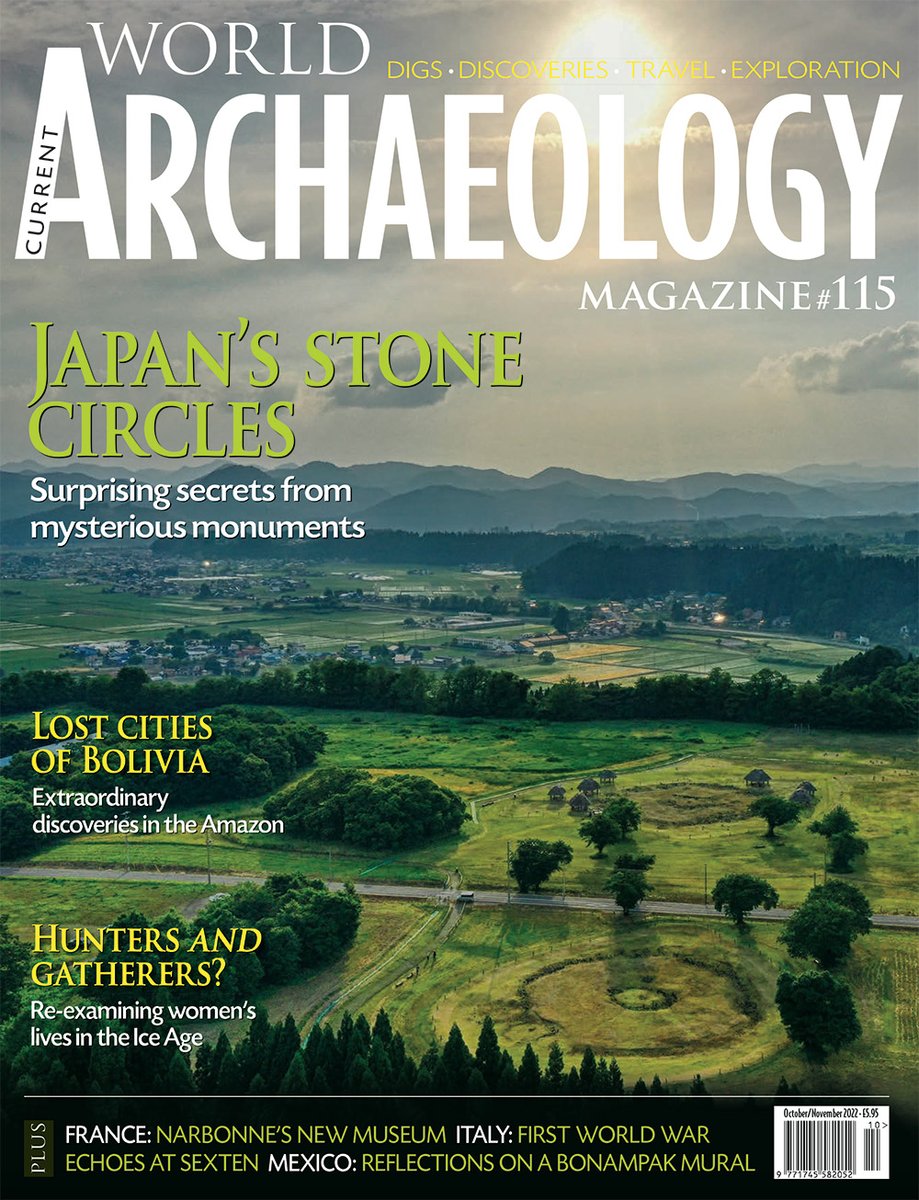
Cover Preview: Current Archaeology – July 2022

This year, events are taking place across the country to celebrate the 1,900th anniversary of the construction of Hadrian’s Wall (the eagle-eyed among you may have spotted that this most-famous Roman landmark has also featured, in some capacity, in every issue of CA since January).

This month our cover story considers whether the Romans too may have commemorated the Wall’s construction – and we also have an opinion piece asking how sure we can be about its date.

From monumental stonework to modern quarrying, we next head to Bedfordshire to learn about archaeological investigations at Black Cat Quarry, carried out before extraction works began on the site. There, excavations have revealed an impressive multi-period landscape, including Neolithic and Bronze Age settlements, a significant Roman farmstead, and what may be the remains of a Viking ‘fort’ referred to in the Anglo-Saxon Chronicle.

Blenheim Palace: Britain’s Answer To Versailles

Blenheim Palace, Oxfordshire — the seat of the Duke of Marlborough — is one of the outstanding palaces of Baroque Europe, and was planned as both a residence and national monument.

Towards the end of the day on August 13, 1704, John Churchill, Duke of Marlborough, exhausted by an intense day of fighting near Blindheim, a village on the Danube, famously scrawled a note to his wife on the back of a tavern bill: ‘I have not time to say more but to beg you will give my duty to the Queen and let her know her army has had a glorious victory.’ The battle of Blenheim — as the name has been anglicised — was, in fact, a confrontation between a Franco-Bavarian army and the forces of a grand alliance of European powers, including the Dutch republic, Austria and Britain, over control of Spain and its empire. It was the first major defeat inflicted on a French army in the field for 50 years and was crowned by the capture of Louis XIV’s commander-in-chief, Marshal Talleyrand, who waited in the Duke’s coach as he scribbled his hasty message.

Although the plans of the building changed considerably over time, something close to the final design was published in the first part of Colen Campbell’s Vitruvius Britannicus (1715). As described by Campbell, ‘the manner is grand, the parts noble, and the air majestick of this palace, adapted to the martial genius of the patron…’ This latter quality was celebrated both in the ornament of the building with military trophies and its original title, ‘Blenheim Castle’.

Fig 5: The Saloon is overlooked by figures representing the four Continents and the marble doorcase is ornamented with an imperial eagle. Blenheim Palace, Woodstock, Oxfordshire, photographed for Country Life Magazine by Will Pryce. ©Country Life

Both Vanbrugh and Hawksmoor were well versed in medieval castle architecture and their knowledge of it shines through the spectacular outline of this building, its great angle towers and the rugged articulation of the masonry. Yet this is really a Classical castle suitable for a general of Britain in its newly assumed character as an Imperial power and second Rome. Borrowing Hawksmoor’s description of Castle Howard, as ‘the seat of one of the chief nobles of Britain, it is both a castle and palace conjoined’.

Preview: Smithsonian Magazine – June 2022

June 2022

Cover for June 2022

FEATURES


Flesh, Blood & Bronze

One sculptor and his team of artists take on the epic project of conveying the century-old conflict through a massive bronze installation

BY JEFF MACGREGOR

PHOTOGRAPHS BY VINCENT TULLO


Not Far From Kyiv

To residents of Southern California with ties to the Eastern European nations, the conflict feels close to home

PHOTOGRAPHS AND INTERVIEWS BY STELLA KALININA


In a Tight Spot

Conservationists are racing to rescue a delightful coastal animal from rising seas

PHOTOGRAPH BY LAUREN OWENS LAMBERT

TEXT BY MADDIE BENDER


The Real Pinocchio

Forget what you know from the cartoon. The 19th-century story, now in a new translation, was a rallying cry for universal education and Italian nationhood

BY PERRI KLASS

PHOTOGRAPHS BY SIMONA GHIZZONI


Escape from the Gilded Cage

Even if her husband was a murderer, a woman in a bad marriage once had few options. Unless she fled to South Dakota

BY APRIL WHITE

DEPARTMENTS

Discussion

Ethical Collecting

For more than a century, museum artifacts were acquired in ways we no longer find acceptable. How can we repair the damage?

Popular Wisdom

The world’s largest book repository has expanded far beyond its original scope to include sound recordings and digitized collections

Van Gogh in the Grove

A new exhibition of lesser known works during a pivotal time sheds light on his budding genius

Role of a Lifetime

An unpublished memoir reveals how the world’s most famous child actress became a star of the environmental movement

A Brief History of Red Drink

The obscure roots of a centuries-old beverage that’s now a Juneteenth fixture

The Next Clone

Forget Dolly the Sheep. The birth of a mouse named Cumulina 25 years ago launched a genetic revolution