

 Facing shortages of critical equipment, medical workers must make life-or-death decisions about who receives care. WSJ’s Joe Palazzolo reports from an emergency room that’s running short on ventilators, and Chris Weaver explains the plans hospitals are putting in place to decide who gets them.
Arthur Caplan, a bioethicist at NYU’s School of Medicine, talks about how hospitals think about these difficult choices.
Exercise physiologists are healthcare professionals that work with patients who are deconditioned or have a variety of different health complications. They work with pulmonary and cardiac patients, as well as competitive athletes with a wide range of fitness issues.
Penn Medicine’s Christopher J. Kusmiesz, MS describes his role as “assessing a patient’s fitness level and providing recommendations and guidance so they can improve and reach their health and fitness goals.”
Exercise physiologists at Penn uses patient test results, recommendations from their cardiologist and the patient’s own goals to create an exercise program that is unique to each patient.
 Though U.S. legislation targeting the problem of surprise medical bills advanced out of key congressional committees in 2019 with support from leaders in both parties, Congress ultimately failed to pass a law to end such bills.
Erin Fuse Brown is an associate professor of law at Georgia State University. Stephen Morrissey, the interviewer, is the Executive Managing Editor of the Journal.
Migraine disease affects 47 million Americans — 75 percent of whom are women. Although headache is one symptom, attacks can include visual disturbances, nausea, extreme light and sound sensitivity, brain fog and debilitating pain. Stigma and gender stereotypes may complicate the medical response, treatments aren’t one-size-fits-all and federal funding is minimal. Stephanie Sy reports.
 As we head into South Carolina’s primary and gear up for Super Tuesday, the 2020 candidates are looking to stand out to voters. But perhaps no policy proposal has marked this election more than Sen. Bernie Sanders’s push for Medicare for All.
While the Democratic candidates agree on expanding health coverage, they’re divided on how to insure everyone, whether to insure everyone, and, of course, how to pay for it all.
So how are they similar? How are they different? And how does that compare to President Trump?
Rachana Pradhan, correspondent for Kaiser Health News; Noam Levey, national healthcare reporter for The LA Times; and Dan Diamond, health reporter for Politico and host of the “Pulse Check” podcast helped us break down where each candidate stood on health care.
From a Becker’s Hospital Review release (02/19/2020):
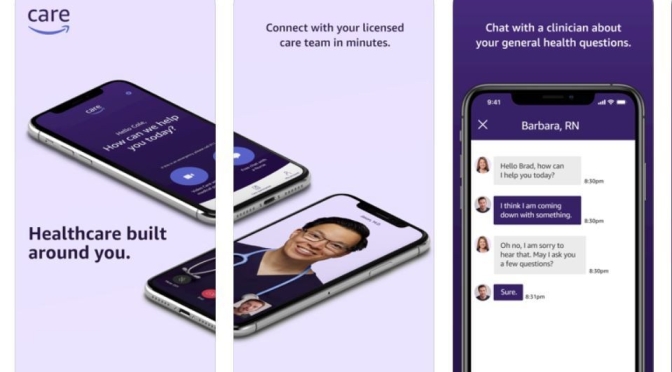
 Amazon’s virtual medical clinic that offers in-person follow-ups is now available to Amazon employees in Seattle.
Five things to know:
1. The virtual medical service, called Amazon Care, went live via the company’s employee benefits portal on Feb. 18. It is available to Amazon employees who work at the company’s headquarters and their dependents.
2. Amazon Care offers employees virtual medical consultations with physicians and nurse practitioners. Patients can use the app to schedule a follow-up visit in their home or office.
 3. Medications prescribed via Amazon Care can be delivered to a patient’s home.
4. “Amazon Care eliminates travel and wait time, connecting employees and their family members to a physician or nurse practitioner through live chat or video, with the option for in-person follow up services from a registered nurse ranging from immunizations to instant strep throat detection,” an Amazon spokesperson told CNBC.
5. Amazon first shared information about Amazon Care in September, noting that it planned to pilot the service in Seattle.
Center for the Digital Future at USC Annenberg (Feb 19, 2020):
 Many Americans are willing to make significant personal tradeoffs to lower their health insurance rates or medical costs, such as agreeing to 24/7 personal monitoring or working with artificial intelligence instead of a human doctor, the Center for the Digital Future at the USC Annenberg School for Communication and Journalism finds.
Among the study’s findings:
Per-Person Health Care Spending Grew 18% from 2014 to 2018, Driven Mostly by Prices
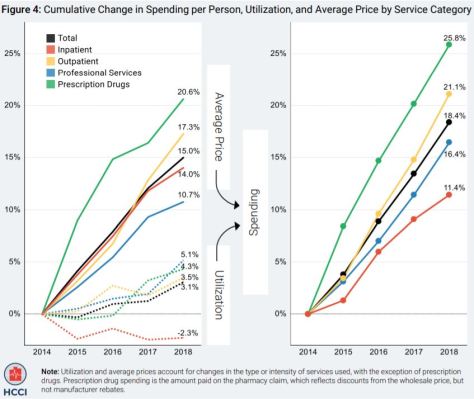
The report examines four groups of health care services and dozens of sub-categories. Of the four major categories, outpatient visits and procedures saw the highest 2018 spending increase (5.5%). Other notable trends include:
From a JAMA Network online study (February 11, 2020):
 In this analysis of commercially insured patients who had undergone elective surgery with an in-network surgeon at an in-network facility, approximately 1 in 5 received an out-of-network bill, with a mean potential balance bill of $2011.
In this retrospective analysis of 347 356 surgical episodes among commercially insured patients who had undergone elective surgery with in-network primary surgeons and facilities, 20% of episodes involved out-of-network charges.
The patterns of out-of-network bills varied with the clinical scenario. Simpler ambulatory procedures that tend to involve 1 surgeon (arthroscopic meniscal repair, breast lumpectomy) had fewer out-of-network bills (13%-15% of cases), whereas inpatient procedures (hysterectomy, knee replacement, colectomy, CABG surgery) had more frequent out-of-network bills (24%-33% of cases). These more complex procedures were also associated with larger potential balance bills, in the range of $2000 to $4000.







 Boomers Daily