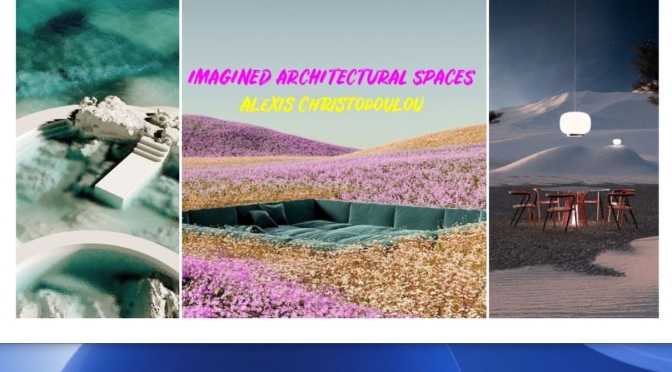
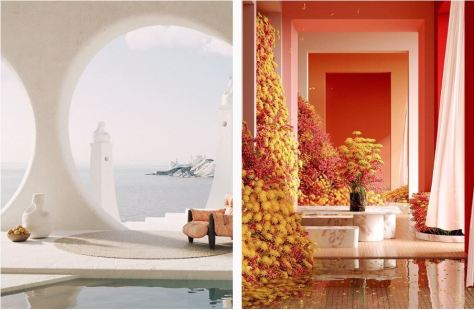
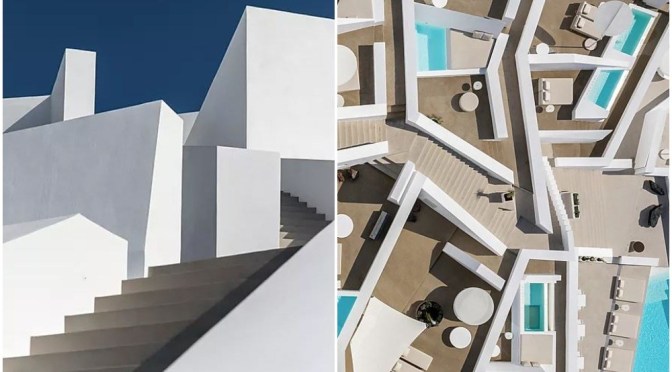
Alexis Christodoulou, a self-taught 3D artist living in Cape Town, South Africa has spent the last 6 years building a collection of works focusing on imaginary architecture. While working professionally as a copywriter for the last decade, Alexis taught himself 3D rendering as a hobby.
From a lifelong fascination of digital worlds and 3D graphics from playing video games a boy, Alexis became frustrated with the lack of modern aesthetics represented therein. The images he creates are a simple extension of this desire to see fantastic spaces come to life that echo a more modern and clean aesthetic.
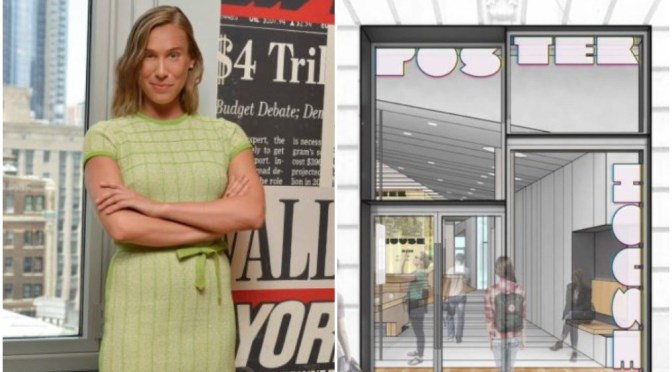
When New York City’s Poster House museum had to close its doors in early March, director Julia Knight wondered how the institution could support the city.
Today her inspiring solution can be seen across all five boroughs.
Poster House is the first museum in the United States dedicated exclusively to posters.
Through exhibitions, events, and publications, Poster House presents a global view of posters from their earliest appearance in the late 1800s to their present-day use. Poster House takes its mission from the medium, aiming to engage and educate all audiences as we investigate this large-format graphic design and its public impact.
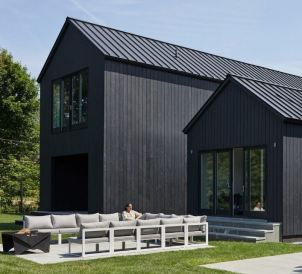
The result is a home with four gabled boxes connected by glass hallways. The two double-story bookend boxes are the private living spaces for each client and the two center boxes house the shared common spaces with one box for the kitchen and dining area and the other for the shared living room.
For many years, a married couple and a friend shared a summer cottage rental on Shelter Island. When they each began the process of looking for property to build a new, year-round vacation home, they decided to maintain the house-sharing relationship in order to maximize resources. A key part of the project brief was the desire to reference the vernacular farm and cottage architecture prevalent on the east end of Long Island.
Another component was the need to support separate living spaces for two families with a shared kitchen and common living area, but maintain a floorpan that could support a single-family scenario if they ever decided to sell the property. Each client also wanted a second-floor master bedroom to maximize views onto the bay behind the house; in each master bedroom, there was the desire to position the bed under the ridge looking out the gable end onto the water. To round out the floor plan, we added extra bedrooms and bathrooms for guests, and a private living room and covered porch for each family.
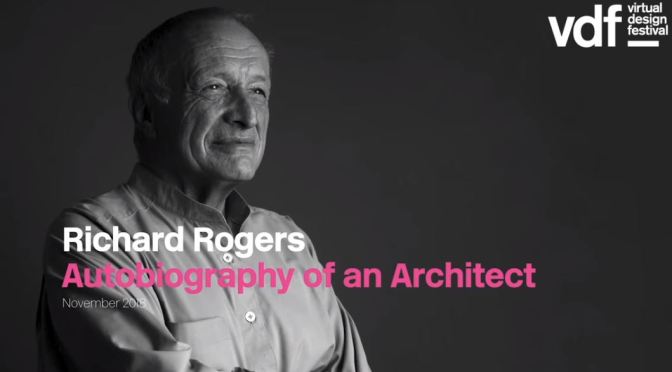
In the second talk as part of our Virtual Design Festival collaboration with Architects, not Architecture, architect Richard Rogers discusses his reluctance to enter the Centre Pompidou competition and liking the Lloyd’s building. The idea behind Architects, not Architecture is for architects to discuss their path, influences and experiences.
In his lecture in November 2017, Rogers explained that he’d been told he couldn’t use buildings for his talk, as the main rule of the series is that architects aren’t allowed to discuss their projects. “I said: That’s like saying I can’t use my two hands,” Rogers said.
“Architecture is part of me. And architecture is not just about buildings, it’s about spaces and places.” Born in Florence, Rogers moved to England with his family and studied at the Architectural Association School in London, where he founded Richard Rogers Partnership with Su Rogers, now Rogers Stirk Harbour + Partners, in 1977.
“The first smart city “conscious oriented”, that will prevent urban sprawl, produce and storage energy, improve air quality, increase urban biodiversity, and create a healthier lifestyle”. Arch. Luca Curci
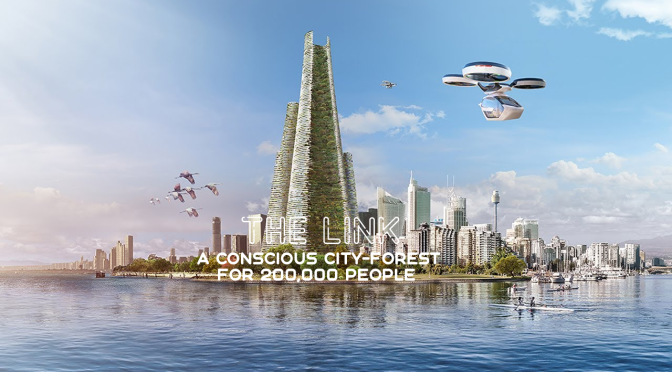
With its 300 floors THE LINK will reach the maximum height of 1200 meters. The project combines sustainability with population density, and it aims to build up a zero-energy city-building. The city-forest is made of 4 main towers, connected one each other, equipped with green areas on each level, natural light and ventilation. 100% green transport systems. The vertical city allows its residents to get into a healthier lifestyle, in connection with natural elements, re-thinking the traditional concept of community and society.
Architecture firm Luca Curci Architects presents THE LINK, a vertical city for 200,000 people. The project aims to rise above the challenge of population density by successfully combining vertical expansion with economic innovation. A self-sustainable city-forest, that will absorb CO2, produce oxygen for cleaner air and increase urban biodiversity. With interconnected communities’ programs. No suburbs. Less poverty oriented.
Using an urban operating system with an AI (Artificial Intelligence), the vertical city will be able to manage the global city temperature, levels of CO2 and humidity, will control the global lighting system, and will storage extra energy produced by solar panels and other renewable energy resources.
The most in-depth exploration of one of the most important, innovative, and creative architecture practices working today.
For the last twenty years Studio Gang, led by Jeanne Gang, has created bold, visionary architecture that engages the urgent social and environmental challenges of our time. This first comprehensive monograph brings together 25 signature projects-from the award-winning Aqua Tower and Writers Theatre to highly-anticipated upcoming buildings for the American Museum of Natural History and O’Hare International Airport-to reveal the resonant concepts and design approach that connect them. With a rich variety of visual materials and short essays by Jeanne Gang, the book elegantly captures the creative sensibility and trajectory of an architecture driven by pressing twenty-first-century questions.
Studio Gang is an international architecture and urban design practice founded and led by Jeanne Gang. A recipient of the National Design Award in Architecture and numerous other honors, the Studio works as a collective to create projects that foster interaction and connection. Their research-based, interdisciplinary approach has produced award-winning buildings across scales and typologies as well as publications and exhibitions that push design’s ability to effect positive change.
Andrew Tuck brings you a special interview with Jan Gehl, perhaps the world’s best-known urban designer. Now 83, he’s waiting this pandemic out while isolating at home, enjoying spring from his garden.
Jan Gehl Hon. FAIA is a Danish architect and urban design consultant based in Copenhagen whose career has focused on improving the quality of urban life by re-orienting city design towards the pedestrian and cyclist. He is a founding partner of Gehl
Container Atlas seeks out luxurious remote hideaways, urban dwellings, community centers, and more, all showing how the humble container can put the fab into pre-fab.
Container architecture has become an essential part of our twenty-first century surroundings, with it being used to create modular structures for pavilions, brand showrooms, retail premises, and even residential homes. Ten years after the first publication of Container Atlas, this eagerly anticipated follow-up charts how this movement has evolved into an essential part of today’s architectural vocabulary. Container Atlas serves as a practical and inspirational reference not only for architects and engineers, but also for all creatives eager to learn about the rich and diverse language of container architecture and modular building.
Architect and Professor Han Slawik and his team have established themselves as international experts in the field of container architecture. He is the author of the first edition of Container Atlas and has returned to the subject with refreshed insights into this burgeoning movement.




 When New York City’s Poster House museum had to close its doors in early March, director Julia Knight wondered how the institution could support the city.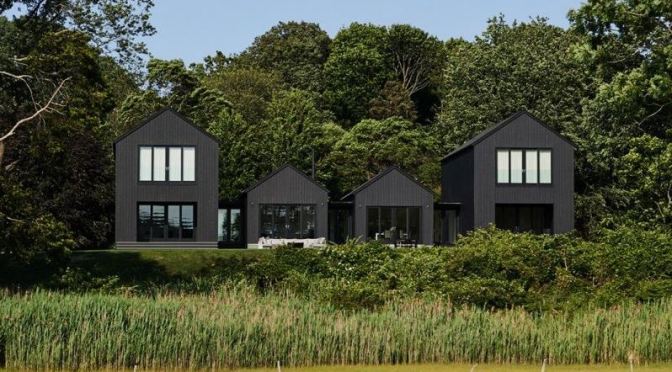
 The result is a home with four gabled boxes connected by glass hallways. The two double-story bookend boxes are the private living spaces for each client and the two center boxes house the shared common spaces with one box for the kitchen and dining area and the other for the shared living room.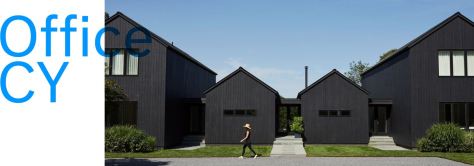

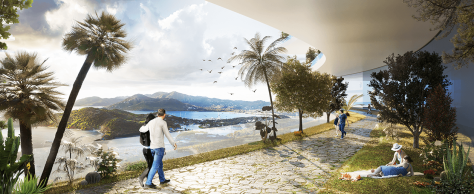
 Architecture firm Luca Curci Architects presents THE LINK, a vertical city for 200,000 people. The project aims to rise above the challenge of population density by successfully combining vertical expansion with economic innovation. A self-sustainable city-forest, that will absorb CO2, produce oxygen for cleaner air and increase urban biodiversity. With interconnected communities’ programs. No suburbs. Less poverty oriented.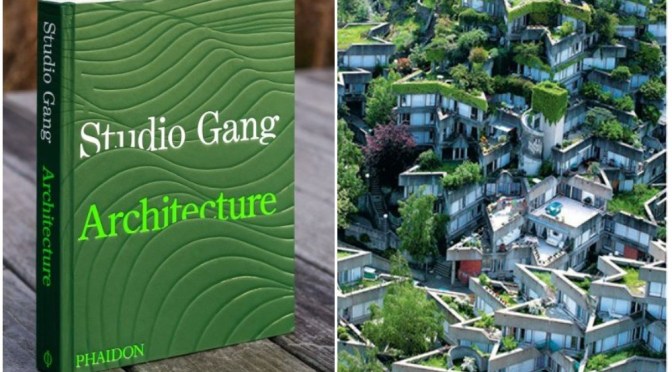
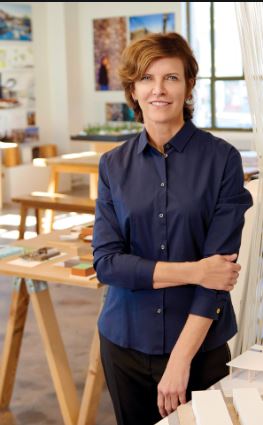 The most in-depth exploration of one of the most important, innovative, and creative architecture practices working today.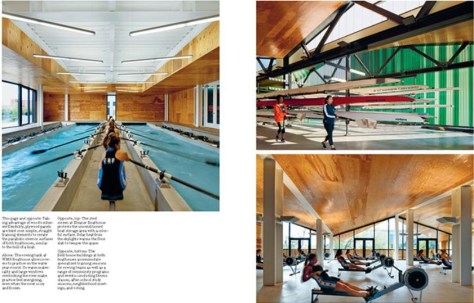
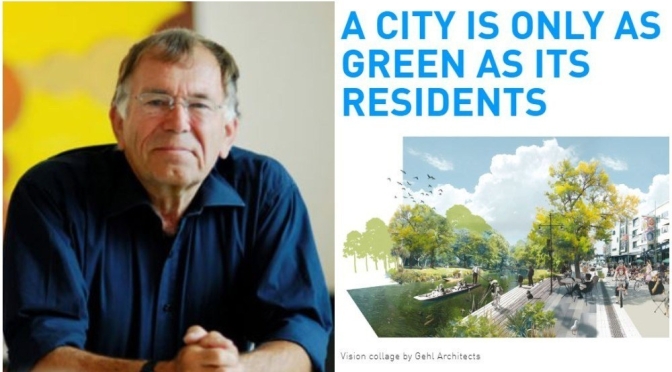
 Andrew Tuck brings you a special interview with Jan Gehl, perhaps the world’s best-known urban designer. Now 83, he’s waiting this pandemic out while isolating at home, enjoying spring from his garden.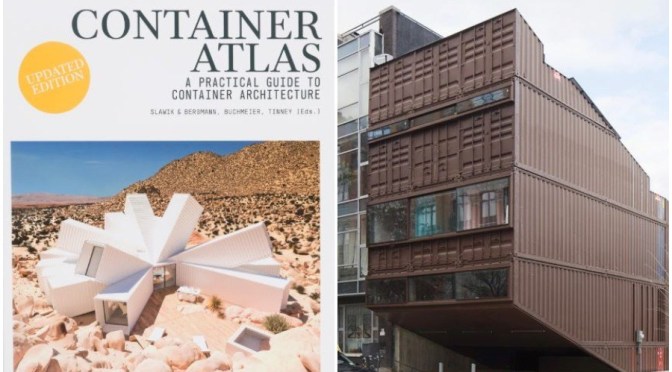

 Boomers Daily