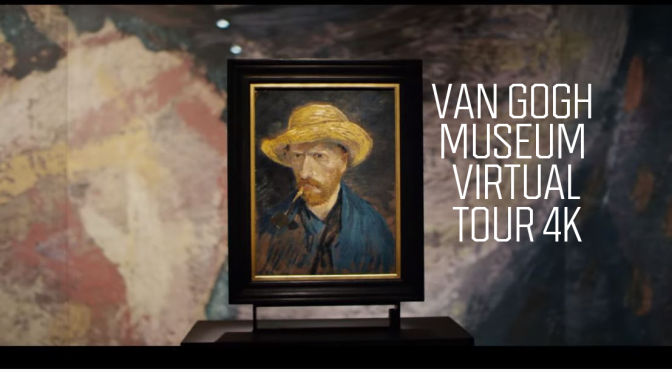
Selfportrait gallery – Van Gogh Museum Amsterdam
Van Gogh Museum Tour in 4K. Have you always wanted to be alone in the Van Gogh Museum? Step into Vincent’s world and enjoy the private video tour. (Episode 1)

Van Gogh Museum Tour in 4K. Have you always wanted to be alone in the Van Gogh Museum? Step into Vincent’s world and enjoy the private video tour. (Episode 1)
Can you imagine a world full of art, instead of adverts? It’s been nearly a month since we took over Piccadilly Circus with nothing but Picasso for a whole half hour, to celebrate our current exhibition ‘Picasso and Paper’. Our friends at Chocolate Films captured it all in this amazing film. Picasso and Paper will be on view at the RA until April 13th, 2020.
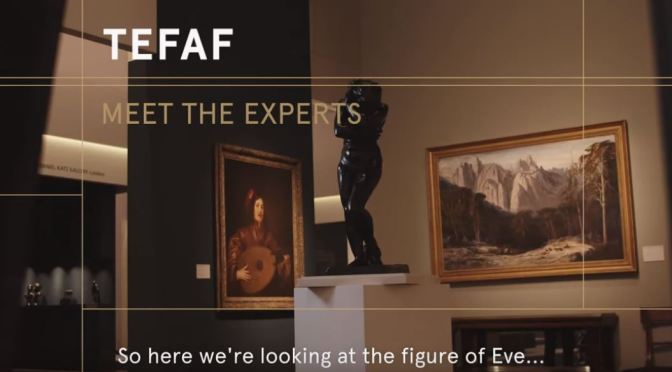
John Swarbrooke from Dickinson Gallery explains the beauty and play of light behind the cast of Auguste Rodin’s Eve.
François Auguste René Rodin (12 November 1840 – 17 November 1917) was a French sculptor. Although Rodin is generally considered the progenitor of modern sculpture, he did not set out to rebel against the past. He was schooled traditionally, took a craftsman-like approach to his work, and desired academic recognition, although he was never accepted into Paris’s foremost school of art.
Eve is a nude sculpture by the French artist Auguste Rodin. It shows Eve despairing after the Fall.
n 1880 Rodin was commissioned to produce The Gates of Hell, for which he exhibited Adam at the 1881 Paris Salon. In a sketch for Gates Rodin showed a central silhouette possibly intended as Eve (both the sketch and Gates are now in the Musée Rodin), but in October 1881 he decided to produce Eve as a pair for Adam, with the two sculptures flanking a huge high-relief bas-relief. This would be the first free-standing female sculpture he had produced since the destruction of his Bacchante in an accident between 1864 and 1870. He began Eve in 1881, later abandoning his intended colossal version of it when he realised his model, probably Adèle Abruzzesi, was pregnant. It was first exhibited to the public at the 1899 Paris Salon. It shows a strong influence from Michelangelo, picked up by Rodin in Italy in 1876.
He also produced an autograph white marble version in 1884 (now in the Museo Soumaya in Mexico City), a version in patinated plaster and a much-reproduced 71 cm high bronze version in 1883 (known as the Petite Ève or Little Eve, whose original is also in the Musée Rodin in Paris). He also reused the same figure of Eve in his marble Eve and the Serpent (1901) and his plaster Adam and Eve (1884).
From Wikipedia
 The British Galleries are reopening with almost 700 works of art on view, including a large number of new acquisitions, particularly works from the 19th century that were purchased with this project in mind. This is the first complete renovation of the galleries since they were established (Josephine Mercy Heathcote Gallery in 1986, Annie Laurie Aitken Galleries in 1989). A prominent new entrance provides direct access from the galleries for medieval European art, creating a seamless transition from the Middle Ages to the Renaissance.
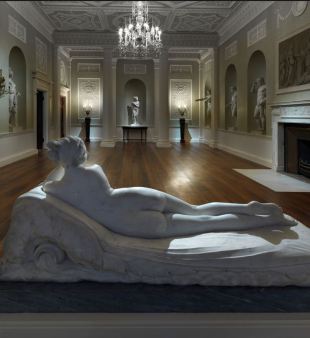 A highlight of The Metropolitan Museum of Art’s 150th anniversary in 2020 is the opening, on March 2, of the Museum’s newly installed Annie Laurie Aitken Galleries and Josephine Mercy Heathcote Gallery—11,000 square feet devoted to British decorative arts, design, and sculpture created between 1500 and 1900. The reimagined suite of 10 galleries (including three superb 18th-century interiors) provides a fresh perspective on the period, focusing on its bold, entrepreneurial spirit and complex history. The new narrative offers a chronological exploration of the intense commercial drive among artists, manufacturers, and retailers that shaped British design over the course of 400 years. During this period, global trade and the growth of the British Empire fueled innovation, industry, and exploitation. Works on view illuminate the emergence of a new middle class—ready consumers for luxury goods—which inspired an age of exceptional creativity and invention during a time of harsh colonialism.
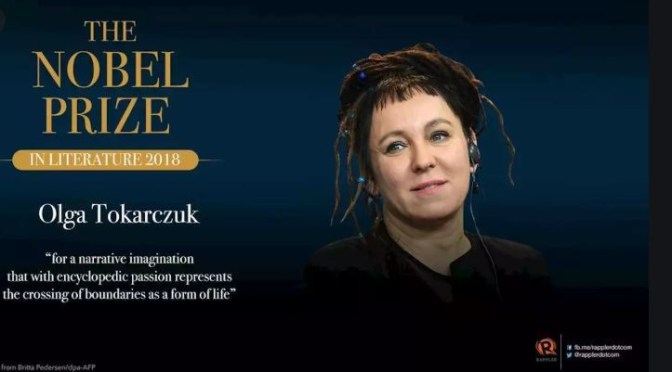
In this interview from the Nobel Banquet on 10 December 2019, Literature Laureate Olga Tokarczuk talks about her childhood dream of being a scientist, curiosity as motivation and the importance of translators.
Olga Tokarczuk, (born January 29, 1962, Sulechów, Poland), Polish writer who was known for her wry and complex novels that leap between centuries, places, perspectives, and mythologies. She received the 2018 Nobel Prize for Literature (awarded belatedly in 2019), lauded for her “narrative imagination that with encyclopedic passion represents the crossing of boundaries as a form of life.” A best-selling author in Poland for decades, Tokarczuk was not well known outside her homeland until she became the country’s first author to win the Man Booker International Prize in 2018 for Flights (2017)—the English translation of her sixth novel, Bieguni (2007).
 What was the world like from 500 to 1500 CE? This period, often called medieval or the Middle Ages in European history, saw the rise and fall of empires and the expansion of cross-cultural exchange.
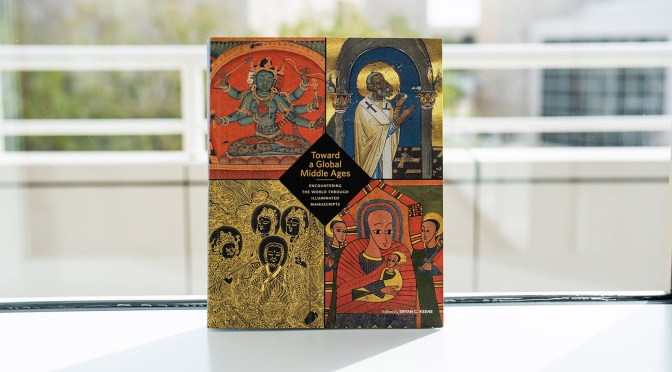
Getty curator Bryan C. Keene argues that illuminated manuscripts and decorated texts from Africa, Asia, Australasia, the Americas, and Europe are windows through which we can view the interconnected history of humanity. In this episode, he discusses his recent book Toward a Global Middle Ages: Encountering the World through Illuminated Manuscripts, highlighting the challenges and opportunities of the emerging discipline known as the Global Middle Ages.
Peer through the lens of flourishing 17th-century Dutch technological innovation to witness wondrous advancements in science, including astronomy and medicine.
Harold J. Cook, John F. Nickoll Professor of History, Brown University
From a New Criterion online article:
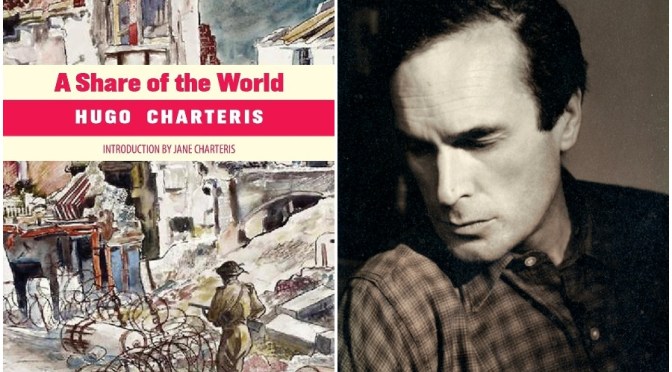
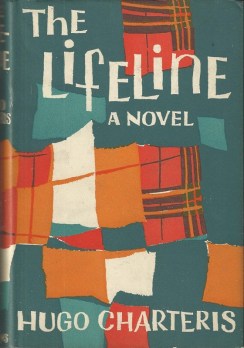 Alan Ross, for forty years The London Magazine’s editor, found Charteris “one of the most original, quirky and shrewd explorers of the behaviour of the landed gentry . . . and at a time when prose was plain, his was idiosyncratically stylish.”
When Hugo Charteris’s first novel, the haunting A Share of the World, was published in 1953 to the praise of Rosamond Lehmann (who helped to get it published), Peter Quennell, Evelyn Waugh, and Francis Wyndham (Charteris’s relation and consistent supporter), the author, just turned thirty-one, seemed set for lasting fame. It hasn’t worked that way in the  almost five decades since his death of cancer in 1970, aged only forty-seven.
Nowadays, few people seem to know his name. This is true among not only the ever-growing majority who pay little attention to novels and novelists, but also the enlightened minority who do.
Excerpts from a Christie’s online article (Feb 28, 2020):
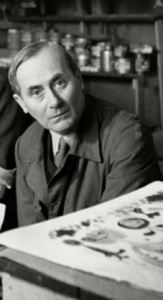
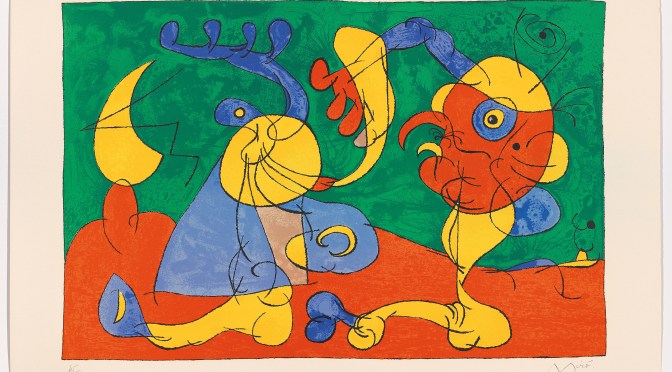
Like Pablo Picasso, his compatriot and peer, Miró had an unwavering commitment to printmaking. Also like Picasso, he created more than 2,000 works in the medium. It’s often said that Miró’s fondness for calligraphic lines — such a distinctive feature of his paintings — lent itself naturally to graphic work.
‘In terms of both the quality and quantity of his output, Joan Miró was one of the most important printmakers of the 20th century,’ says Murray Macaulay, Head of Prints at Christie’s in London.
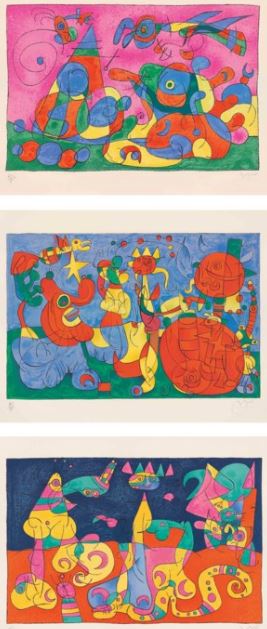 The son of a watchmaker, Joan Miró was born in Barcelona in 1893. He moved to Paris in the early 1920s and soon joined the Surrealist movement. He also befriended a host of avant-garde writers, such as Max Jacob, Tristan Tzara, Antonin Artaud, André Breton and Paul Eluard.
The first prints Miró ever made were illustrations for Tzara’s 1930 book of poems, L’arbre des Voyageurs. Literary sources would prove to be a constant inspiration for him, with notable examples including Alfred Jarry’s play, Ubu Roi; Stephen Spender’s poem, Fraternity; and the mystic, medieval text, Canticle of the Sun, by St Francis of Assisi.
A film by Eric Minh Swenson.
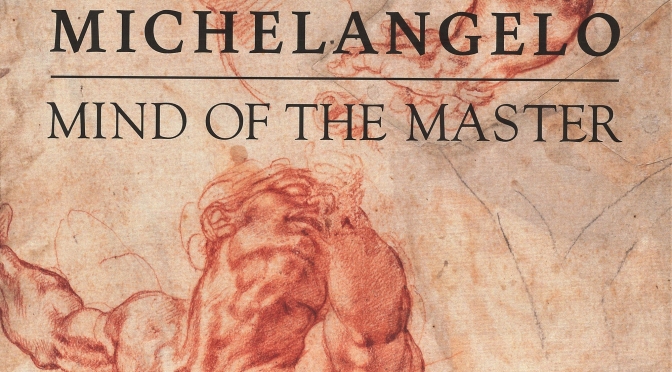
Michelangelo was one of the most creative and influential artists in the history of Western art. This exhibition explores the full range of his work as a painter, sculptor, and architect through more than two dozen of his extraordinary drawings, including designs for celebrated projects such as the Sistine Chapel ceiling, the Medici Chapel tombs, and The Last Judgment. These studies and sketches enable us to witness Michelangelo at work, and to experience firsthand his boundless creativity and his pioneering representation of the human form.
This exhibition has been organized by the Teylers Museum, Haarlem in collaboration with the J. Paul Getty Museum and The Cleveland Museum of Art. It is supported by an indemnity from the Federal Council on the Arts and the Humanities.



 Boomers Daily