
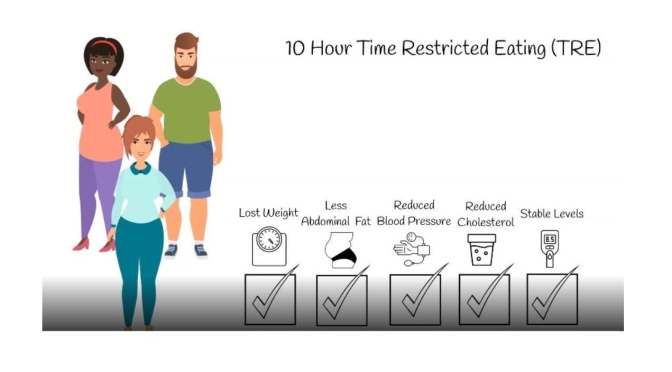
From a Cell Metabolism online study release:
 Ten-hour time-restricted eating (TRE) limits daily dietary intake to a consistent 10-h window, creating a 14-h nightly fast. Researchers studied whether TRE for 12 weeks in people with metabolic syndrome receiving standard medical care (including medications to lower cholesterol and blood pressure) improves markers of health. TRE led to weight loss, healthier body composition (including decreased waist circumference), lower blood pressure and levels of cardiovascular disease-promoting lipids (i.e., “bad cholesterol” levels), and more restful sleep. TRE could be an effective dietary intervention to help those with metabolic syndrome.
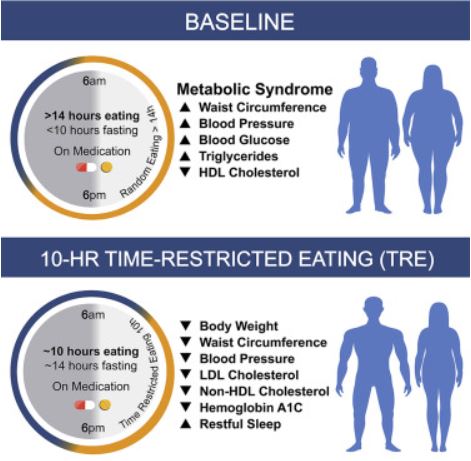
Time-restricted eating (TRE) is an emerging dietary intervention that aims to maintain a consistent daily cycle of feeding and fasting to support robust circadian rhythms (Panda, 2016). Circadian regulation of the endocrine system, autonomic nervous system, and nutrient metabolism contributes to metabolic and physiological homeostasis (Asher and Sassone-Corsi, 2015,Panda, 2016). Both erratic eating patterns and eating over an extended period of time during the 24-h day can disrupt circadian rhythms.
To read entire study: https://www.cell.com/cell-metabolism/fulltext/S1550-4131(19)30611-4

 Fifty-five years after co-founding the rock band The Who, Pete Townshend is still at it. The lead lyricist and guitarist says he actually doesn’t enjoy performing but views it as an “easy” job necessary to finance his lifestyle and support his family and staff. Economics correspondent Paul Solman sits down with Townshend to discuss aging, surviving child abuse and art’s ability to inspire hope.
 It’s a simple question to ask, but seems impossible to answer: What causes one nation to succeed and another to fail? What exactly are the origins of global inequality?
 There are few people who have spent more time trying to answer this question than Prof. James Robinson. Robinson’ first book, Why Nations Fail, was an international best-seller. It laid out in clear and stark terms what the origins of prosperity and poverty really are. Now, he’s written a sequel, The Narrow Corridor, which further explains what ingredients you need to create a prosperous nation.

 After their life as research subjects, what happens to lab monkeys? Some are euthanized to complete the research, others switch to new research projects, and some retire from lab life. Should they retire in place—in the same lab under the care of the same custodians—or should they be sent to retirement home–like sanctuaries? Online News Editor David Grimm joins host Sarah Crespi to discuss recently penned legislation that
 As societal stresses have increased, loneliness and social isolation have become silent killers. Dilip Jeste, MD, a geriatric neuropsychiatrist who specializes in successful aging, explains how loneliness has become an epidemic, the risk factors, helpful interventions, and how we can harness wisdom for compassion, self regulation, and more.
 Led Zep’s Houses of the Holy reflected the rise of funk and reggae. The singer songwriter movement led by Bob Dylan, Neil Young, and Joni Mitchell flourished at the Troubadour and Max’s Kansas City, where Bruce Springsteen and Bob Marley shared bill. Elvis Presley’s Aloha from Hawaii via Satellite was NBC’s top-rated special of the year, while Elton John’s albums dominated the number one spot for two and a half months.
 “Such wearable sweat sensors have the potential to rapidly, continuously, and noninvasively capture changes in health at molecular levels,” Gao says. “They could enable personalized monitoring, early diagnosis, and timely intervention.”
 Gao’s work is focused on developing devices based on microfluidics, a name for technologies that manipulate tiny amounts of liquids, usually through channels less than a quarter of a millimeter in width. Microfluidics are ideal for an application of this sort because they minimize the influence of sweat evaporation and skin contamination on the sensing accuracy. As freshly supplied sweat flows through the microchannels, the device can make more accurate measurements of sweat and can capture temporal changes in concentrations.
 Between the Franco-Prussian War and WWI, France in the 1900s was a gilded moment of peace and prosperity. Critically acclaimed authors Sabine Arqué and Marc Walter curate this XXL collection of some 800 vintage photographs, postcards, posters, and photochromes. From the grand Paris World’s Fair to the honey light of the Côte d’Azur, it’s a glimpse into an era of rose-tinted optimism.
 Thus, while aging led to a pro-inflammatory profile within blood and muscle, lifelong exercise partially prevented this and generally preserved the acute inflammatory response to exercise seen in young exercising men. Lifelong exercise may positively impact muscle health throughout aging by promoting anti-inflammation in skeletal muscle.
 Boomers Daily