Enjoy this 360° video view of the Garden Court of The Frick Collection. Available through your phone with Google Cardboard or other viewer as a 360° VR video. Right click or control + click (on a Mac) to select loop and enjoy the soothing sounds of the fountain. Shot during the exhibition, Canova’s George Washington, on view at The Frick Collection from May 23, 2018 to September 23, 2018.
Chloroquine was shown in 2004 to be active in vitro against SARS coronavirus but is of unproven efficacy and safety in patients infected with SARS-CoV-2. The drug’s potential benefits and risks for COVID-19 patients, without and with azithromycin, is discussed by Dr. David Juurlink, head of the Division of Clinical Pharmacology and Toxicology at Sunnybrook Health Sciences Centre in Toronto.
From Wall Street Journal article:
Our experience suggests that hydroxychloroquine, with or without a Z-Pak, should be a first-line treatment. Unfortunately, there is already a shortage of hydroxychloroquine. The federal government should immediately contract with generic manufacturers to ramp up production. Any stockpiles should be released.
As a matter of clinical practice, hydroxychloroquine should be given early to patients who test positive, and perhaps if Covid-19 is presumed—in the case of ill household contacts, for instance. It may be especially useful to treat mild cases and young patients, which would significantly decrease viral transmission and, as they say, “flatten the curve.”
In a leafy Boston suburb, a place to park cars and repair vintage scooters grows into a bucolic sanctuary.
.
To call architect Colin Flavin’s three-story steel-frame structure with mahogany slat screens a “garage” would be misleading. While there’s room for parking and a Vespa workshop behind the double-wide red door on the ground floor, the spaces above feel and function more like a country retreat. “The clients wanted something innovative to complement their traditional Dutch Colonial,” says Flavin, principal of Flavin Architects.
As many businesses around the world struggle, a Canadian disinfectant company is increasing production to keep up with demand during the novel coronavirus outbreak. Photo: Ron Kolumbus/WSJ
Van Gogh Museum Tour in 4K. Have you always wanted to be alone in the Van Gogh Museum? Step into Vincent’s world and enjoy the private video tour. Episode 3: Van Gogh Museum Amsterdam
“Kenny Rogers took portraits and western landscape photos like no other. He was passionate and fell in love with the warmth and beauty that captured all that he saw through a lens,” says Patty Wente IPHF CEO and President.
“One Tree” – Kenny Rogers
The International Photography Hall of Fame and Museum mourns the passing of its first Lifetime Achievement Award Winner and 2017 inductee Kenny Rogers. Rogers was a dedicated and talented photographer for nearly four decades. His best-known images are portraits of well-known singers, actors, and dignitaries from around the globe.
“The Thumb” – Kenny Rogers
In addition, he had an ongoing passion for photographing the American landscape. Rogers was skilled with his large format view camera, and loved to make prints in his darkroom. Regarding his photography, he said, “I am an impulsive obsessive. I impulsively get involved with something, and then I get obsessed with it. So that’s what happened with photography.”
The race is on to find a vaccine against the new COVID-19 coronavirus. Professor Jonathan Heeney explains why a cautious approach is needed and how his team is using new technology developed for influenza and Ebola viruses to target the new infection.
It is hard now to conceive that two months ago, few people had heard of the new coronavirus. Now, the virus, which causes the disease COVID-19, has spread to every corner of the globe. The World Health Organization has officially declared the outbreak a pandemic.
With the threat of hundreds of thousands – possibly millions – of people being infected and healthcare systems becoming overwhelmed, the race is on to develop a vaccine that will protect individuals and slow the spread of the disease. But Professor Jonathan Heeney, Head of the Laboratory of Viral Zoonotics at the University of Cambridge, and one of the people working on a vaccine, says that coronaviruses present a particular challenge to vaccine developers.
Coronaviruses are named after their appearance: they are spherical objects, on the surface of which sit ‘spike’ proteins. The virus uses these spikes to attach to and invade cells in our body. Once inside, the virus uses the cell’s own machinery to help itself replicate and spread throughout the body, causing disease and allowing it to transmit onwards.
Traditionally, scientists would develop vaccines that programme the body to produce antibodies that recognise and block these spikes. But this strategy can misfire with coronaviruses due to a phenomenon known as ‘antibody-induced enhancement’ or ‘vaccine-induced enhancement’, says Heeney.
“If you make antibodies against the spike, they can end up binding to it and helping the virus invade important immune cells known as monocyte-macrophages. Rather than destroying the virus, these cells can then end up being reprogrammed by the viruses, exacerbating the immune response and making the disease much, much worse than it would otherwise be.”
Van Gogh Museum Tour in 4K. Have you always wanted to be alone in the Van Gogh Museum? Step into Vincent’s world and enjoy the private video tour. Episode 2: Painter of peasant life – Van Gogh Museum Amsterdam
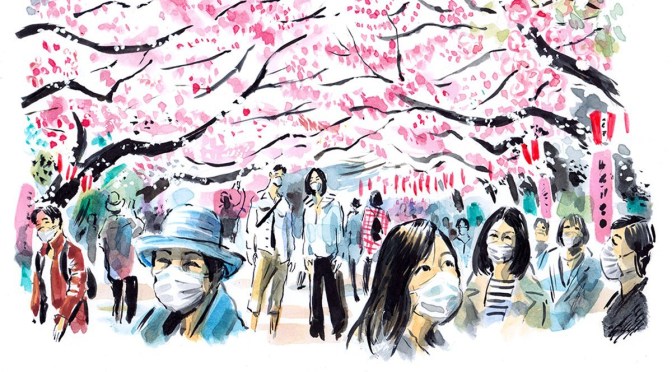
From a The Economist online article (March 23, 2020):
In this year of coronavirus contagion, however, the prospect of cheek-by-jowl hanami parties has alarmed the authorities. Tokyo’s government has urged people to steer clear of gatherings “that involve food and drink” to slow the spread of infection. To little effect.
EVERY MARCH and April trees along the banks of the Meguro river in Tokyo fleetingly erupt with fat pink and white cherry blossoms, heralding the arrival of spring. For a few glorious weeks, millions of people across the city flee the drudgery of the office and factory to spend an hour or two in places like this, eating and drinking under falling sakura petals. It is a ritual with ancient roots, with a chapter devoted to it in “The Tale of Genji”, a tenth-century work that is perhaps the world’s first novel.




 Chloroquine was shown in 2004 to be active in vitro against SARS coronavirus but is of unproven efficacy and safety in patients infected with SARS-CoV-2. The drug’s potential benefits and risks for COVID-19 patients, without and with azithromycin, is discussed by Dr. David Juurlink, head of the Division of Clinical Pharmacology and Toxicology at Sunnybrook Health Sciences Centre in Toronto.
 In a leafy Boston suburb, a place to park cars and repair vintage scooters grows into a bucolic sanctuary.




 The International Photography Hall of Fame and Museum mourns the passing of its first Lifetime Achievement Award Winner and 2017 inductee Kenny Rogers. Rogers was a dedicated and talented photographer for nearly four decades. His best-known images are portraits of well-known singers, actors, and dignitaries from around the globe.


 EVERY MARCH and April trees along the banks of the Meguro river in Tokyo fleetingly erupt with fat pink and white cherry blossoms, heralding the arrival of spring. For a few glorious weeks, millions of people across the city flee the drudgery of the office and factory to spend an hour or two in places like this, eating and drinking under falling sakura petals. It is a ritual with ancient roots, with a chapter devoted to it in “The Tale of Genji”, a tenth-century work that is perhaps the world’s first novel.
 Boomers Daily