

Outdoor reel showcasing some of my favorite moments in motion from the last few years including timelapse photography, aerial cinematography, wildlife videography and more.
Category Archives: Videos

Unique Tiny Homes: “Amp House” In Fayetteville, Arkansas (AD Video)
Today we visit Fayetteville, Arkansas to tour a tiny house capable of booming sound. When Asha Mevlana isn’t on tour with the Trans-Siberian Orchestra, she hosts neighborhood concerts from her compact custom home. Situated between her living quarters and the trailer devoted to her instruments, Asha’s porch has enough room for performers to fill the street with music, courtesy of the built-in, wall-sized outdoor amplifier. The innovations don’t end there, though, as living in a tiny house presents plenty of design challenges to overcome. Watch and learn about the ins and outs of this peculiar property on today’s episode of Unique Spaces.

Top New Nature Videos: “Siouxon Creek” & Falls In Washington State (2020)
Filmed and Edited by: Henry Jackson
Simply capturing the ambiance and feeling of a beautiful location in the Pacific Northwest tucked in the southern forests of Washington. Turquoise rivers and amazing waterfalls housed within one of the most peaceful forests you’ll ever encounter. A location deserving of visual documentation.
Although this gently rolling creekside ramble is one continuous trail, an adventure in three parts awaits. The first few miles are a quiet walk through a classic fern-dotted, mossy forest. In the second section, hikers find Siouxon Creek and fellow waterfall seekers, and the final miles offer more solitude and small narrow canyons with more waterfalls to enjoy.
The trail to Siouxon Falls, Chinook Falls, and at least three other waterfalls along the way, starts from a subtle trail sign three miles before reaching the main Siouxon Trailhead on FR 5071. Look for a plain trail marker on the left side just after a pull-out on the right after a hairpin right turn. Once you step into the trees, you’ll see the Siouxon Trail No. 130 sign pointing the way to Huffman Peak turnoff (1 mile away) and the main Siouxon trailhead in 3 miles.

Artist Profiles: 69-Year Old American Painter Sigrid Burton (Video)
“I draw literally and figuratively from the natural world. My drawing and mark making refer to and derive from botanical and biological anatomies, including marine life, as well as, the structures of both macro and micro cosmologies and writing systems, such as logograms.”
Sigrid Burton is an American painter, long based in New York City, whose semi-abstract work is known for its use of expressive, atmospheric color fields and enigmatic allusions to natural and cultural realms. Burton has had solo exhibitions in New York City, Los Angeles, San Francisco, Chicago and Osaka, including at Artists Space and the Michael C. Rockefeller Arts Center, and been included in shows at A.I.R. Gallery, the John and Mable Ringling Museum of Art, and the Carnegie Art Museum, Oxnard. Her work belongs to the public collections of the Metropolitan Museum of Art, Rockefeller Foundation, and Palm Springs Desert Museum, and has been reviewed in Arts Magazine, Arts & Antiques, Jung Journal, Chicago Tribune and LA Weekly.
Writers most frequently observe that Burton’s atmospheric works recall artists such as J.M.W. Turner, Odilon Redon, Pierre Bonnard and Mark Rothko, as well as the light of her native California. Art & Antiques described her approach as “chromatic expressionism” in which color is “her undisputed protagonist”. Peter Frank observed, “The dialectic between color and form has always inflected, even impelled” Burton’s painting, with color the more omnipresent element, and form the more persistent. Art historian William C. Agee wrote, “The domains she explores […] meet, intersect, fuse, and then disappear, like apparitions, in liquid pools of mist and color. Her pictorial odyssey refers simultaneously to both a higher order, a timeless cosmic vastness, as well as to a private, interior world, abounding in personal histories and memories.” Burton has lived and worked in Pasadena, California since 2013.
From Wikipedia
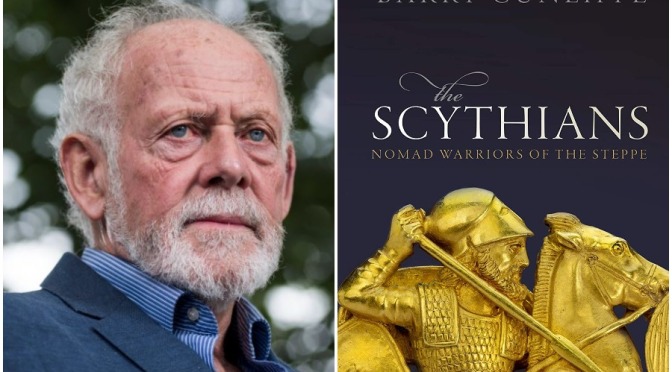
Archaeology Lectures: “The Scythians – Nomad Warriors Of The Steppe” Author Barry Cunliffe
Brilliant horsemen and great fighters, the Scythians were nomadic horsemen who ranged wide across the grasslands of the Asian steppe from the Altai mountains in the east to the Great Hungarian Plain in the first millennium BC.
Their steppe homeland bordered on a number of sedentary states to the south – the Chinese, the Persians and the Greeks – and there were, inevitably, numerous interactions between the nomads and their neighbours. The Scythians fought the Persians on a number of occasions, in one battle killing their king and on another occasion driving the invading army of Darius the Great from the steppe.
Barry Cunliffe, Emeritus Professor of European Archaeology, University of Oxford.
Barry Cunliffe taught archaeology at the Universities of Bristol and Southampton and was Professor of European Archaeology at the University of Oxford from 1972 to 2008, thereafter becoming Emeritus Professor. He has excavated widely in Britain (Fishbourne, Bath, Danebury, Hengistbury Head, Brading) and in the Channel Islands, Brittany, and Spain, and has been President of the Council for British Archaeology and of the Society of Antiquaries, Governor of the Museum of London, a Commissioner of English Heritage, and a Trustee of the British Museum.

Museum Tours: View “The Garden Court – Frick Collection” In 5K Video
Enjoy this 360° video view of the Garden Court of The Frick Collection. Available through your phone with Google Cardboard or other viewer as a 360° VR video. Right click or control + click (on a Mac) to select loop and enjoy the soothing sounds of the fountain. Shot during the exhibition, Canova’s George Washington, on view at The Frick Collection from May 23, 2018 to September 23, 2018.

Health: Disinfectants Fighting Coronavirus – “From Clinical Space To The Mainstream” (WSJ)
As many businesses around the world struggle, a Canadian disinfectant company is increasing production to keep up with demand during the novel coronavirus outbreak. Photo: Ron Kolumbus/WSJ

Health Lecture: “Sleep Medicine, Art & Literature” By Professor Meir Kryger
Sleep medicine, art and literature – ars longa, vita brevis. Organised by the Sleep Medicine Section 4 February 2020.
Professor Meir Kryger, Author and Professor, Yale School of Medicine – Sleep Disorders & Effective Treatments.
Lecture: Sleep in art: A 7000 year odyssey
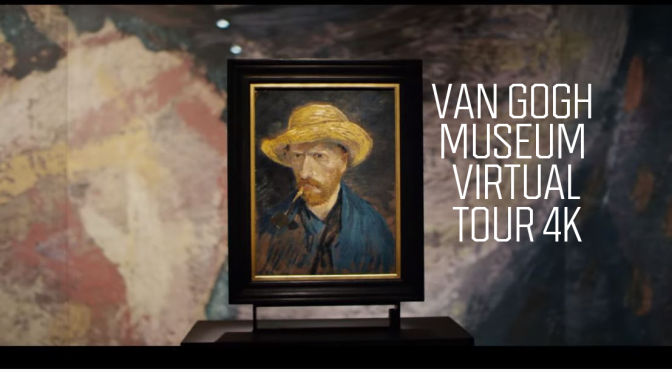
Fine ARTS: 4K Video Tour – The VAN GOGH MUSEUM “Modern Art In Paris”
Van Gogh Museum Tour in 4K. Have you always wanted to be alone in the Van Gogh Museum? Step into Vincent’s world and enjoy the private video tour. Episode 3: Van Gogh Museum Amsterdam
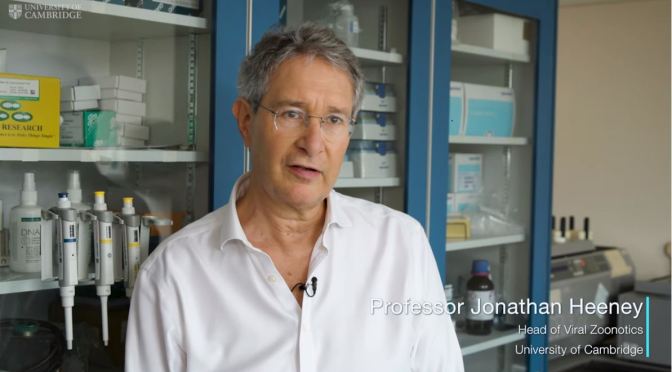
COVID-19 / Coronavirus: Cambridge Scientists Using Genomics To Create “Pandemic Flu Vaccines”
The race is on to find a vaccine against the new COVID-19 coronavirus. Professor Jonathan Heeney explains why a cautious approach is needed and how his team is using new technology developed for influenza and Ebola viruses to target the new infection.
It is hard now to conceive that two months ago, few people had heard of the new coronavirus. Now, the virus, which causes the disease COVID-19, has spread to every corner of the globe. The World Health Organization has officially declared the outbreak a pandemic.
With the threat of hundreds of thousands – possibly millions – of people being infected and healthcare systems becoming overwhelmed, the race is on to develop a vaccine that will protect individuals and slow the spread of the disease. But Professor Jonathan Heeney, Head of the Laboratory of Viral Zoonotics at the University of Cambridge, and one of the people working on a vaccine, says that coronaviruses present a particular challenge to vaccine developers.
Coronaviruses are named after their appearance: they are spherical objects, on the surface of which sit ‘spike’ proteins. The virus uses these spikes to attach to and invade cells in our body. Once inside, the virus uses the cell’s own machinery to help itself replicate and spread throughout the body, causing disease and allowing it to transmit onwards.
Traditionally, scientists would develop vaccines that programme the body to produce antibodies that recognise and block these spikes. But this strategy can misfire with coronaviruses due to a phenomenon known as ‘antibody-induced enhancement’ or ‘vaccine-induced enhancement’, says Heeney.
“If you make antibodies against the spike, they can end up binding to it and helping the virus invade important immune cells known as monocyte-macrophages. Rather than destroying the virus, these cells can then end up being reprogrammed by the viruses, exacerbating the immune response and making the disease much, much worse than it would otherwise be.”
 Boomers Daily