Category Archives: Reviews

Science: How Humans Started Counting, Sea Anemones & ClownFish

The cross-discipline effort to work our how ancient humans learned to count.

In this episode:

00:45 Number origins

Around the world, archaeologists, linguists and a host of other researchers are trying to answer some big questions – when, and how, did humans learn to count? We speak to some of the scientists at the forefront of this effort.

News Feature: How did Neanderthals and other ancient humans learn to count?

07:47 Research Highlights

How sea anemones influence clownfish stripes, and how skin-to-skin contact can improve survival rates for high-risk newborns.

Research Highlight: How the clownfish gets its stripes

Research Highlight: Nestling skin-to-skin right after birth saves fragile babies’ lives

09:48 Briefing Chat

We discuss some highlights from the Nature Briefing. This time, an upper limit for human ageing, and could tardigrades survive a collision with the moon?

Scientific American: Humans Could Live up to 150 Years, New Research Suggests

Science: Hardy water bears survive bullet impacts—up to a point

Reviews: EU Approves Insects As ‘Food’ (Video)

Insects have long been a staple food in Asia. In Europe, not so much. But diets are changing, with ever more people trying to avoid meat – for health or moral reasons, or because raising farm animals is less and less sustainable. Now, the European Commission has officially declared mealworms to be food. It’s a game changer for insect farmers, many of whom have so far operated under temporary license. Insects are rich in protein: Up to 70 percent of their entire mass is protein. In addition to that, they’re also rich in healthy Omega-3 fatty acids, like fish. Some insects, especially the mealworm, have over 14 percent of fatty acids – that’s seven times as much as fish.

Infrastructure: Highways In U.S. Being Removed (WSJ)

President Biden’s infrastructure plan calls for non-traditional projects like the removal of some highways. What Democrats want for cities like Baltimore says a lot about the President’s goals in the next wave of development. Photo: Carlos Waters/WSJ More from the Wall Street Journal: Visit WSJ.com: 

Research: Aging & Cancer Microenvironments

Professor Ashani Weeraratna has been studying the cancer microenvironment in her lab for the past 17 years. Taking into account that the tissues in our bodies change as we age is important when researching cancer biology. She hopes that gaining a better understanding of how the growth of cancer cells is affected by their direct cellular ‘neighbourhood’, especially when we age, could be key to developing better treatments for patients with cancer. Read more in https://www.nature.com/immersive/d428…

Analysis: The Logistics & Challenges Of Flying Cars

As electric vehicle technology takes off—literally—how will the logistics of air traffic work out? Join American broadcaster Miles O’Brien and NOVA to watch how NASA researchers are writing the rules that will make air travel via electric vehicles safe. Tune in to “Great Electric Airplane Race” on Wednesday, May 26 at 9/8c or stream it on the PBS Video app or online now: https://to.pbs.org/3vNPEGF

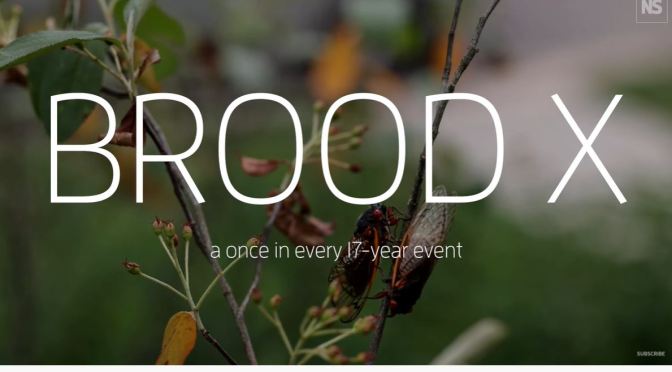
Science: ‘Brood X’ Cicadas Emerge After 17 Years

Trillions of cicadas are starting to emerge in 15 US states after 17 years underground. Gene Kritsky has been studying them for decades and has created a citizen science app, Cicada Safari, to help track the brood.

More than 3000 cicada species have been described worldwide. Most have a yearly life cycle, but seven species in the US belonging to the Magicicada genus remain underground as nymphs for 13 or 17 years before emerging, a process called periodical brooding. The only other two species of cicada to do this are found in Fiji and India. Read more at https://www.newscientist.com/article/…

Italian Design: 90 Years Of ‘Pininfarina’ Celebrated

The world’s most famous automotive design house, Pininfarina celebrates 90 years of style and innovation with a new exhibition at the MAUTO in Turin, open from May to September.

Founded in 1930, Pininfarina has evolved from an artisan concern to a global brand employing over 600 people. In those 90 years Pininfarina has given us some of the world’s most beautiful automobiles, but also demonstrated exciting innovation. Divided up in to six areas the exhibition will showcase the unique breadth of the brand from the gorgeous Cisitalia 2020, to the 1969 Sigma Grand Prix and off into the future with the exciting new Battista, electric hypercar concept.

Read more at Classic Driver

Analysis: Can EV Battery Swapping Gain In The U.S.?

San Francisco-based Ample has brought electric vehicle battery swapping to the U.S. The company was in stealth mode for seven years before launching recently with five swapping stations in the Bay Area. Uber drivers in the area are Ample’s first customers.

The concept isn’t new. A start-up called Better Place launched an EV and battery swapping company after it raised $850 million in venture funding, but it ultimately went bankrupt in 2013. Tesla also demoed battery swapping in 2013 but only opened one station for about a year. Elon Musk said Tesla owners were not interested in it.

Battery swapping is already common in China. Electric vehicle maker Nio, for example, plans to double its network of swapping stations to 500 this year and plans to open stations in Norway as part of its expansion into Europe. Ample has a different approach, with modular batteries and a focus on fleets. CNBC got an inside look at its headquarters and battery factory in San Francisco to learn how the company plans to bring battery swapping into the mainstream.