“Xi’s sense of personal destiny entails significant risk of war…”
Foreign Affairs (September 29, 2023):The United States now confronts graver threats to its security than it has in decades, perhaps ever. Never before has it faced four allied antagonists at the same time—Russia, China, North Korea, and Iran—whose collective nuclear arsenal could within a few years be nearly double the size of its own. Not since the Korean War has the United States had to contend with powerful military rivals in both Europe and Asia. And no one alive can remember a time when an adversary had as much economic, scientific, technological, and military power as China does today.
The problem, however, is that at the very moment that events demand a strong and coherent response from the United States, the country cannot provide one. Its fractured political leadership—Republican and Democratic, in the White House and in Congress—has failed to convince enough Americans that developments in China and Russia matter. Political leaders have failed to explain how the threats posed by these countries are interconnected. They have failed to articulate a long-term strategy to ensure that the United States, and democratic values more broadly, will prevail.
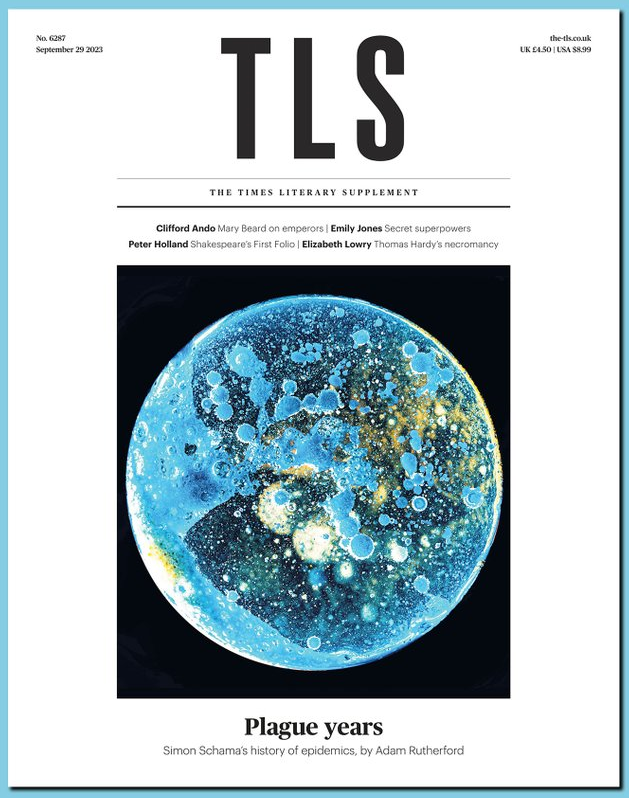
Times Literary Supplement (September 29, 2023): The new issue features The First Folio at 400; how disease shaped global history; novels of queer experience; what Britain laughs at; literary thefts and coincidences – and much more…
Scientists often make poor historians. Their shortcomings in describing and analysing the past include a failure to shed the whiggish stories that academic history moved away from decades ago. Straight lines are still drawn between Great Men and the impact of their brilliant insights on our view of reality. They also sometimes fail to treat the material of history with the seriousness they bring to their own discipline. Simple questions that are drummed into schoolchildren are frequently ignored in analysing documentary evidence: who wrote this, why, and for whom? The result is context-lite narrative that doesn’t stand up to scrutiny.
Next year, the Folger Shakespeare Library in Washington DC will reopen after a three-year closure for a large-scale renovation of its building, which dates from 1932. The centrepiece of the new Shakespeare Exhibition Hall, will be, as the press release puts it, something “that only the Folger could produce: all 82 copies of the 1623 First Folio of Shakespeare that were collected by Henry and Emily Folger”. The Folger holds slightly more than a third of all extant copies of the book and now eighty of them will be on permanent show in a “20-foot long visible vault”, while two more will be open in cases as part of an “interactive” visitor experience. Peering into the vault says much about the Folgers’ appetite for cornering the market in Folios but, since nearly all copies differ in some respects, it did make some kind of sense to buy many of them.
The Week In Art Podcast (September 28, 2023): This week: three big London shows, in depth. As Marina Abramović draws huge crowds to the Royal Academy of Arts in London, we interview her about the exhibition—the first ever dedicated to a woman artist in the Royal Academy’s main galleries.
At the National Gallery, meanwhile, is a remarkable survey of the paintings of the 17th-century Dutch master Frans Hals, which will tour next year to Amsterdam and Berlin. We take a tour with Bart Cornelis, curator of the National’s incarnation of the show. And this episode’s Work of the Week is Peter Paul Rubens’s Three Nymphs with a Cornucopia of around 1625 to 1628 (painted with Frans Snyders). In the collection of the Prado in Madrid, it is one of a number of major loans to the exhibition Rubens and Women at the Dulwich Picture Gallery in London. Amy Orrock, one of the curators of the exhibition, tells us more.
Marina Abramović, Royal Academy of Arts, London, until 1 January 2024. You can hear our interview with Marina during the Covid lockdown in our episode from 8 May 2020, and a conversation with Tate Modern’s Catherine Wood about Ulay, following his death in 2020, in the episode from 6 March that year.
Earth scientists often call climate change a “great global experiment,” which humanity is heedlessly performing as we pump greenhouse gases into the atmosphere. The dire consequences are already becoming clear—not just for the workings of the planet, but for our own health. Over the next few days, the stories in this special package will explore the threats, and how we can minimize them.
From cold viruses to influenza to respiratory syncytial virus, viruses that spread through the air cause billions of infections each year. That makes it important to understand how they will respond to climate change. But little is known so far, except that different viruses will react differently. Measles, for instance, spreads efficiently in all climates, suggesting global warming will make little difference to its transmission.
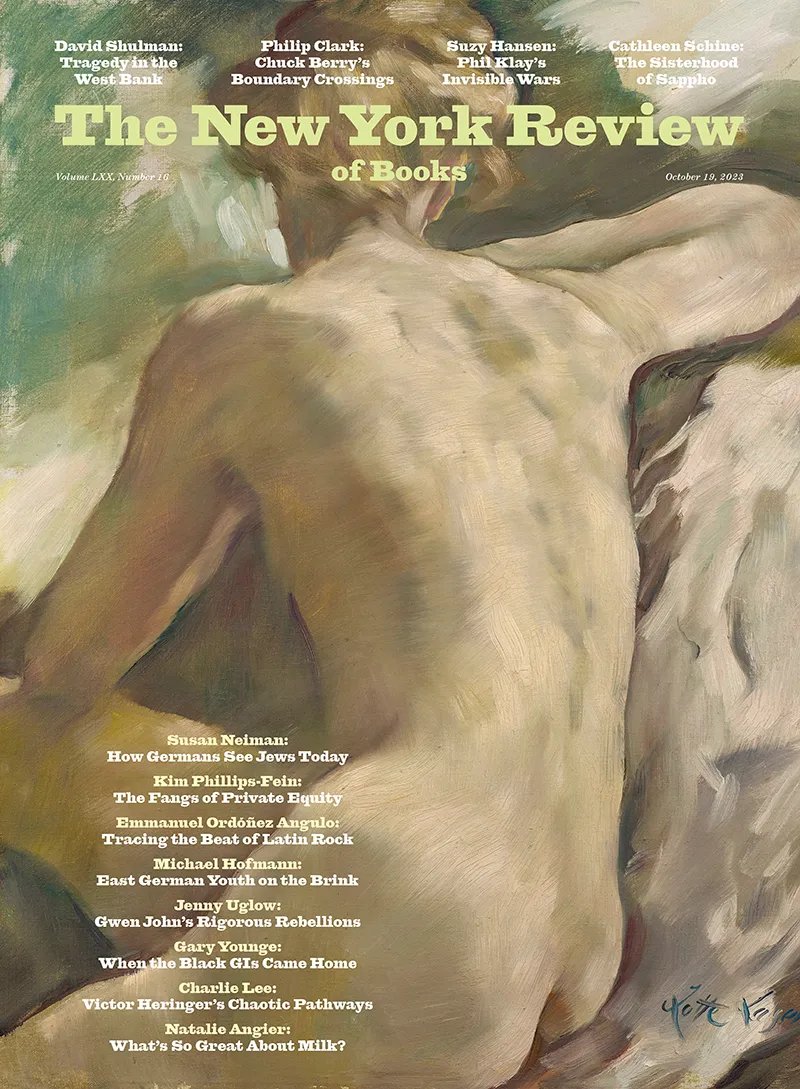
The New York Review of Books (October19, 2023)– The latest issue features with Gary Younge on the Black soldiers who fought for freedom at home and abroad, David Shulman on the road to a second Nakba, Jenny Uglow on the exuberant Gwen John, Suzy Hansen on America’s endless and remote wars, Kim Phillips-Fein on plundering private equity, Natalie Angier on milk, Megan O’Grady on Lucy Lippard, Adam Kirsch on the prophetic Kieślowski, Philip Clark on the lines Chuck Berry crossed, Susan Neiman on Germany’s historical memory, poems by Arthur Sze, Jessica Laser, and Jules Laforgue, and much more.
Half American: The Epic Story of African Americans Fighting World War II at Home and Abroad by Matthew F. Delmont
The ambivalence many Black soldiers felt toward the United States during World War II was matched only by the ambivalence the United States demonstrated toward the principles on which the war was fought.
One of my favorite novels is by Compton Mackenzie, a Scottish writer known today, if he is known at all, for his whimsically comic Whisky Galore (1947) and his ambitious early novel Sinister Street (1913). The one I love, however, is Extraordinary Women: Theme and Variations (1928), a satirical roman à clef about the sapphic adventures of the unorthodox and eccentric inhabitants of an island modeled after Capri during World War I. After Sappho, a novel by Selby Wynn Schwartz that was longlisted for the Booker Prize in 2022, is many things, none of them satirical, but I kept thinking of the title of Mackenzie’s book as I read it.
The Economist Magazine (September 30, 2023): The latest issue features The war in Ukraine is a powerful reason to enlarge—and improve—the EU; Why fear is spreading in financial markets; A humanitarian disaster is under way in Nagorno-Karabakh…
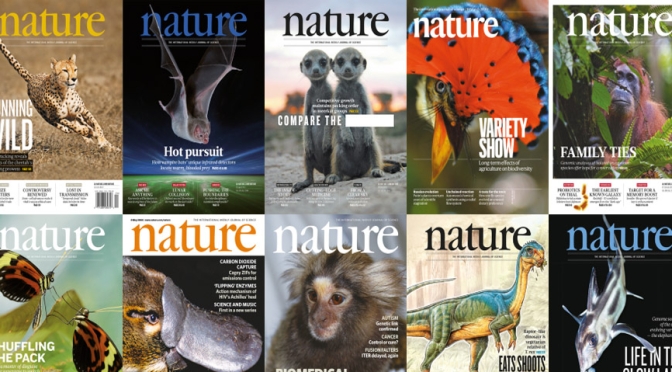
Deceptive videos and images created using generative AI could sway elections, crash stock markets and ruin reputations. Researchers are developing methods to limit their harm.
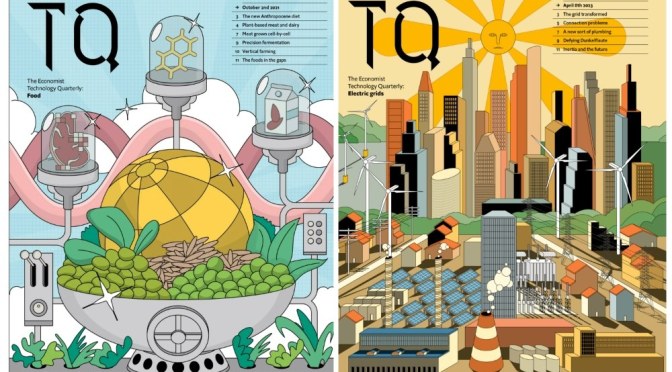
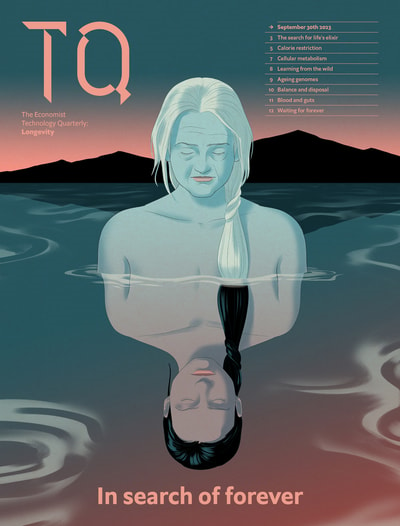
TECHNOLOGY QUARTERLY (SEPTEMBER 27, 2023) – The new issue features ‘In search of forever’ – Slowing, let alone reversing, the process of ageing was once alchemical fantasy. Now it is a subject of serious research and investment, Geoffrey Carr reports.
And some of it is making progress, writes Geoffrey Carr
“All my possessions for a moment of time.” Those, supposedly, were the last words of Elizabeth I, who as queen of England had enough possessions to be one of the richest women of her era. Given her patronage of alchemists—who searched, among other things, for an elixir of life—she may have meant it literally. But to no avail. She had her last moment of time in March 1603, a few months short of the three score years and ten asserted by the Bible to be “the days of our years”.
And various existing medicines may offer similar benefits
In 1991 eight volunteers sealed themselves into a huge greenhouse in the desert near Tucson, Arizona. They were part of an experiment seeking to discover whether a carefully curated selection of plants and animals could develop into a self-sustaining ecosystem: a “Biosphere 2” independent of “Biosphere 1”, aka the outside world.
Country Life Magazine – September 27, 2023: The new issue features The Need For Tweed; A perfect pre-trained gundog; A new Jacobean drawing room is the crowning glory at Shilstone, Devon, and more…
The need for tweed
A true Hebridean hero weaves his magic to create an ‘estate’ Harris tweed for David Profumo
Here’s one I trained earlier
Has your over-excited pup left you red-faced on a shoot day? Katy Birchall has the answer: a perfect, pre-trained gundog
Loved to life
A new Jacobean drawing room is the crowning glory at Shilstone, Devon, discovers John Goodall
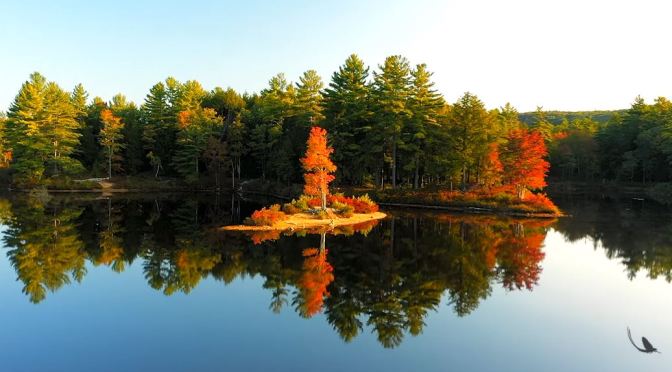
The brilliant mountain maples, birches and beeches in the White Mountains of New Hampshire
NEW YORK TIMES TRAVEL (September 25, 2023) – Here are five beautiful places to catch the leaves — and while you’re there, you can peek out of covered bridges, gaze up at waterfalls, ride a tramway or a train, or even try to spot a legendary Bigfoot-like creature known as the Grassman.
NEW HAMPSHIRE
White Mountains Trail
Driving the White Mountains Trail, a 108-mile loop that winds through groves of gold birches, bronze beeches, and orange, yellow and red mountain maples, you may find yourself unable to resist stopping in the middle of a covered bridge to peek through the walls.
The Albany Covered Bridge, which crosses the rocky Swift River in the White Mountain National Forest near Conway, N.H., is one of 54 remaining covered bridges in the state. Built in 1858, it features a red roof and weathered brown walls with gaps that let the leaves peep at you.
MASSACHUSETTS
Mount Greylock State Reservation
From the study at his farmhouse in Pittsfield, in western Massachusetts, Herman Melville gazed at 3,491-foot Mount Greylock, whose humped shape possibly inspired the white whale in “Moby-Dick.” When the trees on that hump start to change, it becomes more of a gloriously mottled whale.
The mountain’s colors typically peak in early to mid-October, with golds, bright oranges and vivid reds, mainly from tamarack, striped maple and yellow birch. The wet summer may lead to some spotting and discoloration on some leaves, said Nicole Keleher, the director of forest health for the Massachusetts Department of Conservation and Recreation, but she predicted a wide variety of colors overall.
GEORGIA
Chattahoochee-Oconee National Forest
The Russell-Brasstown National Scenic Byway, a 40-mile loop through the nearly 867,000-acre Chattahoochee-Oconee National Forest, winds through mountains drenched in the yellows of tulip poplars, the crimsons of dogwood, and the scarlets and purples of maples — with most expected to peak the week of Oct. 24, said Steven Bekkerus, a public affairs officer for the forest.
Deep in those woods, you’ll find two waterfalls to complement the autumn palette.
OHIO
Cuyahoga Valley National Park
From a vintage rail car on the Cuyahoga Valley Scenic Railroad, the reds and golds of Cuyahoga Valley, Ohio’s only national park, roll by — and if you see a shadow darting among the trees, it could be the Ohio Grassman, also known as the eastern Bigfoot, a creature reputed to reside in the woods there.
The colors, which peak in mid- to late October, “range from brilliant reds of the sugar maples to the deep browns of the white oaks,” said Pamela Barnes, a public information officer at the park, which is just south of Cleveland.
News, Views and Reviews For The Intellectually Curious





























 Boomers Daily