
Category Archives: Arts & Literature

Arts & Travel Videos: “Odunpazari Modern Museum” Is The New Cultural Center In Turkey

Monocle 24 Films logoWe visit a Kengo Kuma-designed art museum in Eskisehir that’s set to become Turkey’s new cultural hotspot.

Odunpazarı Modern Museum is designed by the internationally acclaimed Japanese architecture firm Kengo Kuma and Associates.
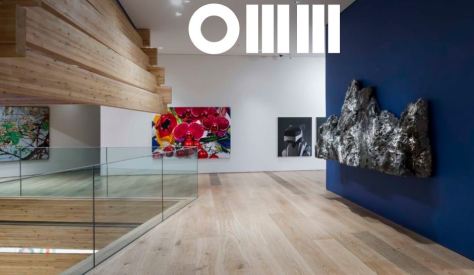
Odunpazarı Modern Museum in Turkey

Kengo Kuma and Associates describes its philosophy as “Amalgamating nature and architecture in a manner that creates a strong bond between the ‘building’ and its ‘location’.” In his design of the OMM building, the architect thus reinterprets the historic fabric of the Odunpazarı district with a contemporary perspective. Paying homage to the local architecture of Odunpazarı, Ottoman dome architecture, and traditional Japanese architecture, OMM’s design is highlighted by four major components: geometry, light, stacking, and timber. Breaking away from conventional design through the transformation of simple geometric lines into complex images, the high-quality light entering the building, and the non-linear forms, the architectural stacking and the timber construction system alluding to the historic fabric of Odunpazarı constitute the sources of inspiration for the architecture of the museum building.

OMM – Odunpazarı Modern Art Foundation was founded in 2019 with the aim of contributing towards the development of cultural, social, and artistic life through events and activities centered on the familiarization and popularization of culture and arts in society, the advancement of art education, the support for artistic and cultural production, and the transmission of cultural values to future generations. OMM – Odunpazarı Modern Museum operates under the auspices of this foundation.
Website

Top Exhibitions: “Painting Edo: Japanese Art from the Feinberg Collection”

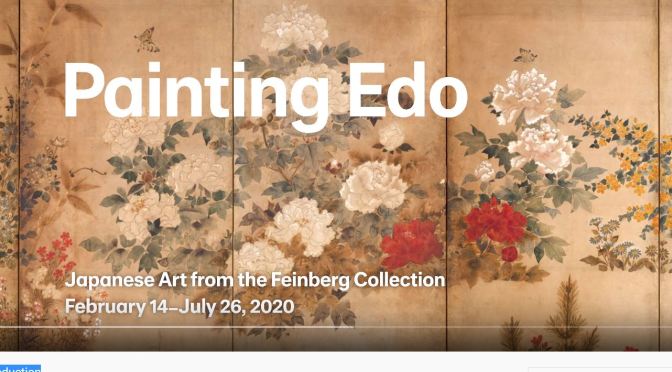
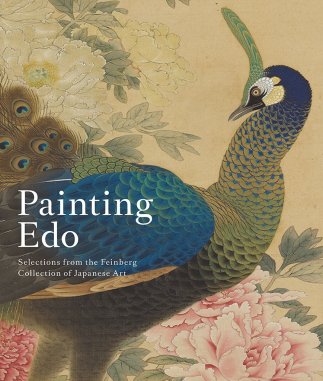
Painting Edo Illustrated Overview HarvardPainting Edo — the largest exhibition ever presented at the Harvard Art Museums — offers a window onto the supremely rich visual culture of Japan’s early modern era. Selected from the unparalleled collection of Robert S. and Betsy G. Feinberg, the more than 120 works in the exhibition connect visitors with a seminal moment in the history of Japan, as the country settled into an era of peace under the warrior government of the shoguns and opened its doors to greater engagement with the outside world. The dizzying array of artistic lineages and studios active during the Edo period (1615–1868) fueled an immense expansion of Japanese pictorial culture that reverberated not only at home, but subsequently in the history of painting in the West.

By the early 18th century, the new shogunal capital of Edo (present-day Tokyo) was the largest city in the world. After centuries of conflict and unrest, the growing stability and affluence of the period encouraged an efflorescence in the arts. Artists creatively juxtaposed past and present, eternal and contingent, elegant and vulgar in a wide range of formats and styles, from brilliant polychrome compositions to monochromatic inkwork. Painting Edo explores how the period, and the city, articulated itself by showcasing paintings in all the major formats—including hanging scrolls, folding screens, sliding doors, fan paintings, and woodblock-printed books—from virtually every stylistic lineage of the era, to tell a comprehensive story of Edo painting on its own terms.

Website

Top Upcoming Movies: “The French Dispatch” Directed By Wes Anderson (Jul 2020)

From a New Yorker online review (February 11, 2020):

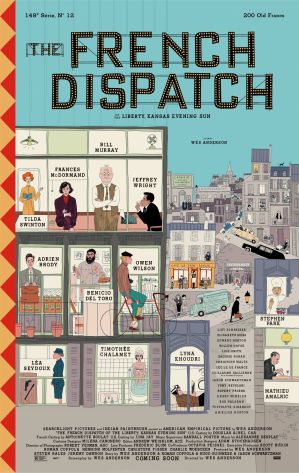
The French Dispatch Movie PosterWes Anderson’s new movie, “The French Dispatch,” which will open this summer, is about the doings of a fictional weekly magazine that looks an awful lot like—and was, in fact, inspired by—The New Yorker. The editor and writers of this fictional magazine, and the stories it publishes—three of which are dramatized in the film—are also loosely inspired by The New Yorker. Anderson has been a New Yorker devotee since he was a teen-ager, and has even amassed a vast collection of bound volumes of the magazine, going back to the nineteen-forties. That he has placed his fictional magazine in a made-up French metropolis (it’s called Ennui-sur-Blasé), at some point midway through the last century, only makes connecting the dots between “The French Dispatch” and The New Yorker that much more delightful.
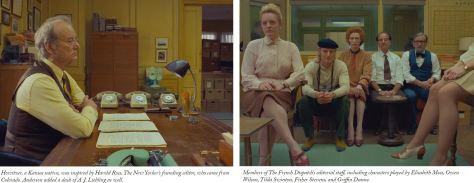
The French Dispatch of the Liberty, Kansas Evening Sun Movie Scenes From the New Yorker February 11 2020

Directed by: Wes Anderson

Screenplay by: Wes Anderson

Produced by: Wes Anderson, Steven Rales and Jeremy Dawson

Cast: Benicio del Toro, Adrien Brody, Tilda Swinton, Léa Seydoux, Frances McDormand, Timothée Chalamet, Lyna Khoudri, Jeffrey Wright, Mathieu Amalric, Stephen Park, Bill Murray and Owen Wilson

Read more

New Exhibits: “Peter Saul – Crime And Punishment” At The New Museum NYC

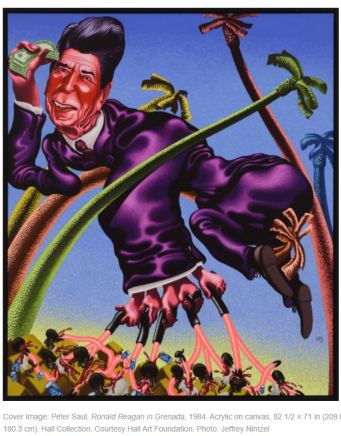
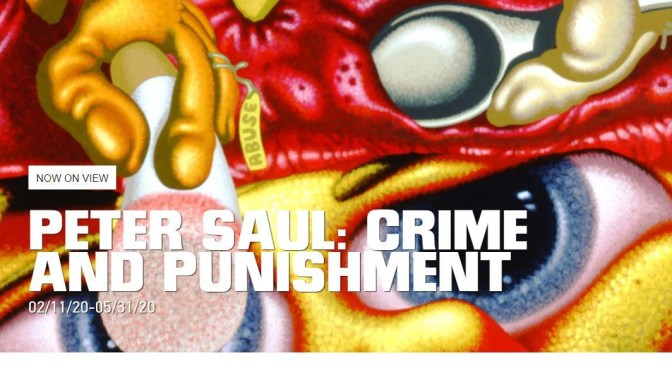
Peter Saul Ronald Reagan in Grenada 1984Beginning in the early 1960s, Peter Saul began to incorporate imagery borrowed from a range of pop-cultural sources into his exuberant, brightly colored paintings, adopting a style that has proven to be far ahead of its time. His work developed independently from concurrent art historical movements like Pop art, with which it shares some superficially similar concerns. Instead of the cool detachment of Andy Warhol and Roy Lichtenstein, however, Saul crafted his own unique blend of Surrealism, history painting, vernacular illustration, and the real-life shock and horror of current events.
Marking the artist’s first New York museum survey, this exhibition will bring together approximately sixty paintings from across his long career.

Saul’s earliest paintings, which he created in Paris, demonstrate a loose, gestural style of abstraction, yet he began to incorporate text, recognizable characters, and consumer products into his works as early as 1960. Around this time, he plucked figures like Donald Duck and Superman from the pages of comic books and deposited them into chaotic scenes representative of the avarice and violence of America. In the late 1960s and early 1970s, Saul created some of his most shocking and indelible works in response to the Vietnam War, with a series that captured the conflict’s grotesque brutality, racism, and destruction. A later group of paintings, which examines the chaotic sociopolitical fabric of urban life in California, reflects the dissolution of 1960s counterculture and the corruption, racism, and greed of US politics.

Saul extended his interrogation of American history in his portraits of infamous criminals like John Wayne Gacy, archetypes like cowboys and businessmen, and US presidents such as Ronald Reagan, George W. Bush, and Donald Trump, whom Saul depicts with disdain and condemnation. He has also looked further back to reimagine supposedly triumphant scenes from America’s past—including Columbus’s arrival in America, Washington crossing the Delaware, and Custer’s Last Stand—as moments of comical failure or disgrace. With a caustic sense of humor, Saul has continuously skewered America’s leaders, rendering their stretched, distorted bodies in Day-Glo colors. His disparate influences range from MAD magazine comics to Surrealist fantasies and American social realist painting from the 1930s.

Peter Saul is an American painter. His work has connections with Pop Art, Surrealism, and Expressionism. His early use of pop culture cartoon references in the late 1950s and very early 1960s situates him as one of the fathers of the Pop Art movement. He realised about 800 paintings during his career.

Website

New Art Books: “The Art Of Still Life” By Todd M. Casey

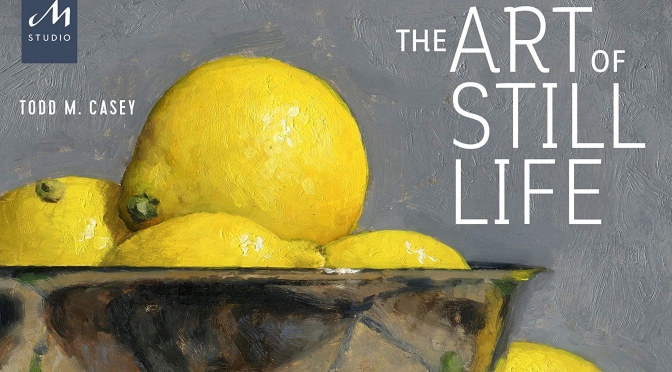
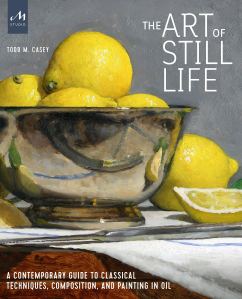
The Art of Still Life A Contemporary Guide to Classical Techniques Composition and Painting in Oil Todd M CaseyEvery artist needs to learn and master the still life. Written by a well-known artist and expert instructor, The Art of Still Life offers a comprehensive, contemporary approach to the subject that instructs artists on the foundation basics and advanced techniques they need for successful drawing and painting.
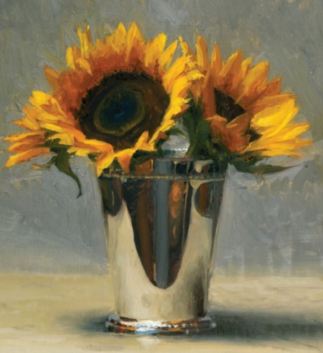
In addition to Casey’s stunning paintings, the work of over fifty past and present masters is included, so that the book will do double duty as a hardworking how-to The Art of Still Life Todd M Casey Feb 2020manual and a visual treasure trove of some of the finest still life art throughout history and being created today.
A Massachusetts native, TODD M. CASEY studied at art schools in Boston and San Francisco before embarking on the classical artistic education offered by Jacob Collins’s famed Water Street Atelier in New York City. A modern master of the still life genre, Casey teaches at several institutions, including the Art Students League of New York. He is represented by Rehs Contemporary Galleries, Inc., New York, and his paintings are held in numerous private collections worldwide. He lives with his wife and daughter in New York’s Hudson Valley. Visit his website at toddmcasey.com.

Read more or purchase

New Art Books: “Cherry Blossoms – Sakura Collections From The Library Of Congress”

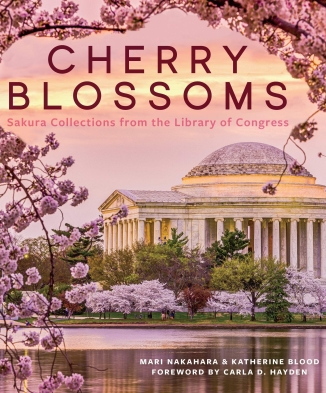
Cherry Blossoms Sakura Collections from the Library of Congress book February 11 2020“Cherry Blossoms” reflects on the long tradition of flower viewing in Japanese culture with vivid color woodblock prints by ukiyo-e master artists, photographs, color lithographic posters and Kōkichi Tsunoi’s exquisite watercolor drawings from 1921. The book highlights the rich connections between Japan’s centuries-old traditions and contemporary counterparts. The American public’s affection for the blossoms is revealed in vintage and contemporary photographs of the Tidal Basin, collections related to the National Cherry Blossom Festival and the Cherry Blossom Princess Program, as well as decades’ worth of creatively designed festival posters.


Vibrant springtime traditions of cherry blossom viewing in Japan and Washington, D.C., are explored in the new book “Cherry Blossoms: Sakura Collections from the Library of Congress,” published today by Smithsonian Books, in association with the Library of Congress.

Visual art, including prints, drawings and photographs from the Library’s collections, provide a fresh look at the tradition of cherry blossom celebrations that originated more than 1,200 years ago. Japan shared the tradition with the United States when they presented the nation’s capital with 3,020 cherry trees in 1912. Ever since, D.C. residents and visitors have been mesmerized by the trees and have joined in the festivities of the National Cherry Blossom Festival, which draws more than 1.5 million visitors each year.

Fascinating Facts about Cherry Blossom Traditions:

  • It started over 1,200 years ago…with plum blossoms! The Japanese custom of flower viewing, or hanami, is thousands of years old. Beginning in the 9th century, saplings and trees were brought down from the mountains to grace the gardens of the aristocracy. The practice was first associated with plum (ume) blossoms before it became linked almost exclusively with cherry blossoms during the Heian period (794-1185).
  • A feudal warlord threw some of the most lavish parties. Before it became popular with people at all levels of society, cherry blossom viewing in Japan was reserved for the elite. Legendary feudal warlord and samurai Toyotomi Hideyoshi (1537-98) sponsored some of history’s most lavish cherry blossom-viewing events. His 1594 celebration at Mount Yoshino included a poetry party, a nō play, and a hanami party with 5,000 guests. In 1598, he built hillside teahouses to accommodate guests for his party at Kyoto’s Daigoji temple and transplanted 700 cherry trees to the site.
  • Blossoms Symbolize Fleeting Delights in Life. Cherry blossoms are heralds of spring, but their short blooming period also evokes the ephemeral beauty of life. Edo period (1603-1868) hanami celebrations featured the pleasure of food and drink, poetry and music – tinged with wistful appreciation of the fleeting beauty of both blossoms and earthly delights. This tradition continues. The transitory beauty of life becomes vivid when gusty spring winds end the blooming season with showers of drifting petals, an effect the Japanese call hanafubuki (cherry blossom blizzard).
  • A “Field of Cherries” in Potomac Park? It took the U.S. Army Corps of Engineers three decades to transform the low-lying area known as Potomac Flats into Potomac Park. A 1914 sightseer map of Washington features the new park and labels the road around the west end of the Tidal Basin as the “Speedway.” U.S. Department of Agriculture botanist David Fairchild and cherry tree advocate Eliza Scidmore promoted the site as an ideal place for a “field of cherries.”
  • Not all cherry blossoms are pink. Cherry blossoms varieties include multiple colors: white, pink, yellow – even green. Twelve different varieties of cherry blossom trees were sent from the city of Tokyo to Washington D.C. in 1912. While most were the white-pink Somei Yoshino, there were also 10 different varieties of double-flowered (or manifold) trees, one variety with green blossoms, called Gyoikō, and some varieties with fragrance. The trees around today’s Tidal Basin are limited primarily to Somei Yoshino and Kwan-Zan.

Authors Mari Nakahara and Katherine Blood, both curators in the Library’s Prints and Photographs Division, present a comprehensive view of the history of this annual celebration, illustrated by prints, posters, photographs and artifacts from the Library’s rich collections.

Website

Interviews: 71-Year Old Singer James Taylor On His Audiobook “Break Shot”

NPR Weekend Edition Sunday logoJames Taylor has been a household name for a long time now. Taylor was just 20-years-old when he released his self-titled debut in 1968; in the half century since then, he has sold over 100 million albums and cemented his status as one of the most successful American singer-songwriters.
But in Break Shot: My First 21 Years, his audio memoir on Audible, Taylor narrates his life before fame — including details of his struggle with drugs, alcohol addiction and time in psychiatric institutions. Taylor is also looking back with American Standard, a new album that revives the American Songbook tunes of his childhood.

NPR’s Lulu Garcia-Navarro spoke with Taylor about revisiting his fraught early memories, dealing with fame at an early age and his connection to The Beatles. Listen to their conversation in the player above and read on for highlights from the interview — including a few audio excerpts from Break Shot.

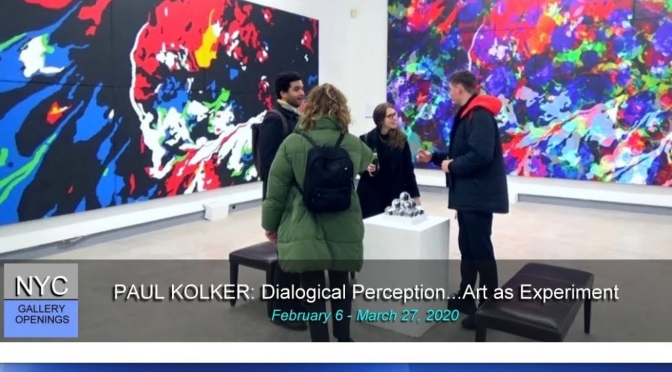
New Exhibitions: 84-Year Old Artist Paul Kolker – “Dialogical Perception…Art As Experiment” (Video)

Paul Kolker is pleased to present his seventy-third solo exhibition, Dialogical Perception… Art as Experiment at his studio, the PAUL KOLKER collection, 511 West 25th Street from February 6 through March 27, 2020.

Paul Kolker (b. 1935) is a New York-based artist with doctorate degrees in medicine and law. He began his career of painting and sculpture in the 1960s, illustrating his peer review medical journal articles and life-casting anatomical models. In the 1970s he treated his art production as a post-minimalist experiment questioning experience and using the viewer as the measuring instrument as well as the interpreter of the experiment’s results. Many of his early works are sculptures, each painted in an elemental color, black or white.

In 1975 Kolker developed a keen and hands on understanding of light optics when he purchased a first generation three tube front end television projector with an alignment grid. That grid became the infrastructure for his works, which involved fractionation of a photographic image and the use of modular panels and canvases to create large scale works. In the 1980s Kolker began making light sculptures using one-way mirror and LED message screens, reflecting ad infinitum. In 2001, when he moved into his studio in Chelsea, he created an algorithm for a process of painting minimal shapes, such as a dot or square, in elemental colors (never mixed with each other, but sometimes mixed with black and/or white to form tints and shades). This process is called ‘fracolor’ in attribution to Benoit Mandelbrot’s fractal geometry, wherein minimal shapes and forms are serially replicated, like branches on a tree, rectangles on a grid, or pixels and dots on a television display screen.

As a result, Kolker’s works have become reminiscent of our pixelated world of digital information transfer, as we see it up close as grids of colored dots on our television, computer and cell phone screens; and how more highly defined that screen becomes when viewed from afar. His works are observational experiments which cry out to us, “Because of biases of color, shapes, parallax and perspective relative to where we stand as the observer, a dot may be a universe; and a universe may be a dot.”

Website

Tributes: Actor Robert Conrad Of “The Wild, Wild West” Dies At 84 (1935 -2020)

Robert Conrad, the actor best known for his role in the television show The Wild Wild West, died today in Malibu, Calif. of heart failure. He was 84 and his death was announced by a family spokesman. Born in Chicago, Illinois, Conrad moved to Los Angeles in 1958 and found almost instant success, booking a recurring role on the TV show Hawaiian Eye in 1959.


Robert Conrad (born Conrad Robert Falk; March 1, 1935 – died February 8, 2020) was an American film and television actor, singer, and stuntman. He is best known for his role in the 1965–69 television series The Wild Wild West, playing the sophisticated Secret Service agent James T. West. He portrayed World War II ace Pappy Boyington in the television series Baa Baa Black Sheep (later syndicated as Black Sheep Squadron). In addition to acting, he was a singer, and recorded several pop/rock songs in the late 1950s and early 1960s as Bob Conrad. He hosted a weekly two-hour national radio show (The PM Show with Robert Conrad) on CRN Digital Talk Radio since 2008.

From Wikipedia

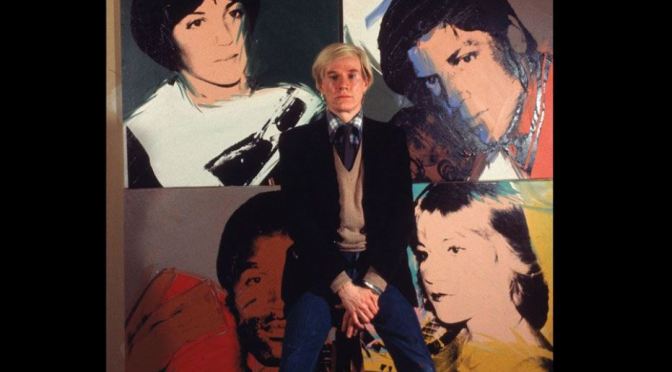
Artists: Inside Story Of Andy Warhol’s “Athletes” Paintings (Christie’s)

From a Christie’s Magazine online article (February 2020):

Christie's Magazine logo‘The sports stars of today are the movie stars of yesterday,’ proclaimed the artist. It was true; thanks to rapid advances in TV broadcasting, sporting champions in the 1970s were starting to achieve the same level of popularity as other entertainers.
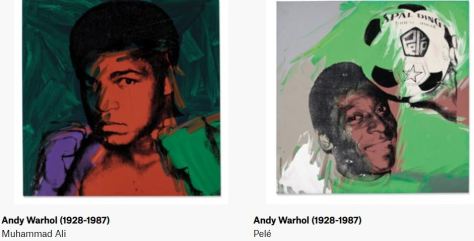
Andy Warhol Athletes paintngs Muhammad Ali & Pele Christie's Magazine February 2020

In 1977, Richard L. Weisman approached his friend Andy Warhol with the idea for a new series: a set of silkscreen portraits of the day’s leading sports stars. Called ‘Athletes’, these pictures have come to be regarded as some of the standout works of Warhol’s later years.

Andy Warhol Athletes paintngs Kareem Abdul-Jabbar & Tom Seaver Christie's Magazine February 2020

Weisman (1940-2018) was a dedicated collector, and the two men bonded mostly over art, although they also crossed paths regularly at social gatherings across New York. On some occasions, these gatherings were held at Warhol’s Factory studio; on others, at Weisman’s apartment on United Nations Plaza.

Read full article