Category Archives: Art

“Do Remember They Can’t Cancel The Spring” – A Message From 82-Year Old Painter David Hockney

David Hockney has unveiled a new painting to add a splash of colour to the dark times facing the country.

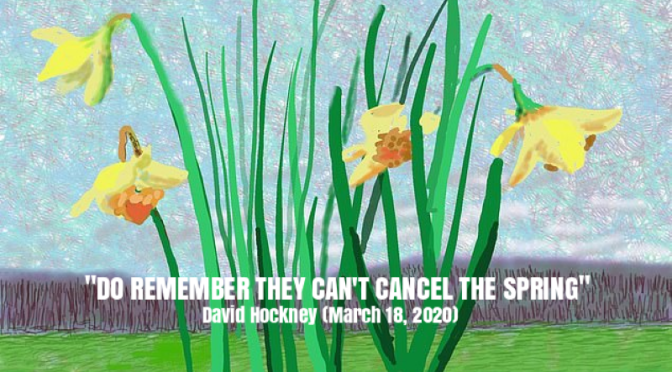
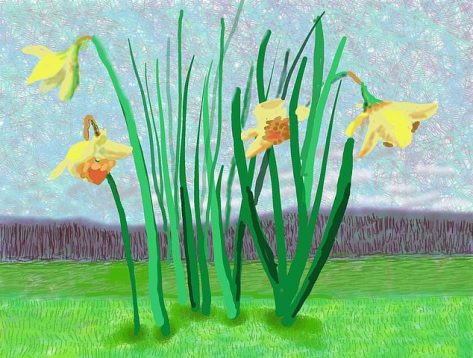
Do remember they can't cancel the spring David Hockney Daffodils March 18 2020

The 82-year-old painter, often dubbed Britain’s greatest living artist, new piece is titled ‘Do remember they can’t cancel the spring’.

Bright yellow daffodils spring up in the foreground in front of a gloomy grey mass in the back of the painting.

Mr Hockney is currently in lockdown in Normandy, northern France, where he has been located since his last exhibition opened.

From a Daily Mail online article


Art & Humor: National Park Posters Based On Visitors’ “1 Star Reviews”

Subpar Parks is a snarky love letter to the National Parks System. When I discovered that there were 1-star reviews for every single one of the 62 national parks, I set out to illustrate each park along with a hand lettered 1-star review as a way to put a positive, fun spin on such a negative mindset.

Humorous National Park Posters based on Visitors 1 star reviews by Amber Share

Amber Share website logo

Interview: 94-Year Old Sidney Felsen, Co-Founder Of Art Publisher Gemini G.E.L. (Getty Podcast)

Getty Art + Ideas logoIn this episode, Sidney talks about how Gemini GEL got started and grew into the organization it is today, sharing stories about the artists he’s worked with along the way.
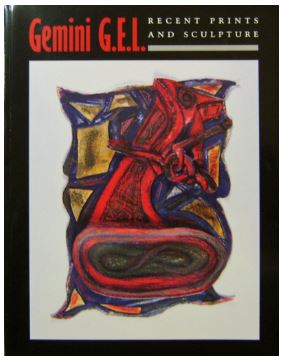
Gemini G.E.L. Recent Prints and Sculpture, author Charles Ritchie (with an introduction by Ruth E. Fine publisher National Gallery of Art, Washington DC.In 1966, at the age of forty-one, Sidney Felsen moved from the world of accounting to that of art, founding the artists’ workshop and fine-art print publisher Gemini GEL in Los Angeles. With Gemini GEL, Sidney quickly got to work with some of the biggest artists of the twentieth century: Man Ray, Josef Albers, Jasper Johns, and Robert Rauschenberg, to name a few. And Gemini GEL continues its work with new generations of artists, including Julie Mehretu, Tacita Dean, and David Hammons.

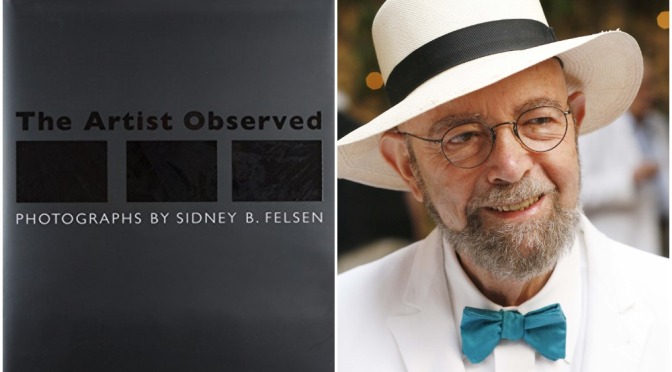
Sidney Felsen is the co-founder of Gemini G.E.L., a printmaking studio in Los Angeles that has been operating since 1965. Some of his photographs documenting the artists at work at Gemini are collected in the book The Artist Observed.

Art Books: “At First Light – Two Centuries Of Maine Artists, Their Homes And Studios” (Rizzoli, Mar 2020)

At First Light Two Centuries of Maine Artists Rizzoli March 2020At First Light chronicles twenty-six extraordinary artists of the last two hundred years who have lived and worked in Maine. Published to coincide with the state’s bicentennial in 2020, the volume considers the significant contributions artists have made to a deeper and more profound understanding of Maine’s history, its land and its peoples. Maine’s unique and breathtaking landscape–from its rugged coastline, quaint harbors, majestic mountains, and verdant forests–continues to have a powerful effect on the artists who are drawn to its shores.
Written and expertly researched by some of the foremost scholars and curators in the field, each chapter focuses on a different artist, featuring the artists’ artworks and anchored by breathtaking contemporary photography of their homes, studios, and surroundings. From picturesque bungalows to grander structures with beautiful vistas, the houses and studios featured are as diverse as the artists who have inhabited them. The artists featured include fan favorites to lesser known yet important figures from the eighteenth century to the present day, working in a range of media from painting to photography to sculpture, including: Jonathan Fisher, Winslow Homer, Frank Weston Benson, Charles Herbert Woodbury, John Marin, Marsden Hartley, Rockwell Kent, N. C. Wyeth, Andrew Wyeth, Jamie Wyeth, Marguerite and William Zorach, Rockwell Kent, Marsden Hartley, John Marin, Eliot Porter, Fairfield Porter, Rudy Burckhardt, Yvonne Jacquette, Ashley Bryan, Lois Dodd, Alex Katz, Bernard Langlais, Robert Indiana, David C. Driskell, Molly Neptune Parker, Richard Tuttle, and William Wegman.

About The Author

Anne Collins Goodyear is codirector of the Bowdoin College Museum of Art. Frank H. Goodyear III is codirector of the Bowdoin College Museum of Art. Michael K. Komanecky is chief curator at the Farnsworth Art Museum, in Rockland, Maine. Stuart Kestenbaum is the Poet Laureate of Maine. Walter Smalling is a photographer based in Washington, D.C.

Read more or purchase

Fine Arts: 4k Virtual Tour Video – Van Gogh Museum “Self-Portraits Gallery”

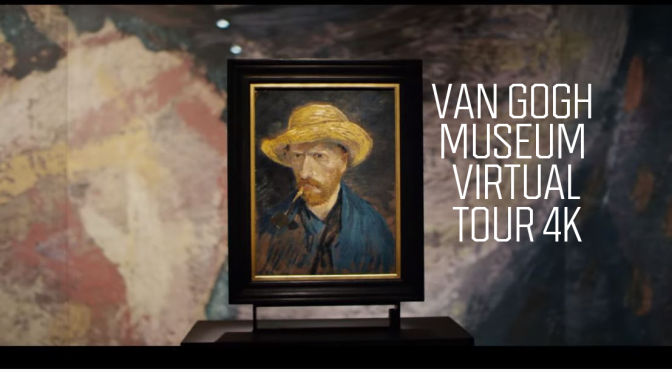
Selfportrait gallery – Van Gogh Museum Amsterdam

Van Gogh Museum Tour in 4K. Have you always wanted to be alone in the Van Gogh Museum? Step into Vincent’s world and enjoy the private video tour. (Episode 1)

Website


Arts & Media: “Picasso And Paper” Short Film Shown Outdoors In Piccadilly Circus, London (Video)

Can you imagine a world full of art, instead of adverts? It’s been nearly a month since we took over Piccadilly Circus with nothing but Picasso for a whole half hour, to celebrate our current exhibition ‘Picasso and Paper’. Our friends at Chocolate Films captured it all in this amazing film. Picasso and Paper will be on view at the RA until April 13th, 2020.

Art: “Eve” Sculpture By Auguste Rodin (1899)

John Swarbrooke from Dickinson Gallery explains the beauty and play of light behind the cast of Auguste Rodin’s Eve.

François Auguste René Rodin (12 November 1840 – 17 November 1917) was a French sculptor. Although Rodin is generally considered the progenitor of modern sculpture, he did not set out to rebel against the past. He was schooled traditionally, took a craftsman-like approach to his work, and desired academic recognition, although he was never accepted into Paris’s foremost school of art.

Eve is a nude sculpture by the French artist Auguste Rodin. It shows Eve despairing after the Fall.

n 1880 Rodin was commissioned to produce The Gates of Hell, for which he exhibited Adam at the 1881 Paris Salon. In a sketch for Gates Rodin showed a central silhouette possibly intended as Eve (both the sketch and Gates are now in the Musée Rodin), but in October 1881 he decided to produce Eve as a pair for Adam, with the two sculptures flanking a huge high-relief bas-relief. This would be the first free-standing female sculpture he had produced since the destruction of his Bacchante in an accident between 1864 and 1870. He began Eve in 1881, later abandoning his intended colossal version of it when he realised his model, probably Adèle Abruzzesi, was pregnant. It was first exhibited to the public at the 1899 Paris Salon. It shows a strong influence from Michelangelo, picked up by Rodin in Italy in 1876.

He also produced an autograph white marble version in 1884 (now in the Museo Soumaya in Mexico City), a version in patinated plaster and a much-reproduced 71 cm high bronze version in 1883 (known as the Petite Ève or Little Eve, whose original is also in the Musée Rodin in Paris). He also reused the same figure of Eve in his marble Eve and the Serpent (1901) and his plaster Adam and Eve (1884).

From Wikipedia

New Exhibitions: “The British Galleries” Reopens At The Metropolitan Museum Of Art (Mar 2020)

The British Galleries Metropolitan Museum of Art Reopens March 2020The British Galleries are reopening with almost 700 works of art on view, including a large number of new acquisitions, particularly works from the 19th century that were purchased with this project in mind. This is the first complete renovation of the galleries since they were established (Josephine Mercy Heathcote Gallery in 1986, Annie Laurie Aitken Galleries in 1989). A prominent new entrance provides direct access from the galleries for medieval European art, creating a seamless transition from the Middle Ages to the Renaissance.

The British Galleries Metropolitan Museum of Art Reopens March 2020A highlight of The Metropolitan Museum of Art’s 150th anniversary in 2020 is the opening, on March 2, of the Museum’s newly installed Annie Laurie Aitken Galleries and Josephine Mercy Heathcote Gallery—11,000 square feet devoted to British decorative arts, design, and sculpture created between 1500 and 1900. The reimagined suite of 10 galleries (including three superb 18th-century interiors) provides a fresh perspective on the period, focusing on its bold, entrepreneurial spirit and complex history. The new narrative offers a chronological exploration of the intense commercial drive among artists, manufacturers, and retailers that shaped British design over the course of 400 years. During this period, global trade and the growth of the British Empire fueled innovation, industry, and exploitation. Works on view illuminate the emergence of a new middle class—ready consumers for luxury goods—which inspired an age of exceptional creativity and invention during a time of harsh colonialism.

Read more

Profiles: 82-Year Old American Abstract Painter Larry Poons

From a Wall Street Journal online profile (March 3, 2020):

I had a handful of school friends, including Francis Ford Coppola, who was in the grade behind me. He was known then as Frank. He directed school plays, such as “Finian’s Rainbow.” That’s where I fell in love with the girl. She was a dancer in the cast.

Painting, music and poetry all spoke to me, especially music. I applied to the New England Conservatory of Music in Boston.

Larry Poons, 82, is an abstract painter best known for his “dot” and “throw” paintings. “Larry Poons” (Abbeville), a book-length monograph of his work from the 1950s to the present, will be published in September. He spoke with Marc Myers.

The first time I painted on canvas board, I was lovesick. I had a crush on a girl in high school and had just finished reading Irving Stone’s Van Gogh biographical novel, “Lust for Life.”

I took my easel to a nearby park and painted trees. As I worked the paint with a small brush, it helped get my feelings out.

Read more

Art: “Before Pennsylvania Station” By American Realist Painter George Bellows (1882-1925)

George Bellows, Pennsylvania Station Excavation, c. 1907–08, oil on canvas, 79.2 x 97.1 cm (Brooklyn Museum), a Seeing America video.

Smarthistory LogoSpeakers: Dr. Margarita Karasoulas, Assistant Curator, American Art, Brooklyn Museum and Dr. Steven Zucker

Website

George Wesley Bellows (August 12 or August 19, 1882 – January 8, 1925) was an American realist painter, known for his bold depictions of urban life in New York City. He became, according to the Columbus Museum of Art, “the most acclaimed American artist of his generation”.

Bellows first achieved widespread notice in 1908, when he and other pupils of Henri organized an exhibition of mostly urban studies. While many critics considered these to be crudely painted, others found them welcomely audacious, a step beyond the work of his teacher. Bellows taught at the Art Students League of New York in 1909, although he was more interested in pursuing a career as a painter. His fame grew as he contributed to other nationally recognized juried shows.

Bellows’ urban New York scenes depicted the crudity and chaos of working-class people and neighborhoods, and satirized the upper classes. From 1907 through 1915, he executed a series of paintings depicting New York City under snowfall. In these paintings Bellows developed his strong sense of light and visual texture,[14] exhibiting a stark contrast between the blue and white expanses of snow and the rough and grimy surfaces of city structures, and creating an aesthetically ironic image of the equally rough and grimy men struggling to clear away the nuisance of the pure snow. However, Bellows’ series of paintings portraying amateur boxing matches were arguably his signature contribution to art history.[11] They are characterized by dark atmospheres, through which the bright, roughly lain brushstrokes of the human figures vividly strike with a strong sense of motion and direction.

Pennsylvania Station New York City

Pennsylvania Station, also known as New York Penn Station or Penn Station, is the main intercity railroad station in New York City and the busiest in the Western Hemisphere, serving more than 600,000 passengers per weekday as of 2019.mPenn Station is in Midtown Manhattan, close to Herald Square, the Empire State Building, Koreatown, and Macy’s Herald Square. Entirely underground, the station is located in Midtown South beneath Madison Square Garden, between Seventh and Eighth Avenues, and between 31st and 33rd Streets, with additional exits to nearby streets.

Penn Station has 21 tracks fed by seven tunnels (the two North River Tunnels, the four East River Tunnels, and the single Empire Connection tunnel). It is at the center of the Northeast Corridor, a passenger rail line that connects New York City with Boston, Philadelphia, Washington, D.C., and intermediate points. Intercity trains are operated by Amtrak, which owns the station, while commuter rail services are operated by the Long Island Rail Road (LIRR) and NJ Transit (NJT). Connections are available within the complex to the New York City Subway, and buses. An underground passageway formerly provided an indoor connection with the 34th Street–Herald Square subway station and 33rd Street PATH station.[7]

Penn Station is named for the Pennsylvania Railroad (PRR), its builder and original tenant, and shares its name with several stations in other cities. The current facility is the remodeled underground remnant of the original Pennsylvania Station, a more ornate station building designed by McKim, Mead, and White and considered a masterpiece of the Beaux-Arts style. Completed in 1910, it enabled direct rail access to New York City from the south for the first time. Its head house was torn down in 1963, galvanizing the modern historic preservation movement.[8] The rest of the station was rebuilt in the following six years, while retaining most of the rail infrastructure from the original station.

From Wikipedia

News, Views and Reviews For The Intellectually Curious