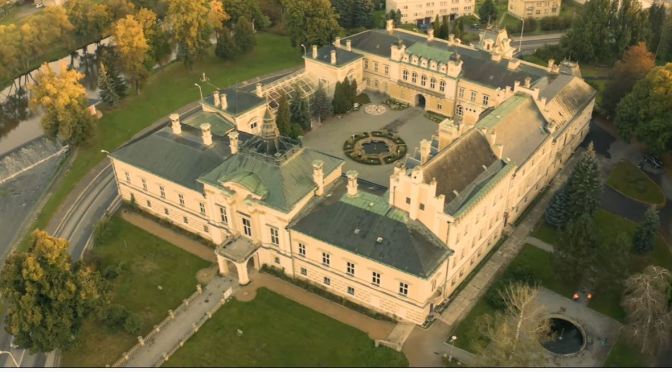
Světlá nad Sázavou is a town in the Havlíčkův Brod District in the Vysočina Region of the Czech Republic. It has a population of about 6,500. The Sázava River flows through the town.
This incredible complex has more than 5,500 sq. meters of usable area and a garden with a park that occupies 14,306 sq. meters. The chateau also has extensive attics and cellars.
The history of the chateau dates back to the Middle Ages when a Gothic fortress was built on the site, which was then a Renaissance hunting lodge was built. Over time, the chateau complex grew to include a Baroque wing and an Empire-style part, as well as a famous orangery. In the 19th century, under the leadership of a prominent Viennese architect, a demanding reconstruction and modification of the complex took place in the Neo-Renaissance style. With this reconstruction, the chateau gained its present appearance. A one-story historic building with four wings was built, which encloses a rectangular courtyard with a fountain. The building combines Renaissance, Baroque, Empire, and Neo-Renaissance elements.
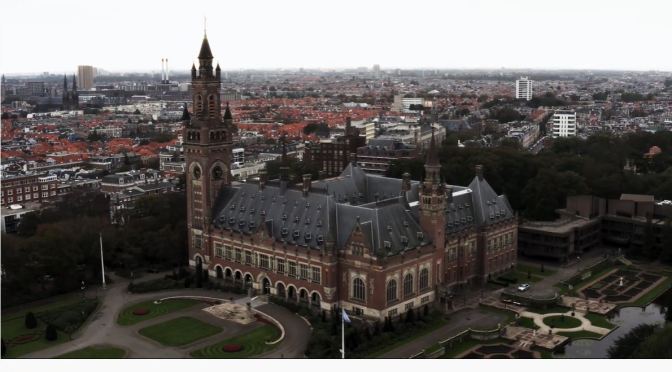
This virtual tour of the International Court of Justice (ICJ) leads the viewers through the rooms of the Peace Palace used by the judges in carrying out their judicial functions.
FAQ ——
What is the International Court of Justice?
The Court is the principal judicial organ of the United Nations. It was established by the United Nations Charter, which was signed in 1945 in San Francisco (United States), and began work in 1946 in the Peace Palace, The Hague (Netherlands).
The Court, which is composed of 15 judges, has a twofold role: first, to settle, in accordance with international law, legal disputes between States submitted to it by them and, second, to give advisory opinions on legal matters referred to it by duly authorized United Nations organs and specialized agencies.
The Court’s official languages are English and French.
Who may submit cases to the Court? Only States are eligible to appear before the Court in contentious cases. The Court has no jurisdiction to deal with applications from individuals, non-governmental organizations, corporations or any other private entity. It cannot provide them with legal advice or help them in their dealings with national authorities. However, a State may take up the case of one of its nationals and invoke against another State the wrongs which its national claims to have suffered at the hands of the latter; the dispute then becomes one between States.
What differentiates the International Court of Justice from the International Criminal Court and the ad hoc international criminal tribunals?
The International Court of Justice has no jurisdiction to try individuals accused of war crimes or crimes against humanity. As it is not a criminal court, it does not have a prosecutor able to initiate proceedings. This task is the preserve of national courts, the ad hoc criminal tribunals established by the United Nations (such as the International Residual Mechanism for Criminal Tribunals (IRMCT), mandated to take over residual functions from the International Criminal Tribunal for the former Yugoslavia (ICTY) and from the International Criminal Tribunal for Rwanda (ICTR)) or in co-operation with it (such as the Special Court for Sierra Leone and the Special Tribunal for Lebanon), and also of the International Criminal Court, set up under the Rome Statute.
Allow us to introduce you to our new publication, The Monocle Book of Italy. Our latest title celebrates the much-loved Mediterranean nation through fantastic photography, witty illustrations and plenty of insightful writing. Join us for a colourful tour.
Ancient Park of the Aqueducts (Parco degli Acquedotti) in Rome located just outside the city on the Appian Way. The Roman water system consisted of artificial channels for conveying water and run for some or all of their path through tunnels constructed underground. There are three Roman aqueducts which gave a possibility for Roman inhabitants to receive 1.000 liters of water per each person daily in 52 A.D.
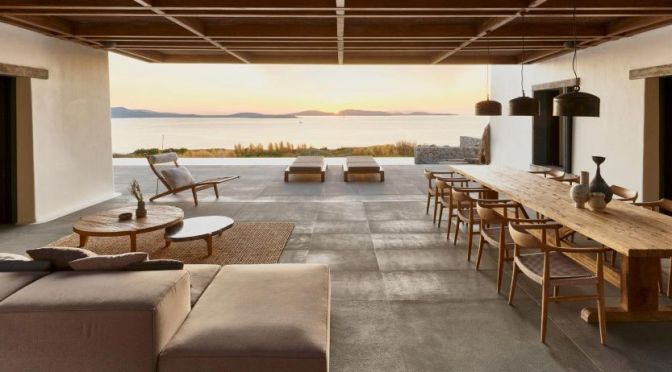
Sitting on the ridge of the hill of Aleomandra in Mykonos yet almost entirely hidden from view, Villa Mandra looks straight out to sea and the sunset over the neighbouring island of Delos. A 6-bedroom holiday house built for a young, dynamic couple to enjoy with their family and friends, it celebrates its spectacular view from a grounded viewpoint blended into a sensitively landscaped, stone-walled garden that screens it from the road behind.
The house is built upon the idea of slow, laid-back summer living, and encourages mindful connection with family, friends and the freedom to exist peacefully in nature. Form follows emotion rather than function, as every space becomes another opportunity for rest, reflection and exploration.
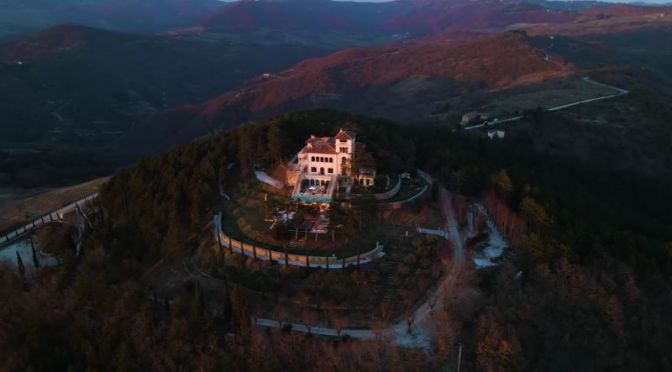
This prestigious villa measures 1,300 sqm, has four floors, a basement and a panoramic roof terrace from which we can appreciate a 360-degree panoramic view of the Umbrian hills. The materials and finishes used in the building are of the highest quality, and include marble floors and bathrooms, large windows and the designer furnishings that contrast with the classic beauty of the facade; the colors that dominate in the rooms are white and black, giving them elegance and sobriety, while the use of wood recalls the surrounding nature.
This property for sale is surrounded by twenty hectares of land consisting of a private garden where the external loggias, terraces and the panoramic swimming pool are connected to a relaxation area where you can enjoy lovely moments good company during the summer; there is also a part with a forest. The basement of this splendid estate houses a heated indoor pool of 79 square meters, partly external but sealable during the colder months.
A well-lit tennis court surrounded by nature is ideal for sports lovers and completes this majestic property for sale near Gubbio. This luxury villa offers every comfort and is perfect for those seeking absolute relaxation and tranquility surrounded by nature.
Around 15 minutes south-west of Hamilton CBD lies the rural suburb of Temple View, established in the 1950s and home to the Taitua Arboretum—a 20-hectare garden comprising woodlands, lakes and open pasture. It was within this bucolic idyll that husband and wife, Noel and Kylie Jessop, found a hilly, 6500m2 block offering wide-ranging views back towards the city, on which to build their family home. “The position is spot on and the views are amazing,” says architectural designer, Noel. The couple bought the site in mid-2018 and spent the next year fine-tuning the design of their home. “There was no real rush to complete the project at that time and so we had the luxury of really working through ideas and discussing what we required as a family of six—as well as what the site would allow, given its topography. “Kylie said from day one that it needed to be light and bright with an open flow and easy access to the outdoors, especially from the ensuite. We had stayed at a resort where the ensuite led straight out onto the pool area and Kylie was keen to replicate that feel.” Noel says it also needed to have a high level of functionality with six people living in the house. There is a mix of individual spaces and communal spaces and an ever-present connection to the outdoors, even upstairs where the only interaction is via the view through the windows, there is still a sense of being in the landscape. “The secret to successfully fulfilling the functional, financial and aesthetic parameters of the project was to keep the form really simple; just one room wide and to do away with extraneous spaces such as corridors. “There is a simplicity to the home, in terms of its layout and construction, that gives it a sense of timelessness—it functions perfectly as a family home and will function perfectly, years from now, when it’s just Kylie and I living here.” Click here to see the full project: https://archipro.co.nz/project/s-and-…
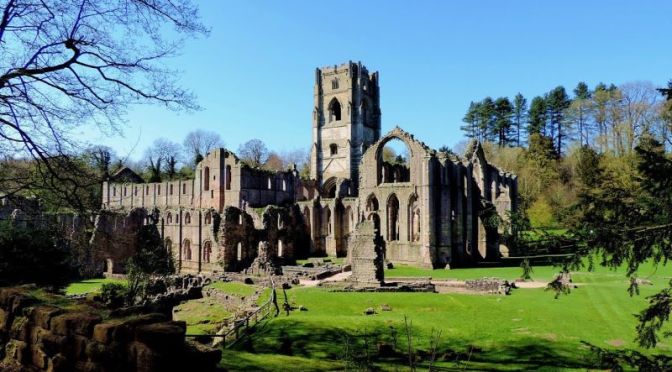
In this video tour, you’ll discover the story of Fountains Abbey, North Yorkshire, where archaeology has shed light on medieval life. Learn more about these archaeological finds and understand how modern technology allows this journey of discovery to continue.
Fountains Abbey is one of the largest and best preserved ruined Cistercian monasteries in England. It is located approximately 3 miles south-west of Ripon in North Yorkshire, near to the village of Aldfield.
Rooftop workers who upkeep Paris’ zinc-covered roofs and give the city an aerial view of a distinct color palette, are seeking UNESCO’s recognition for their craft.
Join curators Keith Christiansen, Stephan Wolohojian, and Adam Eaker on a tour through the newly installed European Paintings galleries and explore new dialogues and themes among the works. A New Look at Old Masters is part of the European Paintings Skylights Project and is a prelude to the final, expansive re-installation of the European Paintings galleries that will take place after the project is completed.
News, Views and Reviews For The Intellectually Curious







 Boomers Daily