Air, Water, Fire, and Earth were formally believed to compose the physical universe. These elements are now the paintbrushes for adventure athletes whose canvas encompasses the great outdoors. These are the Elements Oliver White.
SIMPLY PUT, I’M A FISHERMAN.
It’s the most natural outcome for someone who fell in love with fishing early. And by love, I mean: willing to follow wherever fishing wanted to take me.
Travel to a new country to investigate a fishery? I’ll be packed in an hour. Explore an uncharted river? I’m in. Stalk a fish that’s never seen a fisherman? I want to solve the puzzle, crack into that animal’s head and figure out how to catch it. After years of living in fishing’s gravity, I’ve witnessed how it can alter orbits beyond my own.
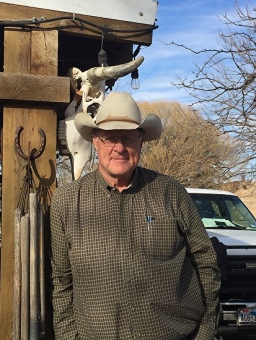
Award winning artist, Jennifer McChristian, was born and raised in Montreal, Canada. From an early age, she knew she wanted to be an artist. Upon completing high school, McChristian began her art education at Dawson’s College in Montreal, Canada. In 1986, she and her family took permanent residency in California, where she earned a Bachelor of Fine Art Degree with Honors from Otis Art Institute in 1990.
Her inspirations consist of notable artists such as John Singer Sargent, Anders Zorn, Nicolai Fechin and Cecilia Beaux. McChristian primarily paints in oils and occasionally watercolors and gouache. She has an affinity for painting ‘en plein air’ and also enjoys creating studio works using her outdoor sketches as inspiration. “Painting is somewhat of a spiritual experience for me. Although challenging at times, the end result evokes within me a sense of elation, nostalgia and harmony”.
As with all artists, my style is constantly evolving but presently I describe my style as “sloppy representationalism”. I paint in a representational style with a “sketchy” quality to it. It seems to fit me. I’m passionate about interpreting and communicating the character and the emotion of places in my work.
Watercolor, in a practiced hand, is the perfect medium for capturing the powerful emotion of a place. While I paint a variety of subjects, I’m most attracted to landscapes that stir passion within me in the moment. I’m always drawn to things western, rural, gritty and seemingly mundane or ordinary. Anything evocative of a ‘time long passed by’ will always capture my attention.
With every sparkling joke, every well-meaning and innocent character, every farcical tussle with angry swans and pet Pekingese, every utopian description of a stroll around the grounds of a pal’s stately home or a flutter on the choir boys’ hundred yards handicap at a summer village fete, he wanted to whisk us far away from our worries.
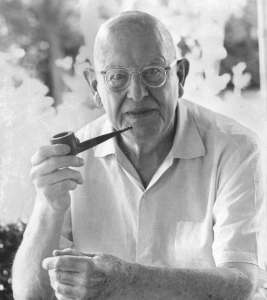
If we’re talking about culture that makes people happy, we have to start with the works of PG Wodehouse. There are two reasons why. One reason is that making people happy was Wodehouse’s overriding ambition. The other reason is that he was better at it than any other writer in history.
The author of almost a hundred books and the creator of Jeeves, Blandings Castle, Psmith, Ukridge, Uncle Fred and Mr Mulliner, P. G. Wodehouse was born in 1881 and educated at Dulwich College. After two years with the Hong Kong and Shanghai Bank he became a full-time writer, contributing to a variety of periodicals including Punch and the Globe. He married in 1914.
As well as his novels and short stories, he wrote lyrics for musical comedies with Guy Bolton and Jerome Kern, and at one time had five musicals running simultaneously on Broadway. His time in Hollywood also provided much source material for fiction.
At the age of ninty-three, in the New Year’s Honours List of 1975, he received a long-overdue knighthood, only to die on St Valentine’s Day some forty-five days later.
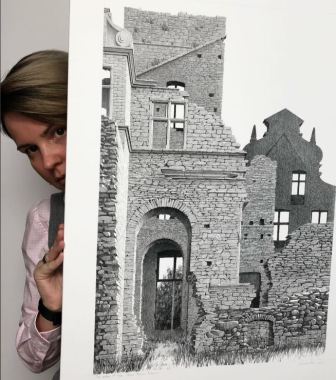
“Buildings and constructions once created by people but now fallen into oblivion have an inspirational value for me,” Mill tells My Modern Met. “They are silent witnesses of history. These giants towering over densely populated cities preserve the memories from the moment of their creation until the last stone drops off their walls.”
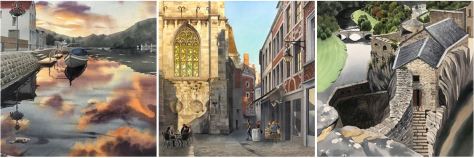
Russian graphic designer and watercolor painter Eleanor Mill has a knack for capturing the spirit of place. Through her architectural watercolor sketches, she documents buildings with exacting detail. At the same time, Mill imbues her work with the color and light that gives each environment character. This allows viewers to come along with her as she places the memories of her travels down on paper.
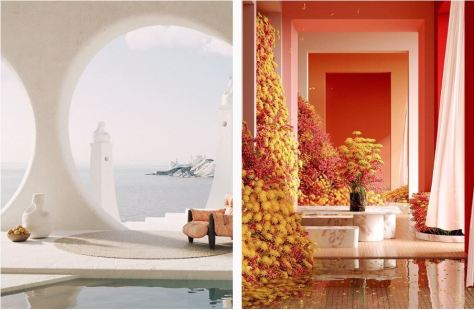
Alexis Christodoulou, a self-taught 3D artist living in Cape Town, South Africa has spent the last 6 years building a collection of works focusing on imaginary architecture. While working professionally as a copywriter for the last decade, Alexis taught himself 3D rendering as a hobby.
From a lifelong fascination of digital worlds and 3D graphics from playing video games a boy, Alexis became frustrated with the lack of modern aesthetics represented therein. The images he creates are a simple extension of this desire to see fantastic spaces come to life that echo a more modern and clean aesthetic.
Singer-songwriter Graham Nash had recently embarked on a sold-out tour, until it was cancelled due to coronavirus. Anthony Mason sits down with Nash in New York City to talk with the former member of The Hollies and Crosby, Stills & Nash about how he has maintained his productivity while remaining under lockdown.
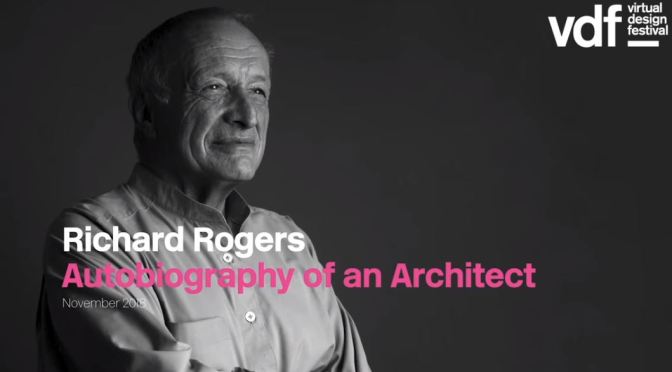
In the second talk as part of our Virtual Design Festival collaboration with Architects, not Architecture, architect Richard Rogers discusses his reluctance to enter the Centre Pompidou competition and liking the Lloyd’s building. The idea behind Architects, not Architecture is for architects to discuss their path, influences and experiences.
In his lecture in November 2017, Rogers explained that he’d been told he couldn’t use buildings for his talk, as the main rule of the series is that architects aren’t allowed to discuss their projects. “I said: That’s like saying I can’t use my two hands,” Rogers said.
“Architecture is part of me. And architecture is not just about buildings, it’s about spaces and places.” Born in Florence, Rogers moved to England with his family and studied at the Architectural Association School in London, where he founded Richard Rogers Partnership with Su Rogers, now Rogers Stirk Harbour + Partners, in 1977.
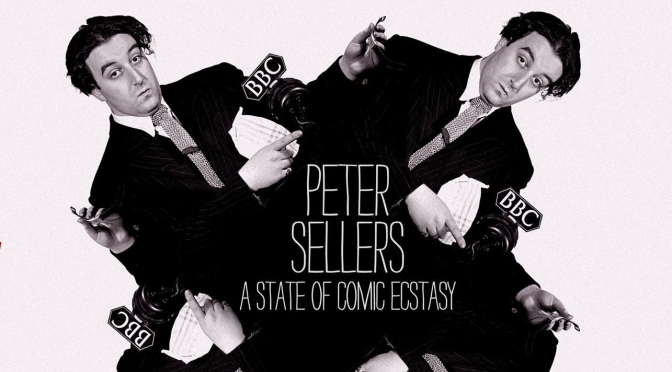
Peter Sellers was one of the twentieth century’s most astonishing actors. His meteoric rise to fame – from his beginnings with Spike Milligan on BBC Radio’s The Goon Show in the 1950s to his multiple Oscar nominations and status as Stanley Kubrick’s favourite actor – is equalled only by the endless complexities of his personal life – the multiple marriages, the chronic health problems, the petulant fits of rage, the deep insecurity, the unwise career choices and the long decline in his later years.
This film explores the life of this peerless actor and comedian, featuring interviews with family, friends, colleagues and critics, many of whom have never spoken out before. The film charts Sellers’s formative years backstage as part of his parents’ itinerant music hall revue group, his wartime service in India and Burma and his journey to global superstardom, where tales of his life backstage with the likes of Sophia Loren, Orson Welles and Alec Guinness were often more unbelievable than the roles they were playing out before the cameras. This is the story of the man who could play any role, apart from one – himself.
With contributions from family members, including second wife Britt Ekland and his daughters Sarah and Victoria, as well as former friends and girlfriends such as Sinead Cusack, Nanette Newman and Janette Scott, the film explores the life of Sellers with candour and affection. Colleagues like director Joe McGrath and actor Simon Williams recall tales of Sellers’s extravagant behaviour onset, and famous fans like Michael Palin, Steve Coogan and Hanif Kureishi reveal why they hold Sellers in such high esteem.
This is a film about family and how Sellers’s mercurial temperament has affected the generation that followed. His two surviving children Sarah and Victoria recall the challenges of growing up alongside his tempestuous mood swings, while his grandson Will explores the troubled legacy his grandfather left behind.


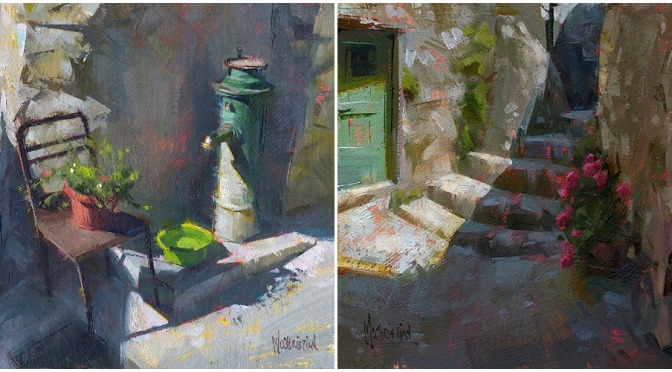
 Award winning artist, Jennifer McChristian, was born and raised in Montreal, Canada. From an early age, she knew she wanted to be an artist. Upon completing high school, McChristian began her art education at Dawson’s College in Montreal, Canada. In 1986, she and her family took permanent residency in California, where she earned a Bachelor of Fine Art Degree with Honors from Otis Art Institute in 1990.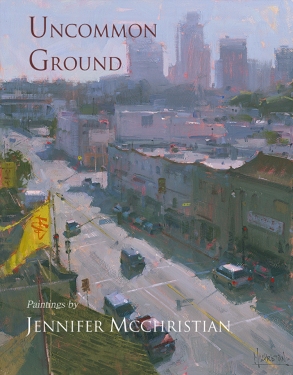
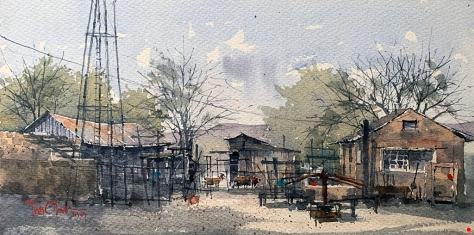
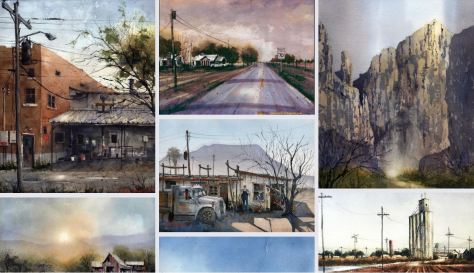
 Watercolor, in a practiced hand, is the perfect medium for capturing the powerful emotion of a place. While I paint a variety of subjects, I’m most attracted to landscapes that stir passion within me in the moment. I’m always drawn to things western, rural, gritty and seemingly mundane or ordinary. Anything evocative of a ‘time long passed by’ will always capture my attention.
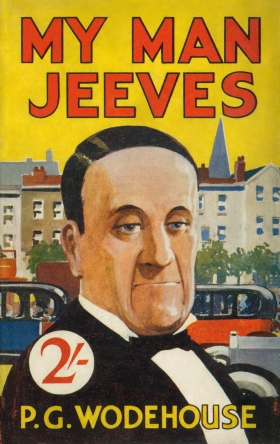 With every sparkling joke, every well-meaning and innocent character, every farcical tussle with angry swans and pet Pekingese, every utopian description of a stroll around the grounds of a pal’s stately home or a flutter on the choir boys’ hundred yards handicap at a summer village fete, he wanted to whisk us far away from our worries.
 T
T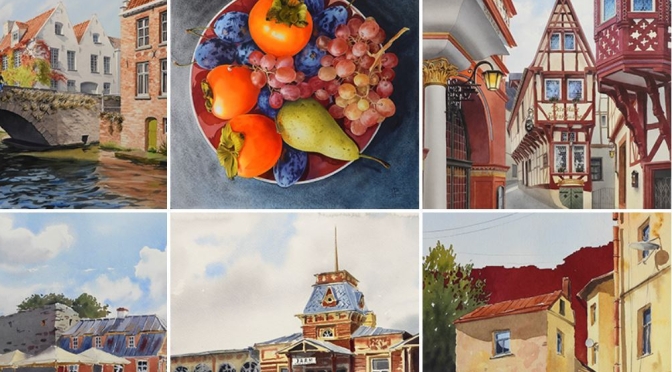
 “Buildings and constructions once created by people but now fallen into oblivion have an inspirational value for me,” Mill tells My Modern Met. “They are silent witnesses of history. These giants towering over densely populated cities preserve the memories from the moment of their creation until the last stone drops off their walls.”
 Russian graphic designer and watercolor painter


 Boomers Daily