Tag Archives: Italy

Amalfi Coast Tour: A 16th-Century Saracen Tower

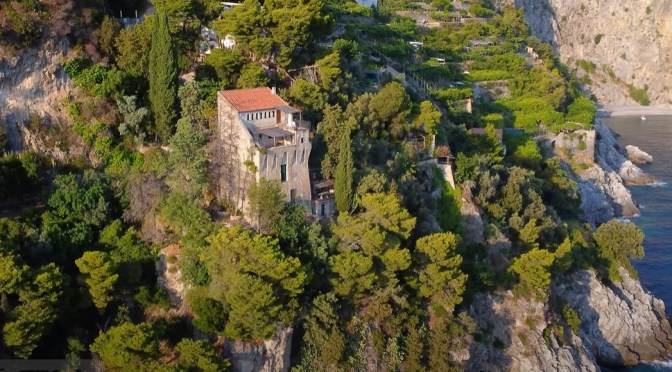
Set into a rock dropping sheer down to the sea, this ancient 16th-century Saracen Tower is located in Maiori, one of the most exclusive areas of the Amalfi Coast.

This is truly a unique object standing between sky and sea, in a panoramic, high position less than a kilometer from the town center of Maiori, protected by a majestic chain of mountains: from here the view sweeps from the mountains to the charming town below, to then get lost in the infinite blue of the sea, offering one of the most picturesque views of the entire Amalfi Coast.

Built as a watchtower to defend this stretch of coast from invasions by the Saracens and pirates, who in past times attacked it by sea, this property has helped preserve the wonders of the Amalfi Coast, of which it is a splendid example. Developed on the panoramic road from the coast to the sea, with exclusive access to a wonderful private platform with sun loungers, this estate is part of a natural setting of incomparable beauty, characterized by dense Mediterranean scrub.

A true maze of paths crosses the 6,500-sqm park, arranged in terraces, along which the various living areas are located, including the Belvedere, the Canonica and the Saracen Tower.
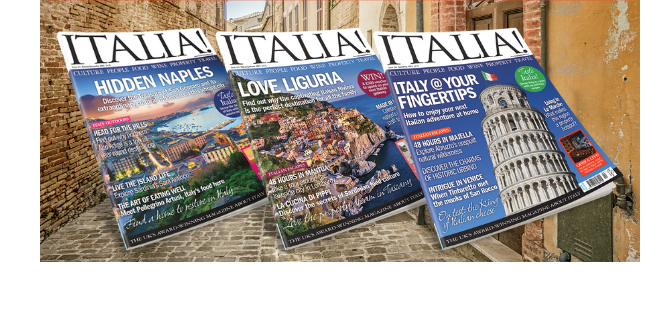
Travel Previews: Italia! Magazine – September 2022

The September 2022 issue features travel inspiration, starting with the island of Elba, just a short ferry ride from the coast of mainland Tuscany. Picture-perfect all year round, it’s certainly a destination we love. We also head to Molise for the Campobasso Mysteries Festival, take a detour to nearby Abruzzo, step off the beaten track to hilltop Casoli, and explore the exquisite city of Lecce.

Read more

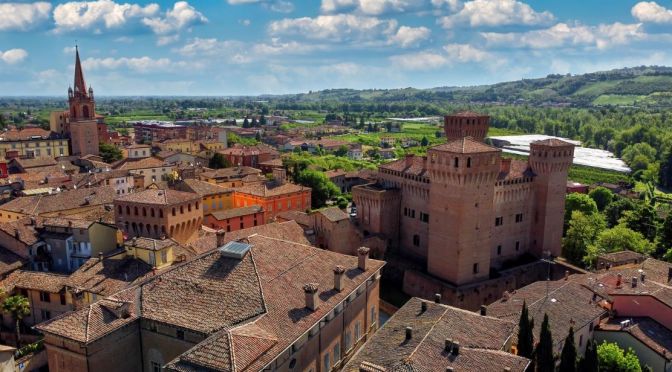
Views: Castles Of Modena In Emilia-Romagna, Italy

Modena and the surrounding area is extremely rich in historic and cultural treasures like these. In their unparalleled beauty, within each castle’s walls lies a special story. 

The castles of the Modena area date to a range of historical periods but together make up an invaluable legacy. They remain today—just as they were when they were built—important cultural landmarks for local community residents.

  • First stop – Palazzo Pio Carpi – Palazzo Pio in Carpi is an imposing and complex structure that comprises fortifications, towers, courtyards, and buildings constructed between the fourteenth and seventeenth centuries. The Palazzo looks out onto Piazza dei Martiri, one of Italy’s most beautiful piazzas, to breathtaking effect. Starting in 1300 and for most of the following two centuries, Palazzo Pio was the residence of the Pio family. The Pio Prince Alberto III, nephew of the famous Pico della Mirandola, transformed the fortress into a splendid Renaissance palace whose rooms were decorated with frescoes by court painters.Today, the town of Carpi has adapted the palazzo for use as a world-class cultural center that houses the Palazzo Pio Museum; the Municipal Museum; the Castello dei Ragazzi, a children’s art and recreation center; and the fascinating Museum and Monument to Political and Racial Deportees.
  • Second stop – Calcagnini Fortress Formigine – The ravishing Rocca Calcagnini Fortress stands in the heart of Formigine, a symbol of the local community and a center for collective historical memories. Built in 1201 by the city of Modena as a defense against attacks by the rival city of Reggio Emilia and to secure its control of the territory, beginning in 1300 the Rocca Calcagnini Fortress was passed among various local noble families until it became property of the Pio family of Carpi, the Estes, and finally the Calcagninis.Around 1400, when the fortress was under the control of the Pios, it was turned into a castle-residence that appears today much as it did then, with a marquis’s palazzo and grounds encircled by a wall with four corner towers and a guardhouse.During the Second World War, the fortress was irreparably damaged in a ferocious bombardment in which virtually the entire Calcagnini family was lost. In 1946, it became the property of the town government and was rebuilt and transformed for use as the city hall.Today the castle houses municipal offices on its ground floor (the city council chambers and a venue for wedding ceremonies) with reception halls located in the northeast tower.To make your visit to the Rocca Calcagnini Fortress extra special, don’t miss the Multimedia Museum of Archaeology. Beautiful and innovative multimedia displays tell the story of the fortress and of the Calcagnini nobility.The Calcagnini Fortress is Formigine’s sparkling “living room.” In addition to housing a restaurant and a wine cellar, each year the castle hosts events of all kinds—music, theater, and much more.
  • Third stop – Spezzano Castle Fiorano Modenese – The origins of Spezzano Castle date to the Middle Ages. The castle was transformed into a noble family residence by the Pios of Savoia in 1529.Today, Spezzano Castle is an elegant country residence surrounded by grounds landscaped in the 19th-century—a lovely place to relax or perhaps have lunch in one of the designated picnic areas.The splendid porticoed courtyard dates to the Renaissance, and the Sala delle Vedute, with its splendid frescoes of towns, towers, and castles of Sassuolo’s feudal period, is especially striking.Its pentagonal tower, at one time a prison, today houses the Municipal Vinegar Cellar and the Fiorano Museum of Ceramics, dedicated to the local history of ceramics, one of the area’s most admired products.
  • Fourth stop – Vignola Fortress Vignola – The Vignola Fortress has also become a symbol—in this case, of Italy’s cherry capital. Its towers, drawbridge, and moat provide one of the most fascinating examples of defensive architecture in the entire Emilia-Romagna Region.The Vignola Fortress was built in the eighth century by the abbot of Nonantola to defend the abbey’s lands. After passing through the hands of several noble families, in 1401 it was ceded by the Este family of Ferrara to Uguccione Contrari who transformed it into a sumptuous noble home and filled the residence with frescoes and precious objets d’art.Vignola’s picturesque city center provides the perfect setting for the imposing and well-preserved Vignola Fortress. The four-sided structure contains five floors and has three square towers. The internal courtyard is magnificent and, on the left side, the “Rocchetta” (the “little fortress”) and the Contrari and Grassoni halls are located. One of the most beautiful structures is the frescoed chapel, a rare gem of “International Gothic” style.
  • Fifth stop – Montecuccoli Castle in Pavullo Pavullo nel – FrignanoMontecuccoli Castle is perched on a spur of rock that overlooks the Scoltenna-Panaro River Valley, three kilometers from the center of Pavullo in the heart of the Frignano area.After briefly being governed by Modena, the surrounding area was ruled by the Montecuccoli family, the powerful lords of Frignano, until the arrival of the House of Este in the mid-fourteenth century. In these ancient times, the Montecuccoli Castle was the residence and military center of the Montecuccoli family, who built dozens of attached towers and fortresses to keep watch over the roads to Tuscany. At the highest point of this point of rock is the original castle keep, which is surrounded by other structures and three rings of walls, constructed over time.Below the castle and through a Gothic portal lies a beautiful medieval village, where the Palazzo del Podestà and the fifteenth-century Church of San Lorenzo are especially noteworthy.Starting in the 1960s, the castle became the property of the town, which restored it and built the Montecuccoli Museum Complex. The Complex contains the Frignano Botanical Museum; Raffaele Biolchini’s “Donazione,” a sculpture gallery featuring works in marble, wood, terracotta, and other materials by one of Modena’s preeminent modern sculptors; and Gino Covili’s “Paese Ritrovato,” a cycle of paintings and drawings dedicated to the work, lives, and history of the people of Frignagno.

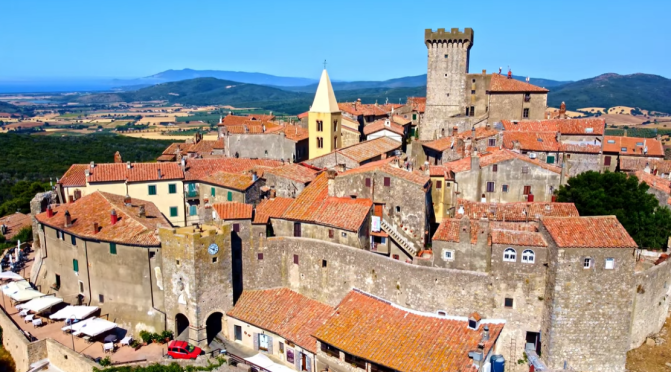
Village Walks: Capalbio In Grosseto, Western Italy

Capalbio, in the province of Grosseto, is called the small Athens, due to its position and the historical and artistic importance assumed in the Renaissance era. Located in the south of Tuscany, Capalbio stands on a hill covered by the typical Maremma scrub. The municipality was awarded with the 5 sails and it is in first place in the Blue Guide for the reception and quality of its area.

Video Timeline: 0:00 – [Drone intro] 3:00 – [Walking tour begins / Start at Piazza Giordano⛲] 4:50 – [Porta Senese (Siena Gate)☀️🏰] 6:20 – [History of Capalbio…more later…at 11:10] 9:34 – [Piazza Magenta⛲] 11:00 – [Panorama and tour around the walls👣] 11:10 – [📋𝗕𝗿𝗶𝗲𝗳 𝗛𝗶𝘀𝘁𝗼𝗿𝘆📋] 14:50 – [Via delle Campane (Bells’ Alley)] 20:30 – [Piazza della Chiesa (Church Square)] 21:40 – [Aldobrandini Castle / Collacchioni Palace🏰] 22:10 – [Church of St.Nicola – *tour inside*☀️⛪] 26:10 – [D’Annunzio’s poem of Capalbio🎼] 27:50 – [Northern Gate🏰] 28:35 – […touring the narrow medieval alleys of Capalbio…👣] 53:20 – [Walking along the walls – history of the walls☀️🏰] 1:01:00 – [☕️…some relax after this beautiful walk!…minutes of Ambient Sounds☕️]

Its history is closely connected to the Tre Fontane Castle of Rome, which today dominates the valley below. The different and characteristic neighboring hamlets make the village very famous. All small and characteristic, some of the hamlets are also known for the wonderful beaches, which offer numerous services and are suitable for families with children and for young people looking for fun.

Village Walks: Rocchetta Nervina In Liguria, Italy

Rocchetta Nervina is a small village in the province of Imperia in Liguria (Italy) with 291 inhabitants. It is built at an altitude of 235 meters, at the bottom of the Barbaira valley, a tributary of the Nervia coming down from the ridge separating the valleys of Nervia and Roya.

Surrounded by mountains, Monte Abelio (1015m), Monte Terca (1070m) and Monte Morgi (870m). Its French twin locality is Sospel. They are located at the same level and at an equal distance (approximately 10 km) on each side of the border.

Rocchetta means small rock or fortress, citadel.Nervina is derived from the name of Nervia. Old fortified town in the 12th century, it was called “Castrum Barbairre”, it was destroyed by the Marquis of Dolceaqua (the same as that of the michettes).

In the middle of the 16th century the castle of Monte Abelio controlled the Roya valley Rochetta is isolated and in a cul-de-sac, its defensive system is particular, access is allowed there thanks to two bridges from medieval times called “humpbacks”.It is still inaccessible today except on foot and of course by Vespa!!!

Classic Cars: 1960 Ferrari 250 GT SWB Berlinetta

For 1960, Ferrari built 46 of these race-prepared, aluminum-bodied Competizione SWBs, a model that is now commonly referred to as the Comp/60.

While many variations existed with regards to aesthetic and mechanical features, most Comp/60s can be identified by a few key visual characteristics: the more elegant front grille and side windows of the original design, a prominent external fuel filler on the rear deck, and a cockpit air vent at the top of the rear window.

The car presented here is a fascinating example of the 250 SWB Comp/60 Berlinetta; it claims a fantastic period-competition history, well-documented provenance, and recent, show-quality restoration.

Walking Tours: Volterra In West Tuscany, Italy (4K)

Volterra is a walled town southwest of Florence, in Italy. The central Palazzo dei Priori has medieval frescoes and a bell tower with expansive views. Volterra Cathedral has a marble entrance and a gilded coffered ceiling. Nearby are the remains of the Etruscan Acropolis. The Guarnacci Etrurian Museum has a rich collection of archaeological artifacts. The Roman Theater complex includes the ruins of 3rd-century baths. 

Video timeline: 0:00 – [Brief intro] 1:15 – [Walking tour begins / Piazza dei Priori] 3:20 – [Palazzo dei Priori☀️🏰] 9:50 – [Piazza San Giovanni⛲] 11:40 – [Chapel Addolorata – *tour inside*⛪] 18:30 – […back to Piazza dei Priori…⛲] 19:20 – [Medieval Show…To see the FULL Show skip to 02:31:00 📸🎼] 27:00 – [Cloister of the Cathedral of St.Maria Assunta – *tour inside*⛪] 32:30 – [Piazza San Giovanni⛲] 37:30 – [Baptistry of St.John – *tour inside*☀️⛪] 46:20 – [Cathedral of St.Maria Assunta – *tour inside*☀️⛪] 58:40 – [Piazzetta dei Fornelli⛲] 59:30 – [Via Orto Tondo] 59:40 – [📋𝗕𝗿𝗶𝗲𝗳 𝗛𝗶𝘀𝘁𝗼𝗿𝘆📋] 1:02:20 – [Vicolo del Mandorlo] 1:04:50 – [Via Francesco da Volterra] 1:05:50 – [Via San Filippo] 1:08:40 – [Via della Pietraia] 1:10:30 – [Vicolo dei Belladonna] 1:11:50 – [Church of San Cristoforo – *tour inside*☀️⛪] 1:14:00 – [Vicolo Chinzica] 1:15:50 – [Church of Madonna del Gabellino – *tour inside*☀️⛪] 1:17:20 – [Ancient Roman Baths🏛] 1:18:10 – [Via San Felice] 1:20:50 – [Via San Lino] 1:21:40 – [Church of St.Lino – *tour inside*☀️⛪] 1:25:10 – [Church of St.Francis – *tour inside*☀️⛪] 1:27:20 – [Cappella della Croce di Giorno☀️] 1:32:20 – [Porta San Francesco (St.Francis Gate)🏛] 1:34:20 – [Via Ripetta] 1:35:40 – [Porta San Felice (St.Felice Gate)🏛] 1:38:25 – [Panoramic Point⛺] 1:41:10 – [Via Lungo le Mura (along the wall alley)] 1:44:25 – [Porta all’Arco (Gate of the Arch)☀️🏛] 1:45:25 – [Via Porta all’Arco] 1:50:00 – [Piazza Martiri della Libertà⛲] 1:50:50 – [Via di Castello] 1:52:10 – [Via Giacomo Matteotti] 1:55:50 – [Via A.Gramsci] 2:00:00 – [Parrocchia della Cattedrale Church – *tour inside*⛪] 2:02:00 – [Piazza XX Settembre⛲] 2:02:30 – [Panorama on Volterra⛺] 2:05:30 – [Church of St.Augustine☀️⛪] 2:09:20 – [Porta Marconi (Marconi Gate)🏛] 2:12:00 – [Via Don Giovanni Minzoni] 2:15:50 – [Medici Fortress☀️🏰] 2:19:30 – [Porta a Selci (A Selci Gate)🏛] 2:20:40 – […a little far to the north… walking near Porta Fiorentina (Florence Gate)] 2:23:45 – [Church of St.Michael Archangel – *tour inside*☀️⛪] 2:26:10 – [Piazzetta San Michele⛲] 2:27:10 – [Via dei Sarti] 2:28:00 – [Viti Palace☀️🏰] 2:28:50 – [Via delle Prigioni (Prisons’ Alley)] 2:30:45 – [☕️📸🎼… the Medieval Show in Volterra! …☕️📸🎼]

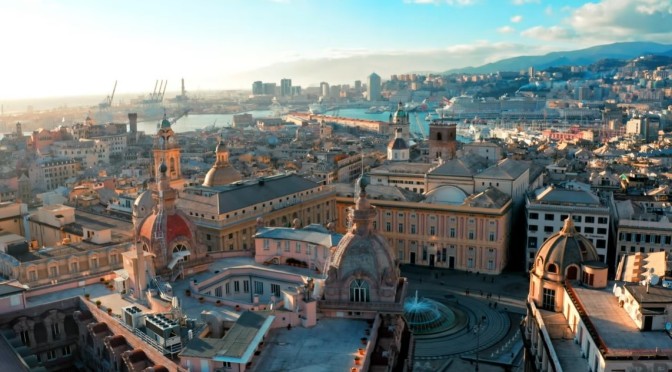
Aerial Views: Genoa In Northwestern Italy (4K)

Genoa (Genova) is a port city and the capital of northwest Italy’s Liguria region. It’s known for its central role in maritime trade over many centuries. In the old town stands the Romanesque Cathedral of San Lorenzo, with its black-and-white-striped facade and frescoed interior. Narrow lanes open onto monumental squares like Piazza de Ferrari, site of an iconic bronze fountain and Teatro Carlo Felice opera house. 

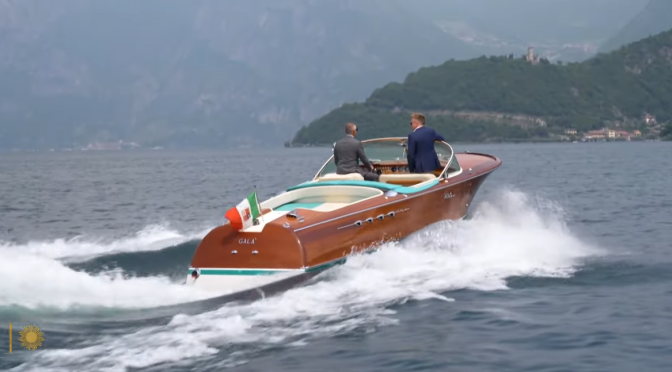
Italian Classics: The ‘Myth’ Behind Riva Aquaramas

During Italy’s post-war boom years, Riva’s glamorous wooden boats were the pinnacle of “la dolce vita” – the Ferraris of motorboats, owned by movie stars, tycoons and royalty. Correspondent Seth Doane takes a spin on the water in a classic Riva; checks out a new edition of the famed Aquarama boat; and learns how the company is working to keep Riva’s spirit alive.

Alberto Galassi is raving about his Riva, a 1970 wooden Aquarama, formed of cedar from Lebanon and mahogany. The CEO of the Ferretti Group, which now owns the Riva boat brand, he took correspondent Seth Doane on a ride on Italy’s picturesque Lake Iseo, racing past Riva’s factory.

“Riva is beyond boating; Riva is a myth,” Galassi said of the classic Riva speedboats, which have been in the hands of royalty, movie stars, rock stars and tycoons. “Let’s be honest. I mean, when you say, ‘I have a Ferrari,’ you need to say you ‘have a car’? Everybody knows what a Ferrari is. Riva is the same thing.”

Headlines: China Live-Fire Military Drills, Politics In Italy, Sri Lanka Economy

China conducts live-fire military drills. Plus: Sri Lanka’s new economic plan, an alliance between Italy’s centre-left and centrists, and Japan’s ‘roll-the-dice train’.