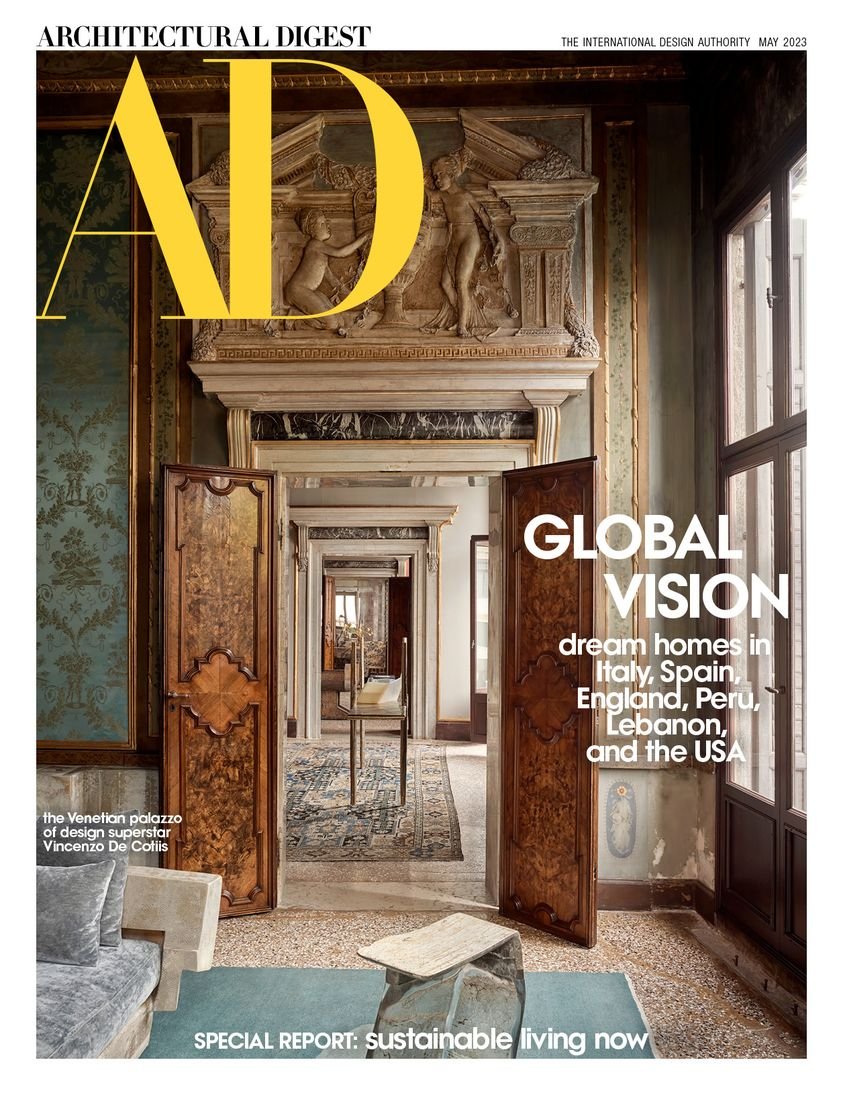
Architectural Digest Magazine (May 2023) – “We were inspired by Venice—the architecture, the history, the monumentality,” says AD100 designer Vincenzo De Cotiis over Zoom, swinging open the shutters of the Palazzo Giustinian Lolin, a Baroque-style palace in the city where he has recently taken up residence on the piano nobile. It’s a misty afternoon in February and a few small boats are traveling along the waterway that has facilitated trade, transit, and cultural exchange for centuries. “When you’re here, you understand what happened in the 15th century,” continues the designer’s wife, Claudia Rose De Cotiis. “How Venice became a world market.”
This palazzo watched it all unfold. Likely constructed around the 15th century by the Miani family, it was bought by the Lolins in the early 17th century. Following plans by the Venetian architect Baldassare Longhena, it was rebuilt around 1630, then willed to one of their relatives, Giovanni Giustinian. The design featured a striking, rather classical façade defined by three bands of pilasters (festooned curtains above the Corinthian columns lend a dash of baroque flair), but Longhena left some traces of the medieval structure intact, like narrow peaked windows and the original floor plan.
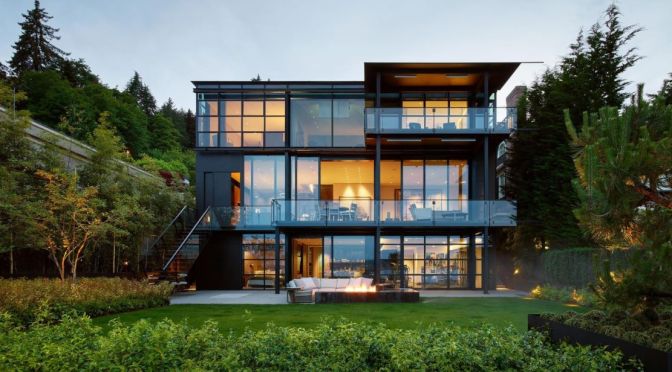
The Local Project – (April 6, 2023) – Located in Seattle, Washington, Leschi Inventors House by Olson Kundig is an inventors dream house with room for the owner to live and experiment.
Video timeline:00:00 – Introduction to the Inventors Dream House 00:23 – The Pacific North-West 00:37 – Liquid Light 00:48 – An Inventors Brief 01:36 – The Caterpillar Yellow 01:58 – A Walkthrough of the Home and the Experimental Spaces 02:25 – The View 02:56 – A Cantilevered Home 03:09 – The Mechanical Room 03:41 – Blurring the Boundaries Between Living and Experimenting 04:16 – The Materials 05:27 – Little Surprises at the Hands of the Craftsmen 06:14 – It’s About ‘How Things Work’
Following a brief that asked for a representation of the client’s characteristics, the architect has focused on supplying a home that allows the owner to create, workshop and experiment on different levels. Additionally, the architect responds to the home’s location, climate and consistent rain by employing materials that become one with the land as well as work with the wet weather Seattle is known for.
At the start of the inventor’s dream house tour, a big yellow front door has been created to greet visitors. Specifically chosen to be the exact same colour as Caterpillar’s heavy machinery, the door opens to reveal the unique interior of steel and concrete. On the front door, the owner’s experimental characteristics can be appreciated with a lock usually seen and used within a bank vault. As one continues through the inventors dream home and passes by the staircase made of industrial level steel, the welcoming of a double-height living space showcases the union between domains for experimentation and living.
As such, the use of black granite counters with an inbuilt Bunsen burner on the island table allows for the owner to do their own research within the comfort of their home with views over Lake Washington. To connect to the surrounds, giant glass panel doors have been installed across one wall of the living space – once opened, the living room becomes a deck space in which the owner can enjoy all year round. The main living quarters cantilever off a thick steel pipe, which also services the living room’s fireplace.
Upstairs, a loft has been stationed to be a think space for the inventor, while located on the ground floor is the mechanical room. Seen as the most important room within the inventors dream house, the undercroft of the home showcases an expression of all the mechanics and systems to the home, while also becoming celebration of everyone involved in the process. In the materiality palette of the inventors dream house, the architect uses weathered steel on the exterior as well as the interior – the cladded elements within the home have been waxed to allow for the steel to remain in its natural finish as it came out of the factory.
Additionally, concrete covers the floor to further allow for the owner to experiment with ease. Matched with the light and dark walls is the cabinetry, which is created from a dense particle board that has been stained and finished with a flat clear lacquer over the top. Designed to be a union between an assembly of pieces, the inventors dream house is finished and made to evolve in the wet weather so to become one with its surrounds.
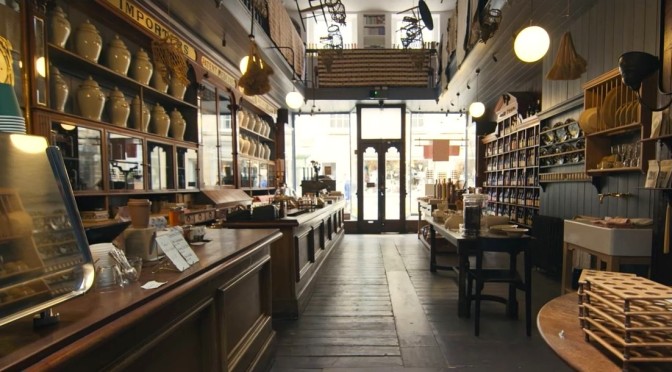
House & Garden (April 7, 2023) – Patrick & Neri Williams welcome us into their shop & home, Berdoulat, based in the World Heritage Site of Bath, England. The interior design duo have transformed a truly unique space in the heart of Bath, which sees Georgian, Regency and Victorian architecture converge.
Video timeline:00:00 – Shop: “Originally in the 18th-century, the shop would have a completely different format” 02:51 – Kitchen & Living Room: “The kitchen is the real heart of the home” 05:24 – Internal Courtyard: “This is the room where we relax and also come up with ideas” 07:54 – Bedroom: “We colour-matched the original Georgian green” 10:30 – Shop Vaults: “This is the original kitchen from the 18th-century servants’ quarters”
With a deep respect for the history and soul of the building, they have sensitively renovated the Grade II-listed space. “In 1890, three very eccentric Victorians joined forces,” explains Patrick as he stands in the front-of-house shop.
“What they did with the building was to completely reformat the space. All of the internal walls at ground and first-floor were removed, as was the ceiling to create this fantastic double-heighted space.” Watch the full episode of Design Notes with Patrick & Neri Williams and tour Berdoulat in Bath.
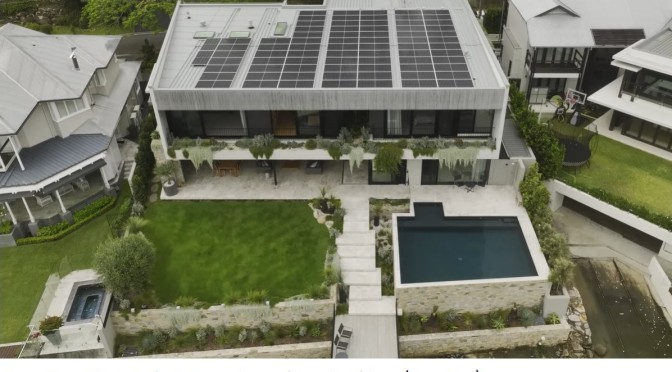
The Local Project – (April 4, 2023) – Fulfilling the client’s desire to build their concrete dream house, Shaun Lockyer Architects considers the tactile and environmental benefits of building with concrete. Located in an inner-city suburb of Brisbane,
Video timeline:00:00 – Introduction to the Concrete Dream House 00:32 – The Home and The Area 01:05 – Views from the Home 01:31 – A Modernist Theme on Approach 02:02 – A Walkthrough of the Home 02:22 – A Canvas for Life and Personality 02:40 – Less is More 02:59 – The Materials 03:41 – Controlling and Curating the Light 04:29 – Engaging with the Landscape 05:16 – Client and Architect Relationships
Dilkera embodies responsive design in how it reacts to both its climate as well as its location. Dilkera’s striking concrete façade and distinctive form are largely informed by the subtropical climate. The residence is a direct expression of how a home’s design can manage a rapidly changing mix of rain, heat and humidity – typical conditions of Brisbane and south-east Queensland where the home resides.
So that the inhabitants are not constantly moving between the inside and the outside to avoid the weather, there are deep thresholds, lovely wide eaves and protected edges so there’s a constant sense of being able to live throughout the entire concrete dream house, despite the season. Shaun Lockyer Architects also explores what elements make up a concrete dream house. The home offers vestiges to surrounding scenery, including views of bushland on the eastern side, an expansive river looking across to New Farm Park and The Powerhouse on the western side, and views of the city to the southwest.
Through a bold approach to materiality, Shaun Lockyer Architects designs a robust yet welcoming home. The structure’s materiality is kept minimal and, while concrete dominates, it is complemented by a beautiful stone that forms the base of the house along with black and blond timbers throughout. Concrete floor finishes from the inside to outside are consistent, creating a seamlessness between indoor and outdoor spaces as the concrete transitions to oak cabinetry and extends through to the furniture.
An incremental revealing of what lies beyond this concrete dream house expresses a deliberate modernist theme. As soon as one enters the home there is an opening of space, with a double-height room that becomes the centre of gravity in both the form and architecture of the house. Walking around the home, views through to the landscape and garden reveal themselves, which nurtures a connection to the outside and a sense of the residence’s transparency.
Dilkera expresses the tangible reality of what was once a mere vision of a concrete dream house. To achieve this, Shaun Lockyer Architects prioritised the relationship with the client and in turn created a home that is distinctly different, resulting in a deliberate attempt for the home to engage with the landscape rather than be a dialogue about the building in itself.
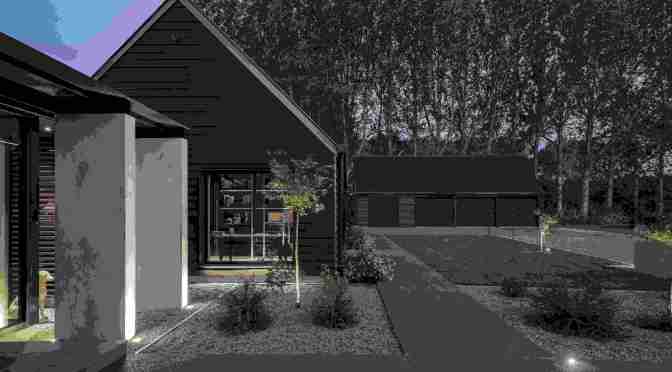
The Local Project (March 31, 2023) – Bordered by the Southern Alps on one side and the sea on the other, Hepburn’s Road House by Warren and Mahoney and Detail by Davinia Sutton is a country home that responds to the New Zealand landscape.
Video timeline:00:00 – Introduction to the Ultimate Country Home 01:08 – A Symmetrical Home 01:27 – Using Durable Materials 01:52 – An Anecdote to a Town House 02:11 – The transition Between Inside and Outside 02:29 – The Theme of Longevity 02:55 – An Honest and Tailored Approach to Detailing 04:01 – Meeting the Needs of Entertaining 04:18 – Proud Moments 04:35 – Favourite Aspects of the Home 04:45 – Elegant Spaces of Good Proportions
Using a range of trees, orchards, a tennis court and walls, the architects slowly reveal the country home, creating an air of suspense as nothing is immediately available upon arrival. With its symmetrical layout, the home begins with a long gallery at the front entrance with bedrooms on either side and a large living space that is placed behind. To deal with a tough site and the New Zealand climate, Warren and Mahoney employed materials that directly respond to these challenges while also providing durability. Such materials used include concrete, timber weatherboard, profiled metal roof and cladding, timber shutters and flooring, and stone.
Designed to be an antidote to the townhouse, the employed materials of the country home also respond to the difference between the types of homes and, in turn, the difference between city and country living. As such, the approach towards relaxation, level of formality and materials used allows the country home to become a place that the owners can find shelter and freedom. Used to break down the transition between inside and outside, moving timber shutters are placed over the operable glass doors and walls to help create versatile uses for the spaces.
Additionally, the themes of longevity, proportions, symmetry, and the juxtaposition between the interiors and the exterior façade, helped to lead the design choices by Detail by Davinia Sutton. Embracing New Zealand design throughout the build, with an honest and tailored approach, the interior designer offers a sincere tactic delivered with a contained palette. Seen through the bedrooms, the calming palette is a union of travertine stone alongside honed and soft finishes that add a wholeness to the private spaces. Addressing the needs and requirements of the home’s landscape, the interior design incorporates elements that answer these needs directly.
Experienced within the laundry, the room has been turned into a mud room that allows the owners to freshen up before entering the home. Furthermore, extra storage has been introduced with appliances such as a wine fridge and cool and dry fridges, which offer a prolonged ability to store produce. Finished with Fisher & Paykel appliances, the country home integrates a refined ease of living for the owners and responds to their love for entertaining. Deepening the connection and celebration of landscape and entertainment, Warren and Mahoney’s work seamlessly unites with Detail by Davinia Sutton’s interior design so that the owners can easily transition from inside to outside living.
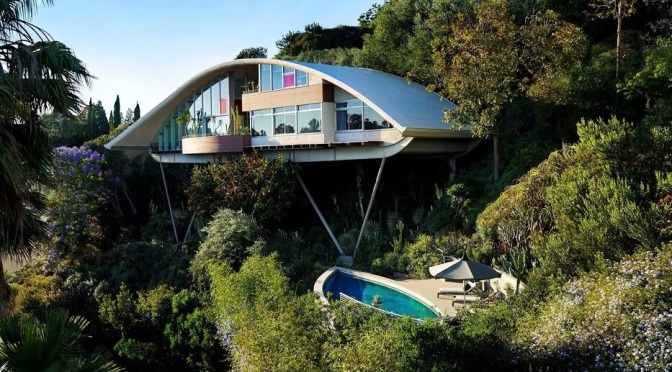
Architectural Digest (March 30, 2023) – Today Architectural Digest takes you up into the Hollywood Hills of Los Angeles to visit Garcia House on Mulholland Drive, a legendary mansion designed by architect John Lautner that was recently on the market for $16 million.
For John McIlwee, living in John Lautner’s Garcia House has been nothing short of life-altering. “It’s been empowering and substantial,” he tells AD. An entertainment business manager, McIlwee and his partner, Bill Damaschke, bought the 1962 modernist masterpiece from Vincent Gallo in 2002, who told them the property would change their lives. McIlwee says it did. “John Lautner has kind of a cult following with people from all walks of life, so it’s been an amazing way to be part of a bigger collective world of art and architecture,” he says. Now, it’s time to pass the torch—or, better phrased, the keys—to a new owner.
The Local Project – (March 21, 2023) – Only reachable by boat, Marra Marra Shack by Leopold Banchini Architects is a hidden eco-friendly timber cabin that embraces a quiet lifestyle removed from the bustle of city living.
Video timeline:00:00 – Introduction to the Eco-Friendly Timber Cabin 00:46 – The Site and its Location 01:06 – The Brief: Simplicity and Discovery 01:30 – Working with a Remote Construction Site 01:59 – Hand Built and Off-Grid 02:32 – A Walkthrough of the Cabin 03:06 – The Feature Window 03:57 – A Timber Structure 04:29 – Custom Made Furniture 05:00 – The Materials 05:36 – Hidden in Plain Sight
As Leopold Banchini Architects’s first Australian project, the hidden eco-friendly timber cabin required only two bedrooms, easy living spaces and a connection to landscape. Using the occasion to discover the Australian landscape, the Swiss architect has used the unique crafts only available in this country. The entire building has been completed by two carpenters and using materials that required no heavy machinery.
Additionally, each chosen material responds directly to the complexity of weather, tides and floods experienced in the unique riverside location. Sitting on a slope, the hidden eco-friendly timber cabin welcomes guests with an awe-inspiring reveal upon arrival at the renovated jetty. After walking up the stairs the house tour begins at the entrance to the main living spaces, which includes the living room, dining area and kitchen. Located to the rear of the shack are two smaller bedrooms with bathrooms, both of which have been designed to offer solitude where the owners can enjoy their own space.
Finished with a large window that overlooks the river, the living room gives the impression that the home sits upon the water instead of above. By using counterweights, the opened window turns the living space into an inside and outside deck, allowing a deeper connection to the wider surrounds. The interior of the hidden eco-friendly timber cabin has been imbued with locally sourced timbers, including iron bark that is used for the pillars that hold the home together. Other elements within the home, including the stairs and flooring, are made from turpentine wood from the old jetty, while spotted gum forms the structural beams along the roof of the cabin.
Additionally, the furniture of the home has been designed specifically for Marra Marra Shack by using leftover wood from the construction. Other elements in the home, including the fireplace, sink and all steel elements, have been custom made to resolve the few needs of the owners while staying in the house. Being in the middle of an Australian national park, the architect had to respond to certain elemental outcomes including floods, fire and tide heights. Built up on a slope to respond to the conditions, the exterior of the home has also been covered in fibre cement and plaster board to address fire safety in the warmer months.
While the exterior of the hidden eco-friendly timber cabin appears to be made of other materials, it is evident when entering the home that the interior is entirely made of timber. Elevated and surrounded by trees, Marra Marra Shack does not transform the landscape but becomes one with it.
Country Life Magazine (March 22, 2023) – Verdi’s land of opera and glory, Picasso in Spain’s cradle of the Arts, where leading writers find their inspiration, French breeds to provoke English envy and the best in luxury overseas property
Once derelict, Gurney Manor Mill was rescued in the early 1990s and transformed into a lovely family home.
Any property that is surrounded by water is guaranteed to be impressive. It’s sort of an unwritten rule. Naturally, as a former watermill, Gurney Manor Mill falls into this category: the mill and its 1.2 acres of gardens are surrounded by the historicwater system, creating a bucolic setting.
Thirsty work
Amelia Thorpe selects watering cans for the home and garden
Food stuff: a simple guide to nutrients and fertilisers
Don’t know your potassium from your phosphorus? Fear not, as Steven Desmond explains what to feed your plants and when
Blossoming ideas
There’s more to ornamental apple trees than merely fruit, reveals Charles Quest-Ritson
Holey moley!
Meet the ‘gentleman in velvet’—Harry Pearson unearths the underground world of the mole
The Local Project – (March 21, 2023) – Celebrating a 1970s clifftop house and its original design, Stawell House by Architects EAT is a culmination of subtle restorations and additions that bring a modern liveliness to the home’s 50-year-old history.
Video timeline:00:00 – Introduction to the 1970s Clifftop House 00:26 – The Location and The History 00:56 – Clifftop Views 01:14 – A Walkthrough of the Home 01:53 – Experiencing Everything Nature Has to Offer 02:08 – The Materials 03:18 – A Personal Project for the Owners 03:57 – The Landscape 04:18 – A Restoration Project not a Redesign
Located in Studley Park, Melbourne, the 1970s clifftop house showcased original architecture that could not be replicated. However, desiring a respectful and modern update the clients chose to collaborate with Architects EAT, who agreed that retaining Stawell House’s character was important. While also taking on the role of project managers, the owners were able to maintain an intimate and collaborative throughout the entire process of restorations. Overlooking the Yarra River, the 1970s clifftop house asserts itself as part of the landscape blending effortlessly into the topography.
As the house tour begins, Stawell House’s modern renovations unfold like a sincere love letter to its original form. Beginning from the façade, the red brick home references the traditional build, yet once the door opens modern uplifts begin to take centre stage. After a linear skylight leads onto the kitchen and dining space, guests and owners make way to the balcony, which overlooks the west. Additionally, a spare bedroom and bathroom and the master bedroom have been installed on the entrance level to allow the owners ease of movement from private rooms to the public spaces.
Located downstairs, the guest room has been built with an ensuite containing an outdoor bathtub allowing the guest to fully experience the elements. To deal with the effects of a west-facing house, the architects have delivered a range of architectural devices which includes external steel shading. The external materials used for the 1970s clifftop house provide a weather resistance while also maintaining a tree like appearance to fit in with the surrounds. Honouring the original layout of the home, the floorplan remains wide as to allow an ease of movement and living.
Furthermore, timber cladding has been heavily featured on the internal walls and windows. Taken from the original home, the timber has been painstakingly removed, sanded and oiled again before re-use. Managing the entire construction process themselves, the owners work closely with the builders and trades to deliver personal modern updates to the 1970s clifftop house. Showing Architects EAT a range of design inspirations found in magazines, the owners were able to collaborate and create a home that reflects their personalities.
Additionally, the owner has also worked on the landscape, adding a deep personal touch that will grow with the home. Focused more on restoration rather than redesign, Architects EAT have worked closely with the owners and the trades to create a defining home for the modern age.
News, Views and Reviews For The Intellectually Curious












 Boomers Daily