
Tag Archives: Global Warming

Climate Change: A Review Of High-Tech Solutions

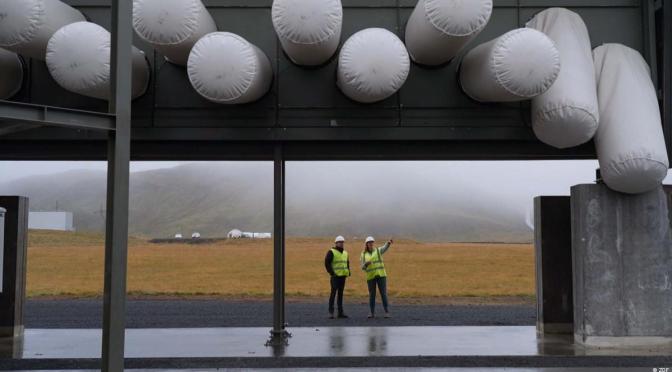
DW Documentary (June 13, 2023) – Can high-tech solutions help protect the climate? What would be the side effects of further human intervention in nature?

Attempts are being made to reduce the CO2 in the atmosphere with technical solutions. For example, new carbon capture technology that can extract CO2 from air and water, even if the amount currently captured is minimal and not enough to prevent the climate crisis and its consequences. Still, there is no shortage of ideas. Adding basalt rock dust to agricultural fields not only binds carbon dioxide but keeps the soil fertile.

Biochar, made from organic waste, has a similar effect. Some ideas are bolder: A protective screen of particles in the upper layers of the atmosphere could filter sunlight, as seen with the eruption of the Pinatubo volcano in the Philippines in 1991. The millions of tons of sulfur dioxide spewed into the stratosphere cooled the earth significantly.

Theoretically, aircraft could be used to deliver the particles. But experts warn that the consequences for humans and the weather would be felt worldwide and could never be fully controlled.

#documentary #dwdocumentary #climatechange

Emissions: The Problem With NYC’s Skyscrapers

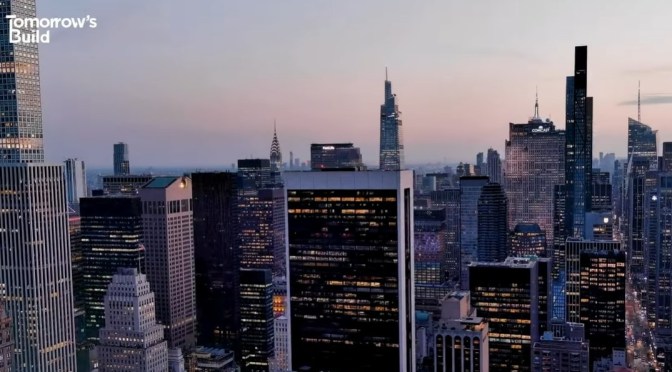
Tomorrow’s Build (May 9, 2023) – Thousands of Manhattan’s tall buildings now HAVE to change.

Local Law 97

Buildings account for approximately two-thirds of greenhouse gas emissions in New York City and Mayor de Blasio has pledged to address these emissions as part of his plan to make the city carbon neutral by 2050.
 
Local Law 97 is one of the most ambitious plans for reducing emissions in the nation. Local Law 97 was included in the Climate Mobilization Act, passed by the City Council in April 2019 as part of the Mayor’s New York City Green New Deal.
 
Under this groundbreaking law, most buildings over 25,000 square feet will be required to meet new energy efficiency and greenhouse gas emissions limits by 2024, with stricter limits coming into effect in 2030. The goal is to reduce the emissions produced by the city’s largest buildings 40 percent by 2030 and 80 percent by 2050. The law also established the Local Law 97 Advisory Board and Climate Working Groups to advise the city on how best to meet these aggressive sustainability goals. 
 
Local Law 97 generally covers, with some exceptions:

  • Buildings that exceed 25,000 gross square feet;
  • Two or more buildings on the same tax lot that together exceed 50,000 square feet;
  • Two or more buildings owned by a condo association that are governed by the same board of managers and that together exceed 50,000 square feet. 

Culture: Dal Lake Floating Market, Srinagar, Kashmir

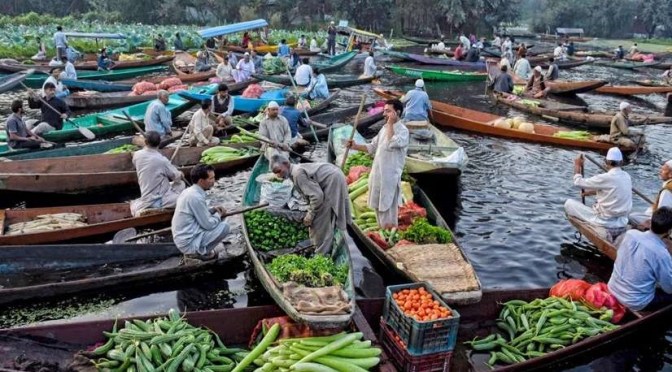
Insider Business (April 21, 2023) – For generations, farmers in Indian-administered Jammu and Kashmir have been selling their crops on the Dal Lake in a floating market. The lake is an economic hub for people living there – with many working in agriculture, fishing, and tourism. But decades of pollution have threatened their livelihoods.

The floating vegetable market on Dal Lake is in Srinagar, Kashmir, where locals trade out of their canoes. The produce sold here is grown in floating gardens.. The rich ecosystem of this wetland produces plenty of tomatoes, cucumbers, water chestnuts and the famous nadru (lotus roots, a delicacy in the Kashmir Valley).

They gather in the centre of the lake at dawn, and disappear just as sunlight hits the waters.

Climate Change: 10 Foods That Keep Getting Pricier

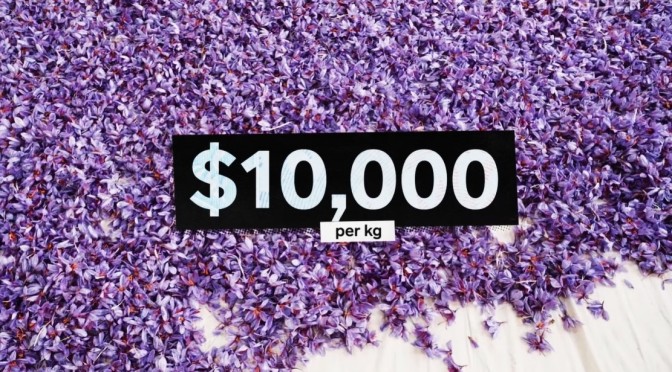
Insider Business (April 4, 2023) – Purple flowers in Kashmir produce the world’s most expensive spice — saffron. While it can sell for $10,000 per kilogram, climate change is making it even more expensive. Because of lower-than-usual rainfall over the last few years, production has dropped significantly.

And fields that once yielded this delicate spice have become sites for new housing construction. Climate change is threatening the production of all kinds of foods from cloves in India to eels in Japan and Spain. Here are 10 expensive, and vulnerable, foods and why climate change is making them so much more expensive.

Opinion: China-US Danger Zone, Big Tech AI Race, Rice Fuels Diabetes Epidemic

April 3, 2023: A selection of three essential articles read aloud from the latest issue of The Economist. This week, the China-US contest is entering a new and more dangerous phase, how the tech giants are going all in on artificial intelligence (10:26) and why rice is fuelling climate change and diabetes (25:03).

Why the China-US contest is entering a new and more dangerous phase

Chinese officials rage at what they see as American bullying

Big tech and the pursuit of AI dominance

The tech giants are going all in on artificial intelligence. Each is doing it its own way

The global rice crisis

Rice feeds more than half the world—but also fuels diabetes and climate change

Disasters: Earthquakes & Cyclones Ravage Vanuatu

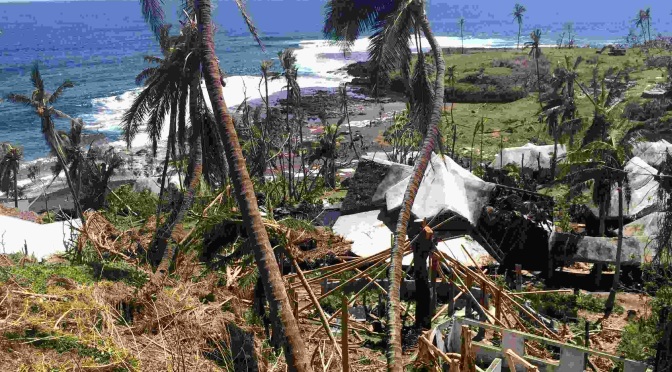
The Independent (March 28, 2023) – The tiny Pacific island state of Vanuatu was hit by two category-four cyclones and two earthquakes over three days this month, in a devastating onslaught that destroyed homes, cut power, and impacted 80 per cent of the population.

Scientists say global heating is already making major tropical cyclones like those that hit Vanuatu more frequent. Under moderate and worst-case climate scenarios, the country is expected to lose around 20-25 per cent of its GDP from natural disasters each year, according to a recent UN report. Later this month Vanuatu’s proposal for a top international court to clarify the obligations of states to tackle climate change and the consequences of not doing so under international law will be put to a vote at the United Nations.

Vanuatu is a South Pacific Ocean nation made up of roughly 80 islands that stretch 1,300 kilometers. The islands offer scuba diving at coral reefs, underwater caverns and wrecks such as the WWII-era troopship SS President Coolidge. Harborside Port Vila, the nation’s capital and economic center, is on the island of Efate. The city is home to the Vanuatu National Museum, which explores the nation’s Melanesian culture.

Environment: ‘Guardians Of The Glaciers’ In France

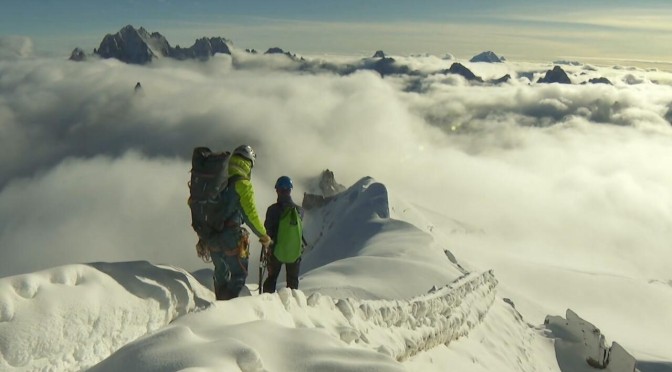
FRANCE 24 English (February 7, 2023) – Glaciers are increasingly threatened by climate change. The French Alps are home to more than 4,000 of these fascinating natural monuments, of which 80 to 90 percent are set to disappear by 2100 due to global warming.

Among the most emblematic glaciers is the Mer de Glace, or Sea of Ice, which retreats a little more each year, under the watchful eye of tourists. Meanwhile, the Bossons glacier reveals aircraft debris that was thought to be lost forever. FRANCE 24 went to meet some of the guardians of the glaciers.

Siberia Views: The Nomadic Nenets Reindeer Herders

BBC Earth – Arctic Siberia’s Nomadic Nenets herders have migrated with reindeer for generations. Reindeer were among the last animals domesticated by humans.

According to the Nenets legend, the humans promised the reindeer that they would protect them on their long migration from the mainland to the seashores as long as the reindeer provide humans with all their needs, including milk, fat, meat, bones, horns, and skins. The nomadic reindeer herders reside in the taiga forests of the Russian tundra and northern Mongolia. 

Food Science: Developing Hardier Coffee Beans (FT)

Financial Times – One of world’s favorite drinks is under threat from global warming. The world’s top coffee producing nations all lie at similar tropical latitudes, where even small rises in temperature are forecast to have severe consequences for people and agriculture. But as the FT’s Nic Fildes reports, in Australia, scientists are tackling the problem by trying to develop a better, hardier coffee bean.

Home Design: ‘Land On Water’ – MAST Studio (2022)

Land on Water by Copenhagen-based Architecture Studio MAST 

Land on Water

The system is based on simple flat pack modules made from recycled reinforced polymer. These are extremely strong and resilient and can be easily transported and assembled on location

The modules can be assembled in different configurations to provide floating foundations for floating infrastructure, public spaces or housing.

A growing acknowledgement of sea level rise and an increased risk of urban flooding has contributed to a sharp increase in interest in building on water, but current solutions, including polystyrene filled concrete foundations and plastic pontoons are inflexible, difficult to transport and highly unsustainable. 

MAST has envisioned a new system of simple of flat-packed modules made from recycled reinforced plastic, that can be easily transported around the globe and assembled into countless configurations, providing a secure floating foundation. The system offers a sustainable and highly flexible solution for building almost anything on the water; from floating houses in Seattle, to floating campsites on Oslo fjord, to saunas on Hobart’s riverfront.

The system was inspired by gabion construction, an ancient technology which utilises mesh cages filled with rubble to create extremely sturdy, low cost foundations. In this case the concept is inverted; and the modular ‘cages’ are filled with locally sourced, up-cycled floatation supporting the weight of any structure built on top. they are also much more adaptable than existing solutions since floatation can be added or adjusted at any time if weight is added or shifted around above.

Land on water will provide a climate resilient and adaptable solution for the construction of new floating buildings worldwide but could also lead to an entirely new type of dynamic and organic off-grid floating community and an alternative to the large master-planned floating cities currently under development which repeat many of the mistakes made by urban planners in the middle of the 20th century.