
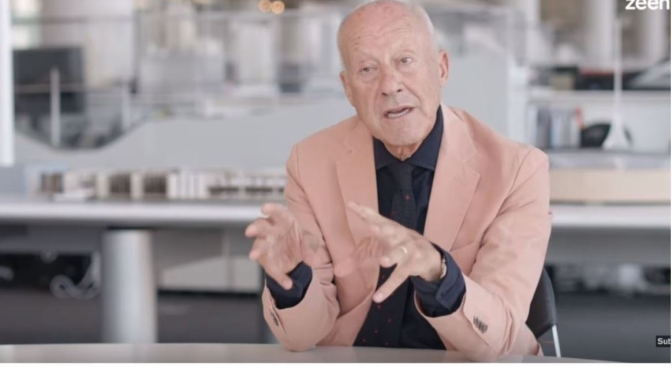
“High-tech is something to do with the expression of the technology – the means by which the building stands,” the award-winning architect told Dezeen in an exclusive interview at his London practice.
 British architect Norman Foster reflects on his first high-tech building and how it shaped offices to come, in this exclusive video produced by Dezeen. Named after the electronics manufacturer that commissioned the building,
Reliance Controls was an industrial facility located in Swindon in Southwest England. Completed in 1967, the building was the last to be designed by Team 4, an architecture practice comprising Foster, Richard Rogers, Su Brumwell and Wendy Cheesman, before the group disbanded. The single-storey rectangular shed, which was designed to house the company’s factory and offices, was one of the first buildings labelled as high-tech – a style of architecture that Foster defines as a celebration of a building’s functional components.
Reliance Controls was the first building to dissolve the traditional boundaries between factory workers and office workers. “There was only a glass screen that would separate the assembly line for electronics from those who are managing the sales force,” said Foster. “They would all share the same kitchen and dining facilities, the same bathrooms. That we take for granted now but at that time it was it was really revolutionary – unheard of.”
Website: https://www.dezeen.com/2019/12/13/norman-foster-reliance-controls-video-interview/

 Melvyn Bragg and guests discuss the history and social impact of coffee. From its origins in Ethiopia, coffea arabica spread through the Ottoman Empire before reaching Western Europe where, in the 17th century, coffee houses were becoming established.
 In the new series “Economics For People” from the Institute for New Economic Thinking (INET), University of Cambridge economist and bestselling author Ha-Joon Chang explains key concepts in economics, empowering anyone to hold their government, society, and economy accountable.
 Food defines us as individuals, communities, and nations – we are what we eat and, equally, what we don’t eat. When, where, why, how and with whom we eat are crucial to our identity. Feast and Fast presents novel approaches to understanding the history and culture of food and eating in early modern Europe.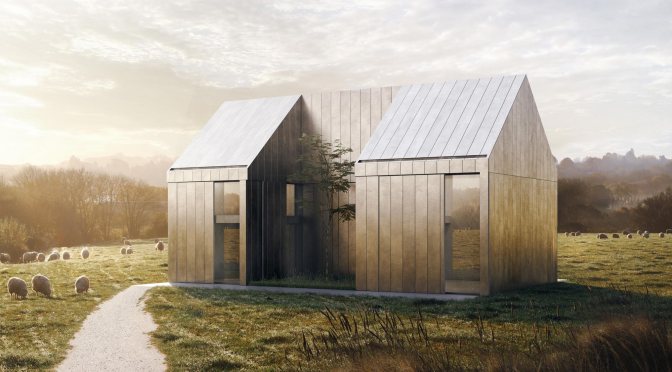
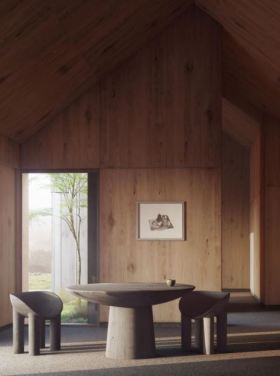 Most notable is Toogood’s sensitive approach to materials. She offers two different, equally alluring solutions to the exterior cladding and the internal finishes. Both external cladding options, raw galvanised steel and dark charred timber, are suggestive of industrial or agricultural structures, making it something of a thrill to see them in a domestic setting. The building clad in raw galvanised steel will have a refined, cream-coloured interior, whilst the structure clad in dark charred timber will have an exposed plywood interior finish.
 Shortly after George Orwell’s death in 1950, his widow Sonia was visited in London by two representatives of the American film producer, Louis de Rochemont. They sought the rights to Orwell’s novel from five years earlier, Animal Farm. It’s said Sonia took some convincing but eventually agreed, on the promise that de Rochemont would introduce her to her hero, Clark Gable.
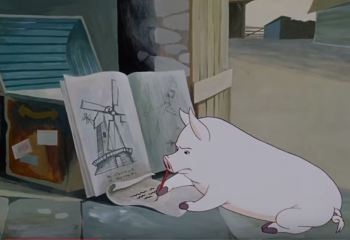 A conventional, live-action adaptation was out of the question given that the book’s main characters were farmyard animals, so an animated movie was decided upon instead. De Rochemont chose to have it made in the UK rather than the US — partly because of lower production costs, partly because he admired the work of British husband-and-wife duo





 Boomers Daily