Tag Archives: 1960’s

Exhibitions: “Envisioning 2001: Stanley Kubrick’s Space Odyssey” (MOMI NYC)

From a New York Times online review:

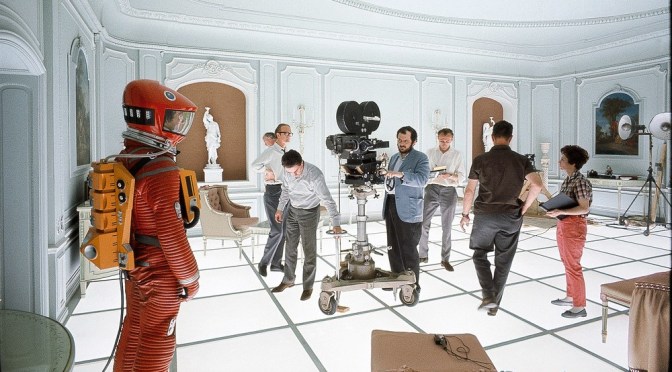
“Envisioning 2001” shows Kubrick as a director in command of all aspects of filmmaking, and it suggests that he and Clarke were no small obsessives when it came to understanding their subject matter. One of the first items in the exhibit is a request form from 1964, with Clarke’s name and address, sent to the United States Air Force. He sought information on a sighting — which turned out to be a satellite — that he and Kubrick, then developing the story for the movie, had seen in the sky over New York.

Some of the first visitors to see the exhibition Envisioning 2001 Stanley Kubrick's Space Odyssey. Photo by Thanassi Karageorgiou Nas Karas Studios Jan 16, 2020 at Museum of the Moving Image
Some of the first visitors to see the exhibition Envisioning 2001: Stanley Kubrick’s Space Odyssey. Photo by Thanassi Karageorgiou Nas Karas Studios Jan 16, 2020 at Museum of the Moving Image

As it approaches its 52nd birthday, “2001: A Space Odyssey” remains one of the most inventive and enduring of all movies. But from the vantage point of 2020, it can be difficult to appreciate the sheer breadth of imagination involved in its making.

Enter “Envisioning 2001: Stanley Kubrick’s Space Odyssey,” a new exhibit at the Museum of the Moving Image in Astoria, Queens, that runs through July 19. The show brings together original correspondence, sketches, storyboards, props, video clips and much more to illustrate how Kubrick, the film’s director, and Arthur C. Clarke, the science fiction author who collaborated with him on the screenplay, set about bringing the future to the screen.
Read full article

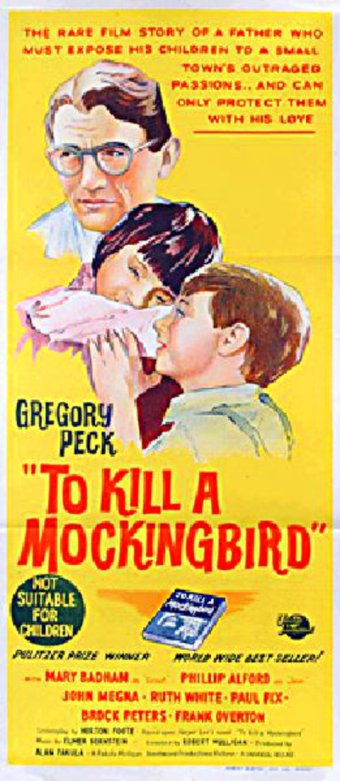
Movie Scenes: Atticus Finch (Gregory Peck) Closing Argument In “To Kill A Mockingbird” (1962)

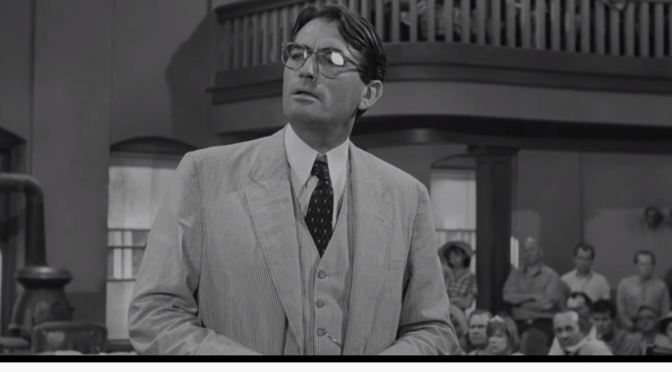
To Kill A Mockingbird 1962 Movie starring Gregory Peck“Now, gentlemen, in this country our courts are the great levelers. In our courts, all men are created equal. I’m no idealist to believe firmly in the integrity of our courts and of our jury system. That’s no ideal to me. That is a living, working reality!”
Gregory Peck won an Oscar® for his brilliant performance as the Southern lawyer who defends a black man accused of rape in this film version of the Pulitzer Prize-winning novel. The way in which it captures a time, a place, and above all, a mood, makes this film a masterpiece. The setting is a dusty Southern town during the Depression. A white woman accuses a black man of rape. Though he is obviously innocent, the outcome of his trial is such a foregone conclusion that no lawyer will step forward to defend him – except Peck, the town’s most distinguished citizen. His compassionate defense costs him many friendships but earns him the respect and admiration of his two motherless children.

© 1963 Pakula-Mulligan Productions, Inc. & Brentwood Productions, Inc. All Rights Reserved.

Cast: Gregory Peck, John Megna, Ruth White, Paul Fix, Brock Peters, Frank Overton Produced By: Alan J. Pakula

Directed By: Robert Mulligan

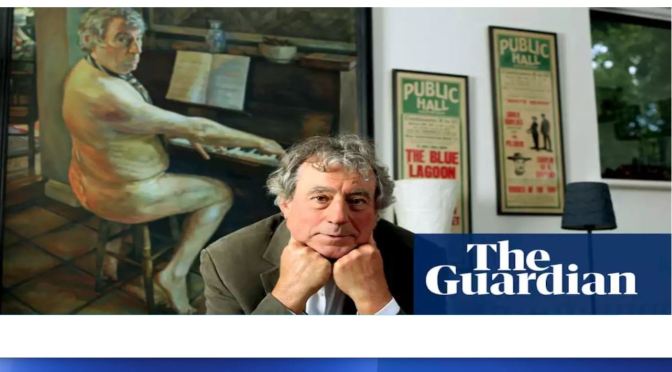
Tributes: Monty Python Member Terry Jones Is Dead At 77 (1942 – 2020)

Terry Jones, Monty Python founder and Life of Brian director, dies aged 77. Jones, who was diagnosed with dementia in 2015, was the main directing force in Python’s films, as well a prolific creator of TV documentaries and children’s books.

https://www.youtube.com/watch?v=quWtWWmj-lk

In 1969, Palin and Jones joined Cambridge graduates Cleese and Graham Chapman – along with Idle and animator Terry Gilliam – on a BBC comedy sketch show. Eventually broadcast under the title Monty Python’s Flying Circus, it ran until 1974, with Jones largely writing with Palin (complementing Cleese’s partnership with Chapman). Seemingly chaotic, frequently surreal and formally daring, Monty Python’s Flying Circus would became one of the most influential shows in BBC history, revolutionising comedy formats, spawning scores of catchphrases, and inspiring an entire generation of comedians. Jones’s fondness for female impersonation was a key feature of the show, as was his erudite writing.

Read more

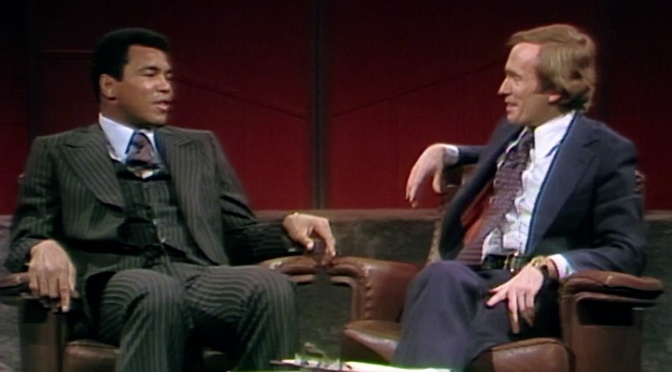
New Documentaries: “Ali & Cavett: The Tale Of The Tapes” On HBO (Trailer)

Eye-opening documentary explores the life of boxing legend Muhammad Ali through the lens of his many appearances on Dick Cavett’s iconic, long-running talk show. Ali & Cavett: The Tale of the Tapes premieres Feb. 11 at 9pm on HBO.

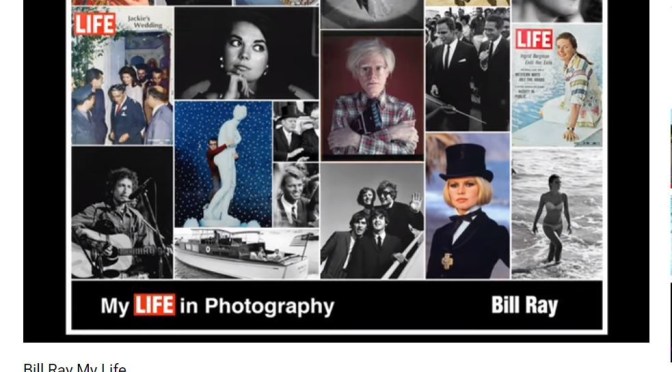
Tributes: LIFE Magazine Photographer Bill Ray Dies At 84 (1936 – 2020)

From a The Guardian online release:

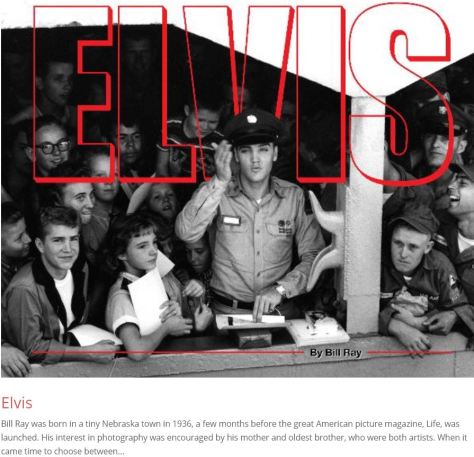
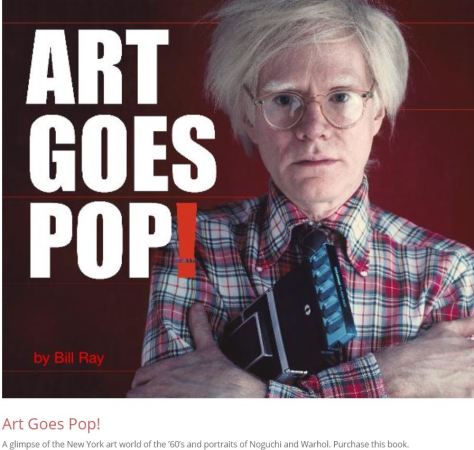
Bill Ray, primarily known for his work for Life magazine, has died aged 84. Born in Nebraska in 1936, he graduated from local newspapers to a staff job on Life, and photographed 46 covers for Newsweek. He was famed for his images of celebrities, and also covered the Hells Angels motorcycle club and the aftermath of the Watts riots.

Photographer Bill Ray Elvis

Photographer Bill Ray Art Goes Pop!

Bill Ray Website


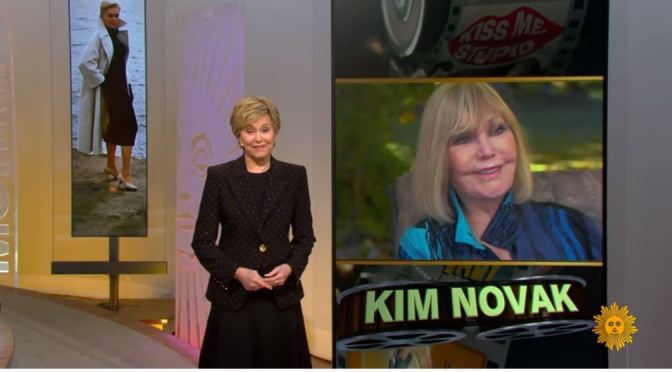
Video Profiles: 86-Year Old Actress Kim Novak On Her Love Of Artwork (CBS)

Now on the cusp of turning 87, Kim Novak is still finding herself. The star of such classics as Alfred Hitchcock’s “Vertigo,” “Picnic,” and “Bell, Book and Candle,” the actress turned her back on Hollywood in the 1960s and has since pursued artwork and a love of animals. Mo Rocca reports.

New Arts & Culture Books: “Federico Fellini – The Book Of Dreams” (Rizzoli)

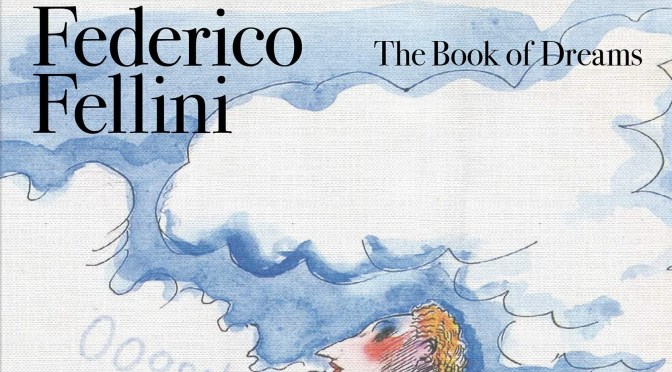
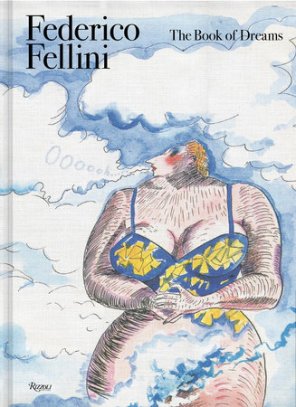
Federico Fellini The Book of Dreams Rizzoli 2020The volume will be released to coincide with the centenary of Federico Fellini’s birth (January 2020), which will be celebrated in Italy with a traveling exhibition on the director that will start its journey from Milan in December 2019.
A highly colorful journey into the boundless territory of a genius’s imagination, this is a work that added a fundamental element to the study of Federico Fellini and his creative experience. From the late 1960s until 1990, the great director used this diary to represent his nocturnal visions in the form of drawings or, as he himself described them, “scribbles, rushed and ungrammatical notes.”

About The Author

Sergio Toffetti, born in Turin in 1951, is president of the Museo Nazionale del Cinema and has published essays on Italian and international cinema, and on the conservation and restoration of film. Felice Laudadio is president of the Fondazione Centro Sperimentale di Cinematografia in Rome. He has overseen numerous cinema events, such as MystFest, EuropaCinema, and RomaFictionFest. Gian Luca Farinelli has been director of the Cineteca of Bologna since 2000. In 1986 he created, together with Nicola Mazzanti, Il Cinema Ritrovato an event dedicated to the history of cinema and the activity of film libraries. Together with Martin Scorsese, Raffaele Donato, Thierry Frémaux, and Alberto Luna he founded the World Cinema Foundation, which brings together about twenty great international directors for the restoration of third-world films.

To review or purchase

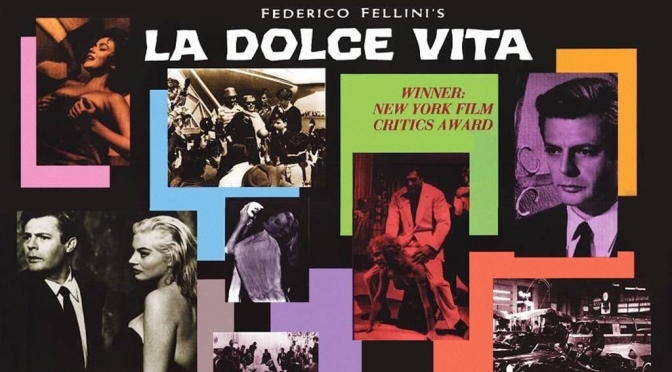
Film History: Federico Fellini’s “La Dolce Vita” (1960) At 60 Years (Video)

La Dolce Vita (“the sweet life” or “the good life”) is a 1960 comedy-drama film directed and co-written by Federico Fellini. The film follows Marcello Rubini (Marcello Mastroianni), a journalist writing for gossip magazines, over seven days and nights on his journey through the “sweet life” of Rome in a fruitless search for love and happiness. La Dolce Vita won the Palme d’Or (Golden Palm) at the 1960 Cannes Film Festival[ nd the Oscar for Best Costumes. The film was a worldwide box-office success.

From Wikipedia

Classic Cars: “1965 Corvette L76 Stingray”

From Wikipedia:

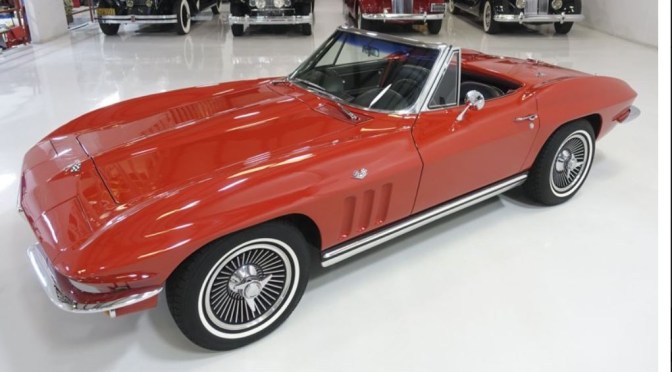
1965 Chevrolet Corvette L76 Stingray interiorFor its third season, the 1965 Corvette Sting Ray further cleaned up style-wise and was muscled up with the addition of an all-new braking system and larger powerplants. 1965 styling alterations were subtle, confined to a smoothed-out hood now devoid of scoop indentations, a trio of working vertical exhaust vents in the front fenders that replaced the previous nonfunctional horizontal “speedlines,” restyled wheel covers and rocker-panel moldings, and minor interior trim revisions. The 1965 Corvette Sting Ray became ferocious with the mid-year debut of the “Big-Block” 396 cu in (6,490 cc) engine producing 425 hp (317 kW).

Ultimately, this spelled the end for the Rochester fuel injection system, as the carbureted 396ci/425hp option cost $292.70 to the fuel injected 327ci/375hp’s $538.00. Few buyers could justify $245 more for 50 hp (37 kW) less, even if the FI cars offered optional bigger brakes not available on carbureted models.[18] After only 771 fuel injected cars were built in 1965, Chevrolet discontinued the option. It would be 18 years until it returned.

Classic Driver logo1965 also added another 350 hp small block engine (Option L79) which used hydraulic rather than solid lifters, a milder camshaft and a modestly redesigned smaller oil pan.[19] Otherwise, the 350 hp engine was cosmetically and mechanically identical to the 365 hp engine (Option L76) solid lifter engine. The smaller oil pan allowed this high output small block 350hp engine to be ordered with optional Power Steering for the first time amongst the optional stable of higher output small block engines. Power steering was previously only available with the lower 250 hp and 300 hp engines.

More photos

Classic Car Nostalgia: “1963 Plymouth Valiant”

From Wikipedia:

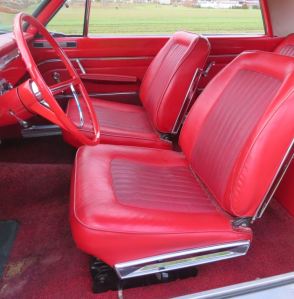
1963 Chrysler Plymouth Valiant Signet 200 interiorThe Plymouth Valiant (first appearing in 1959 as simply the Valiant) is an automobile which was manufactured by the Plymouth division of the Chrysler Corporation in the United States from the model years of 1960 through 1976. It was created to give the company an entry in the compact car market emerging in the late 1950s. The Valiant was also built and marketed, without the Plymouth name, worldwide in countries including ArgentinaAustraliaBrazilCanadaFinlandMexicoNew ZealandSouth AfricaSweden and Switzerland, as well as other countries in South America and Western Europe. It became well known for its excellent durability and reliability, and was one of Chrysler’s best-selling automobiles during the 1960s and 1970s, essentially keeping the company afloat during its hard economic times.

Classic Driver logoThe Valiant was totally reskinned for 1963 with a 0.5 in (13 mm) shorter wheelbase; it had a wide, flat hood and a flat square rear deck. The upper belt feature line ran from the rear body, in a gentle sweep, to the front fender tip. Here it was ‘veed’ back and down to the trailing edge of the front fender. The roofline was flatter and sharpened in profile. The grille was a variation of the inverted trapezoid shape that characterized contemporary Chryslers, with a fine mesh insert. Advances in body structure, many accessories and a new spring-staged choke were promotional highlights. The Valiant was offered as a 2-door hardtop and convertible, a 2- or 4-door sedan, and a 4-door station wagon. The hardtop and the convertible, with manual- or optional power-operated top, were offered only in the high V200 and premium Signet trim levels.

View more pictures