Just like relationships between people, relationships between countries can all too easily be built on a foundation of unintentional misunderstandings, faulty assumptions and predigested truths. In her forthcoming, at times provocative and disquieting book, “The New China Playbook,” Keyu Jin, a professor at the London School of Economics and a board member at Credit Suisse, is trying to rework the foundation of what she sees as the West’s deeply flawed understanding of China’s economy, its economic ambitions and its attitude toward global competition.
Randi Schofield is the sole provider for an ailing father and, at the same time, for her own children — a situation now common among Americans in their 30s and 40s.
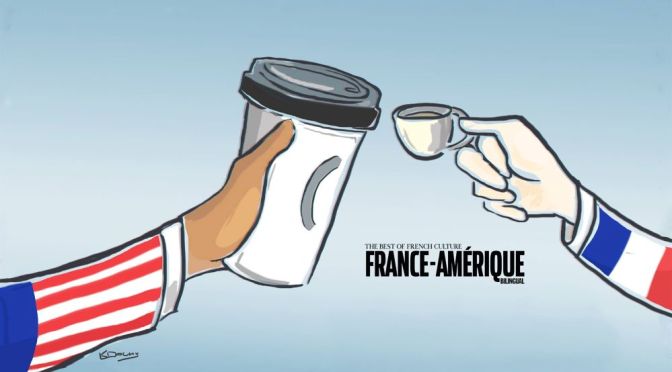
France-Amérique Magazine – April 2023 – Ahead of Earth Day, April 22, we profiled five Gallic startups based in the United States and helping biodiversity, fighting against food waste, and curbing global warming. We also sat down with Tristan Grimbert, the French CEO of EDF Renewables North America, one of the leaders on the green energy market in the United States and Canada. Also in this issue, read about the 15-Minute City, a model born in Paris and advocating for livable, sustainable urban centers; discover our profile of Gérard Araud, the former ambassador of France to the U.S. and a sharp observer of international relations; and read our interview with William Christie, the American conductor who has done more than anyone else for the revival of French baroque music.
“French Classical Music Owes a Lot to American Universities”
American harpsichordist and conductor William Christie has arguably done more than anyone else for the global revival of French baroque music. He now lives in France, but on April 25-26, he will bring his ensemble Les Arts Florissants to Carnegie Hall.
Table of contents
FROM THE NEWSDESK
France Rethinks, Once Again, Its Relationship with Africa. By Anthony Bulger
COME ON OUT
French Cultural Events in North America. By Tracy Kendrick
EDITORIAL
Wokeness Dividing the (French) People. By Guy Sorman
INTERVIEW
Julie Taymor: “The Lion King Makes People Laugh from Paris to New York.” By Guy Sorman
THE OBSERVER
Why the 15-Minute City May Be Your Next Home. By Anthony Bulger
BUSINESS
Five French Entrepreneurs Caring for the Planet. By Benoît Georges
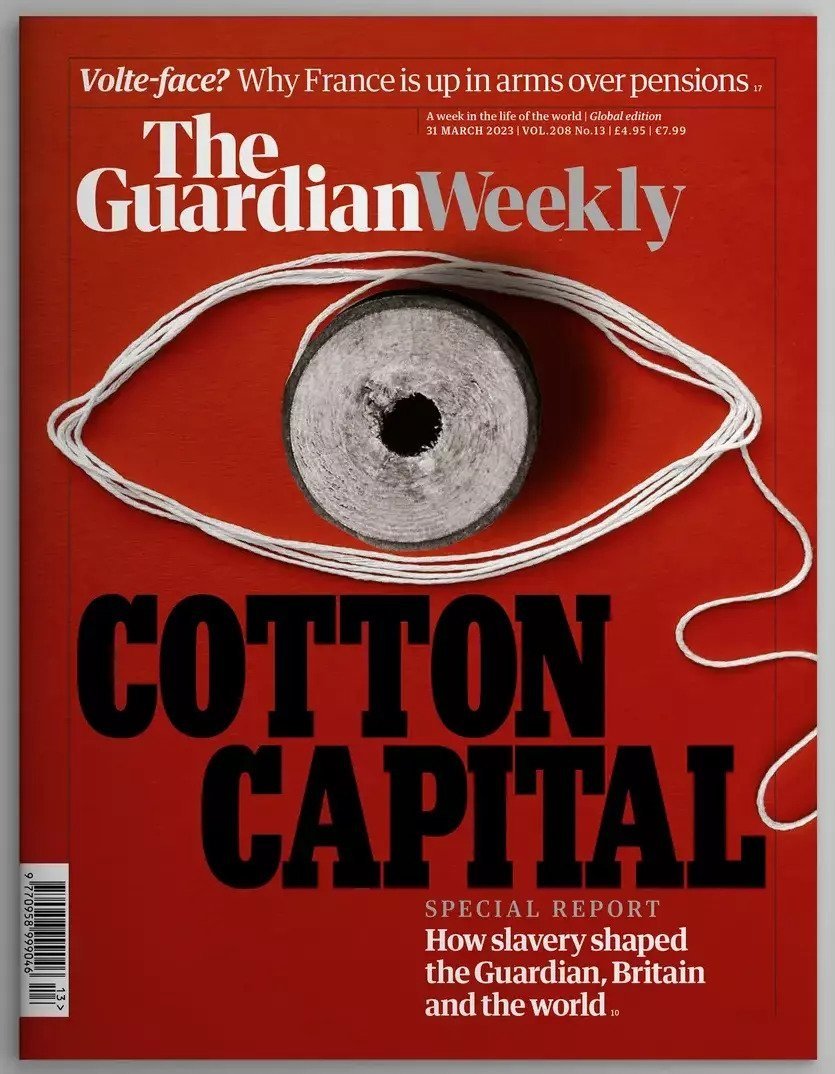
The Guardian Weekly (March 31, 2023) – This week sees an important moment in the history of the Guardian with the launch of Cotton Capital, a series revealing the links between the 19th-century Manchester founders of the newspaper, the transatlantic cotton industry and the enslaved labour upon which the trade was built.
In France, national protests against the proposed increase to the pension agehave become so inflamed that a state visit by Britain’s King Charles had to be postponed. Kim Willsher reports on a wave of anger and how women are at the forefront of the demonstrations.
As if life wasn’t pressurised enough already for top-level football referees, the advent of video assistant technology only seems to have made the job even harder than ever, leading to a slew of controversial decisions. From hotel breakfasts to being holed up in front of TV monitors, William Ralston goes behind the scenes with the men and women in black.
On the Culture pages, there’s also a great interview with the indie supergroup Boygenius, whose band members Phoebe Bridgers, Lucy Dacus and Julien Baker talk to Laura Barton about songwriting, friendship and group therapy.
Daniela Hernandez | WSJ (March 24, 2023): HBO’s The Last of Us previews what a fungal apocalypse might look like. While scientists aren’t worried about the Cordyceps fungus taking us out IRL, deaths due to severe fungal infections are going up and raising alerts from public-health agencies.
Video timeline:0:00 Fungal infections kill an average of 1.6 million people per year 0:30 How climate change has aided in fungi production 2:11 Infectious fungi are more dangerous for compromised immune systems 2:42 Why there are limited treatment options for fungal infections 3:29 How worried should you be about fungi?
I explain three big reasons why the next big health threat might come from a fungus.
Candida auris is an emerging fungus that presents a serious global health threat. CDC is concerned about C. auris for three main reasons:
It is often multidrug-resistant, meaning that it is resistant to multiple antifungal drugs commonly used to treat Candida infections. Some strains are resistant to all three available classes of antifungals.
It is difficult to identify with standard laboratory methods, and it can be misidentified in labs without specific technology. Misidentification may lead to inappropriate management.
It has caused outbreaks in healthcare settings. For this reason, it is important to quickly identify C. auris in a hospitalized patient so that healthcare facilities can take special precautions to stop its spread.
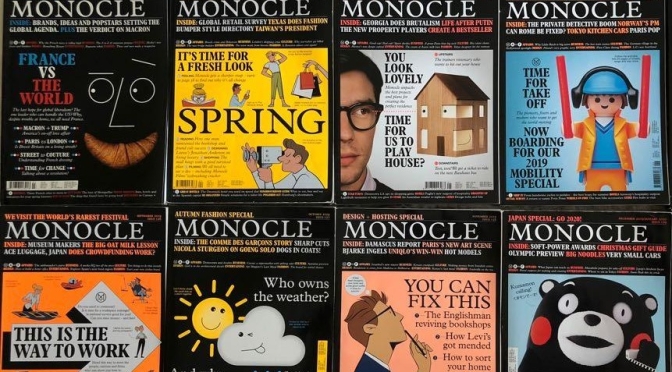
Monocle Magazine (April 2023 issue) – What’s in store for retail? Monocle’s Retail Survey checks out the global benchmarks in shopping, while our spring Style Directory rounds up the labels, designers and products on the radar of the sharpest dressers.
EDITOR’S LETTER – Bricks-and-mortar retail, from tiny independent shops to giant malls, can shape and inspire the community around it. Andrew Tuck finds Monocle’s Retail Survey reflecting what we’ve always believed: that in-person experiences are the most valuable. There’s plenty more too.
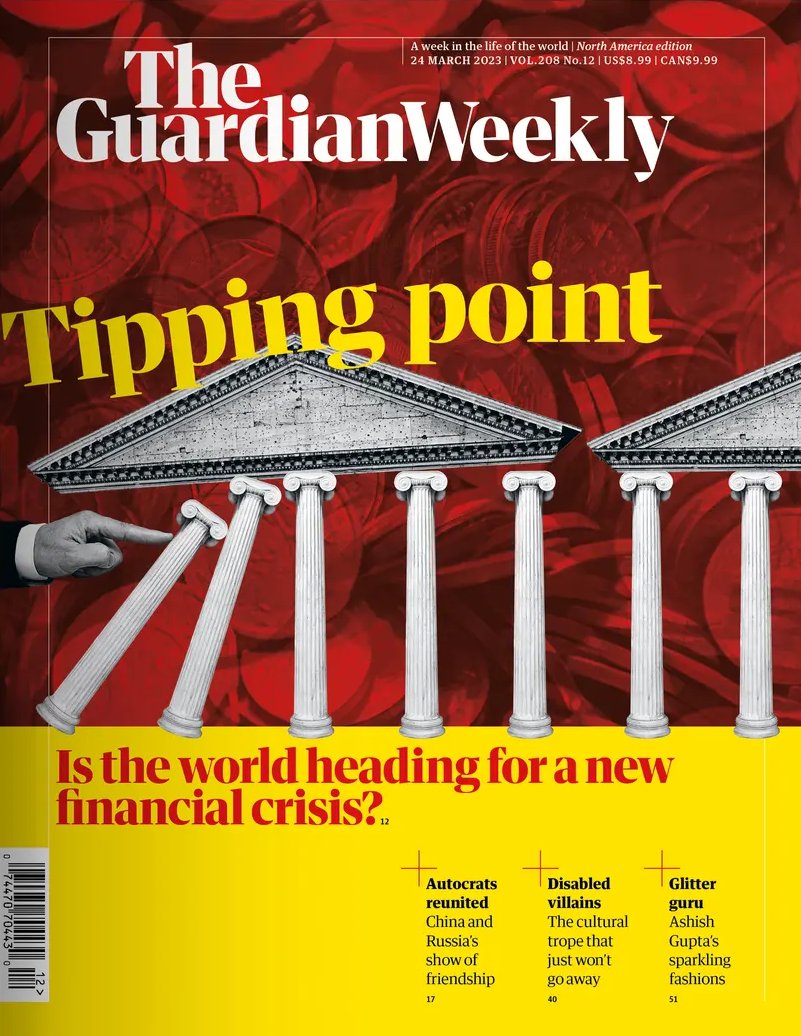
The Guardian Weekly (March 24, 2023)– You’d be forgiven for having allowed the collapse of the tech industry lender Silicon Valley Bank, earlier this month, to pass you by. Even the news that SVB’s UK operation had been salvaged in a deal brokered by the British government might not have registered too much. But the rescue this week of Switzerland’s second-largest lender Credit Suisse had a more ominous feel to it, a sense of fiscal dominoes cascading slowly into one another.
For our big story this week, Anna Isaac and Kalyeena Makortoff report on a week that brought back anxious memories of the 2008 financial crash, while economics editor Larry Elliott argues that only the era of ultra-low interest rates that followed the previous crash has prevented a further correction happening sooner.
Chinese president Xi Jinping’s visit to Russia this week had the feel of a pivotal momentfor global diplomacy. Russian affairs reporter Pjotr Sauer and senior China correspondent Amy Hawkins look at what the strengthening of the Sino-Russian alliance signifies for Moscow, Beijing and the rest of the world.
This week also saw the 20th anniversary of the US invasion of Iraq. Diplomatic editor Patrick Wintour reflects on a botched intervention that still haunts global politics to this day, while on the Opinion pages Randeep Ramesh argues that the US foreign policy debacle still serves to underline what he describes as “the capricious and self-centred nature of American global power”.
“This is going to change the world as we know it.”
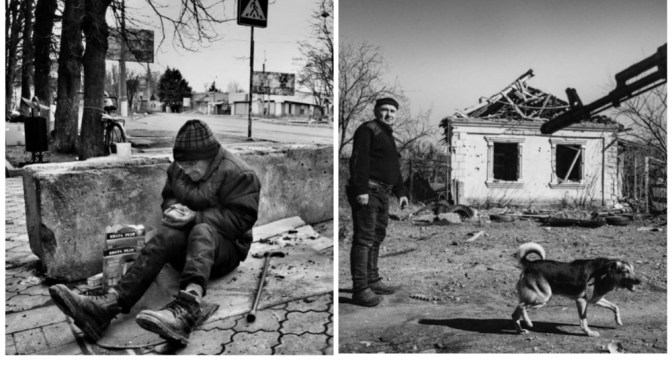
“The pictures are a documentation of the brutality within the conflict itself. It’s about civilians and civilian casualties because they are the ones hit the hardest. “
“The Russians are terrorizing the civilian population. They are hitting civilian infrastructure, may it be water, electricity, or heating. That brutality is extremely important to show. For me, it is about getting as close to these people as possible.”
Grarup is convinced that the ongoing war in Ukraine will mark the beginning of a new area that will isolate Russia from the Western World for generations to come: “I have been covering wars and conflicts for the last 35 years – just about every conflict you can imagine. In many ways, the brutality of the genocide in Rwanda in 1994 is second to none. But the war in Ukraine comes really, really close. It’s basically a country which is desiring democracy and freedom and independence – and because of that, its people are killed.”
Grarups also reflects upon his feelings covering the war, such as his general discomfort with silence as “you can be sure that something is about to happen.” On the other hand, he sees the necessity to document the war for future generations and the possible prosecution of war crimes. “What I like about black-and-white photography is its timelessness. We think in our part of the world that the world has changed, developed, and moved far away from what we have seen historically.
But the fact is: It hasn’t. It’s still the same atrocities. It’s still the same victims.” Jan Grarup was born in Denmark in 1968 and is today regarded as one of the leading and most experienced war photographers globally. Already in 1991, the year of his graduation, he won the prestigious Danish Press Photographer of the Year Award, a prize he would receive on several further occasions. In 1993, he moved to Berlin for a year, working as a freelance photographer for Danish newspapers and magazines. Afterwards, Grarup covered many wars and conflicts worldwide, including the Gulf War, the Rwandan genocide, the siege of Sarajevo and the Palestinian uprising against Israel in 2000.
His coverage of the conflict between Palestine and Israel led to two series: The Boys of Ramallah, which earned him the Pictures of the Year International World Understanding Award in 2002, followed by The Boys from Hebron. His book, Shadowland (2006), presents his work during the 12 years he spent in Kashmir, Sierra Leone, Chechnya, Rwanda, Kosovo, Slovakia, Ramallah, Hebron, Iraq, Iran, and Darfur. In the words of Foto8’s review, it is “intensely personal, deeply felt, and immaculately composed.”
His second book, Darfur: A Silent Genocide, was published in 2009. In 2017 he released the prizewinning bestseller And Then There Was Silence. He is currently working on a follow-up called While We Bleed with Danish author Adam Holm about the war in Ukraine. Jan Grarup has won numerous prizes for his dedicated work, for example eight World Press Awards, the Pictures of the Year International World Understanding Award, the UNICEF Children Photo of the Year Award, Visa d’Or, Leica Oskar Barnack Award, to mention a few of the more prestigious ones. Jan Grarup was interviewed by Marc-Christoph Wagner in Copenhagen, Denmark.
The interview took place at the Danish War Museum in March 2023 on the occasion of Grarup’s exhibition One Year With War. Camera: Jakob Solbakken Edited by: Helle Pagter Produced by: Marc-Christoph Wagner
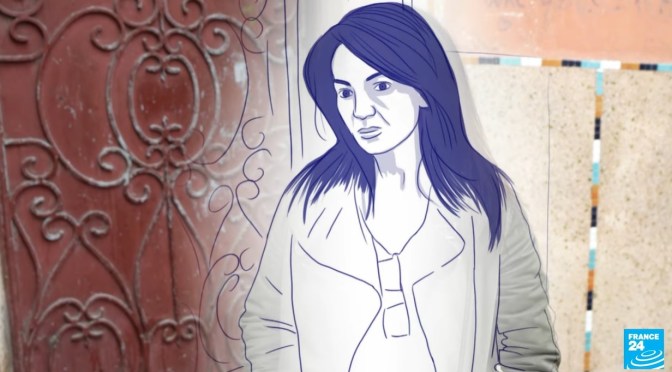
FRANCE 24 (March 17, 2023) – Morocco is often hailed for its stability, its position as a regional leader in women’s rights and for having a rich cultural history. But it’s still a largely male-dominated society. So what does that mean for women in the arts?
Eve Jackson meets three female creatives in and around Morocco’s frenetic commercial hub Casablanca, who are making space for themselves in their craft by using their art to protect and celebrate their heritage, while at the same time creating constructive conversations about subjects sometimes considered sensitive in the kingdom.
















 Boomers Daily