
Category Archives: Reviews

Reviews: The 10 Best Books Of 2024 (New York Times)

New York Times reveals 10 best books of 2024 - Good Morning America

The New York Times Book Review (December 3, 2024): The staff of The New York Times Book Review choose the year’s top fiction and nonfiction.

Fiction

The book cover is an illustration of a sun setting behind a cliff. The title and author’s name are in white.

July’s second novel, which follows a married mother and artist who derails a solo cross-country road trip by checking into a motel close to home and starting an affair with a younger rental-car worker, was the year’s literary conversation piece, dubbed “the talk of every group text — at least every group text composed of women over 40” and “the first great perimenopause novel” in just two of many articles that wrestled with its themes. Sexually frank and laced with the novelist’s loopy humor, the book ends up posing that most universal question: What would you risk to change your life? Read our review.

Local bookstores | Barnes and Noble | Amazon | Apple

The book cover for “Good Material” is modular, with the title and author name appearing in brightly-colored rectangles. There are also two illustrations: one of a person pulling on socks while seated on a bed and another of another person slipping off a pair of socks.

In Alderton’s brisk, witty novel, a 35-year-old struggling comedian in London tries to make sense of a recent breakup at the same moment when the majority of his friends seem to be pairing off for life. Cue snappy dialogue, awkward first dates and a memorable quest for a new home; toss clichéd gender roles, the traditional marriage plot and a ho-hum happily ever after. Not only does Alderton cement herself as a latter-day Nora Ephron, she also puts her own mark on the classic romantic comedy form. There are no second fiddles in “Good Material”; every character sings. And there is a deeper message, revealed in a surprise twist, having to do with independence, adventure and charting your own course. Read our review.

Local bookstores | Barnes and Noble | Amazon | Apple

The cover of “James” is black. The title is in yellow, and the author’s name is in white.

It takes a lot of ambition, skill and vision to reinvent one of the most iconic books in American letters, but Everett demonstrates he possesses those virtues in spades in “James.” The novel is a radical reworking of Mark Twain’s “Huckleberry Finn,” telling the story not from Huck’s perspective, but from the point of view of the enslaved man who accompanies Huck down the Mississippi River: Jim (or, as he clarifies, James). From James’s eyes, we see he is no mere sidekick but rather a thinker and a writer who is code-switching as illiterate and fighting desperately for freedom. Everett’s novel is a literary hat trick — a book that highlights the horrors in American history and complicates an American classic, all while also emerging as a work of exquisite originality in its own right. Read our review.

Local bookstores | Barnes and Noble | Amazon | Apple

The cover of “Martyr!” features the title and author’s name in black type on a mustard background. A small illustration of an armored knight on horseback thrusting his sword into the air sits atop the first letter of the author’s name on the bottom left.

Cyrus Shams, an Iranian American aspiring poet and recovering drug addict, wallows in a post-college malaise in a fictional Midwestern town. He’s working dead-end jobs and halfheartedly attending A.A., while grieving his parents’ deaths and, increasingly, fantasizing about his own. Cyrus is lost and sad, but this captivating first novel, by an author who is himself a poet, is anything but. As Akbar nudges Cyrus closer to uncovering a secret in his family’s past, he turns his protagonist’s quest for meaning — involving a road trip to New York and a revelatory encounter in the Brooklyn Museum — into an indelible affirmation of life, rife with inventive beauty, vivid characters and surprising twists of plot. Read our review.

Local bookstores | Barnes and Noble | Amazon | Apple

The cover of “You Dreamed of Empires,” by Álvaro Enrigue, shows stylized blue lines against a green backdrop, converging in what looks like a whirlpool. At the center of the whirlpool, a horse (visible only from the chest up) struggles to emerge.

History has long been Enrigue’s playground, and his latest novel takes readers to 16th-century Tenochtitlan, or what is now Mexico City. Hernán Cortés and his men have arrived at Moctezuma’s palace for a diplomatic — if tense and comically imbalanced — meeting of cultures and empires. In this telling, it’s Moctezuma’s people who have the upper hand, though the emperor himself is inconveniently prone to hallucinogenic reveries and domestic threats. The carnage here is devilishly brazen, the humor ample and bone-dry. Read our review.

Local bookstores | Barnes and Noble | Amazon | Apple


Nonfiction

The cover of “Cold Crematorium” shows a bleak, sketchy pencil drawing of a dark road lined on one side by bare trees. On the other side, there is a black smear, as if something has been smudged away or a giant, bottomless pit has been dug whose mouth extends out of frame.

Debreczeni, 39 when he was deported from his native Hungary to what he calls “the Land of Auschwitz,” would later memorialize the experience in a book that defies easy classification. First published in 1950, “Cold Crematorium” is a masterpiece of clinical, mordant observation. In a cattle car he watches a fellow deportee whose hand retains the gestures of a chain-smoker; newly arrived at Auschwitz, he encounters the lousy barroom piano player he avoided back home. This is more than gallows humor; it’s a stubborn fight to stay human and place the unimaginable in the context of the known. Look elsewhere for platitudes — Debreczeni witnessed, and reported, the best and worst of mankind and showed it to us to use as we will. Read our review.

Local bookstores | Barnes and Noble | Amazon | Apple

The pale pink cover of “Everyone Who Is Gone Is Here” has an illustration of a bird, collaged from bits of map, what looks like a vintage postcard and a blue U.S. visa stamp.

Blitzer, a staff writer at The New Yorker, presents a timely analysis of the situation at America’s southern border, placing the blame for today’s screaming headlines, detainee camps and unaccompanied minors firmly on post-Cold War U.S. policy. His kaleidoscopic narrative moves between the Central American insurgencies that flooded this country with refugees, and the shifting and frequently incoherent policies that worsened the fallout. We meet morally pragmatic domestic politicians, a tireless activist who’s moved from El Salvador to Chicago, Los Angeles teenagers ensnared in gang pipelines. None of it is simple; all of it has a terrible cost. Blitzer handles his vast topic with assurance and grace, never losing sight of the human element behind the global crisis. Read our review.

Local bookstores | Barnes and Noble | Amazon | Apple

The cover of Lucy Sante’s book, “I Heard Her Call My Name: A Memoir of Transition,” is a sepia-toned photograph of a woman shown covering her face with her hands. The title and the author’s name are in red.

When the veteran literary and cultural critic came out as transgender in 2021 at the age of 66, she described in an email to her loved ones the devastating realization that her “parallel life” — the one presented to her by a “gender-swapping” app that showed her how she would have looked as a girl and then a woman at various junctures in her life — had passed her by. “Fifty years were under water, and I’d never get them back.” As she reflects on her upbringing as the “only child of isolated immigrants,” her early adulthood in 1970s New York and her career of seeking truths through writing while hiding an important truth about herself, Sante fearlessly documents a transformation both internal and external, one that is also a kind of homecoming. Read our review.

Local bookstores | Barnes and Noble | Amazon | Apple

The cover of “Reagan” shows a cutout of a black-and-white photograph of Ronald Reagan striding through toward the viewer. The cutout sits on an off-white background. His shadow can also be seen extending off the frame.

This elegant biography of the 40th president stands out for its deep authority and nimble style. Boot, a historian and foreign policy analyst, grew up idolizing Ronald Reagan, but after a decade of interviews and research, he finds himself asking whether his onetime hero paved the way for Donald Trump, the man whose ascent to power led Boot to abandon the right. The book is a landmark work that shows how Reagan emerged from his New Deal roots to become a practiced Red baiter and racist dog whistler before settling into the role of the optimistic all-American elder statesman. “It is no exaggeration,” Boot writes, “to say that you cannot fully comprehend what happened to America in the 20th century without first understanding what happened to Ronald Reagan.” Read our review.

Local bookstores | Barnes and Noble | Amazon | Apple

The cover of “The Wide Wide Sea” is a photograph of the sun setting over the sea. The title is in white, and the author’s name is in blue.

In this masterly history, Sides tracks the 18th-century English naval officer James Cook’s third and final voyage across the globe, painting a vivid and propulsive portrait that blends generations of scholarship with the firsthand accounts of European seafarers as well as the oral traditions of Indigenous Pacific islanders. The story begins in Britain as the last embers of the Enlightenment are going out, a time when curiosity and empathy gave way to imperial ambition and moral zeal. Between tales of adventure on the open ocean, complex depictions of Polynesian culture and colorful scenes of a subarctic frost littered with animal life, Sides expertly probes the causes of Cook’s growing anger and violence as the journey wears on and the explorer reckons with the fallout of what he and others had wrought in expanding the map of Europe’s power. Read our review.

Books: Literary Review Magazine – December 2024

Literary Review – December 2, 2024: The latest issue features ‘Mandeville’s Dangerous Idea’

Lines of Insight

“Mondrian: His Life, His Art, His Quest for the Absolute” By Nicholas Fox Weber

Will Someone Think of the Barristers?

“Man-Devil: The Mind and Times of Bernard Mandeville, the Wickedest Man in Europe” By John Callanan

Raising the Flag of Freedom

“Predator of the Seas: A History of the Slaveship That Fought for Emancipation” By Stephen Taylor

Literary Arts: The London Magazine – December 2024

Image

The London Magazine (December 2, 2024): The latest issue features poetry, short fiction and…

Joey Connolly on information overload, syzygy and Liz Truss.

Betty Rose Townley on Hera Lindsay Bird and the texture of bisexuality.

Jen Calleja on writing experimental memoirs.

Aidan Tulloch on walking through England’s World’s Ends. 

Richie Jones on Jack Reacher and headbutts. 

Reviews by Rowland Bagnall, Tommy Gilhooly, Patrick Cash, Tallulah Griffith.

Cover image by Paul Graham.

Preview: The New Yorker Magazine – Dec. 9, 2024

The Knicks players outside Madison Square Garden.

The New Yorker (December 2, 2024): The latest issue features John Cuneo’s “Garden Party” – The Knicks are making a joyful comeback.

Stopping the Press

After spending years painting the media as the “enemy of the people,” Donald Trump is ready to intensify his battle against the journalists who cover him. By David Remnick

R.F.K., Jr., Wants to Eliminate Fluoridated Water. He Used to Bottle and Sell It

Donald Trump’s nominee to lead H.H.S. once started a bottled-water line, Keeper Springs. What was in it? By Charles Bethea

On the Block: Where Jerry Lewis and Buddy Hackett Once Schvitzed

The tummlers have moved on, but the distinctive Friars Club building, in midtown, is going to the highest bidder. By Bruce Handy

The New York Times Book Review – December 1, 2024

THE NEW YORK TIMES BOOK REVIEW (December 1, 2024): The latest issue features ‘Unfinished Business’ – “The City and Its Uncertain Walls features all of Haruki Murakami’s signature elements — and his singular voice — in a new version of an old story.

100 Notable Books of 2024

Here are the year’s notable fiction, poetry and nonfiction, chosen by the staff of The New York Times Book Review.

How the World’s Largest Democracy Slid Toward Authoritarianism

“The New India,” by Rahul Bhatia, combines personal history and investigative journalism to account for his country’s turn to militant Hindu nationalism.

What Exactly Is Morning Mist? And Other Questions.

In “The Miraculous From the Material,” the best-selling author Alan Lightman examines the science behind the wonder.

Angela Merkel Tells Us What She Really Thinks

In her memoir, the former German chancellor reflects on her political rise and defends her record as the outlook for her country turns grim.

The New York Times Magazine-Dec. 1, 2024

Current cover

THE NEW YORK TIMES MAGAZINE (November 30, 2024): The 12.1.24 Issue features Susan Dominus on an I.V.F. mix-up; Amir Ahmadi Arian on the director Mohammad Rasoulof; Francesca Mari on deadly superbugs bred by modern warfare; and more.

An I.V.F. Mix-Up, a Shocking Discovery and an Unbearable Choice

Two couples in California discovered they were raising each other’s genetic children. Should they switch their girls?

Modern Warfare Is Breeding Deadly Superbugs. Why?

Researchers are trying to understand why resistant pathogens are so prevalent in the war-torn nations of the Middle East.

Am I a Hypocrite for Calling Donald Trump a Liar?

The magazine’s Ethicist columnist on hypocrisy. By Kwame Anthony Appiah

Finance Preview: Barron’s Magazine – Dec. 2, 2024

Barron's | Financial and Investment News

BARRON’S MAGAZINE (November 30, 2024): The latest issue features ‘Tax ‘Moves for Trump 2.0’

Trump Tax Cuts 2.0: How They Will Affect You

A postelection look at how tax laws are likely to change, and especially the outlook for the 2017 tax cuts.

What the Trump Tax Cuts Mean for the Deficit and Your Bond Portfolio

The deficit is likely to rise a lot more, and inflation could prove stubborn, leading to higher interest rates. How investors can protect themselves.

It’s Time for a Portfolio Reality Check

Rebalancing after a strong year for stocks may be uncomfortable. Do it anyway.

Research Preview: Science Magazine – Nov. 29, 2024

Contents | Science 386, 6725

Science Magazine – November 29, 2024: The new issue features ‘Eating The Earth’ – The vast, vulnerable global food trade…
Micrometer-sized robotic chameleons

A multifunctional metamaterial can change shape and steer light simultaneously

Contemporary hominin locomotor diversity

Footprints in Kenya show that hominin bipedalism had a complex evolutionary history

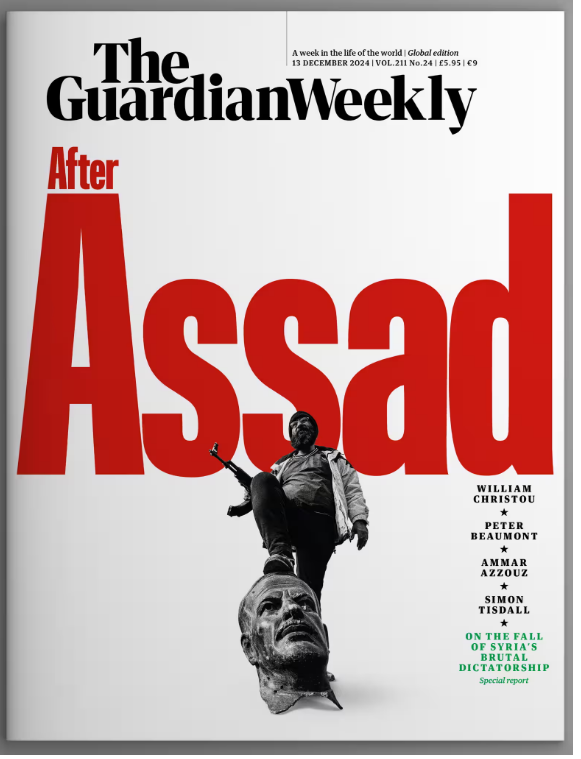
Politics: The Guardian Weekly – Nov. 29, 2024

The Guardian Weekly (November 28, 2024): The new issue features last week’s escalation of Nato ballistic missile activity, in which UK and US-made missiles were launched into Russia for the first time, brought a predictably cold response from Vladimir Putin – who loosened Moscow’s nuclear doctrines and promised more attacks with a new, experimental ballistic missile.

1

Spotlight | Does lame duck Biden have time to Trump-proof democracy?
The outgoing US president may only have weeks left in the White House, but activists say he can secure civil liberties, accelerate spending on climate and healthcare, and spare death row prisoners. David Smith reports

2

Science | My weird, emotional week with an AI pet
Casio says Moflin can develop its own personality and build a rapport with its owner – and it doesn’t need food, exercise or a litter tray. But is it essentially comforting or alienating? Justin McCurry finds out

3

Feature | Are we right to strive to save the world’s tiniest babies?
Doctors are pushing the limits of science and human biology to save more extremely premature babies than ever before. But when so few survive, are we putting them through needless suffering? By Sophie McBain

4

Opinion | A social media ban is in everyone’s interests – not just kids under 16
Van Badham on why she resents being excluded from protection against monetised fear, anger and toxicity

5

Culture | A road trip like no other: an epic drive on the Autobahn
Fifty years after electronic pioneers Kraftwerk released a 23-minute song about a road – and changed pop music for ever – Tim Jonze hits the highways of Düsseldorf and Hamburg in search of its futuristic brilliance

The New York Review Of Books – December 19, 2024

Table of Contents - December 19, 2024 | The New York Review of Books

The New York Review of Books (November 28, 2024) The latest issue features ‘The Evils of Factory Farming’…

Israel’s Revenge: An Interview with Rashid Khalidi

The scholar of Palestinian history talks about what has and has not surprised him about the world‘s response to Israel‘s assault on Gaza.

Under the Spanish Volcano

A recent exhibition at the Prado showcased artists engaging with the ferment and conflict of turn-of-the-century Spain.

‘The Look of Shame’

The French director Catherine Breillat has spent her career insisting on women’s agency and reclaiming taboo desires—sometimes with troubling implications.