
Category Archives: Previews

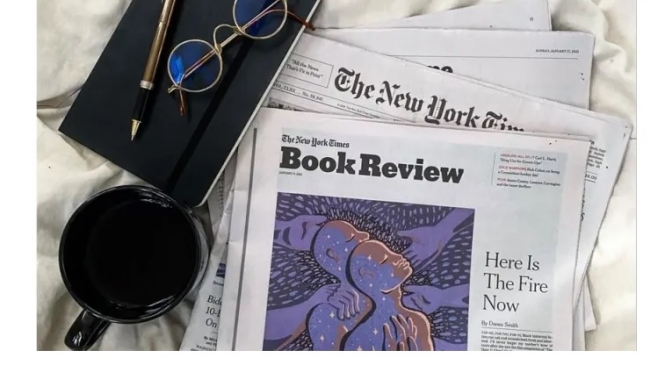
The New York Times Book Review – January 14, 2024

Image

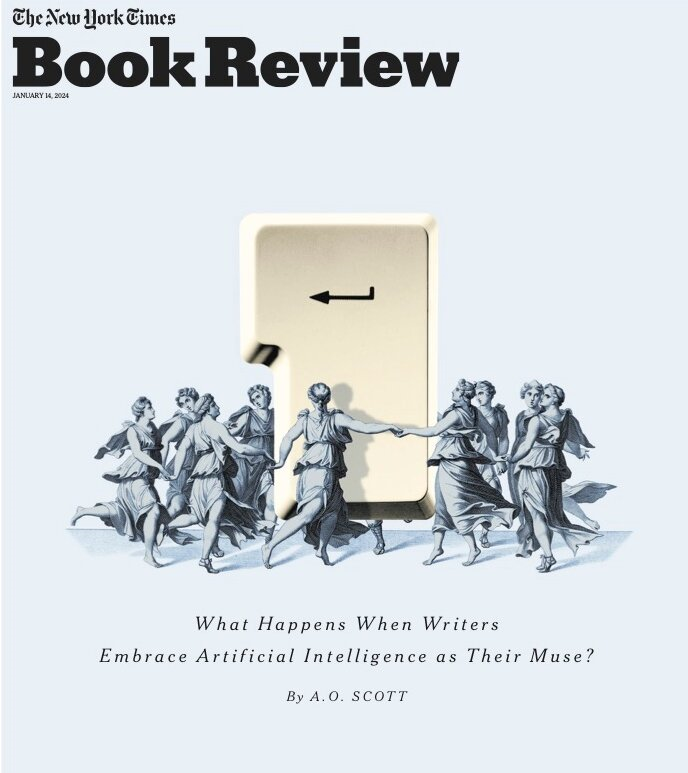
THE NEW YORK TIMES BOOK REVIEW (January 12, 2024): The latest issue features ‘What Happens When Writers Embrace Artificial Intelligence as Their Muse? by A.O. Scott…

Literature Under the Spell of A.I.

This image shows the nine female muses of Greek myth as miniature figures in shades of blue against a pale blue background. The muses are holding hands and encircling an enlarged return key of the sort that appears on a laptop keyboard.

What happens when writers embrace artificial intelligence as their muse?

By A.O. Scott

The robots of literature and movies usually present either an existential danger or an erotic frisson. Those who don’t follow in the melancholy footsteps of Frankenstein’s misunderstood monster march in line with the murderous HAL 9000 from “2001: A Space Odyssey,” unless they echo the siren songs of sexualized androids like the ones played by Sean Young in “Blade Runner” and Alicia Vikander in “Ex Machina.”

We fantasize that A.I. programs will seduce us or wipe us out, enslave us or make us feel unsure of our own humanity. Trained by such narratives, whether we find them in “Terminator” movies or in novels by Nobel laureates, we brace ourselves for a future populated by all kinds of smart, possibly sentient machines that will disrupt our most cherished notions of what it means to be human.

A Clash of Civilizations Brought to Life

In this close-up, black-and-white portrait, Álvaro Enrigue’s hair is windblown and he is holding his jacket’s collar up, obscuring part of his face.

For Álvaro Enrigue, a novelist fascinated with historical detail, the first meeting of the Aztecs and Spanish conquistadors is the obsession of a lifetime. He brings it to life in “You Dreamed of Empires.”

By Benjamin P. Russell

The Aug. 13, 2021 edition of The New York Times failed to mention the 500th anniversary of the fall of Tenochtitlan, the erstwhile Aztec capital out of which Mexico City was born. Álvaro Enrigue noticed. Of course.

The 54-year-old Enrigue, who grew up in Mexico City, believes that early meeting between Europe and the Americas changed the trajectory of global commerce, urbanism, industry and much else besides. Modernity itself, he argues, was born in the moment the Aztec emperor Moctezuma and Hernan Cortés, the Spanish conquistador, first looked each other in the eye in 1519, a clash of empires that set in motion the city’s capture two years later.

The Economist Magazine – January 13, 2024 Preview

Image

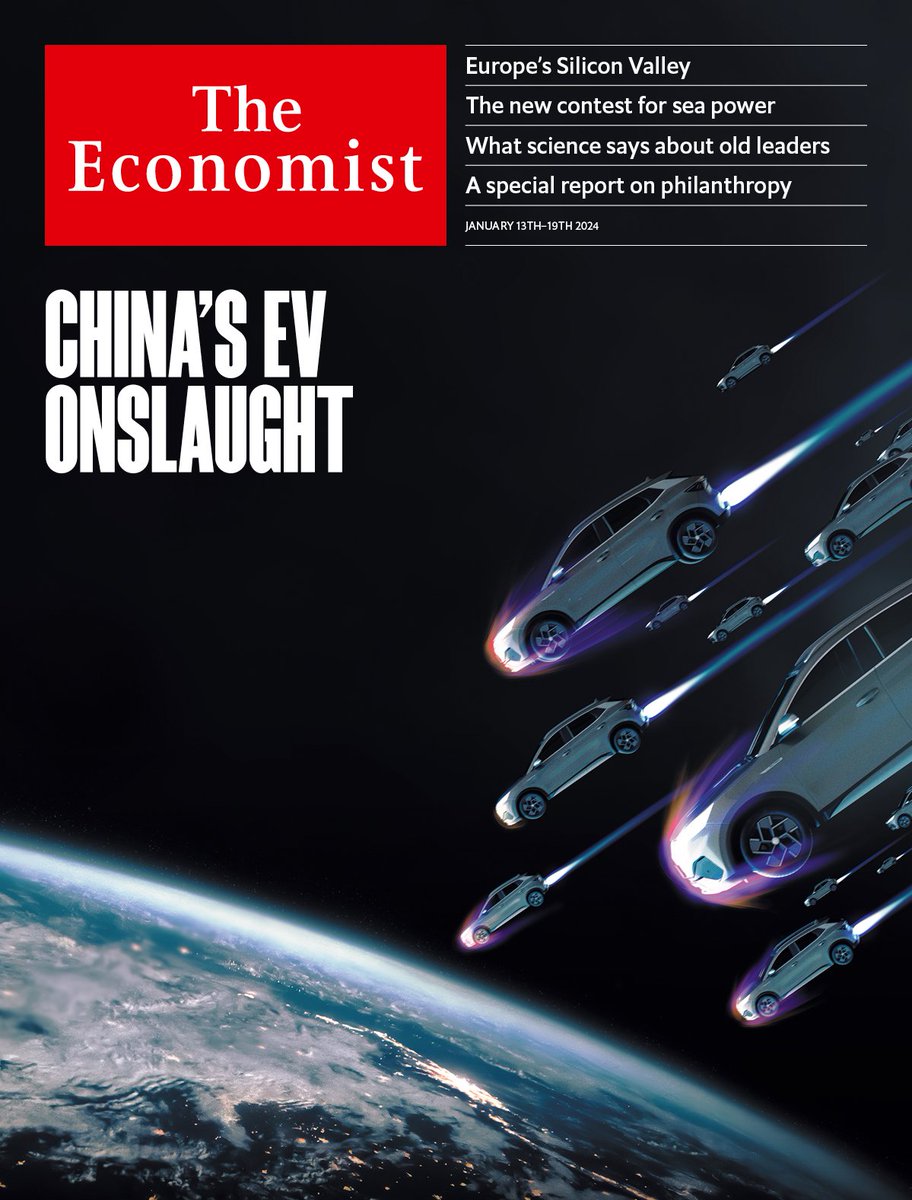
The Economist Magazine (January 12, 2024): The latest issue features ‘China’s EV Onslaught’ – An influx of Chinese cars is terrifying the West; Europe’s Silicon Valley; ‘America Fights Back’ The new contest for sea power; Why Olaf Scholz is no Angela Merkel – Germany is unable and unwilling to lead Europe; What science says about old leaders…

An influx of Chinese cars is terrifying the West

But it should keep its markets open to cheap, clean vehicles

America fights back

The war against the Houthis is part of an escalating struggle for the seas

Why Olaf Scholz is no Angela Merkel

Germany is unable and unwilling to lead Europe

The New York Times Magazine- January 14, 2024

Image

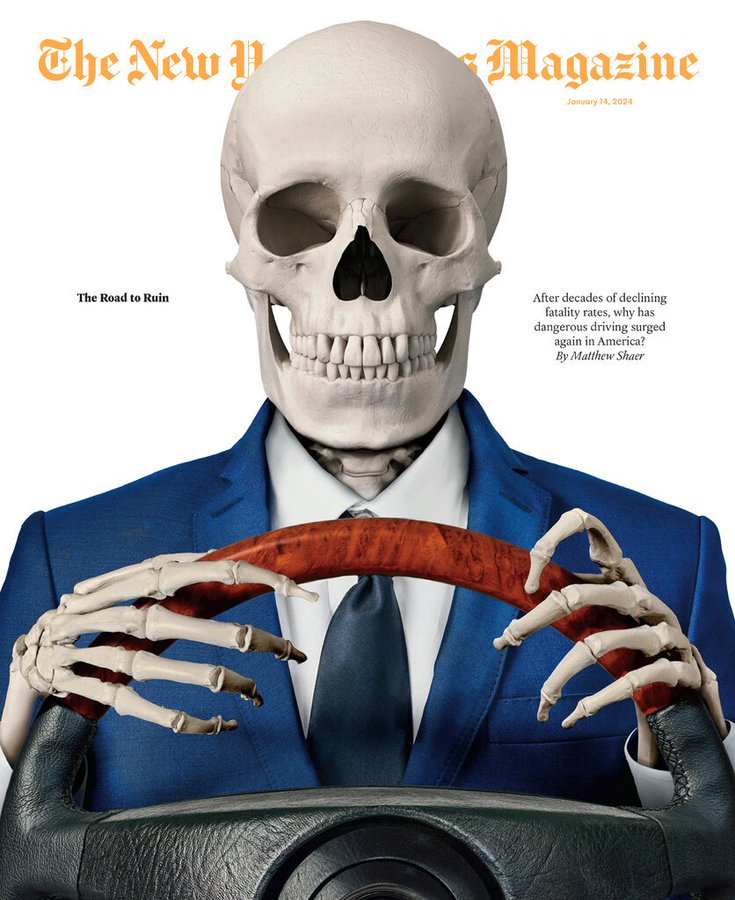
THE NEW YORK TIMES MAGAZINE (January 12, 2024): The new issue features ‘Why Are American Drivers So Deadly’ – After decades of declining fatality, dangerous driving has surged again….

Why Are American Drivers So Deadly?

A photo illustration of a skeleton in a suit driving a car.

After decades of declining fatality rates, dangerous driving has surged again.

By Matthew Shaer

In the summer of 1999, a few years after graduating from medical school, Deborah Kuhls moved from New York to Maryland, where she had been accepted as a surgical fellow at the R Adams Cowley Shock Trauma Center in Baltimore. Founded by a pioneer in emergency medicine, Shock Trauma is one of the busiest critical-care facilities in the country — in an average year, doctors there see approximately 8,000 patients, many of them close to death.

The All-Time-Great Coach Who Makes Football Fun

Andy Reid with Mahomes and other Chiefs players.

Andy Reid’s diligence and sense of mischief have made him one of the game’s best-ever coaches. Can he get his struggling Chiefs back to the Super Bowl?

By Michael Sokolove

Andy Reid, the coach of the Kansas City Chiefs, has won more than 250 games in his career, fourth all-time, which puts him high on any list of the N.F.L.’s greatest coaches. Most of the others in that pantheon are men who personify the sport’s militaristic soul — Vince Lombardi, for example, the fabled coach of the 1960s-era Green Bay Packers, or Reid’s contemporary, the grim Bill Belichick of the New England Patriots. But Reid is no Lombardi or Belichick; he’s Steve Jobs. He’s a designer, a tinkerer, a product engineer who imbues his football with creativity and even an occasional touch of whimsy.

Research Preview: Science Magazine -January 12, 2024

Image

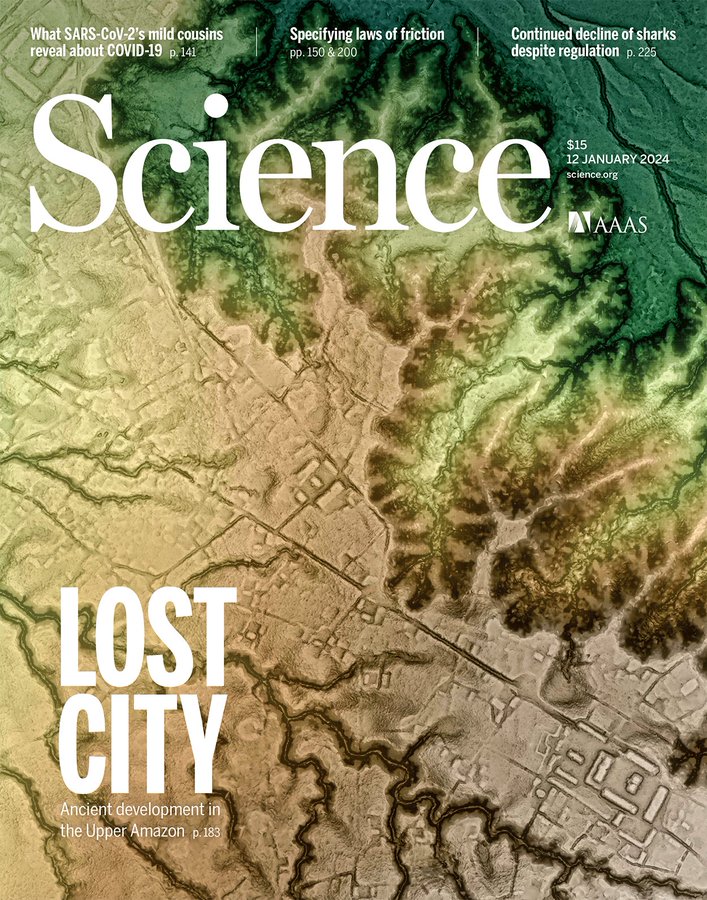
Science Magazine – January 11, 2024: The new issue features ‘Lost City’ – Ancient development in the Upper Amazon; What SARS-CoV-2’s mild cousins reveal about Covid-19; Specifying laws of friction and a Continued decline in sharks despite regulation…

The hottest year was even hotter than expected

Greenhouse gases, El Niño, and cleaner air fueled record heat in 2023

Tectonic plate under Tibet may be splitting in two

Peeled-apart Indian Plate could be affecting earthquake hazards

Politics: The Guardian Weekly – January 11, 2024

Image

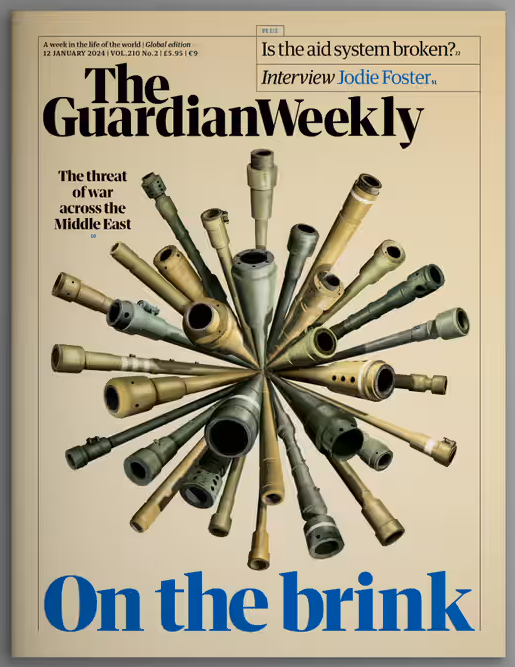
The Guardian Weekly (January 10, 2024) – The new issue features ‘Middle East on the brink’ – The threat of a regional war. Also, Inside the Post Office Horizon IT scandal…

The assassination of a Hamas chief in Lebanon. A terror attack on mourners of an Iranian former general. Commercial shipping in the Red Sea targeted by Yemeni rebels, and a US airstrike in Iraq. All were separate events in the Middle East last week but all were linked, in one way or another, to the presence of autonomous but Iranian-backed militia forces in the region.

When asked to visualise the threat of war engulfing the Middle East, for this week’s cover, illustrator Carl Godfrey took a literal approach. “I wanted to convey the tense and unpredictable situation,” says Carl, “and there’s nothing more tense than looking down the barrel of a gun. Especially when those barrels are pointing in all directions, and the risk of war is expanding in all directions.”

Research Preview: Nature Magazine January 11, 2024

Volume 625 Issue 7994

Nature Magazine – January 10, 2024: The latest issue cover features Steppe Change’ – Migration and lifestyle shifts in prehistoric Eurasia linked to raised genetic risk of multiple sclerosis.

Cancer-fighting CAR T cells could be made inside body with viral injection

Scientists are devising ways to edit the genomes of immune cells without having to extract them from the people being treated.

Japan earthquakes: the science behind the deadly tremors

A massive quake that triggered tsunamis, fires and multiple aftershocks was the largest on the country’s west coast in more than a century.

Boosting microbiome science worldwide could save millions of children’s lives

Studies of the microbes living on and in our bodies are conducted mainly in a few rich countries, squandering opportunities to improve the health of people globally.

Arts/Books: Times Literary Supplement – Jan 12, 2024

Image

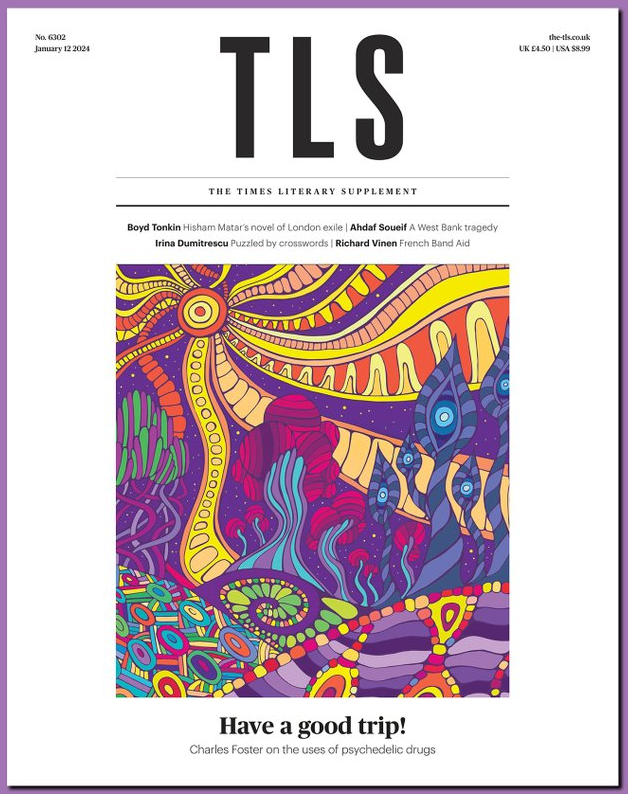
Times Literary Supplement (January 10, 2024): The latest issue features ‘Have a good trip’ – On the uses of psychedelic drugs; Hisham Matar’s novel of London exile; A West Bank tragedy; Puzzled by crosswords; French Band Aid, and more…

Previews: Country Life Magazine-January 10, 2024

Image

Country Life Magazine – January 9, 2024: The latest issue features ‘Walk This Way’ – England’s secret sunken roads; Return of the curly-coated retriever; Tom Parker Bowles on the comfort of pie; Britain’s most poisonous plants, and more…

Curls, curls, curls

The intelligent, powerful curly-coated retriever was favoured by the Victorians and is still winning plaudits as a working breed, discovers Katy Birchall

Rolling in the deep

Ben Lerwill follows in the foot-steps of our ancestors to explore the history of holloways, those sunken and often secret routes criss-crossing the countryside

Little crop of horrors

From hemlock and henbane to giant hogweed, Britain is home to a host of poisonous plants. John Wright reveals how to spot the dangerous and the deadly

Why we all cry for pie

Tom Parker Bowles earns his crust with an ode to the enduring appeal of this humble, yet oh so heavenly savoury creation

Lady Violet Manners’s favourite painting

The broadcaster chooses a poignant work that speaks of absolute parental devotion

A distant horizon conquered

Fiona Reynolds explores the ancient Wiltshire Downs, with her sights set firmly on the far-off landmark of Cherhill Monument

The future as a footstool

The landmark 1980s restoration of London’s Liverpool Street Station is under threat from new proposals, argues Ptolemy Dean

The Midas touch

In the first of two articles, John Goodall investigates the early history of Madresfield Court, Worcestershire, which has been in the same family for 900 years

I can’t believe it’s British butter

Butter is making a comeback in a welcome celebration of our dairy heritage—Jenny Linford meets the artisan makers who are helping to spread the word

The good stuff

Tackle the snow in style this winter with Hetty Lintell’s pick of the best skiing accessories

Sweet dreams are made of these

The gardens at Villa Durazzo-Pallacini in Italy are Heaven on Earth for Charles Quest-Ritson

 ‘I have seen a very pretty thing…’

Lucien de Guise reveals how you can add a true touch of Ottoman opulence to your home

Interiors

Amelia Thorpe selects the hottest new stoves, fires and range cookers, and Giles Kime examines the growing range of options fuelled by bioethanol

Money for old rope

Deborah Nicholls-Lee looks at how hemp can help in the battle against climate change

Arts & Literature: Kenyon Review – Winter 2024

Image

Kenyon Review – Winter 2024: The Winter 2024 issue of The Kenyon Review includes an essay by Carrie Cogan, the winner of the 2023 Kenyon Review Nonfiction Contest, selected by Leslie Jamison; work by the 2021 Kenyon Review Developmental Editing Fellows, Allison AlbinoEmily Stoddard, and Jane Walton; poetry by Sara Abou Rashed, Sarah Ghazal Ali, David Joez Villaverde, and Kim Garcia; fiction by K-Ming ChangMelissa Yancy, and Brian Ma; nonfiction by Oz Johnson and Sarah Minor; and much more. The cover art is by DARNstudio, which consists of Ron Norsworthy and David Anthone.

Lowest of the Low on a High Red Hill

By Carrie Cogan

I rode west with a childhood friend who was driving to a job in California. We passed through Tennessee, Arkansas, Oklahoma, and still there was no sign of the Commander. My friend placed a bag of chocolate-covered espresso beans on the console between us, jumble of rich dark gems, glittering like they were wet. I crunched them in my teeth without thinking. Sometimes I drove and let her sleep. When clouds clotted the sun her hair still glowed, some mix of orange and yellow and pink. Toast, or the honey for it, or the cinnamon.  

After we spent a day and a night in a certain desert town, I told my friend to go on without me. I’d stay. The town was bordered by empty hills and endless sky: room to disappear. I found an unopened pack of Juicy Fruit gum on the sidewalk, which I took for a sign. 

Preview: MIT Technology Review – January 2024

Image

MIT Technology Review (January/February 2024) – The new issue features 10 Innovations that could change our World.

10 Breakthrough Technologies 2024

Every year, we look for promising technologies poised to have a real impact on the world. Here are the advances that we think matter most right now.

AI for everything

Passwordless Login

We now live in the age of AI. Hundreds of millions of people have interacted directly with generative tools like ChatGPT that produce text, images, videos, and more from prompts. Their popularity has reshaped the tech industry, making OpenAI a household name and compelling Google, Meta, and Microsoft to invest heavily in the technology.

Super-efficient solar cells

Solar power is being rapidly deployed around the world, and it’s key to global efforts to reduce carbon emissions. But most of the sunlight that hits today’s panels isn’t being converted into electricity. Adding a layer of tiny crystals could make solar panels more efficient. WHY IT MATTERS

Apple Vision Pro

Apple will start shipping its first mixed-reality headset, the Vision Pro, this year. Its killer feature is the highest-resolution display ever made for such a device. Will there be a killer app? It’s early, but the world’s most valuable company has made a bold bet that the answer is yes. WHY IT MATTERS

Weight-loss drugs

The global rise in obesity has been called an epidemic by the World Health Organization. Medications like Mounjaro and Wegovy are now among the most powerful tools that patients and physicians have to treat it. Evidence suggests they can even protect against heart attacks and strokes. WHY IT MATTERS