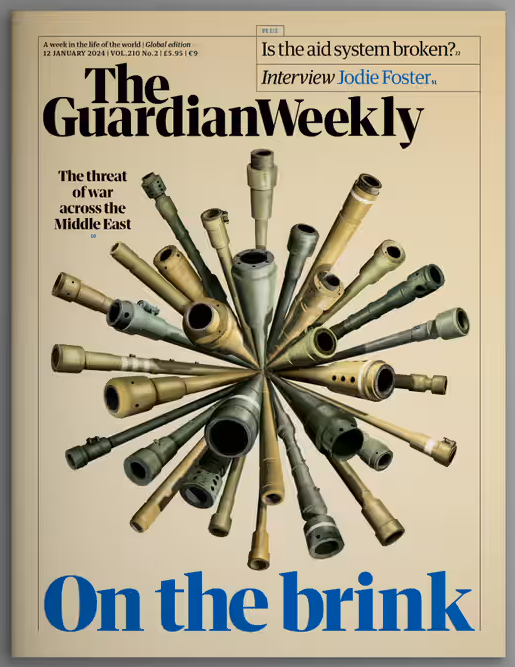
The assassination of a Hamas chief in Lebanon. A terror attack on mourners of an Iranian former general. Commercial shipping in the Red Sea targeted by Yemeni rebels, and a US airstrike in Iraq.All were separate events in the Middle East last week but all were linked, in one way or another, to the presence of autonomous but Iranian-backed militia forces in the region.
When asked to visualise the threat of war engulfing the Middle East, for this week’s cover, illustrator Carl Godfrey took a literal approach. “I wanted to convey the tense and unpredictable situation,” says Carl, “and there’s nothing more tense than looking down the barrel of a gun. Especially when those barrels are pointing in all directions, and the risk of war is expanding in all directions.”
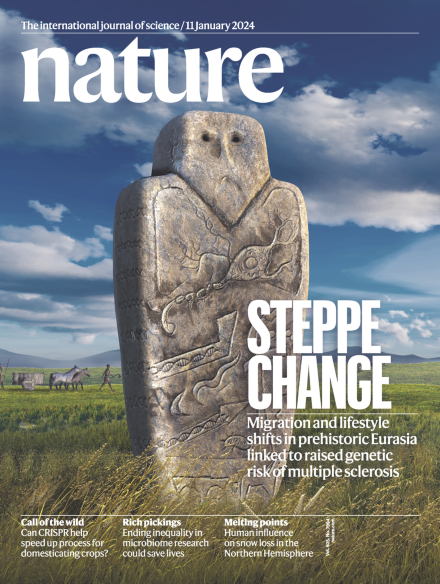
Studies of the microbes living on and in our bodies are conducted mainly in a few rich countries, squandering opportunities to improve the health of people globally.
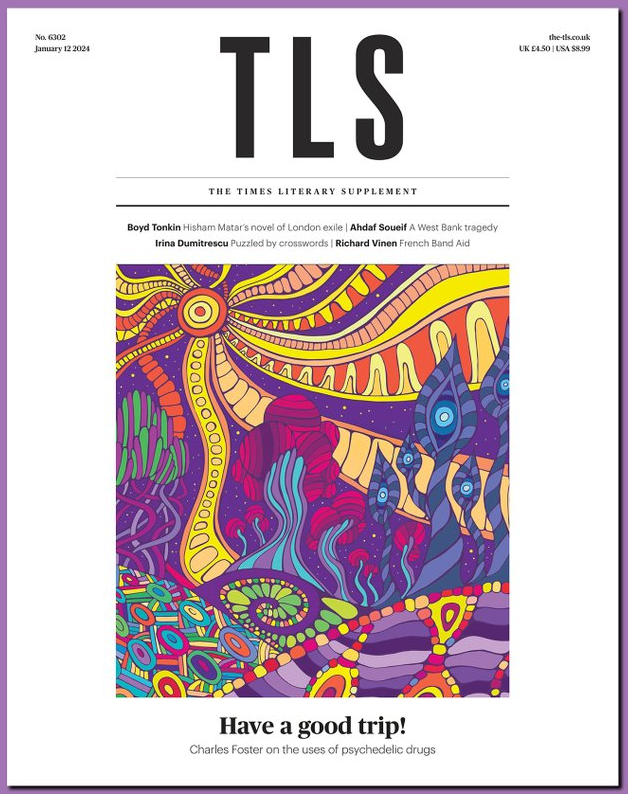
Times Literary Supplement (January 10, 2024): The latest issue features ‘Have a good trip’ – On the uses of psychedelic drugs; Hisham Matar’s novel of London exile; A West Bank tragedy; Puzzled by crosswords; French Band Aid, and more…
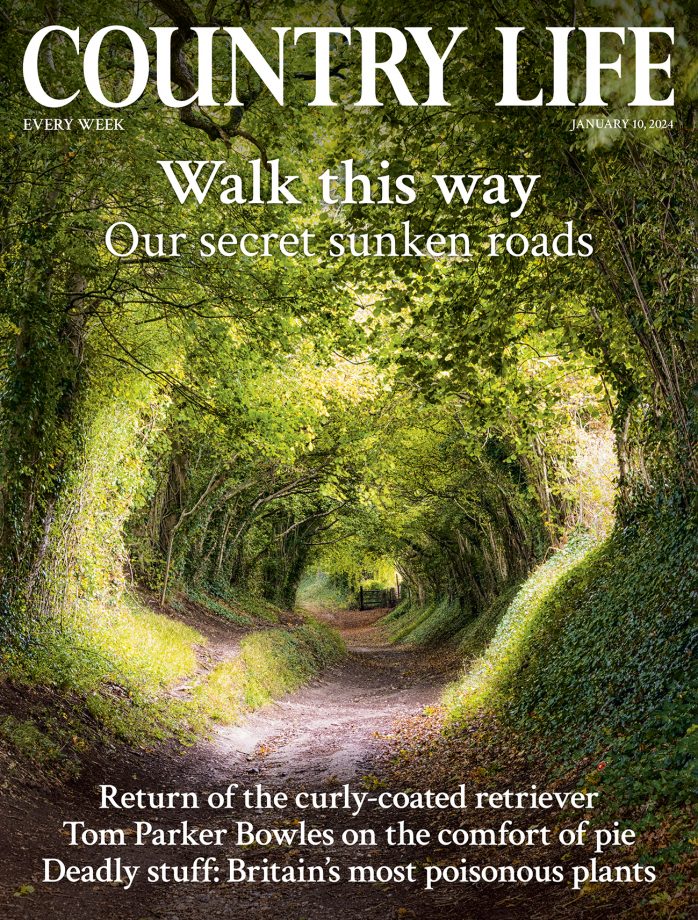
Country Life Magazine – January 9, 2024: The latest issue features‘Walk This Way’ – England’s secret sunken roads; Return of the curly-coated retriever; Tom Parker Bowles on the comfort of pie; Britain’s most poisonous plants, and more…
Curls, curls, curls
The intelligent, powerful curly-coated retriever was favoured by the Victorians and is still winning plaudits as a working breed, discovers Katy Birchall
Rolling in the deep
Ben Lerwill follows in the foot-steps of our ancestors to explore the history of holloways, those sunken and often secret routes criss-crossing the countryside
Little crop of horrors
From hemlock and henbane to giant hogweed, Britain is home to a host of poisonous plants. John Wright reveals how to spot the dangerous and the deadly
Why we all cry for pie
Tom Parker Bowles earns his crust with an ode to the enduring appeal of this humble, yet oh so heavenly savoury creation
Lady Violet Manners’s favourite painting
The broadcaster chooses a poignant work that speaks of absolute parental devotion
A distant horizon conquered
Fiona Reynolds explores the ancient Wiltshire Downs, with her sights set firmly on the far-off landmark of Cherhill Monument
The future as a footstool
The landmark 1980s restoration of London’s Liverpool Street Station is under threat from new proposals, argues Ptolemy Dean
The Midas touch
In the first of two articles, John Goodall investigates the early history of Madresfield Court, Worcestershire, which has been in the same family for 900 years
I can’t believe it’s British butter
Butter is making a comeback in a welcome celebration of our dairy heritage—Jenny Linford meets the artisan makers who are helping to spread the word
The good stuff
Tackle the snow in style this winter with Hetty Lintell’s pick of the best skiing accessories
Sweet dreams are made of these
The gardens at Villa Durazzo-Pallacini in Italy are Heaven on Earth for Charles Quest-Ritson
‘I have seen a very pretty thing…’
Lucien de Guise reveals how you can add a true touch of Ottoman opulence to your home
Interiors
Amelia Thorpe selects the hottest new stoves, fires and range cookers, and Giles Kime examines the growing range of options fuelled by bioethanol
Money for old rope
Deborah Nicholls-Lee looks at how hemp can help in the battle against climate change
I rode west with a childhood friend who was driving to a job in California. We passed through Tennessee, Arkansas, Oklahoma, and still there was no sign of the Commander. My friend placed a bag of chocolate-covered espresso beans on the console between us, jumble of rich dark gems, glittering like they were wet. I crunched them in my teeth without thinking. Sometimes I drove and let her sleep. When clouds clotted the sun her hair still glowed, some mix of orange and yellow and pink. Toast, or the honey for it, or the cinnamon.
After we spent a day and a night in a certain desert town, I told my friend to go on without me. I’d stay. The town was bordered by empty hills and endless sky: room to disappear. I found an unopened pack of Juicy Fruit gum on the sidewalk, which I took for a sign.
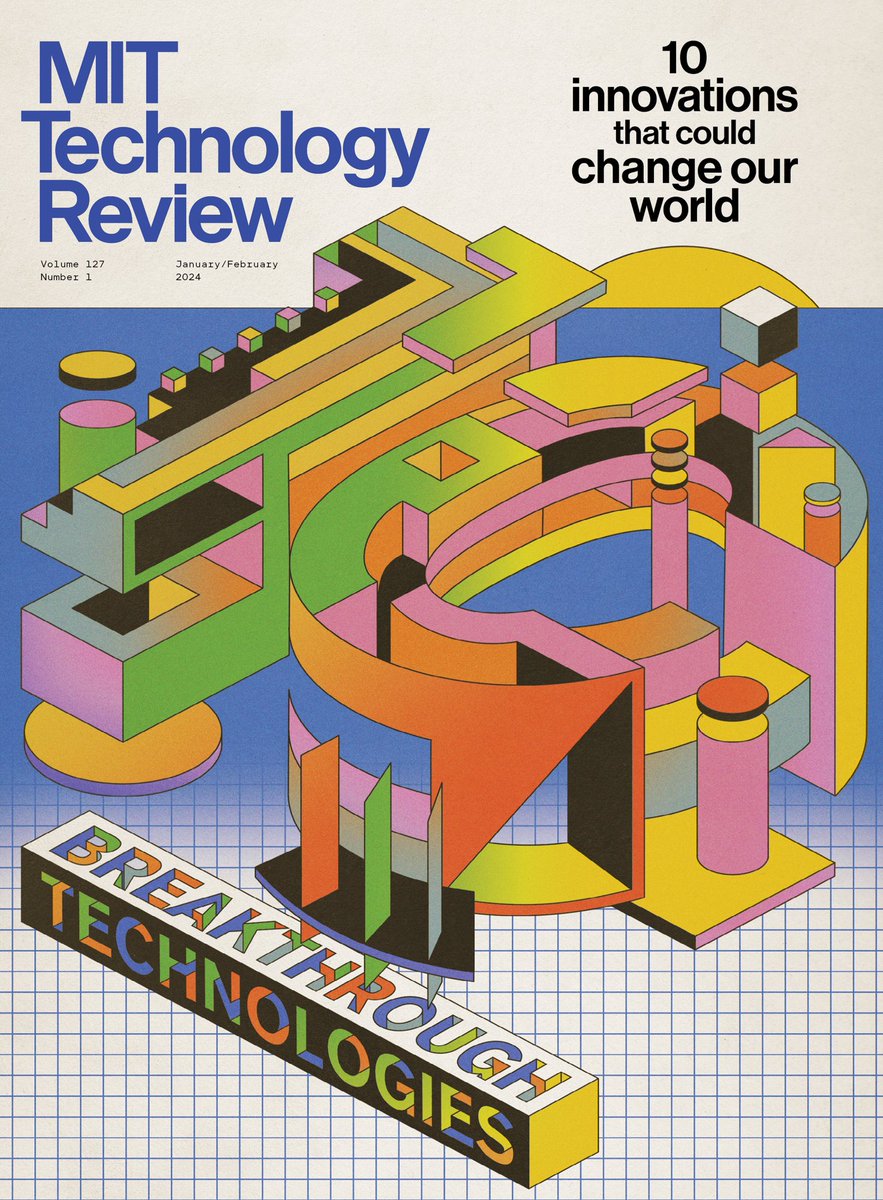
Every year, we look for promising technologies poised to have a real impact on the world. Here are the advances that we think matter most right now.
AI for everything
We now live in the age of AI. Hundreds of millions of people have interacted directly with generative tools like ChatGPT that produce text, images, videos, and more from prompts. Their popularity has reshaped the tech industry, making OpenAI a household name and compelling Google, Meta, and Microsoft to invest heavily in the technology.
Super-efficient solar cells
Solar power is being rapidly deployed around the world, and it’s key to global efforts to reduce carbon emissions. But most of the sunlight that hits today’s panels isn’t being converted into electricity. Adding a layer of tiny crystals could make solar panels more efficient. WHY IT MATTERS
Apple Vision Pro
Apple will start shipping its first mixed-reality headset, the Vision Pro, this year. Its killer feature is the highest-resolution display ever made for such a device. Will there be a killer app? It’s early, but the world’s most valuable company has made a bold bet that the answer is yes. WHY IT MATTERS
Weight-loss drugs
The global rise in obesity has been called an epidemic by the World Health Organization. Medications like Mounjaro and Wegovy are now among the most powerful tools that patients and physicians have to treat it. Evidence suggests they can even protect against heart attacks and strokes. WHY IT MATTERS
If your Medicare modified adjusted gross income is on the edge of a tax bracket, you could save thousands of dollars a year by keeping it from going over.
Japan was once the world’s hottest stock market, before falling into a decadeslong slumber. It revived in 2023, awakening investors to its long-term potential. How to invest in the country now.
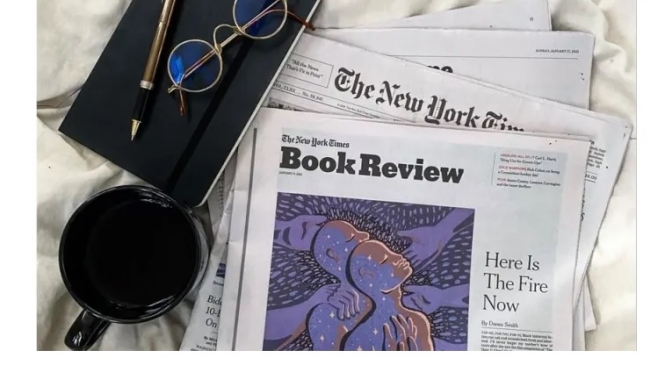
THE NEW YORK TIMES BOOK REVIEW (January 5): The latest issue features ‘Read This And Learn’ – For decades, Juan Rulfo’s novel, “Pedro Páramo,” has cast an uncanny spell on writers. A new translation may bring it broader appeal.
For decades, Juan Rulfo’s novel, “Pedro Páramo,” has cast an uncanny spell on writers. A new translation may bring it broader appeal.
By Valeria Luiselli
Readers of Latin American literature may have heard one of the many versions of this story:
It is 1961 and Gabriel García Márquez has just arrived in Mexico City, penniless but full of literary ambition, trying desperately to work on a new novel. One day, he is sitting in the legendary Café La Habana, where Fidel Castro and Che Guevara were said to have plotted the Cuban Revolution. Julio Cortázar walks in, carrying a copy of Juan Rulfo’s novel “Pedro Páramo.” With a swift gesture, as if he’s dealing cards, Cortázar throws the book on García Márquez’s table. “Tenga, pa que aprenda,” he says. “Read this and learn.”
Early in 1935, a blizzard blew through New York City. The storm was so fierce, it virtually emptied Central Park. But Willa Cather spent her morning there, sledding with the violin prodigy Yehudi Menuhin and his sisters.
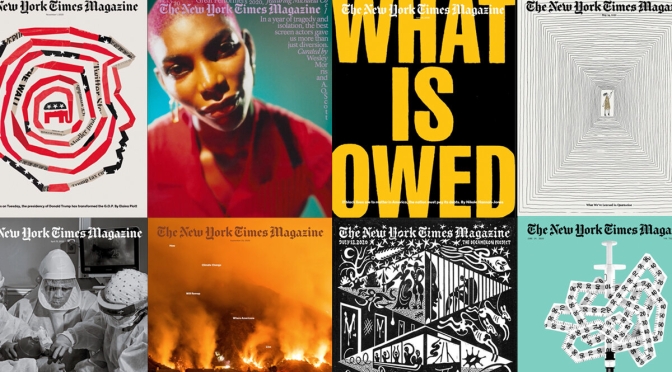
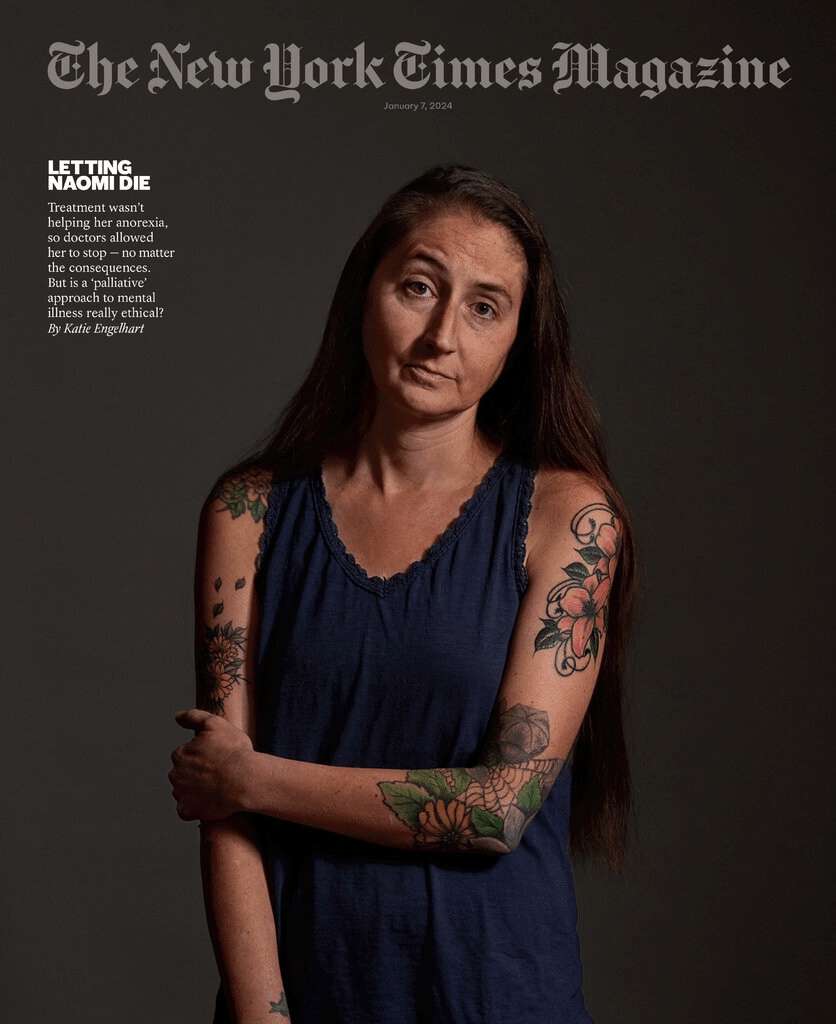
THE NEW YORK TIMES MAGAZINE (January 5, 2024): The new issue features “Letting Naomi Die” – Treatment wasn’t helping her anorexia, so doctors allowed her to stop, no matter the consequences. But is a ‘palliative’ approach to mental illness really ethical?
Treatment wasn’t helping her anorexia, so doctors allowed her to stop — no matter the consequences. But is a “palliative” approach to mental illness really ethical?
By Katie Engelhart
The doctors told Naomi that she could not leave the hospital. She was lying in a narrow bed at Denver Health Medical Center. Someone said something about a judge and a court order. Someone used the phrase “gravely disabled.” Naomi did not think she was gravely disabled. Still, she decided not to fight it. She could deny that she was mentally incompetent — but this would probably just be taken as proof of her mental incompetence. Of her lack of insight. She would, instead, “succumb to it.”
What If People Don’t Need to Care About Climate Change to Fix It?
By David Marchese
“It seems like we’ve been battling climate change for decades and made no progress,” Dr. Hannah Ritchie says. “I want to push back on that.” Ritchie, a senior researcher in the Program on Global Development at the University of Oxford and deputy editor at the online publication Our World in Data, is the author of the upcoming book, “Not the End of the World.” In it, she argues that the flood of doom-laden stats and stories about climate change is obscuring our ability to imagine solutions to the crisis and envision a sustainable, livable future.
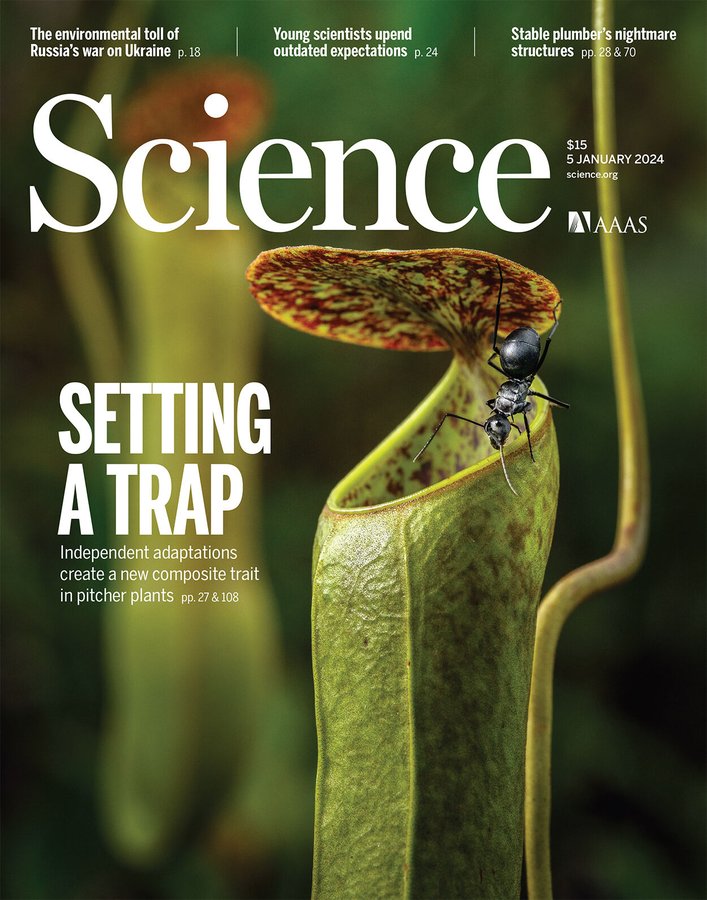
Science Magazine – December 21, 2023: The new issue featuresa carnivorous Nepenthes gracilis pitcher plant luring an ant into a precarious position under the roof-like trap lid.


















 Boomers Daily