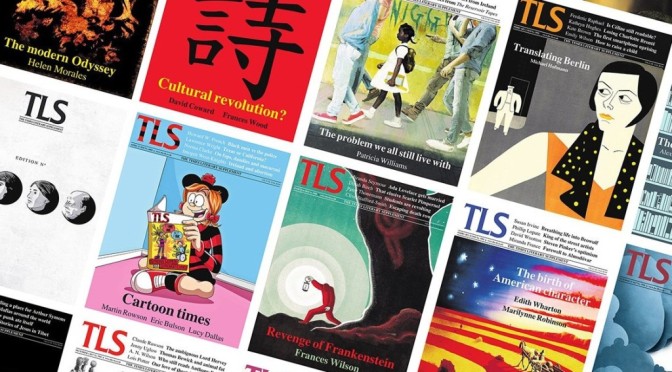
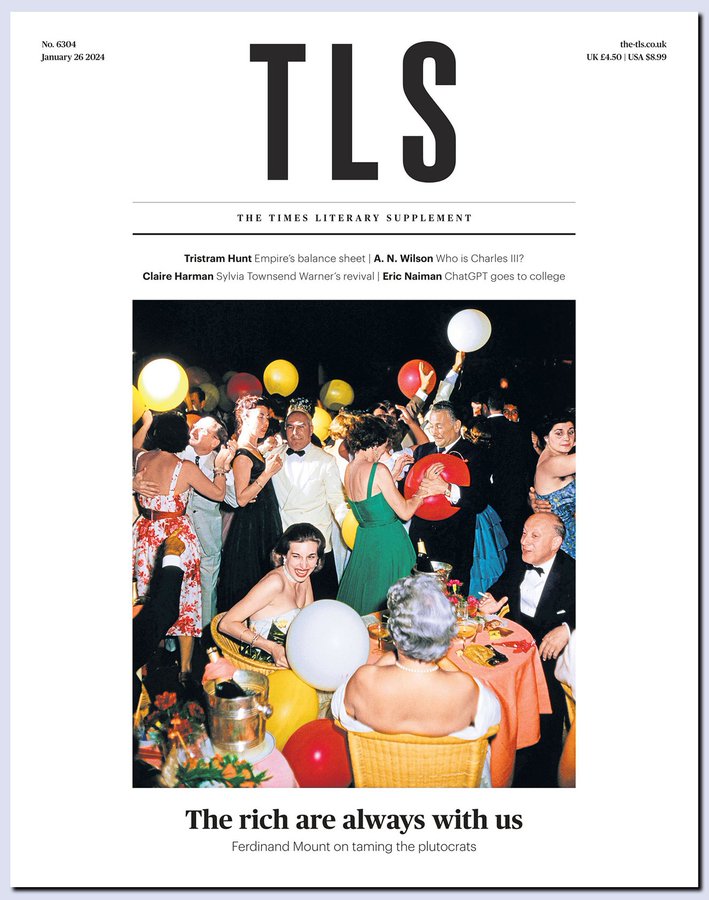
Times Literary Supplement (January 24, 2024): The latest issue features ‘The Rich Are Always With Us’ – Ferdinand Mount on taming the plutocrats; Empire’s balance sheet; Who is Charles III?; Silvia Townsend Warner’s revival and ChatGPT goes to college…
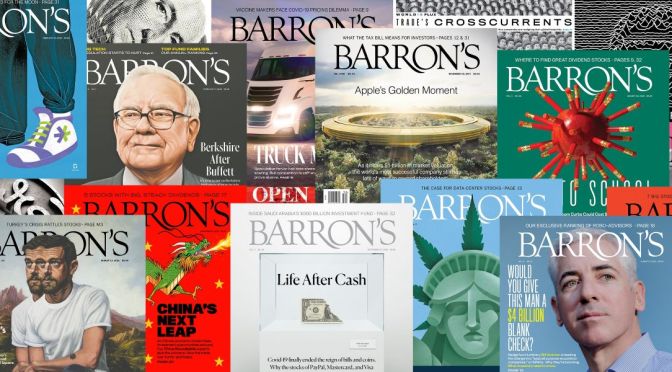
The 77 companies featured in bullish Barron’s articles last year returned nearly 10% on average, slightly trailing their benchmarks. Here’s what we got right—and wrong.
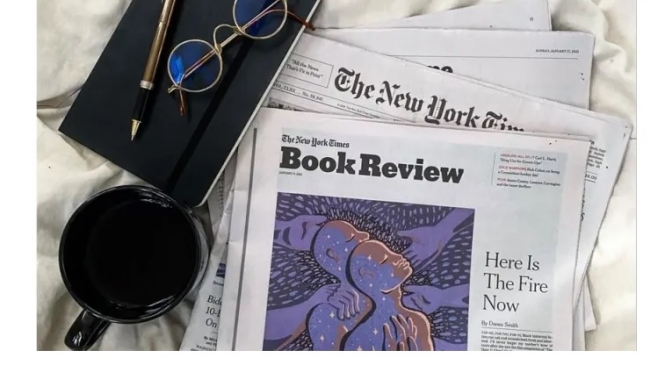
THE NEW YORK TIMES BOOK REVIEW (January 19, 2024): The latest issue features the excitement over advance copy reviews of a January novel, Kaveh Akbar’s “Martyr!” …“You’ve got to read this,” one editor said. “One of the most electric novels I’ve read in a long while,” another said. This kind of thing — everyone thrilled by the same book — is unusual at the TBR, and explains why “Martyr!,” about a grieving young man’s search for meaning, graces our cover this week.
In “Martyr!,” the poet Kaveh Akbar turns a grieving young man’s search for meaning into a piercing family saga.
Martyr!, by Kaveh Akbar
Reviewed by By Junot Díaz
Cyrus Shams, the aching protagonist at the heart of Kaveh Akbar’s incandescent first novel, is a veritable Rushdiean multitude: an Iranian-born American, a “bad” immigrant, a recovering addict, a straight-passing queer, an almost-30 poet who rarely writes, an orphan, a runner of open mics, an indefatigable logophile, a fiery wit, a self-pitying malcontent. But above all else Cyrus is sad; profoundly, inconsolably, suicidally sad.
Here are the books discussed in this week’s episode:
“Knife,” by Salman Rushdie
“James,” by Percival Everett
“The Book of Love,” by Kelly Link
“Martyr,” by Kaveh Akbar
“The Demon of Unrest,” by Erik Larson
“The Hunter,” by Tana French
“Wandering Stars,” by Tommy Orange
“Anita de Monte Laughs Last,” by Xochitl Gonzalez
“Splinters,” by Leslie Jamison
“Neighbors and Other Stories,” by Diane Oliver
“Funny Story,” by Emily Henry
“Table for Two,” by Amor Towles
“Grief Is for People,” by Sloane Crosley
“One Way Back: A Memoir,” by Christine Blasey Ford
“The House of Hidden Meanings: A Memoir,” by RuPaul
The importance of Homer by Joshua T. Katz Galaxy brains by Gary Saul Morson The Thames: river of destinies by Jeremy Black “Breakfast Special”: a new story by Woody Allen
New poems by Nicholas Friedman, Jessica Hornik & Michael Spence
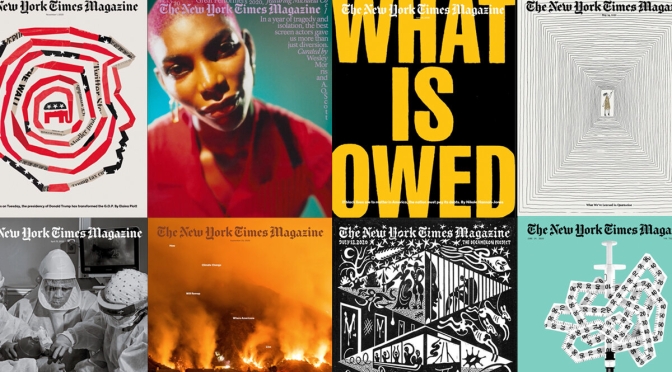
THE NEW YORK TIMES MAGAZINE (January 19, 2024): The new issue features ‘The Whale Who Went AWOL’ – How do you solve a problem like Hvaldmir?; How Group Chats Rule the World – They quietly became the de facto spaces to share dumb jokes, grief or even plans for an insurrection…
Hvaldimir escaped captivity and became a global celebrity. Now, no one can agree about what to do with him.
By Ferris Jabr
On April 26, 2019, a beluga whale appeared near Tufjord, a village in northern Norway, immediately alarming fishermen in the area. Belugas in that part of the world typically inhabit the remote Arctic and are rarely spotted as far south as the Norwegian mainland. Although they occasionally travel solo, they tend to live and move in groups. This particular whale was entirely alone and unusually comfortable around humans, trailing boats and opening his mouth as though expecting to be fed. And he seemed to be tangled in rope.
They quietly became the de facto spaces to share dumb jokes, grief or even plans for an insurrection.
By Sophie Haigney
I am texting all the time. I am, at the very least, receiving texts all the time, a party to conversations in which I am alternately an eavesdropper and an active participant. This is because I am in a lot of group chats — constant, interlinked, text-message-based conversations among multiple friends that happen all day long. I dip into and out of these conversations, on my phone and on my computer. Sometimes I will put both away for two hours and return to find 279 new messages waiting.
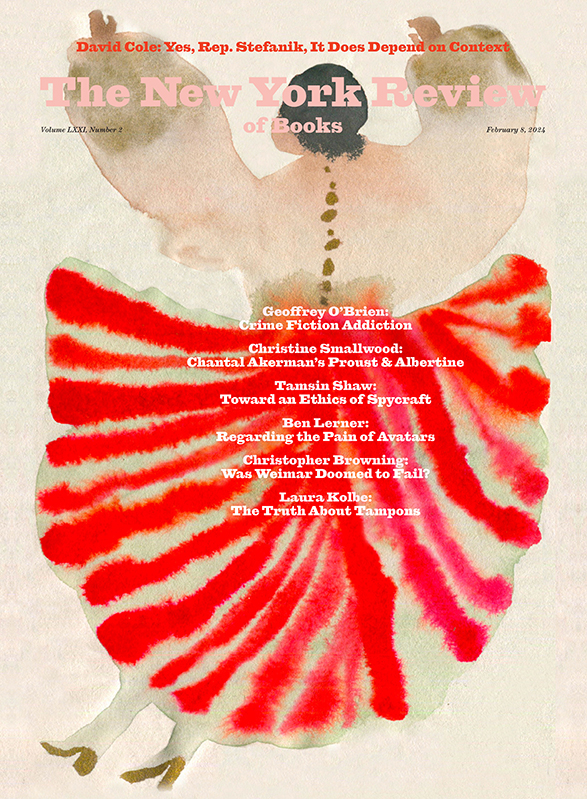
Spies: The Epic Intelligence War Between East and West by Calder Walton
Spying Through a Glass Darkly: The Ethics of Espionage and Counter-Intelligence by Cécile Fabre
On October 7, as Hamas fighters roared into southern Israel from Gaza, bringing terror and death to anyone they encountered—Israeli soldiers, Bedouins, young people dancing and getting high together, kibbutzniks scooping up small children into desperate arms—I was sleeping in a comfortable hotel room in Georgia. All around me in the sultry darkness of a beautiful resort, many of the US intelligence community’s finest minds were also slumbering. We awoke with the expectation that we would be addressed by CIA director William Burns at the opening of the Cipher Brief’s annual Threat Conference, a yearly gathering of national security professionals from the private and public sectors, plus a few academics and journalists.
Science Magazine – January 18, 2024: The new issue features‘Plants And People’ – Global Hotspots of Utilized Plants; Long Covid Markers of Immune Dysfunction; A mammoth’s life story, written in tusk, and more…
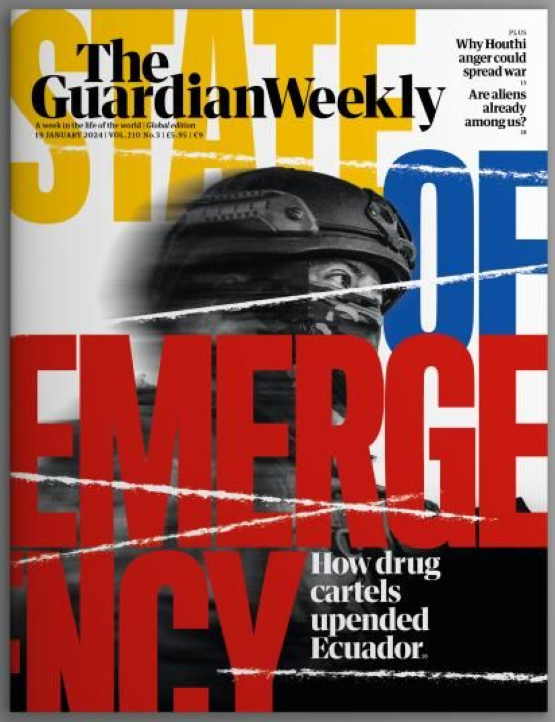
The Guardian Weekly (January 18, 2024) – The new issue features ‘State Of Emergency’ – How drug cartels upended Ecuador; Why Houthi anger could spread war; Are aliens already among us?…
Not long ago, Ecuador was chiefly known for its volcanoes, wildlife and eco-tourism. It’s an image that may now need some rehabilitation after chaos and bloodshed sparked by the prison escape last week of Adolfo Macías, the country’s most notorious gang leader and drug lord.
With cartels from Peru and Colombia routinely funnelling narcotics through Ecuador’s ports en route to Europe, Latin America correspondent Tom Phillips reports on a rising problem that threatens to tear apart the once-peaceful Andean state.
In the Middle East, Yemen’s Houthi rebels could stymie the increasingly slim chances of preventing a regional war. With the US and UK bombing Houthi bases in response to attacks on commercial shipping, diplomatic editor Patrick Wintour recounts the Houthis’ rise and why military strikes against them may not lead to the desired outcome.
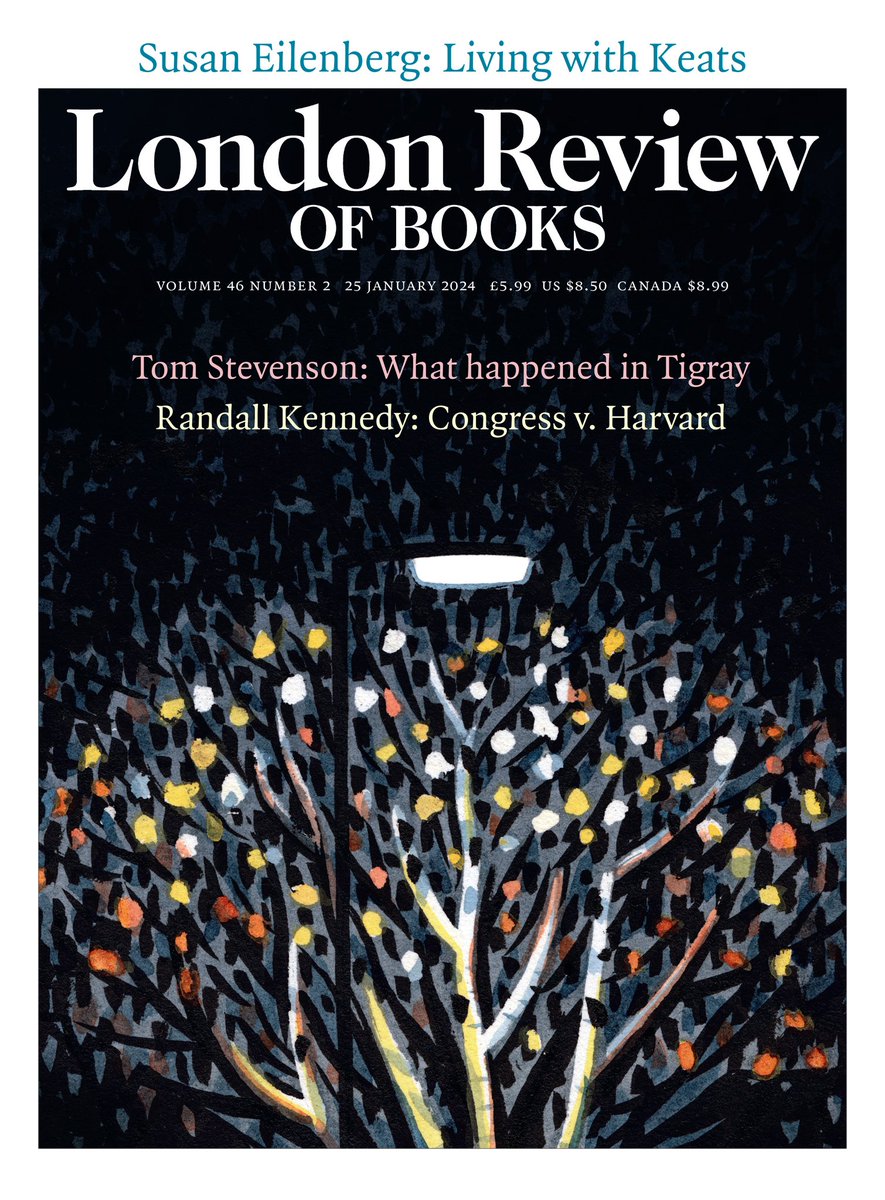
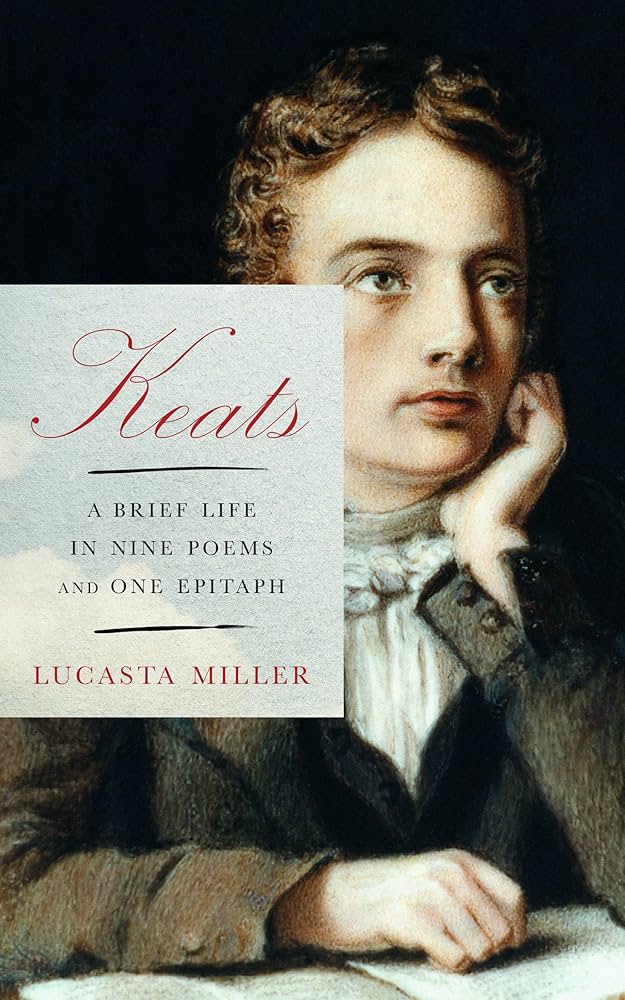
London Review of Books (LRB) – January 17, 2024: The latest issue features ‘Living With Keats’ – A Brief Life in Nine Poems and One Epitaph; Congress vs Harvard; The West’s Fight to Reverse the Russian Revolution, and more…
Looking back to September 1820, when things had gone badly wrong but not yet so grotesquely as to be visibly beyond repair, we can see how few and how poor Keats’s options were. Surely it was better that (in the absence of other volunteers) the young artist Joseph Severn agreed to travel with the dying poet to Rome that autumn than that he had refused.
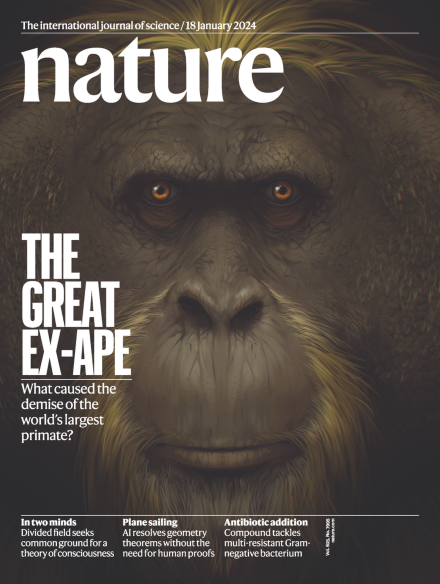
Nature Magazine – January 17, 2024: The latest issue cover features the giant ape Gigantopithecus blacki, thought to be the largest primate that ever lived, which lived in China between 2 million and 300,000 years ago.


















 Boomers Daily